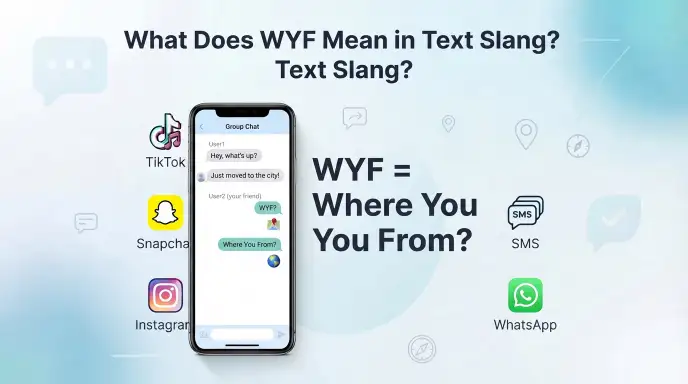
WYF usually means “Where You From?” in text slang. It is a casual abbreviation people use to ask where someone is from, such as their city, country, or hometown. You may see it in texting, TikTok comments, Snapchat chats, Instagram DMs, WhatsApp, and other informal online conversations.
If someone sends you “Hey, WYF?”, they are usually asking, “Where are you from?” It is often used when people are meeting online, starting a conversation, or simply trying to learn more about each other.
People search for the meaning of WYF because texting slang can be confusing. Three letters can sometimes represent an entire question, and WYF can have different meanings in different conversations.
The most important clue is context. While “Where You From?” is the most common meaning reported in casual texting, some sources also document uses such as “What You Feeling?” or “What’s Your Favorite?”
WYF Meaning in Text
The most common meaning of WYF in texting is “Where You From?”
In standard English, the complete question would be:
“Where are you from?”
Texting removes unnecessary words to make the message quicker. The result is “Where you from?” and then the phrase is shortened to WYF.
For example:
A: Hey! WYF?
B: I’m from Toronto.
Here, the person is asking about the other person’s general location or background.
They might be asking about your:
- City
- State or province
- Country
- Hometown
- General area
- Place where you grew up
It does not normally mean that someone wants your exact home address.
Is WYF Slang, an Acronym, or an Abbreviation?
WYF is best described as an informal texting abbreviation. It is also commonly referred to as an internet slang acronym or initialism because the letters represent words in a longer phrase.
Here is the basic breakdown:
| Letter | Word |
| W | Where |
| Y | You |
| F | From |
So:
WYF → Where Are You From?
It is not standard formal English. Instead, it belongs to the shortifform language people use in texts, DMs, online chats, and social media.
Similar texting shortcuts include IDK (“I Don’t Know”), IDC (“I Don’t Care”), IMO (“In My Opinion”), and BRB (“Be Right Back”).
What Does WYF Mean in Everyday Chat?
In everyday conversation, WYF is usually a quick icebreaker.
Imagine someone follows you on Instagram and sends:
“Hey, WYF?”
They probably want to know where you are from before continuing the conversation.
You could answer:
“I’m from Lahore.”
Or:
“Originally from London.”
Or:
“I live in Texas. WYF?”
The abbreviation keeps the conversation short and relaxed.
It is especially useful when two people do not know each other well and are starting a casual conversation.
WYF Can Have Other Meanings
Although “Where You From?” is the most common interpretation in the sources reviewed, WYF is not completely fixed. Some online slang references document other meanings, including “What You Feeling?” and “What’s Your Favorite?”
For example:
“WYF for dinner?”
could be interpreted as asking what you feel like eating.
Likewise:
“WYF movie?”
could mean “What’s your favorite movie?” in a context where that usage is established.
That is why it is better to read the whole message instead of interpreting WYF by itself.
Where People Use WYF
WYF is mainly used in informal digital communication. You can encounter it across several social and messaging platforms.
WYF on TikTok
On TikTok, WYF may appear in comments, direct messages, or conversations between users.
Someone might see a creator discussing their hometown and comment:
“WYF?”
The intended meaning is likely “Where are you from?”
TikTok comments often rely on short expressions because users communicate quickly. However, the exact meaning can depend on the words around WYF.
For example:
“WYF? I love your accent.”
clearly suggests that the person is asking where the other person is from.
WYF on Snapchat
Snapchat is another place where short texting expressions are common.
A person might send:
“WYF?”
when starting a conversation with someone they recently added.
The question may be part of getting to know the other person.
For example:
A: Heyyy
B: Hey
A: WYF?
B: Pakistan, you?
The conversation is casual and informal.
WYF on Instagram
On Instagram, you may see WYF in DMs, comments, or replies to Stories.
For example, someone might post a travel photo and receive:
“This place looks amazing. WYF?”
In that situation, the sender is probably asking where the person is from or possibly where they are based, depending on the surrounding conversation.
Instagram DMs are generally informal, so abbreviations such as WYF fit naturally there.
WYF on WhatsApp
WhatsApp conversations often include short forms because people use the app for fast personal messaging.
A friend might send:
“WYF?”
You could reply:
“I’m from Karachi.”
Or:
“Lahore. You?”
The meaning remains the same: the person wants to know where you are from.
WYF in SMS
Traditional SMS texting can also contain WYF, especially when people are trying to keep messages short.
For example:
“Hey WYF?”
is simply a shortened version of:
“Hey, where are you from?”
Because SMS slang is informal, WYF is better suited to personal conversations than formal communication.
Real Chat Examples of WYF
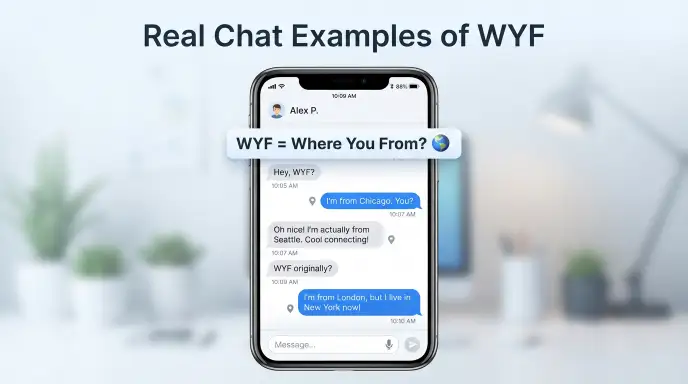
Seeing WYF in realistic conversations makes the meaning much easier to understand. Here are 10 examples showing how people might use it.
Example 1: Meeting Someone Online
A: Hey, nice to meet you!
B: You too!
A: WYF?
B: I’m from Chicago. You?
Here, WYF means “Where You From?”
Example 2: Instagram DM
A: Your travel pictures are amazing.
B: Thanks!
A: WYF?
B: I’m originally from Boston.
The sender is asking about the person’s background.
Example 3: Snapchat
A: Hey, I think we have some mutual friends.
B: Really?
A: Yeah lol. WYF?
B: Atlanta. What about you?
The abbreviation works as a casual conversation starter.
Example 4: New Friend
A: Hey!
B: Heyy
A: What’s up? WYF?
B: I’m from Dallas.
Here, the sender wants to know the person’s general location or hometown.
Example 5: Gaming Chat
A: You play this game a lot?
B: Almost every night 😂
A: Nice. WYF?
B: New York.
The question helps the players get to know each other.
Example 6: Group Chat
A: We have people from everywhere in this group.
B: Fr 😂
A: WYF everyone?
C: California
D: London
E: Toronto
Here, WYF is directed toward multiple people and means “Where You From?”
Example 7: Casual Conversation
A: Your accent sounds familiar.
B: Haha really?
A: Yeah. WYF?
B: Manchester.
The context makes the meaning especially clear.
Example 8: Dating Conversation
A: Hey, how’s your day going?
B: Pretty good!
A: Nice. WYF?
B: I’m from Seattle.
In dating or social conversations, WYF can be an icebreaker.
Example 9: Travel Conversation
A: Have you always lived there?
B: No, I moved last year.
A: Oh nice. WYF originally?
B: Miami.
The added word “originally” makes the intended meaning obvious.
Example 10: When WYF Has a Different Meaning
A: We need to order food.
B: Pizza or burgers?
A: WYF?
B: Pizza for sure 😂
In this type of conversation, WYF could be understood as “What You Feeling?” rather than “Where You From?” Context is what makes the difference. Some slang references document this alternate interpretation.
How to Reply When Someone Says “WYF”
If someone sends you “WYF?”, your reply depends on what they appear to mean.
If they are asking where you are from, you can simply give a general location.
You do not need to provide personal details you are uncomfortable sharing.
Funny Replies
If you know the person well, you can make the response playful.
- “Earth 😂”
- “Somewhere on this planet.”
- “Classified information 😭”
- “Guess first 😂”
- “Take a guess!”
These replies work best with friends or people who understand your sense of humor.
Casual Replies
For a normal conversation, keep it simple.
- “I’m from Lahore. WYF?”
- “I’m from Toronto.”
- “Originally from New York.”
- “I live in London.”
- “Texas. You?”
There is no need to make the answer complicated.
Friendly Replies
If you want to keep the conversation going, answer and return the question.
- “I’m from Chicago! What about you?”
- “Originally from Miami. Where are you from?”
- “I’m from Pakistan. You?”
- “I grew up in Boston. WYF?”
This gives the other person an easy way to continue the conversation.
Neutral Replies
If you do not want to share much information, you can keep your answer general.
- “I’m in the U.S.”
- “I’m from the UK.”
- “I’m based in Canada.”
- “I’d rather not share my location.”
The last response is completely reasonable if the person is a stranger.
What If You Are Not Sure What WYF Means?
Context can usually solve the problem.
If someone writes:
“Hey WYF?”
“Where You From?” is the likely meaning.
But if someone writes:
“We’re ordering food. WYF?”
they may be asking what you feel like eating.
If you still cannot tell, simply ask:
“What do you mean by WYF?”
That is better than giving an unrelated answer.
Is WYF Rude or Offensive?
WYF itself is not generally a rude or offensive expression. It is normally a casual way to ask someone where they are from.
However, the situation matters.
A friendly:
“Hey, WYF?”
is usually harmless.
But asking a stranger for locationifrelated information can feel intrusive if the person is uncomfortable sharing it.
Is WYF Safe to Use?
In a casual conversation with friends, online acquaintances, or people you already know, WYF is generally straightforward.
With strangers, it is sensible to avoid asking for an exact address or other private information.
If someone asks you “WYF?”, you can answer as generally as you want.
For example:
“I’m from Pakistan.”
You do not have to provide your neighborhood, street, house number, or exact current location.
Is WYF Appropriate at School?
In a casual message to a friend, it may be fine.
However, it is not appropriate for formal school writing, essays, assignments, or official communication.
Instead of:
“WYF?”
use:
“Where are you from?”
Is WYF Appropriate at Work?
WYF is generally too informal for professional emails, reports, business documents, or formal workplace communication.
If you need to ask a colleague about their background, use complete language such as:
“Where are you from?”
or:
“Where are you based?”
The full version sounds clearer and more professional.
Who Uses This Term?
WYF is most closely associated with casual internet communication and texting culture.
Age Groups
You are more likely to encounter WYF among people who regularly use online messaging, social media, gaming chats, and other informal digital spaces.
Younger internet users may be especially familiar with abbreviations, but that does not mean WYF belongs exclusively to one generation.
Adults can use texting abbreviations too, particularly in personal messages.
Gen Z Usage
Gen Z frequently uses shortened language in digital conversations, but individual usage varies.
Some people use abbreviations constantly. Others prefer writing complete
So seeing WYF does not automatically tell you the sender’s age.
Common Platforms
WYF can appear in:
- TikTok
- Snapchat
- SMS
- Online chats
- Gaming communities
- Dating conversations
Slang references also describe WYF as an onlineifchat and textifmessaging abbreviation.
How Often Does WYF Appear Online?
WYF is recognizable as an informal texting abbreviation, but there is no single reliable public statistic that gives its exact frequency across every platform.
Its use also changes between communities. Some groups may use it regularly, while others may rarely use it.
That is one reason context is important when interpreting short internet expressions.
Origin of the Term
There is no widely established single person credited with creating WYF.
Like many texting abbreviations, it appears to have developed from the general habit of shortening phrases in digital communication.
The phrase “Where are you from?” is already a shortened conversational version of “Where are you from?” Turning the first words into letters makes the message even faster:
Where You From → WYF
Texting culture, instant messaging, online communities, and social media all helped create an environment where short forms became normal.
Slang references generally describe WYF as part of online and texting culture rather than attributing it to one specific creator.
Why Do People Shorten Words Online?
Speed is one obvious reason.
Typing:
“Where are you from?”
takes more characters than:
“WYF?”
Short forms can also make a message feel more relaxed.
That does not mean everyone prefers abbreviations. Some people find them confusing, especially when they encounter a term for the first time.
This is why websites explaining texting slang remain useful: the meaning is often obvious to experienced users but unclear to everyone else.
WYF vs. IDK, IDC, IMO, and BRB
WYF belongs to the same broad world of texting abbreviations as IDK, IDC, IMO, and BRB, but each one performs a different job.
| Term | Meaning | Type | Usage | Popularity |
| WYF | Where You From? | Texting abbreviation | Asking where someone is from | Common in casual chats |
| IDK | I Don’t Know | Texting abbreviation | Showing uncertainty or lack of knowledge | Very common |
| IDC | I Don’t Care | Texting abbreviation | Expressing indifference | Very common |
| IMO | In My Opinion | Texting abbreviation | Introducing an opinion | Very common |
| BRB | Be Right Back | Texting abbreviation | Saying you will return shortly | Very common |
Unlike IDK or BRB, WYF is usually a question.
That difference makes it easy to recognize once you know what the letters represent.
For example:
“IDK” gives information about what the sender knows.
“BRB” tells you what the sender is going to do.
“WYF?” asks you a question.
The comparison also shows why texting abbreviations should be understood from context rather than treated as formal English vocabulary.
RealifWorld Usage Example
Imagine you join an online photography group and start talking with another member.
You discuss cameras, travel, and favorite places to take pictures.
The person says:
“You’ve got some great travel photos. WYF?”
They are most likely asking where you are from.
A natural reply could be:
“Thanks! I’m from Pakistan. WYF?”
The conversation can then continue naturally:
“I’m from Canada. I visited Pakistan a few years ago.”
In this situation, WYF works as a simple conversation starter.
Now imagine a different situation.
You are chatting with a friend about dinner:
Friend: “Pizza or tacos?”
You: “WYF?”
Friend: “Tacos 😂”
Here, the surrounding conversation suggests a different interpretation, such as “What You Feeling?”
This example shows why you should never assume that every threeifletter abbreviation has only one possible meaning.
Frequently Asked Questions
Q1: What does WYF mean in text messages?
WYF most commonly means “Where You From?” It is a casual abbreviation for asking where someone is from, such as their city, country, or hometown.
Q2: What does WYF mean on TikTok?
On TikTok, WYF commonly means “Where You From?” Context can sometimes give it another meaning, so check the surrounding comment or message.
Q3: Is WYF slang?
Yes. WYF is an informal texting abbreviation commonly used in online chats and social media. It is not standard formal English.
Q4: Is WYF rude or offensive?
No, WYF is generally not rude or offensive. However, asking strangers about their location can feel personal, so people should share only information they are comfortable giving.
Q5: How should you reply to WYF?
If it means “Where You From?”, give a general location such as your city, country, or region. You can also reply with “You?” to keep the conversation going.
Conclusion
WYF most commonly means “Where You From?” in texting and online slang. People use it as a quick, informal way to ask about someone’s hometown, country, city, or general background.
You may encounter WYF on TikTok, Snapchat, Instagram, WhatsApp, SMS, gaming chats, and other casual online spaces. The expression is generally harmless, but the meaning can occasionally change depending on the conversation.
If someone sends you “WYF?”, look at the surrounding message before replying. And if the person is asking about your location, remember that you never need to share private information you are uncomfortable providing.
For formal school or workplace communication, use the complete phrase “Where are you from?” instead. It is clearer, more professional, and easier for everyone to understand.

I’m Dylan Foster, a slang and internet culture writer passionate about exploring how people communicate online and in everyday conversations. I write about texting abbreviations, social media expressions, and modern slang to help readers understand meanings, origins, and real-world usage in a simple way.