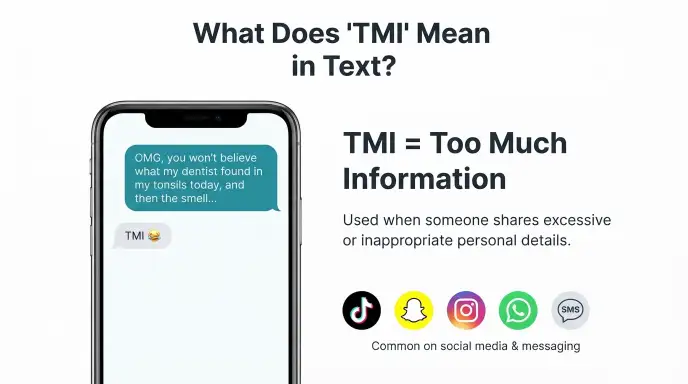
TMI in text means “too much information.” People use it when someone shares more personal, embarrassing, or unnecessary details than they wanted to hear. You may see TMI in texting, TikTok, Snapchat, Instagram, WhatsApp, and online chats.
The abbreviation is usually casual and often playful. Someone might say “TMI!” after a friend describes a private bathroom problem, an awkward date, or another detail that feels overly personal.
If you searched for “TMI mean in text,” you probably saw the abbreviation in a message or social media comment and wanted to know if it was serious, rude, or simply a joke. The good news is that TMI is easy to understand once you know how people use it.
TMI Meaning in Text
TMI means “too much information.” It is a common internet abbreviation used when a person thinks someone has shared more information than necessary.
For example, imagine a friend texts:
“I can’t come out tonight. My stomach has been terrible all day, and I’ve already been to the bathroom six times.”
You might reply:
“Okay, TMI 😂”
Here, TMI does not necessarily mean that you are angry. You are simply saying that the description was more personal than you needed.
TMI is usually an acronym because each letter represents the first letter of a word: Too Much Information.
It can also be described as an internet abbreviation or slang expression because it is widely used in casual digital communication.
What Does TMI Mean in Everyday Chat?
In everyday conversation, TMI is generally a quick way to say:
- “I didn’t need to know that.”
- “That’s more information than I wanted.”
- “That’s a little too personal.”
- “You could have left out that detail.”
- “Okay, that’s more than I needed to hear.”
The tone depends heavily on the situation.
A close friend may say “TMI 😂” while laughing. In another situation, someone might use “TMI” because they genuinely feel uncomfortable with the information being shared.
That is why context matters.
Is TMI Always Serious?
No. TMI is very often humorous.
Friends frequently use it to tease one another after someone gives an unnecessarily detailed explanation. The abbreviation can make the response shorter and less awkward than directly saying, “I really didn’t want to hear that.”
For example:
Friend: “I couldn’t sleep because my neighbor’s dog kept barking at 3 a.m.”
You: “TMI, but okay.”
Depending on the relationship, this could be playful rather than genuinely offended.
Where People Use TMI
TMI appears across many forms of digital communication. Because it is short and easy to recognize, people can use it almost anywhere informal conversations happen.
TMI on TikTok
On TikTok, TMI can appear in comments, captions, direct messages, and videos.
A creator might tell a story that includes an unusually personal detail. Someone in the comments may respond with:
“TMI 😭”
TikTok users may also use TMI humorously when a video becomes unexpectedly personal.
For example, someone could begin a story about getting ready for work and suddenly start explaining a private health or relationship problem. A commenter might write:
“We went from makeup tips to TMI real fast.”
In this context, TMI signals that the story became more personal than expected.
TMI on Snapchat
Snapchat conversations are often informal, so TMI fits naturally into chats between friends.
Someone might send a long message explaining an embarrassing situation. Their friend could respond:
“Brooo TMI 😂”
The disappearing message style of Snapchat also encourages quick, conversational responses, making short abbreviations common.
TMI on Instagram
On Instagram, TMI may appear in comments, DMs, Stories, and captions.
For example, a person could post a story about an awkward first date and include an extremely personal detail. A friend might reply:
“Girl, TMI 😂”
The meaning is still “too much information,” but the tone may be affectionate and joking.
TMI on WhatsApp
WhatsApp users commonly use abbreviations when chatting with friends and family.
Someone might explain every detail of a minor problem, and the other person could respond:
“TMI 😭 I only asked why you were late.”
Because WhatsApp conversations can range from casual friendships to family and professional groups, the appropriateness of TMI depends on who is receiving the message.
TMI in SMS and Text Messages
TMI has also been used in ordinary text messaging for years.
For example:
A: “Why are you staying home?”
B: “I ate way too much spicy food last night and my stomach is still suffering.”
A: “TMI 😂”
In a casual conversation, this is usually a lighthearted response.
10 Real Chat Examples of TMI
The best way to understand an abbreviation is to see it in natural conversations. Here are realistic examples of how people might use TMI in texting.
Example 1: An Embarrassing Story
A: I fell in front of everyone at the restaurant.
B: Nooo 😭
A: And then my shoe came off and landed under another table.
B: TMI about the shoe situation 😂
Example 2: Too Much Personal Detail
A: Why didn’t you go to class?
B: I wasn’t feeling well. Let’s just say my stomach completely betrayed me.
A: TMI bro 😭
B: You asked!
Example 3: Relationship Conversation
A: How was your date?
B: Good, but he kept talking about his ex the whole time.
A: That’s already a red flag.
B: Then he showed me 47 pictures of her.
A: TMI, but also definitely weird 😂
Example 4: Funny Friend Conversation
A: Why are you awake at 4 a.m.?
B: I had three coffees and now my heart thinks it’s running a marathon.
A: TMI 😭
B: You literally asked me.
Example 5: Social Media Story
A: Did you see her new story?
B: Yes.
A: She explained her entire breakup.
B: I saw it. TMI honestly.
Example 6: Family Chat
A: Why did Dad leave the party early?
B: His shoes were hurting his feet.
A: That’s normal.
B: He showed everyone his blisters.
A: Okay, TMI.
Example 7: School Friends
A: Why weren’t you at lunch?
B: I had a headache and felt sick.
A: Are you okay?
B: Yeah, just needed to go home.
A: Good. And thank you for not giving me the full medical report 😂
B: TMI avoided.
Example 8: Casual Snapchat Chat
A: I finally cleaned my room.
B: Nice.
A: Found socks under my bed that I don’t remember buying.
B: TMI about your sock history 😂
Example 9: WorkifRelated Conversation
A: Why are you working from home today?
B: Personal reasons. Everything is fine.
A: Got it.
B: Actually, I could explain exactly what happened—
A: TMI 😂 Just take the day.
This example shows that TMI can gently stop a conversation from becoming unnecessarily personal.
Example 10: Playful Use
A: I had the worst morning.
B: What happened?
A: I woke up late, spilled coffee on my shirt, and then—
B: TMI about the whole morning 😂
A: You asked!
Here, TMI is clearly being used as a joke.
How to Reply When Someone Says “TMI”
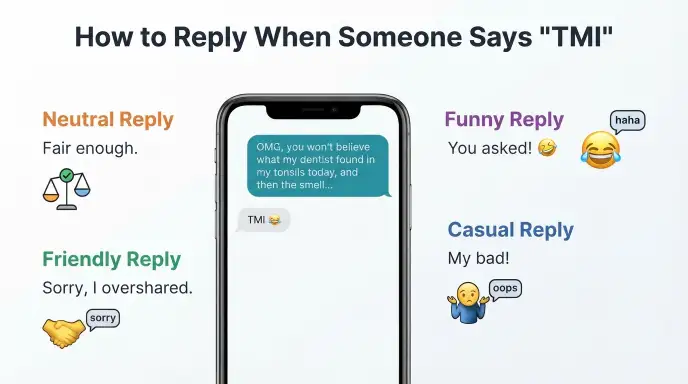
If someone sends you “TMI,” don’t automatically assume they are angry. Your response should depend on the relationship and the tone of the conversation.
Funny Replies
If the conversation is clearly playful, you can respond with humor.
- “You asked! 😂”
- “My bad 😭”
- “I haven’t even gotten to the worst part.”
- “Too late now.”
- “You wanted the details!”
- “Okay, I’ll stop 😂”
These work best with friends who understand your sense of humor.
Casual Replies
If you want to keep things simple, try:
- “Haha, sorry.”
- “My bad.”
- “Okay, fair.”
- “Got it.”
- “I probably overshared.”
- “I’ll spare you the details.”
These responses acknowledge the comment without making the conversation awkward.
Friendly Replies
If you think the other person genuinely felt uncomfortable, a polite response is better.
- “Sorry, I didn’t mean to overshare.”
- “My bad, I should’ve kept that private.”
- “Sorry! I didn’t realize I was giving that much detail.”
- “You’re right. I’ll leave it there.”
This is especially useful when you’re talking to someone you don’t know very well.
Neutral Replies
Sometimes you can simply move the conversation forward.
Them: TMI.
You: Fair enough. Anyway, how was your day?
This avoids turning a small comment into a bigger issue.
Is TMI Rude or Offensive?
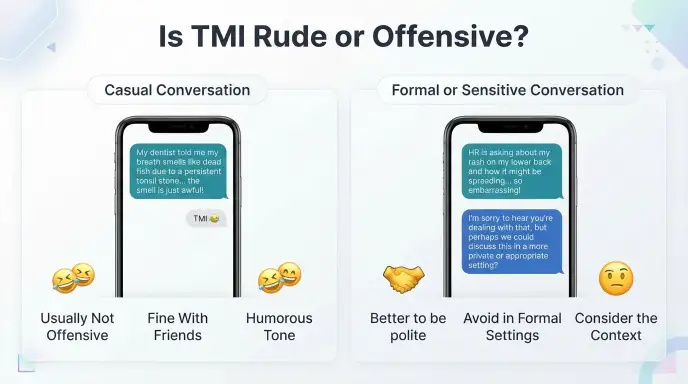
TMI itself is not usually considered offensive. It is a common casual expression, and people often use it jokingly.
However, the way it is used can affect how it sounds.
If you say “TMI 😂” to a close friend who just shared an embarrassing story, they may laugh and understand that you’re joking.
But if someone is discussing a serious personal problem, replying “TMI” could come across as dismissive or insensitive.
Is TMI Safe to Use?
Generally, yes, especially in informal conversations.
It is common in:
- Text messages
- Social media comments
- DMs
- Group chats
- Conversations between friends
Still, casual slang is not suitable for every setting.
Can You Use TMI at School?
With friends, TMI is usually fine.
However, if you are speaking to a teacher, school administrator, or writing a formal assignment, it is better to use standard language.
Instead of writing:
“TMI.”
You could simply say:
“That’s more personal information than I needed.”
The second version is more appropriate for formal communication.
Can You Use TMI at Work?
TMI can be acceptable in a casual workplace chat if your team normally uses informal language.
For example, coworkers who know each other well might joke with “TMI 😂.”
However, professional emails, formal meetings, job applications, and business documents generally aren’t the right places for internet abbreviations.
When in doubt, choose a clear and professional language.
Who Uses TMI?
TMI is used by a wide range of internet users, particularly people who communicate frequently through texting and social media.
Gen Z Usage
Gen Z users commonly encounter abbreviations such as TMI while chatting online.
The abbreviation fits naturally into short messages because it communicates a complete idea using only three letters.
However, TMI isn’t exclusive to Gen Z. Older internet users may recognize and use it as well.
Millennials and Other Age Groups
TMI became popular through earlier internet and texting culture, so many millennials and older users are familiar with it.
Someone doesn’t have to be a teenager or Gen Z user to understand the abbreviation.
Common Platforms
You may encounter TMI on:
- TikTok
- Snapchat
- Text messages
- Online forums
- Group chats
- Private messages
Its meaning generally stays the same across these platforms.
How Often Does TMI Appear Online?
TMI is a recognizable internet abbreviation, but its frequency varies by community and conversation.
It is more likely to appear when people are discussing personal experiences, embarrassing stories, relationships, healthifrelated details, dating, or other subjects where someone may accidentally overshare.
It is less common in formal online communication.
Origin of the Term TMI
TMI comes from the phrase “too much information.”
Unlike some newer internet expressions whose origins are difficult to trace, the basic phrase is straightforward: a person shares more information than another person wants or needs to know.
The shortened form became especially useful as internet chat, instant messaging, forums, and text messaging grew.
Online communication encourages people to shorten common phrases. Expressions such as LOL, BRB, IDK, and TMI became convenient ways to communicate quickly.
How Internet Culture Influenced TMI
Internet culture helped turn TMI into a recognizable response.
People began using it not only when information was genuinely uncomfortable, but also as a humorous reaction to oversharing.
That humorous use is important.
Today, someone can say “TMI” even when they aren’t seriously upset. It may simply mean:
“Wow, I did not need to know that!”
The exact history of when TMI became widespread is less important to everyday users than its established meaning: too much information.
TMI vs. IDK vs. IDC vs. IMO vs. BRB
TMI belongs to a larger group of internet abbreviations. Some abbreviations express reactions, while others describe a person’s thoughts or actions.
| Term | Meaning | Type | Usage | Popularity |
| TMI | Too Much Information | Acronym | Used when someone overshares | Common |
| IDK | I Don’t Know | Acronym | Used when someone doesn’t know something | Very common |
| IDC | I Don’t Care | Acronym | Shows indifference or lack of concern | Common |
| IMO | In My Opinion | Acronym | Introduces a personal opinion | Common |
| BRB | Be Right Back | Acronym | Tells someone you will temporarily leave | Common |
These abbreviations are not interchangeable.
For example, if someone asks:
“What time does the movie start?”
You could answer:
“IDK.”
You would not normally answer “TMI,” because the person hasn’t shared too much information.
Similarly, BRB is about temporarily leaving a conversation, while IMO introduces an opinion.
Understanding the individual meaning of each abbreviation makes online conversations much easier to follow.
Real:World Usage Example
Imagine two close friends are talking after school.
One friend asks:
“Why did you leave the party so early?”
The other friend starts explaining:
“I was tired, then I ate too much food, and my stomach started hurting. I spent the next hour sitting in the bathroom, and then I realized I had accidentally worn my shirt inside out.”
The first friend might laugh and say:
“Okay, TMI!”
In this situation, TMI doesn’t necessarily mean the friendship is in trouble. It simply communicates that the explanation became much more detailed and personal than expected.
The same expression could have a different tone in a serious conversation.
For example, if someone is discussing a private medical issue, saying “TMI” could make them feel uncomfortable or embarrassed. In that situation, showing empathy is more appropriate than joking about the amount of information they shared.
This is why context, tone, and your relationship with the other person matter when using internet slang.
Frequently Asked Questions
Q1. What does TMI mean in text messages?
TMI means “too much information.” It is used when someone shares more personal, detailed, or unnecessary information than the other person wanted to hear.
Q2. What does TMI mean on TikTok?
On TikTok, TMI has the same meaning: “too much information.” People often use it in comments or messages when a video or story becomes unexpectedly personal.
Q3. Is TMI slang?
TMI is commonly considered an internet abbreviation or acronym and is also used as casual slang. It comes from the phrase “too much information.”
Q4. Is TMI rude or offensive?
TMI is not normally offensive, but it can sound rude if used during a serious or sensitive conversation. With friends, it is often used jokingly.
Q5. How should you reply to TMI?
You can reply with “My bad,” “Sorry, I overshared,” or “You asked! 😂” depending on the tone. If the other person seems uncomfortable, a polite apology is best.
Conclusion
TMI means “too much information.” In text messages and social media, people use it when someone shares more personal, embarrassing, or unnecessary details than they expected.
You can see TMI on TikTok, Snapchat, Instagram, WhatsApp, SMS, group chats, and other informal online conversations. It is often playful, especially between friends, but its tone depends on the situation.
TMI is generally safe for casual conversations, but it is better to avoid internet slang in formal school or workplace communication. Most importantly, pay attention to context. When someone shares something serious or sensitive, responding with understanding is usually better than making a joke about oversharing.
Once you know that TMI simply means “too much information,” you’ll be able to understand and use the abbreviation naturally in everyday online conversations.

I’m Dylan Foster, a slang and internet culture writer passionate about exploring how people communicate online and in everyday conversations. I write about texting abbreviations, social media expressions, and modern slang to help readers understand meanings, origins, and real-world usage in a simple way.