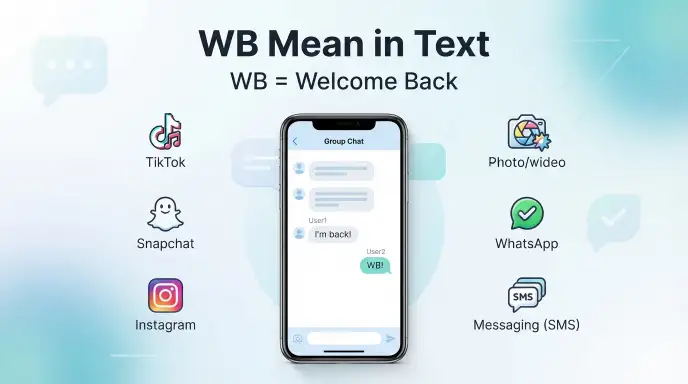
WB in text usually means “Welcome Back.” It is a casual abbreviation people use when someone returns to a chat, comes back online, or rejoins a conversation. You may see it on TikTok, Snapchat, Instagram, WhatsApp, or in regular text messages.
If you received a message such as “WB!” after saying “I’m back,” the sender is most likely welcoming you back. The phrase is friendly and usually has a positive tone.
People search for “wb mean in text” because short internet abbreviations can be confusing, especially when the same letters may have different meanings in other situations. In casual messaging, however, “Welcome Back” is the main meaning.
This guide explains how WB works in everyday conversations, where you may see it, how to reply, and when you should use the full phrase instead.
WB Meaning in Text
The most common meaning of WB in texting is “Welcome Back.” It is a short, informal way to acknowledge that someone has returned after being away.
For example:
A: I’m finally back online!
B: WB!
Here, “WB” simply means “Welcome back!”
You might receive it after leaving a group chat, going offline for a while, returning from a trip, or reconnecting with someone. The exact length of the absence does not matter. Even a short break can lead to a “WB” message.
Is WB Slang, an Acronym, or an Abbreviation?
WB is best described as a texting abbreviation or internet shorthand.
It is formed from the first letters of Welcome Back:
- W = Welcome
- B = Back
People normally read the letters separately as “WifB” rather than treating WB as a regular spoken word.
It is sometimes casually called slang because it is common in informal online communication. More precisely, though, it is an abbreviation used in texting and social media.
What Does WB Mean in Everyday Chat?
In everyday chat, WB generally communicates a simple greeting:
- “Welcome back!”
- “Good to see you again.”
- “Glad you’re back.”
- “Nice to have you back.”
- “You’re back!”
The tone is normally friendly and relaxed.
For example, imagine someone leaves a gaming chat for dinner and returns later. A friend might type:
“WB! Did you win?”
That means:
“Welcome back! Did you win?”
Can WB Have Other Meanings?
Yes. Like many short forms, WB can mean something different when the surrounding conversation changes.
For example, WB can sometimes mean “Write Back.” In that case, it is a request for someone to respond.
If someone writes:
“Let me know what you think. WB.”
they may mean “write back.”
Context is therefore important. If someone has just returned to a conversation, “Welcome Back” is the natural interpretation. If the message asks you to respond, “Write Back” may fit better.
Outside texting, WB can also have completely different meanings. For example, dictionaries list other uses in business, transportation, science, and entertainment.
Where People Use WB
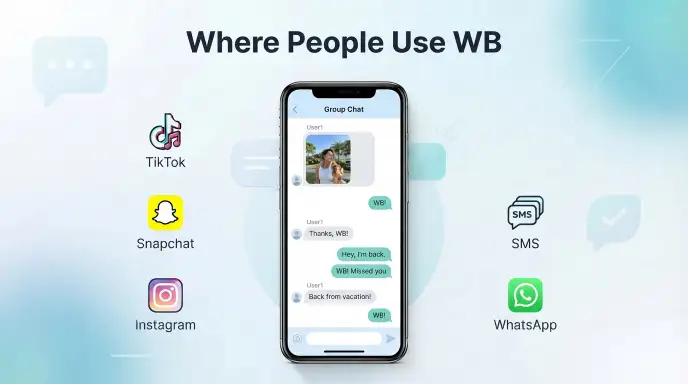
WB is mainly found in informal digital communication. You may encounter it on several social platforms, but the meaning generally stays the same when someone has returned.
WB on TikTok
On TikTok, WB can appear in comments, direct messages, or conversations between people who already know each other.
For example:
User 1: I deleted the app for two weeks but I’m back 😂
User 2: WB!!
The person is simply saying “Welcome back.”
It is more natural in a casual conversation than in a formal TikTok caption.
WB on Snapchat
Snapchat is built around quick, informal communication, so short abbreviations can fit naturally into conversations.
Someone might return after being offline and receive:
“WB 👋”
The emoji can make the message feel warmer, but it is not necessary.
You might also see lowercase “wb”. Capitalization usually does not change the meaning.
WB on Instagram
On Instagram, WB may appear in DMs or comments when someone returns to a conversation.
For example:
“Heyyy, I’m back!”
“WB 😂”
It can also be used when a friend returns after being away from Instagram for a while.
WB on WhatsApp
WhatsApp is one of the places where WB can be especially easy to understand because people frequently use abbreviations in private and group chats.
For example:
“Sorry, had to go. I’m back now.”
“WB! We were just talking about you.”
In a group, WB can be a quick way to acknowledge someone’s return without interrupting the conversation.
WB in SMS and Text Messages
Traditional SMS texting can also use WB.
A friend might send:
“WB! How was your vacation?”
The abbreviation keeps the greeting short while still sounding friendly.
Because texting is usually informal, there is rarely a need to spell out “Welcome Back” unless you want to sound more deliberate or formal.
Real Chat Examples of WB
Seeing WB in actual conversations makes the meaning easier to understand. Here are 10 natural examples.
Example 1: Returning to a Group Chat
A: Sorry guys, my internet died.
B: WB!
A: Thanks 😂 What did I miss?
Here, WB means “Welcome back.”
Example 2: Coming Online
A: I’m finally online again.
B: WB!
A: Took forever lol.
The person is being welcomed back after being offline.
Example 3: After a Short Break
A: Had to grab some food. I’m back.
B: WB 😄
A: Did you guys start without me?
The abbreviation is friendly and casual.
Example 4: Returning to a Gaming Chat
A: My game crashed.
B: WB bro
A: Hopefully it stays working this time.
In gaming conversations, short messages are common, so WB fits naturally.
Example 5: Instagram DM
A: Haven’t been on Instagram all week.
B: WB 😂
A: I had a lot going on.
The sender is acknowledging the person’s return.
Example 6: Snapchat
A: Just got my phone back.
B: WB!
A: Finally 😭
The response means “Welcome back!”
Example 7: Vacation
A: Just got home from my trip.
B: WB! How was it?
A: Amazing. I took so many pictures.
The abbreviation works as a quick greeting before asking a question.
Example 8: Returning to a Group
A: Hey everyone, I’m back!
B: WB!!
C: We missed you 😂
A: Missed you guys too.
Here, the extra punctuation makes the welcome feel more enthusiastic.
Example 9: Casual Friend Chat
A: Sorry, disappeared for a bit.
B: WB lol
A: Life got busy.
The lowercase form makes the message look especially casual.
Example 10: Possible “Write Back” Meaning
A: I sent you the details. Let me know what you think. WB.
B: Sure, I’ll check them tonight.
Here, the context can suggest that WB means “Write Back” rather than “Welcome Back.”
That is why looking at the entire conversation is important.
How to Reply When Someone Says “WB”
If someone sends you “WB!”, you usually do not need a complicated response.
Your reply can match the tone of the conversation.
Funny Replies
If you are joking with friends, you could say:
- “I have returned 😂”
- “Did you miss me?”
- “Back from the dead 😭”
- “The legend is back.”
- “Finally escaped offline mode 😂”
These work best with people you already know.
Casual Replies
For an ordinary conversation, keep it simple:
- “Thanks!”
- “Hey!”
- “Good to be back.”
- “Thanks haha.”
- “Yep, I’m back.”
There is no need to overthink the response.
Friendly Replies
If you want to sound warm:
- “Thanks! Good to be back 😊”
- “Aww, thanks!”
- “Glad to be back!”
- “Thanks, I missed everyone too.”
- “Good to see you guys again!”
Neutral Replies
If you do not know the person very well, a neutral response is safer:
- “Thanks.”
- “Thank you!”
- “Hey, I’m back.”
- “Appreciate it.”
- “Thanks, good to be back.”
A simple “Thanks!” works in most casual situations.
Is WB Rude or Offensive?
WB is generally not rude or offensive. When it means “Welcome Back,” it is normally a friendly greeting.
The abbreviation itself does not contain an insult or offensive expression. However, tone can change depending on the situation.
For example:
“WB 😊”
sounds friendly.
But:
“Oh, WB.”
could sound sarcastic if the surrounding conversation is tense.
The letters themselves are not usually the problem. The relationship between the speakers, punctuation, previous messages, and overall tone can affect how the message is understood.
Is WB Safe to Use?
Yes, WB is generally safe for casual online conversations.
It can work well with:
- Friends
- Family members
- Online communities
- Gaming friends
- Group chats
- Social media contacts
If you are unsure if someone understands internet abbreviations, simply write “Welcome back!” instead.
Is WB Appropriate at School or Work?
That depends on the situation.
In a casual message to a classmate, “WB!” may be perfectly normal.
In a formal email to a teacher, professor, manager, client, or business contact, writing “Welcome back” is usually clearer and more professional.
For example:
Casual:
“WB! 😊”
Professional:
“Welcome back. I hope you had a good trip.”
The full phrase is not much longer, and it avoids possible confusion.
Who Uses This Term?
WB is mainly associated with informal digital communication rather than formal writing.
Teenagers and Young Adults
Teenagers and young adults who regularly communicate through messaging apps, social media, gaming platforms, and group chats may recognize WB quickly.
However, it is not limited to one generation.
Gen Z Usage
Gen Z users are familiar with many forms of internet shorthand, especially on platforms where fast, informal communication is common.
WB can fit naturally into these conversations because it takes only two letters to communicate a familiar phrase.
That does not mean every Gen Z user uses WB frequently. Slang preferences vary between friend groups, communities, countries, and platforms.
Older Internet Users
Adults who have used online chat, instant messaging, forums, or texting may also recognize WB.
In fact, the broader culture of internet shorthand existed long before today’s social media platforms. Short forms developed partly because digital communication encourages quick responses.
Common Online Spaces
You may encounter WB in:
- Text messages
- Instagram DMs
- Snapchat
- TikTok conversations
- Gaming chats
- Group chats
- Online communities
Its meaning is easiest to identify when someone has clearly returned to the conversation.
Origin of the Term
There is no single confirmed moment when WB was invented.
The abbreviation grew naturally from the wider culture of internet shorthand and text messaging. Early online chat rooms, instant messaging, forums, and SMS encouraged users to shorten familiar phrases so they could communicate more quickly.
“Welcome back” was already a normal English expression before texting. Digital communication simply made it convenient to reduce the phrase to its initial letters.
This is similar to other common shortcuts such as:
- BRB = Be Right Back
- IDK = I Don’t Know
- IDC = I Don’t Care
- IMO = In My Opinion
- BTW = By The Way
Over time, these abbreviations became recognizable within online communities.
The exact history of when WB first appeared is difficult to establish, so it is better to describe its origin as part of the broader development of digital shorthand rather than claim a specific inventor or date.
WB vs. IDK, IDC, IMO, and BRB
WB belongs to the same general world of texting abbreviations, but each term serves a different purpose.
| Term | Meaning | Type | Usage | Popularity |
| WB | Welcome Back | Abbreviation | Greeting someone who returned | Common in casual chats |
| IDK | I Don’t Know | Abbreviation | Showing uncertainty or lack of knowledge | Very common |
| IDC | I Don’t Care | Abbreviation | Showing indifference | Very common |
| IMO | In My Opinion | Abbreviation | Introducing a personal opinion | Common |
| BRB | Be Right Back | Abbreviation | Saying you will return soon | Common |
One useful distinction is that WB usually responds to someone’s return, while BRB usually tells someone that you are leaving temporarily and plan to return.
For example:
“I’m going to get dinner. BRB.”
means:
“I’m going to get dinner. Be right back.”
Later, when you return, someone might say:
“WB!”
That makes WB and BRB natural companions in online conversations.
Real if World Usage Example
Imagine a group of college friends working together on a project through WhatsApp.
One person leaves the group conversation because they need to attend a class. About an hour later, they return and write:
“Sorry, I’m back. What did I miss?”
Another friend responds:
“WB! We finished the first part.”
The returning student understands that WB means “Welcome Back.” They can then continue the conversation normally.
This is a good example of why context matters. The abbreviation makes sense because the person has just announced that they have returned.
Now imagine seeing “WB” in a business document. You should not automatically assume it means “Welcome Back.” Abbreviations can have specialized meanings outside casual texting. For example, Cambridge Dictionary lists WB as a written abbreviation for “waybill” in a commerce and transport context.
The safest habit is simple: look at the surrounding words before deciding what an abbreviation means.
Frequently Asked Questions
Q1. What does WB mean in text messages?
WB usually means “Welcome Back.” It is a casual abbreviation used when someone returns to a chat or conversation.
Q2. What does WB mean on TikTok?
On TikTok, WB usually means “Welcome Back” when someone returns to a conversation, DM, or online community.
Q3. Is WB slang?
WB is better described as a texting abbreviation or internet shorthand. People may casually call it slang because it is common in informal online communication.
Q4. Is WB rude or offensive?
No. WB is generally friendly and harmless when it means “Welcome Back.” The tone can depend on the surrounding conversation.
Q5. How should you reply to WB?
A simple “Thanks!” is enough. You can also say “Good to be back,” or use a funny response such as “I have returned 😂” with close friends.
Conclusion
WB in text usually means “Welcome Back.” It is a short, casual abbreviation used when someone returns to a conversation, comes back online, or rejoins a group.
You may see it on WhatsApp, Snapchat, Instagram, TikTok, gaming chats, and ordinary text messages. The abbreviation is normally friendly and not offensive.
Still, context matters because WB can have other meanings, including “Write Back,” and it can mean completely different things in professional or specialized settings.
For casual conversations, “WB!” is a simple way to welcome someone back. For school, work, or formal communication, spelling out “Welcome back” is usually the clearer choice.
I’m Dylan Foster, a slang and internet culture writer passionate about exploring how people communicate online and in everyday conversations. I write about texting abbreviations, social media expressions, and modern slang to help readers understand meanings, origins, and real-world usage in a simple way.