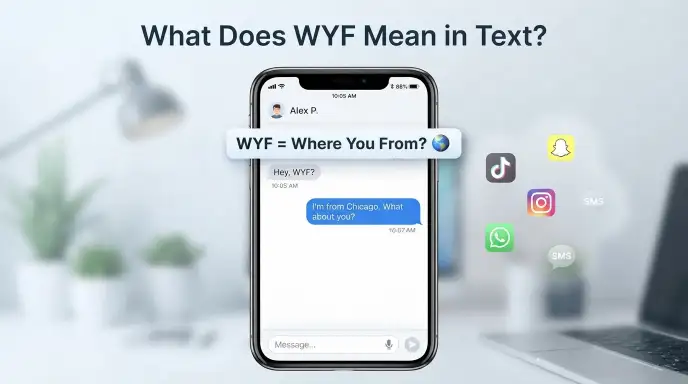
If you see “WYF?” In a text, it most commonly means “Where You From?if a casual way to ask where someone is from. You may see it in texting, TikTok, Snapchat, Instagram, or other online chats.
People often search for the meaning because internet slang can be confusing, especially when a short abbreviation appears without any context.
In most conversations, WYF is simply asking about someone’s hometown, city, country, or general background. It usually does not mean someone wants your exact address or live location.
Like many texting shortcuts, though, WYF can have other meanings in certain conversations. Looking at the words around it is the best way to understand what the sender intended.
WYF Meaning in Text
The most common WYF meaning in text is “Where You From?” The standard English version would be “Where are you from?”
For example:
A: Hey, you seem cool. WYF?
B: I’m from Dallas. You?
Here, the sender simply wants to know where the other person is from.
WYF is an informal texting abbreviation rather than standard English. It is also commonly described as internet slang because people use it in casual digital conversations.
The abbreviation comes from the main words in the shortened question:
- W = Where
- Y = You
- F = From
The word “are” is left out because casual texting often removes words that are easy to understand from context.
What Does WYF Usually Ask?
When someone says WYF?, they may be asking about:
- Your hometown
- Your city
- Your state or region
- Your country
- Where you grew up
- Your general background
It normally refers to a broad location rather than a precise physical address.
For example, you could reply:
“I’m from Lahore.”
Or:
“I’m from Texas.”
You do not have to give a street address or other private information.
Is WYF an Acronym or Abbreviation?
WYF is best understood as a texting abbreviation or initialism. People take the first letters of the important words in “Where You From?” and use them as a quick shortcut.
In everyday conversation, you may also hear people casually call WYF an acronym or slang term. The important point is that it is informal, not something normally used in formal English.
Can WYF Mean Something Else?
Yes. Context matters with short internet expressions.
Although “Where You From?” is the most common interpretation, some people use WYF in other ways, such as “What’s Your Favorite?” or “What You Feeling?” in particular conversations.
For example:
“WYF movie?”
could mean:
“What’s your favorite movie?”
Similarly:
“Pizza or tacos, WYF?”
could be asking what you feel like having.
These alternative meanings are less straightforward, so don’t automatically assume them when you see WYF by itself.
Where People Use WYF
WYF is mainly found in informal digital communication. It fits situations where people want to type quickly and keep a conversation relaxed.
You may encounter it on several popular platforms.
WYF on TikTok
On TikTok, WYF can appear in comments, direct messages, or conversations between users.
If someone sees your video and wants to know where you are from, they might comment:
“WYF?”
The likely meaning is:
“Where are you from?”
For example, someone might notice your accent, location, clothing, or travel content and become curious about your background.
However, TikTok comments can be very contextifdependent. If the conversation is about favorite songs, food, movies, or other preferences, the intended meaning may be different.
WYF on Snapchat
Snapchat is a natural place for short abbreviations because conversations often happen through quick messages and replies.
You might see:
A: Your story is nice 😂
B: Thanks!
A: WYF?
Here, WYF most likely means:
“Where are you from?”
You could simply answer with your city or country.
Remember that WYF does not normally ask for your exact Snapchat location. If someone wants your current location, they may use a different expression, such as “WYA?” or directly ask where you are.
WYF on Instagram
Instagram users may use WYF in:
- DMs
- Comment sections
- Story replies
- Group chats
For example:
“Love your accent. WYF?”
This clearly suggests that the person is asking about your background.
On Instagram, WYF can sometimes be part of a conversation between people who have just met online. It can work as a simple conversation starter.
WYF on WhatsApp
WhatsApp conversations often mix standard English with abbreviations, especially among friends and family.
Someone might send:
“Hey WYF?”
If there is no other context, the safest interpretation is usually:
“Where are you from?”
A natural answer could be:
“I’m from Karachi. What about you?”
WYF in SMS Texting
Traditional SMS texting can also contain WYF, particularly when people are having casual conversations.
For example:
“Hey! WYF?”
is faster to type than:
“Hey! Where are you from?”
Texting abbreviations are especially useful when people want to keep messages short and conversational.
Real Chat Examples of WYF
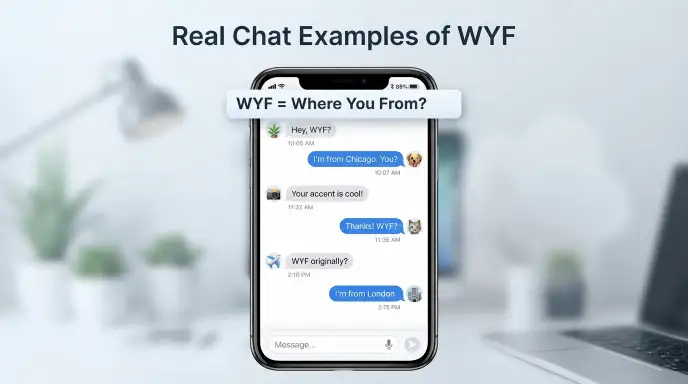
The easiest way to understand texting slang is to see it in realistic conversations. Here are ten examples showing how WYF can naturally appear.
Example 1: Meeting Someone Online
A: Hey, nice profile.
B: Thanks!
A: WYF?
B: I’m from Atlanta. You?
Here, WYF asks about the person’s general location or background.
Example 2: Talking About Accents
A: Your accent is really cool.
B: Haha, thank you!
A: WYF?
B: I’m from London.
The sender is curious about where the person comes from.
Example 3: Instagram DM
A: I saw your travel post.
B: Oh yeah, I love traveling.
A: WYF originally?
B: I grew up in Toronto.
Adding “originally” makes the meaning especially clear.
Example 4: Snapchat
A: You always post beach pics 😂
B: I know lol
A: WYF?
B: California.
The conversation naturally leads to a question about where the person is from.
Example 5: New Friend
A: We should play sometime.
B: Definitely.
A: Btw WYF?
B: Chicago. What about you?
Here, WYF works as a casual conversation starter.
Example 6: TikTok Comment
A: Your voice sounds familiar.
B: Really? 😂
A: Yeah lol, WYF?
B: New York.
The question is about geographic background.
Example 7: Dating Conversation
A: Hey, how’s your day going?
B: Pretty good! Yours?
A: Good. WYF?
B: I’m from Miami.
In dating conversations, WYF can be an easy way to learn more about someone.
Example 8: Group Chat
A: We have people from everywhere in this group.
B: Fr 😂
C: WYF everyone?
A: I’m from Seattle.
B: Boston here.
WYF is being used to ask everyone about their locations.
Example 9: Travel Conversation
A: I love your vacation photos.
B: Thanks!
A: WYF?
B: I’m from Pakistan, but I live in Dubai now.
The person can clarify if they are answering with their birthplace or current home.
Example 10: When the Meaning Is Different
A: Movie night tonight?
B: Sure!
A: We have action, comedy, or horror. WYF?
B: Comedy 😂
Here, WYF may be interpreted from context as asking what the person feels like choosing or what their preference is. This is why the surrounding conversation matters.
How to Reply When Someone Says “WYF”
If someone sends “WYF?”, your response depends on the situation and how much information you want to share.
You don’t have to overthink it. If they mean “Where you from?”, a simple location is enough.
Casual Replies
Try:
“I’m from Chicago. You?”
Or:
“Texas! WYF?”
Or:
“I’m from Toronto.”
These replies are short and natural.
Friendly Replies
If you want to keep the conversation going:
“I’m from Boston! What about you?”
Or:
“Originally from London. Where are you from?”
Or:
“I’m from Pakistan. Have you been there?”
A small followifup question can turn a oneifword answer into a real conversation.
Funny Replies
With close friends, you can be playful:
“The mysterious land of good snacks 😂”
Or:
“Classified information 😭”
Or:
“Guess first 😂”
These responses work best when you already know the person and understand their sense of humor.
Neutral Replies
If you don’t know the sender well, keep it simple:
“I’m from California.”
Or:
“I’m based in New York.”
Or:
“I’d rather not share my location.”
That last response is completely reasonable. You never need to disclose personal information simply because someone asks.
If You Aren’t Sure What They Mean
If the conversation doesn’t make the meaning clear, just ask:
“Do you mean where I’m from?”
Or:
“What do you mean by WYF?”
Asking for clarification is better than confidently giving the wrong answer.
Is WYF Rude or Offensive?
WYF is not normally rude or offensive. It is generally a casual way of asking where someone is from.
However, the way it is used can affect how the message feels.
Is WYF Safe to Use?
In ordinary casual conversations, yes.
For example:
“Hey, WYF?”
is generally harmless.
But remember that the question may come from someone you don’t know. You can choose how much information you want to reveal.
A city or country may be enough. You don’t need to provide:
- Your home address
- Your school address
- Your workplace location
- Your exact current location
- Private identifying information
Can WYF Sound Abrupt?
Sometimes.
Because WYF is only three letters, a message like:
“WYF?”
can feel blunt if it comes from a stranger.
That doesn’t necessarily mean the sender is being rude. Texting removes facial expressions and voice tone, so short messages can sometimes seem colder than intended.
Adding a greeting can make it warmer:
“Hey! WYF?”
sounds more conversational than simply:
“WYF?”
Is WYF Appropriate at School?
For a casual conversation with friends, it may be fine.
For school assignments, essays, presentations, or formal communication with teachers, use standard English instead:
“Where are you from?”
rather than:
“WYF?”
Text slang belongs mainly in informal communication.
Is WYF Appropriate at Work?
Usually, avoid it in formal workplace communication.
For example, an email should say:
“Where are you from?”
rather than:
“WYF?”
Even if coworkers use slang in casual chats, professional communication is clearer when you use complete sentences.
Who Uses This Term?
WYF is most closely associated with casual online communication, particularly among people who regularly use texting and social media.
You may encounter it among:
- Teens
- Young adults
- Gen Z users
- Younger millennials
- Social media users
- Online gaming communities
- People chatting on dating platforms
That does not mean only young people use it. Anyone familiar with internet shorthand can use WYF.
Gen Z and WYF
Gen Z communication often includes short forms such as:
- WYF
- IDK
- IDC
- IMO
- BRB
- LOL
- BTW
- TTYL
These shortcuts make fast conversations easier.
WYF fits especially well in DMs and casual chats because it compresses an entire question into three letters.
How Often Does WYF Appear Online?
There is no single official measurement that can tell us exactly how often WYF appears across every platform.
Its visibility can vary by community, age group, country, and platform.
The important point is that WYF is recognizable as informal internet shorthand, but it is not as universally understood as extremely common abbreviations such as LOL or IDK.
Origin of the Term
There is no single, clearly documented inventor of WYF.
Like many texting abbreviations, it appears to have developed naturally from the way people shorten phrases in fast digital communication.
The phrase “Where are you from?” is itself a casual version of the standard question “Where are you from?” Once texting culture made short messages increasingly common, users could reduce the main words to their initials:
Where + You + From = WYF
Internet culture helped these shortcuts spread between text messages, social media, chat rooms, gaming communities, and direct messages.
Why Did People Start Shortening It?
The reason is simple: speed and convenience.
Typing:
“Where are you from?”
takes much longer than:
“WYF?”
Short forms also fit the relaxed style of online conversations.
The exact history of the abbreviation is difficult to pin down because slang usually develops informally rather than through an official organization or dictionary. Current slang references consistently identify “Where You From?” as the dominant interpretation.
So it is better to say the origin is informal and gradual, rather than claiming a specific person or website invented it.
WYF vs. IDK vs. IDC vs. IMO vs. BRB
WYF belongs to a much larger family of texting shortcuts. Understanding related abbreviations can make online conversations easier to follow.
| Term | Meaning | Type | Usage | Popularity |
| WYF | Where You From? | Texting abbreviation | Asking about someone’s background or location | Common |
| IDK | I Don’t Know | Texting abbreviation | Showing uncertainty or lack of knowledge | Very common |
| IDC | I Don’t Care | Texting abbreviation | Showing indifference | Very common |
| IMO | In My Opinion | Texting abbreviation | Giving a personal opinion | Very common |
| BRB | Be Right Back | Texting abbreviation | Saying you will return shortly | Very common |
The biggest difference is what each abbreviation does in a conversation.
WYF asks a question.
IDK gives an answer expressing uncertainty.
IDC expresses a lack of concern or preference.
IMO introduces an opinion.
BRB tells someone that you are temporarily leaving the conversation.
How to Tell Which Meaning WYF Has
Because WYF can occasionally have different interpretations, context is your best tool.
Look at the Topic
If the conversation is about cities, countries, accents, or hometowns, WYF almost certainly means:
“Where are you from?”
If you’re discussing movies, food, music, or preferences, another interpretation may make more sense.
Look at What Comes After WYF
Compare these:
“WYF?”
This most naturally means “Where you from?”
But:
“WYF movie?”
may be asking “What’s your favorite movie?”
And:
“Pizza or burgers, WYF?”
may be asking what the person feels like choosing.
The surrounding words give you clues.
Consider Who Sent It
A stranger on Instagram may be asking about your background.
A friend who is choosing dinner may use the same letters differently.
That’s why a dictionary definition alone cannot always tell you what someone intended.
Real: World Usage Example
Imagine you’re at a community event and meet someone who recently moved to your city.
After talking about music and travel, you exchange social media accounts.
Later, they send:
“Hey! WYF?”
They are most likely asking:
“Where are you from?”
You could answer:
“I’m from Lahore. What about you?”
They might reply:
“I’m from Islamabad, but I live here now.”
The abbreviation makes the conversation quick and informal. In this situation, it acts as an easy icebreaker rather than anything complicated.
The same idea applies online. Someone may see your profile, notice that you have an interesting accent or post about a particular place, and use WYF to start a conversation.
Frequently Asked Questions
Q1. What does WYF mean in text messages?
WYF most commonly means “Where You From?” It is a casual abbreviation used to ask about someone’s hometown, city, country, or background.
Q2. What does WYF mean on TikTok?
On TikTok, WYF usually means “Where You From?” However, the surrounding comment or conversation can change the intended meaning.
Q3. Is WYF slang?
Yes. WYF is an informal texting abbreviation and internet slang used mainly in casual digital conversations.
Q4. Is WYF rude or offensive?
No, WYF is not normally rude or offensive. It is a casual question, although you can choose not to share personal location information with strangers.
Q5. How should you reply to WYF?
If it means “Where are you from?”, simply give a general location, such as “I’m from Chicago. You?” You can also politely decline to answer if you prefer.
Conclusion
So, what does WYF mean in text? In most casual conversations, it means “Where You From?” It is a short, informal way to ask someone about their hometown, country, city, or general background.
You may see WYF in text messages, TikTok comments, Snapchat chats, Instagram DMs, WhatsApp conversations, and other social platforms. It is especially useful when people want to keep a conversation quick and relaxed.
Remember that context matters. WYF can occasionally have other meanings, so look at the surrounding conversation before deciding exactly what the sender means.
And if someone asks you WYF, you only need to share what you’re comfortable sharing. A general city, region, or country is enoughif you never need to provide private location details.

I’m Dylan Foster, a slang and internet culture writer passionate about exploring how people communicate online and in everyday conversations. I write about texting abbreviations, social media expressions, and modern slang to help readers understand meanings, origins, and real-world usage in a simple way.