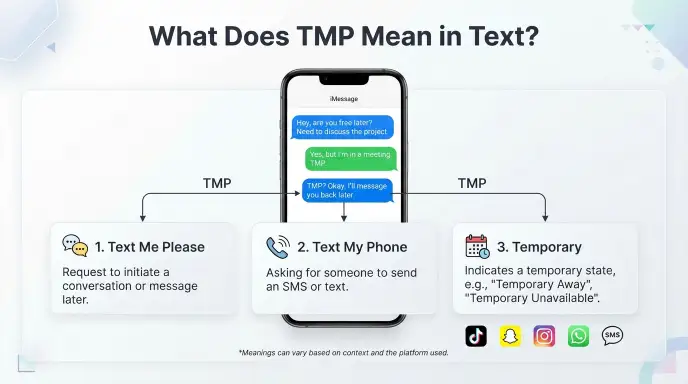
TMP in text usually means “Text Me Please,” “Text My Phone,” or “temporary,” depending on the context. You may see it in texting, TikTok, Snapchat, Instagram, WhatsApp, or online chats.
People often search for “tmp mean in text” because this abbreviation can be confusing. Unlike common terms such as LOL, IDK, or BRB, TMP does not always have one fixed meaning.
In a casual conversation, TMP may be a quick way to ask someone to text them. In a technical or general context, it can refer to something temporary. The surrounding words usually reveal which meaning is intended.
TMP Meaning in Text
TMP is mainly an abbreviation or shorthand expression used in digital communication. Its exact meaning depends on the situation and the person using it.
When used in casual texting, TMP may mean “Text Me Please” or “Text My Phone.” Both meanings suggest that the sender wants the other person to communicate through text.
For example:
“I can’t talk here. TMP.”
The sender may be asking the other person to text them privately.
However, TMP can also mean “temporary.” This meaning is especially possible when the conversation involves accounts, files, phone numbers, plans, or other things that are only being used for a short period.
What Does TMP Stand For?
Here are some meanings you may encounter:
| TMP Meaning | Context | What It Means |
| Text Me Please | Casual texting | Asking someone to send a text |
| Text My Phone | Messaging | Asking someone to contact them by phone |
| Temporary | General or technical use | Something that is not permanent |
The important thing to remember is that TMP is contextifdependent.
If someone says, “TMP when you get home,” they may be asking you to text them.
If someone says, “This is a tmp account,” they are more likely using TMP as shorthand for “temporary.”
Is TMP Slang or an Abbreviation?
TMP is better described as an abbreviation rather than a traditional slang word.
Words such as “sus,” “ghost,” or “cap” have meanings that developed through informal language and internet culture. TMP usually works differently: it shortens a longer phrase or word.
People use abbreviations because they make messages quicker to type and easier to fit into fastifmoving conversations.
TMP in Everyday Chat
Understanding TMP becomes easier when you look at the whole message instead of focusing only on the three letters.
For example:
“I need to tell you something. TMP.”
This likely relates to texting someone.
But:
“I’m using a tmp number for now.”
clearly points toward the meaning “temporary.”
So, if you see TMP in a message and the meaning is not obvious, check the surrounding words before deciding what it means.
Where People Use TMP
TMP can appear on many popular messaging and social media platforms. However, its meaning may vary from one conversation to another.
TMP on TikTok
On TikTok, TMP may appear in comments, captions, direct messages, or conversations between users.
For example:
“I can’t explain it here. TMP.”
In a casual conversation, this may suggest that the person wants to continue the discussion through text.
TikTok also has users from many different online communities, so an abbreviation may have a specialized meaning in a particular group.
TMP on Snapchat
Snapchat is known for quick, informal conversations, making abbreviations common.
Someone might write:
“TMP when you’re free.”
They may be asking you to text them when you have time.
If you are unsure, it is completely fine to ask what the person means.
TMP on Instagram
TMP may appear in Instagram DMs, comments, group chats, or captions.
In a private conversation, someone might use it to suggest moving the conversation to text.
For example:
“I’ll explain everything later. TMP.”
The exact interpretation still depends on the context.
TMP on WhatsApp
WhatsApp users frequently use short forms to make everyday conversations faster.
You could see TMP in a private message or group chat, such as:
“TMP the address when you can.”
Here, the sender may be asking you to send the address by text.
Because WhatsApp is used by people around the world, abbreviations can also differ between communities.
TMP in SMS
SMS texting is one of the most natural places for short abbreviations.
Instead of typing:
“Text me when you get home, please.”
someone might use a shorter expression such as:
“TMP when you get home.”
if TMP means “Text Me Please” or something else should still be confirmed from the conversation.
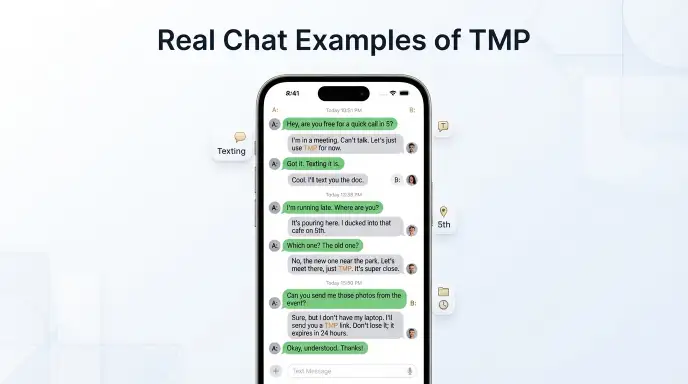
Real Chat Examples of TMP
Seeing TMP in real conversations makes its meaning much easier to understand. Since the abbreviation can have more than one interpretation, the examples below show how context changes its meaning.
Example 1: Asking Someone to Text
A: I need to tell you something private.
B: Sure, what’s going on?
A: I can’t say it here. TMP.
B: Okay, I’ll text you.
Here, TMP can mean “Text Me Please” or “Text My Phone.”
Example 2: Continue the Conversation Later
A: Are you free tonight?
B: Not right now. I’m with my family.
A: No problem. TMP later.
B: Sure, I will.
In this conversation, TMP is being used as a quick request to communicate by text later.
Example 3: Sending an Address
A: Do you have the restaurant address?
B: Yes, I saved it.
A: TMP when you get a chance.
B: Sure, I’ll send it now.
The context suggests that the person wants the address sent through a text message.
Example 4: Private Conversation
A: I don’t want to discuss this in the group chat.
B: That’s fine.
A: TMP.
B: Okay, I’ll message you privately.
Here, the abbreviation is being used to move the conversation away from the group.
Example 5: Sending Photos
A: Did you take pictures at the event?
B: Yeah, I took a lot.
A: TMP please.
B: Sure, I’ll send them.
The sender is asking the other person to send the photos through text.
Example 6: Temporary Account
A: Is this your new account?
B: No, my old one isn’t working.
A: So you’re keeping this one?
B: No, it’s just tmp for now.
Here, TMP means “temporary.” The person is saying the account will only be used for a short time.
Example 7: Temporary Number
A: Is this your permanent number?
B: No, it’s only for a few weeks.
A: Oh, okay.
B: Yeah, it’s a tmp number.
In this example, the context clearly points to temporary rather than a textingifrelated meaning.
Example 8: Temporary Solution
A: Did you fix the computer problem?
B: Not completely.
A: Then what did you do?
B: I made a tmp fix until I can repair it properly.
Here, TMP means that the solution is temporary.
Example 9: Social Media DM
A: Can I tell you something?
B: Sure.
A: It’s too much to type here. TMP.
B: Okay, I’ll text you.
The conversation gives TMP a textingifrelated meaning.
Example 10: Asking for Clarification
A: TMP when you’re free.
B: Do you mean text you?
A: Yeah 😂
B: Got it.
This is a useful example because abbreviations are not always obvious. Asking a quick question can prevent confusion.
How to Reply When Someone Says “TMP”
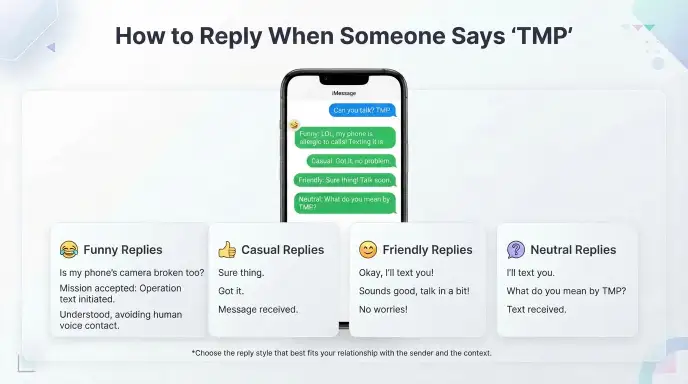
Your response should depend on what TMP means in the conversation.
If the person appears to be asking you to text them, you can give a short acknowledgment. If TMP means “temporary,” respond to the subject they are discussing.
When you’re unsure, asking for clarification is the safest option.
Funny Replies
If you’re talking with a close friend, you can make your response playful:
- “Okay, secret agent 😂”
- “Got you. Incoming text!”
- “Say less 😂”
- “Texting mode activated.”
- “Fine, switching to text now.”
These replies work best in relaxed conversations where both people already understand each other’s humor.
Casual Replies
For everyday texting, you do not need a complicated answer:
- “Sure.”
- “Okay, I will.”
- “Got it.”
- “No problem.”
- “I’ll text you later.”
- “Sure, give me a minute.”
These responses are simple and natural.
Friendly Replies
If you want your answer to sound a little warmer, try:
- “Sure! I’ll text you when I’m free.”
- “Of course, I’ll message you.”
- “No worries, I’ve got you.”
- “Sure, I’ll send it over.”
- “Absolutely, I’ll text you soon.”
These work well when responding to friends, classmates, or people you know reasonably well.
Neutral Replies
Sometimes you may not understand what TMP means. There is no need to guess.
You can say:
- “What do you mean by TMP?”
- “Do you mean text you?”
- “Do you mean temporary?”
- “Can you clarify?”
- “Sorry, what does TMP mean here?”
A clarification question is especially useful when you’re speaking with someone for the first time.
Is TMP Rude or Offensive?
TMP is generally not considered rude or offensive.
It is usually an informal abbreviation. The tone depends more on the message around it and the relationship between the people communicating.
For example:
“TMP when you get home.”
is generally a simple request.
However, sending only an abbreviation can sometimes appear abrupt. Someone unfamiliar with TMP may not know what you mean.
Is TMP Safe to Use?
In casual conversations, TMP is generally fine when both people understand it.
If the meaning could be misunderstood, using the complete phrase is better.
Instead of:
“TMP.”
you could write:
“Text me when you get home.”
The longer version is clearer and works with almost everyone.
Is TMP Appropriate at School?
TMP may be acceptable in a casual message to a friend.
However, avoid unexplained texting abbreviations in:
- School essays
- Assignments
- Formal messages to teachers
- Academic presentations
- Official school documents
For example, instead of writing:
“TMP after class.”
in a formal message, write:
“Please text me after class.”
Clear language is usually the better choice in academic settings.
Is TMP Appropriate at Work?
Workplace communication depends on the situation and the people involved.
An informal team chat may allow abbreviations, particularly when coworkers regularly communicate casually.
But for a formal email, client message, report, or business document, it is better to avoid unclear shorthand.
For example:
Informal:
“TMP when you’re free.”
More professional:
“Please text me when you are available.”
The second version removes ambiguity and sounds more professional.
Who Uses TMP?
TMP does not belong exclusively to one age group.
You may encounter it among teenagers, young adults, social media users, gamers, and people who regularly communicate through messaging platforms.
However, not everyone will recognize it immediately.
Gen Z Usage
Gen Z often uses abbreviations and shortened expressions in online communication.
Common examples include:
- IDK
- IDC
- IMO
- BRB
- TBH
- BTW
TMP is less universally recognized than many of these familiar abbreviations.
That means one person may understand it immediately while another may need an explanation.
Common Platforms
You may encounter TMP in:
- TikTok
- Snapchat
- SMS
- Messenger
- Discord
- Gaming chats
- Online forums
Its meaning should always be interpreted according to the conversation.
How Often Does TMP Appear Online?
TMP is not as universally recognizable as abbreviations such as LOL, IDK, or BRB.
Its use can also vary between online communities. Someone who spends a lot of time in a particular group may understand TMP differently from someone outside that community.
That is one reason context matters so much when interpreting short internet abbreviations.
Origin of TMP
The exact origin of TMP as a modern texting abbreviation is uncertain.
Unlike some famous internet abbreviations, TMP does not have one clearly documented origin that explains every modern use.
One important use comes from technology, where “tmp” is commonly associated with “temporary.” You may see the shortened form in computing, file names, temporary files, and other technical contexts.
The textingifrelated meanings, such as “Text Me Please” or “Text My Phone,” fit naturally with the broader internet habit of shortening phrases.
People have long created abbreviations to save time while texting. As messaging became faster and more informal, short expressions became common across social platforms.
Internet Culture and TMP
Internet culture encourages communication that is quick, compact, and easy to type.
This is why abbreviations can develop naturally within online communities.
A phrase may start as personal shorthand between friends and then spread to a larger group. Different communities can also give the same abbreviation different meanings.
That appears to be part of the reason TMP can be confusing today.
There is no need to assume that every use comes from one specific platform or generation. Its meaning has to be understood from the situation.
TMP vs. IDK, IDC, IMO, and BRB
TMP differs from several common texting abbreviations because its meaning is more dependent on context.
| Abbreviation | Meaning | Type | Usage | Popularity |
| TMP | Text Me Please / Text My Phone / Temporary | Contextifdependent abbreviation | Casual chat and technical contexts | Less universal |
| IDK | I Don’t Know | Text abbreviation | Everyday texting and social media | Very common |
| IDC | I Don’t Care | Text abbreviation | Casual conversations | Very common |
| IMO | In My Opinion | Text abbreviation | Chats, comments, and discussions | Very common |
| BRB | Be Right Back | Text abbreviation | Messaging and gaming | Very common |
The main difference is how predictable the meaning is.
When someone writes IDK, most readers immediately understand “I Don’t Know.”
When someone writes TMP, you may need to examine the rest of the conversation.
For beginners, this is the most important point: never interpret TMP completely on its own when the context is unclear.
Real: World Usage Example
Imagine two friends are making plans for the weekend.
One friend is currently in a busy group chat and does not want to discuss their plans publicly.
They might write:
“I can’t explain everything here. TMP when you get home.”
The other friend may understand this as a request to continue the conversation through text.
Now imagine a different situation involving technology.
Someone might say:
“I’m using a tmp account until my main account works again.”
Here, the meaning is clearly temporary.
These two examples show why TMP cannot always be translated into one fixed phrase.
The same abbreviation can have different meanings depending on the topic, sentence, and community.
If you are unsure, simply ask:
“What do you mean by TMP?”
That is often much easier than trying to guess.
How to Identify the Correct Meaning of TMP
When you see TMP in a message, a few simple clues can help.
Look at the Topic
First, identify what the conversation is about.
If the topic involves texting, calling, messages, or sending information, a textingifrelated meaning may make sense.
If the topic involves accounts, files, numbers, plans, or replacements, “temporary” may be more likely.
Read the Words Around It
The words immediately before and after TMP can provide useful clues.
For example:
“TMP when you arrive.”
This sounds like a request to contact someone.
Meanwhile:
“It’s only a tmp solution.”
clearly describes something temporary.
Consider the Relationship
Friends often create their own shorthand.
A phrase that makes perfect sense between two close friends may be confusing to someone else.
Therefore, personal communication style can also affect what TMP means.
Ask If You Are Unsure
There is no problem with asking.
A quick:
“What does TMP mean here?”
can immediately remove the confusion.
That is especially useful when the conversation is important or when the abbreviation could have multiple interpretations.
Frequently Asked Questions About TMP
Q1. What does TMP mean in text messages?
TMP can mean “Text Me Please,” “Text My Phone,” or “temporary,” depending on the context. Check the surrounding message to understand the intended meaning.
Q2. What does TMP mean on TikTok?
On TikTok, TMP can be used as informal shorthand in comments or messages. Its meaning is contextifdependent and may refer to texting someone or something temporary.
Q3. Is TMP slang?
TMP is mainly an abbreviation or shorthand expression. Some uses are informal, while “tmp” meaning “temporary” is also common in technical and general digital contexts.
Q4. Is TMP rude or offensive?
No. TMP is generally not rude or offensive. It is usually casual, although using an unfamiliar abbreviation can sometimes make a message seem unclear.
Q5. How should you reply to TMP?
If TMP means that someone wants you to text them, you can reply, “Sure,” “Got it,” or “I’ll text you.” If you are unsure, simply ask what they mean.
Conclusion
TMP is a short abbreviation that can have different meanings depending on where and how it is used.
In casual texting, TMP may mean “Text Me Please” or “Text My Phone.” In other situations, particularly technical or general conversations, it can mean “temporary.”
You may encounter the abbreviation in TikTok comments, Snapchat messages, Instagram DMs, WhatsApp chats, SMS, gaming conversations, and other online spaces.
TMP is generally not offensive, so it is usually fine in casual conversations. However, it is not the best choice for formal writing because not everyone will understand it.
If you are talking with friends who know your shorthand, using TMP can be quick and convenient. For teachers, employers, clients, or other formal situations, writing the complete phrase is clearer.
Most importantly, use context to understand TMP. If the meaning is still unclear, asking the sender is better than guessing.

I’m Dylan Foster, a slang and internet culture writer passionate about exploring how people communicate online and in everyday conversations. I write about texting abbreviations, social media expressions, and modern slang to help readers understand meanings, origins, and real-world usage in a simple way.