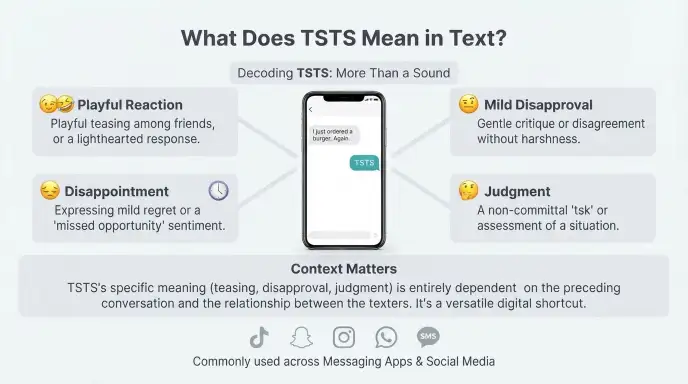
TSTS in text usually works as an informal reaction similar to “tsk tsk,” showing playful disapproval, teasing, mild disappointment, or judgment. However, TSTS is not a standardized texting abbreviation, so its exact meaning can change with the conversation and the person using it.
You may come across “tsts” in a text message, TikTok comment, Snapchat chat, Instagram DM, WhatsApp group, or another online conversation. Because it looks like a short abbreviation, it can be difficult to understand at first.
The confusion comes from the fact that TSTS does not have one universally accepted definition. Some online sources report alternative expansions, while current slang references also describe it as a written version of “tsk tsk.”
So, if someone sends you “tsts,” don’t automatically assume it has one fixed meaning. Look at the message around it, the punctuation, emojis, and the relationship between you and the sender.
TSTS Meaning in Text
The most useful way to understand tsts mean in text is to think of it as a written reaction rather than a traditional abbreviation.
In many casual conversations, “tsts” resembles “tsk tsk.” The expression represents the sound people make by clicking their tongue to show disapproval, disappointment, teasing, or mild judgment.
For example:
Friend: I ate the cake you told me to save.
You: Tests 😂
In this situation, TSTS probably means something like:
- “Really?”
- “Oh, come on!”
- “You shouldn’t have done that.”
- “I’m judging you.”
- “Tsk tsk.”
The message is usually not a serious insult. Between friends, it can be a playful way to call someone out.
Is TSTS slang, an acronym, or an abbreviation?
This depends on how it is being used.
When TSTS represents a “tsk tsk” reaction, it is better understood as a written sound or expressive reaction rather than a normal acronym. It does not necessarily represent four separate words.
At the same time, different internet communities have used TSTS for other phrases. Some sources report meanings such as “Too Smart To Say,” “Too Shy To Say,” and other communityifspecific expansions.
That is why context matters so much.
What does TSTS mean in everyday chat?
In everyday casual chat, TSTS can communicate an attitude without requiring a full sentence.
It may suggest:
- playful disapproval
- teasing
- mild disappointment
- joking judgment
- light sarcasm
- “really?” or “come on”
- a playful head shake
For example:
“You bought another pair of shoes? Tsts 😂”
The sender probably isn’t seriously criticizing the person. The expression adds a little playful drama to the message.
If TSTS appears during an argument, however, it may sound more negative or dismissive.
Where People Use TSTS
TSTS can appear in many forms of online communication, but its meaning still depends on context.
TSTS on TikTok
On TikTok, short reactions are common in comments and replies. A person may type “tsts” after seeing a funny mistake, an embarrassing moment, or something they consider questionable.
For example:
“You really posted that? Tsts 😂”
Here, the writer is probably teasing rather than seriously criticizing.
TikTok comments often rely heavily on context, emojis, and shared internet humor. Because of that, a short expression such as TSTS may communicate an attitude rather than a literal definition.
TSTS on Snapchat
Snapchat conversations are generally informal, so TSTS may appear in private chats, story replies, or quick reactions.
For example:
“You left me on opened again. Tsts 😭”
The expression could mean “really?” or “I’m disappointed in you,” but the crying emoji makes the message feel more playful.
TSTS on Instagram
On Instagram, you might see TSTS in DMs, comments, or replies to Stories.
Someone could write:
“Tsts, caught you 😂”
That could be a playful reaction to something the other person posted.
Because Instagram conversations can range from close friendships to conversations with strangers, the same expression can have different tones.
TSTS on WhatsApp
WhatsApp is especially flexible because people use it for both personal and group conversations.
In a family or friend group, TSTS might be used jokingly:
“You finished the whole pizza yourself? Tsts 😂”
In a serious conversation, however, it could sound like genuine disapproval.
TSTS in SMS and regular texting
Traditional text messages can also contain TSTS, particularly between friends who already understand each other’s communication style.
Unlike common abbreviations such as LOL, IDK, or BRB, TSTS is less standardized. This means someone unfamiliar with the expression may need to ask what the sender means.
If the meaning is unclear, asking is better than guessing.
Real Chat Examples of TSTS
The easiest way to understand this expression is to see it in realistic conversations.
Example 1: Playful teasing
A: I ate your fries.
B: Tests 😂 I knew I couldn’t trust you.
A: They were too good.
Here, TSTS is playful. B is not seriously angry.
Example 2: Someone arrives late
A: Sorry, I’m 30 minutes late.
B: Tsts, you’re always late 😭
A: I know, I know.
The expression adds mock disappointment.
Example 3: A funny mistake
A: I sent the message to the wrong person.
B: TSTS 😭
A: Don’t remind me.
Here, TSTS is similar to saying “Oh no” or “tsk tsk.”
Example 4: Friendly judgment
A: I bought another pair of sneakers.
B: Tsts, you have a problem 😂
A: They were on sale!
The expression is teasing rather than offensive.
Example 5: Forgetting something
A: I forgot to bring the tickets.
B: Tsts… seriously?
A: I’m sorry!
Here, the expression can show mild disappointment.
Example 6: Flirty teasing
A: You ignored my message all day.
B: I was busy!
A: Tsts, excuses 😏
B: Okay, okay 😂
The meaning comes from the playful conversation rather than the letters themselves.
Example 7: Social media reaction
A: Just posted the most embarrassing photo of myself.
B: Tsts 😂 why would you do that?
A: For the memories.
The reaction is humorous.
Example 8: A small mistake
A: I put salt in my coffee instead of sugar.
B: Tsts 😭
A: Don’t laugh.
Here, TSTS is basically a playful reaction to the mistake.
Example 9: Mild disappointment
A: I promised I’d call, but I forgot.
B: Tsts. I was waiting.
A: Sorry, I’ll call now.
This version sounds more serious because of the surrounding words.
Example 10: Group chat teasing
A: Who ate the last slice?
B: Not me 👀
C: Tsts, we all know it was you.
B: Okay, fine 😂
In this conversation, TSTS helps create a joking, teasing tone.
How to Reply When Someone Says “TSTS”
Your response should depend on what the sender appears to mean.
If they are teasing you, you can tease them back. If they seem genuinely disappointed, a straightforward response is better.
Funny replies
If the conversation is playful, try:
- “Caught me 😂”
- “Okay, okay!”
- “Don’t judge me 😭”
- “I regret nothing.”
- “Mind your business 😂”
These responses work well when TSTS is clearly being used jokingly.
Casual replies
For a relaxed conversation, you could say:
- “What? 😂”
- “I know, I know.”
- “My bad.”
- “Fair enough.”
- “Haha, okay.”
These keep the conversation moving without making the situation more serious.
Friendly replies
If someone is joking with you, a friendly response might be:
- “You know me too well 😂”
- “I couldn’t help it.”
- “Okay, you got me.”
- “Don’t be mad!”
- “I’ll behave next time.”
Neutral replies
If you’re unsure about the intended tone, keep your response simple:
- “What do you mean?”
- “Haha, why?”
- “Is that a bad thing?”
- “I’m not sure what you mean by TSTS.”
- “Can you explain?”
Asking is especially useful when you are talking to someone you do not know well.
Is TSTS Rude or Offensive?
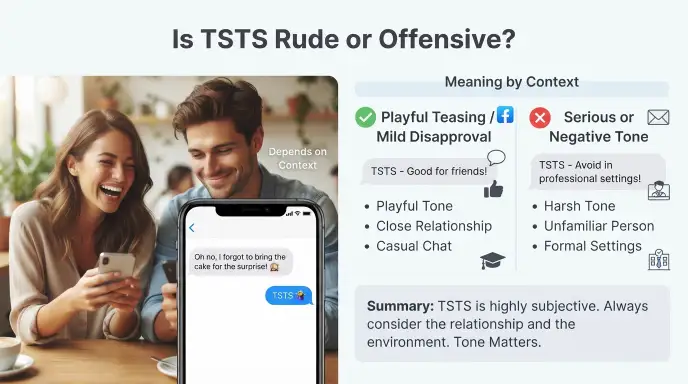
TSTS is not automatically rude or offensive.
Its tone depends on how it is used.
Among close friends, it can be completely harmless and playful. Someone might use it after a silly mistake simply to tease you.
For example:
“You forgot your own password again? Tsts 😂”
That sounds lighthearted.
But the same expression can feel less friendly during an argument:
“You lied to me again. Tsts.”
Without a laughing emoji or playful context, the message could communicate genuine disappointment or judgment.
Is TSTS safe to use?
It is generally best treated as a very informal internet language.
Use it when you know the person understands your tone. Avoid using it when a clear and professional message is expected.
Can you use TSTS at school?
For casual messages to friends, probably yes if everyone understands the expression.
For example, instead of:
“Tsts, that was a bad idea.”
You could simply write:
“That probably wasn’t a good idea.”
Can you use TSTS at work?
It is better to avoid TSTS in formal emails and professional communication.
Even if you intend it as a joke, the other person may not understand your tone. Written communication does not provide facial expressions or voice tone, so slang can easily be misunderstood.
Who Uses This Term?
TSTS is most likely to appear in informal online communication rather than formal writing.
It may be used by younger internet users, including people familiar with TikTok, Snapchat, Instagram, messaging apps, gaming communities, and online slang.
However, it would be misleading to say that every Gen Z user knows or uses TSTS.
Unlike very common abbreviations such as LOL, IDK, or BRB, TSTS is relatively uncommon and does not have one universally accepted meaning. Current online references specifically note that its interpretation can vary between communities.
You may encounter it in:
- private messages
- group chats
- social media comments
- TikTok replies
- Instagram DMs
- Snapchat conversations
- gaming chats
- casual texting
Its frequency can also change as internet slang evolves.
Origin of the Term
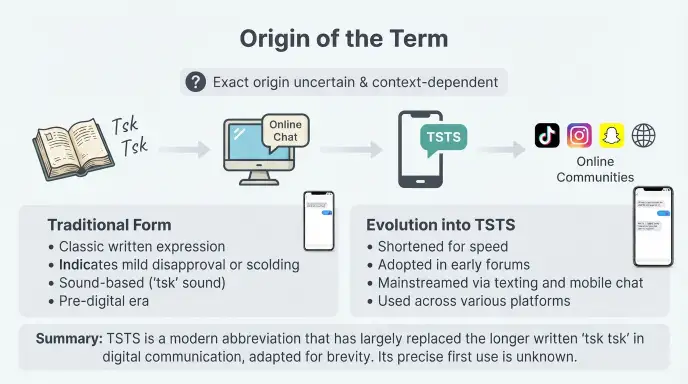
The exact origin of TSTS is uncertain.
There is no strong evidence establishing one person, website, or specific date as the creator of the modern texting expression. Several meanings have developed around the same four letters.
One important connection is the expression “tsk tsk.”
“Tsk” represents a tongueifclicking sound traditionally associated with disapproval or impatience. In written communication, people have long used “tsk tsk” to express reactions such as disappointment or mild criticism.
TSTS appears to function similarly in some modern online conversations, although the exact path from “tsk tsk” to “TSTS” is not clearly documented
Other online sources give TSTS alternative expansions, including “Too Smart To Say” and “Too Shy To Say.” Because these definitions are not consistent across sources, they should be treated as contextifspecific rather than universal.
There are also recent references describing another slang interpretation, “type shit, type shit,” particularly as an expression of agreement or shared understanding. This further shows why the surrounding conversation is essential when interpreting TSTS.
In other words, TSTS is a good example of how internet language develops: a short sequence of letters can take on different meanings in different online communities.
TSTS vs IDK, IDC, IMO, and BRB
TSTS is less standardized than many familiar texting abbreviations.
| Term | Meaning | Type | Usage | Popularity |
| TSTS | Often a “tsk tsk” style reaction; other meanings can occur | Slang / written reaction | Casual chats, DMs, comments | Less common |
| IDK | I don’t know | Abbreviation | Texting, social media, everyday chat | Very common |
| IDC | I don’t care | Abbreviation | Texting and online conversations | Very common |
| IMO | In my opinion | Abbreviation | Texting, forums, social media | Very common |
| BRB | Be right back | Abbreviation | Texting, gaming, chats | Very common |
The main difference is that IDK, IDC, IMO, and BRB have widely recognized expansions.
TSTS does not have the same level of standardization. One current source describes it as a “tsk tsk” reaction, while other online references document different expansions.
That makes context more important with TSTS.
Realif World Usage Example
Imagine two friends are meeting for lunch.
One friend arrives 20 minutes late.
Friend 1: Sorry! Traffic was terrible.
Friend 2: Tsts, you said you’d be here at 1.
Friend 1: I know 😂 I’m buying lunch.
In this situation, TSTS works as a playful expression of disappointment.
Friend 2 isn’t necessarily angry. The rest of the conversation makes the tone clear.
Now imagine a different situation:
Friend 1: You told me you would help me yesterday.
Friend 2: I forgot.
Here, TSTS feels more serious.
This is why translating TSTS into one fixed phrase can sometimes be misleading. The same four letters can express playful teasing in one conversation and genuine disappointment in another.
How to Know Which Meaning TSTS Has
When you see TSTS and aren’t sure what it means, check a few simple clues.
Look at the message before it
The previous sentence often tells you what the sender is reacting to.
If someone made a silly mistake, TSTS may be playful.
If someone did something hurtful, it may express disappointment.
Check the emojis
Emojis can change the tone dramatically.
“Tsts 😂” usually feels more playful than:
“Tsts.”
Likewise, “tsts 😭” may indicate joking or exaggerated disappointment.
Think about your relationship
A close friend may use TSTS as a joke.
A stranger, teacher, coworker, or someone you’re arguing with may intend something different.
Look at the rest of the conversation
Never interpret a slang term from four letters alone when the surrounding conversation gives you more information.
If the conversation still does not make sense, simply ask.
Frequently Asked Questions
Q1. What does TSTS mean in text messages?
TSTS often works like “tsk tsk,” showing playful disapproval, teasing, mild disappointment, or judgment. However, it can have other meanings in different online communities.
Q2. What does TSTS mean on TikTok?
On TikTok, TSTS can be used as a short reaction to something funny, questionable, embarrassing, or disappointing. The exact tone depends on the comment and surrounding context.
Q3. Is TSTS slang?
Yes. TSTS is an informal internet language, but it is not a standardized abbreviation with one universally accepted meaning.
Q4. Is TSTS rude or offensive?
Not necessarily. Among friends it can be playful, but it may sound judgmental or dismissive in a serious conversation. It is best avoided in formal communication.
Q5. How should you reply to TSTS?
If it is playful, you can reply with “Haha, okay,” “Caught me 😂,” or “My bad.” If you’re unsure, ask the sender what they mean.
Conclusion
The TSTS meaning in text is not completely fixed. In many current online uses, “tsts” works as a written version of “tsk tsk,” expressing playful disapproval, teasing, mild disappointment, or judgment.
At the same time, other online communities use TSTS for different phrases, which means you should not assume that every “TSTS” has exactly the same meaning. Context, punctuation, emojis, and the relationship between the people chatting can all change the interpretation.
You are most likely to see TSTS in casual texts, social media comments, DMs, and group chats. It is informal, so it is better to avoid it in school assignments, professional emails, or situations where clear communication matters.
When you see TSTS and the meaning isn’t obvious, the simplest solution is often the best: look at the surrounding conversation or ask the sender. That small step can prevent an awkward misunderstanding.

I’m Dylan Foster, a slang and internet culture writer passionate about exploring how people communicate online and in everyday conversations. I write about texting abbreviations, social media expressions, and modern slang to help readers understand meanings, origins, and real-world usage in a simple way.