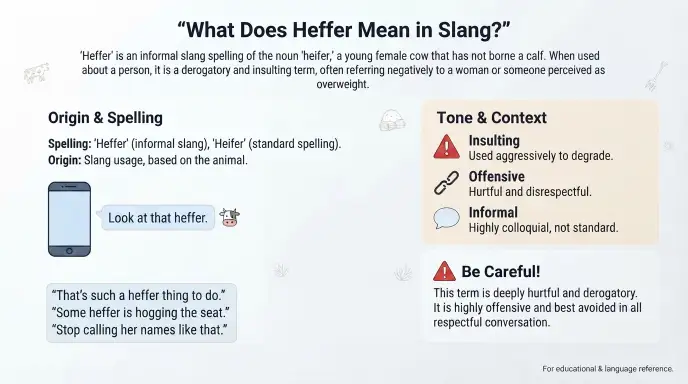
If you have seen someone called a “heffer” online or in a conversation, you may wonder if it is simply a misspelling or an actual slang term. The word can be confusing because it sounds very similar to “heifer,” a standard English word associated with cattle.
In slang, however, heffer can be used as a derogatory term for a woman, particularly one perceived asor physically large. The expression is generally negative and can easily offend the person being described.
This guide explains what does heffer mean in slang, where the expression comes from, how people use it, and why its tone matters. You will also see simple examples so you can recognize the word when it appears in texting, social media, comments, or casual conversations.
Quick Answer what does heffer mean in slang
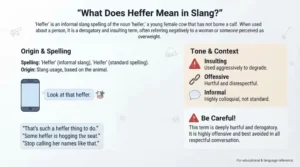
“Heffer” is slang for a woman, usually a woman who is considered or heavy. It comes from the word “heifer,” which originally refers to a young female cow. When used about a person, heffer is usually insulting, disrespectful, or bodyifshaming, so it is best avoided in polite conversation.
What Does “Heffer” Mean in Slang?
In slang, “heffer” is generally an insulting term for an or heavy woman. It is a variation or slang spelling of “heifer,” comparing a person to a female cow.
The term is not normally used as a neutral description. When someone calls another person a “heffer,” the speaker is usually making a negative comment about her body, size, or appearance.
For example:
“He called her a heffer, which was really rude.”
Here, the word is clearly being used as an insult rather than a friendly nickname.
Is “Heffer” a Real Word?
Yes, heffer appears in informal slang usage, but it should not be confused with the standard English noun heifer.
Heifer is the conventional spelling for a young female cow that has not had a calf. Heffer, meanwhile, is commonly encountered as an informal or slang spelling when the term is applied to a person.
| Term | Meaning | Tone |
| Heffer | Slang insult directed at a woman, often referring to body size | Offensive |
| Heifer | A young female cow | Neutral |
| Heffer used for a person | Comparison of a woman to a large animal | Derogatory |
The important point is that “heffer” can carry a strong insulting meaning when directed at a person.
Where Does “Heffer” Come From?
In standard English, a heifer refers to a young female bovine, especially one that has not yet produced a calf. Over time, comparisons between people and animals have produced various insulting expressions in informal speech.
When heifer is applied to a woman, it can suggest that she is large, heavy, or unattractive. The slang spelling heffer is often used to reflect informal pronunciation or internetifstyle writing.
The meaning therefore depends heavily on context. Someone discussing cattle could simply be referring to a female cow. But calling a woman a “heffer” changes the word into a personal insult.
Why Does the Spelling “Heffer” Appear?
Informal language often changes spelling to match pronunciation or to create a more slangiflike appearance.
“Heffer” is particularly common in informal online writing because people may write the word the way they hear it rather than following the standard spelling heifer.
This does not mean that “heffer” and “heifer” always have exactly the same meaning. Context is important:
- Heifer → standard agricultural/animal term.
- Heffer → informal spelling often associated with slang.
- Heffer directed at a woman → usually an insult about her size or appearance.
How Is “Heffer” Used in Slang?
It can appear in faceiftoifface conversations, social media posts, comments, texting, memes, or other informal communication.
Its exact tone can vary depending on the relationship between the speakers. In some groups, people may use insulting words jokingly among close friends. However, that does not make the term universally acceptable.
Example in a Conversation
Person A: “Did you hear what he called her?”
Person B: “Yeah. He called her a heffer. That was unnecessary.”
Example in Social Media
Someone might write:
“Why is that heffer always complaining?”
The speaker is not using the word as a neutral description.
Example in Texting
“He was calling people names and even called one girl a heffer.”
Here, the word describes something someone else said.
Is “Heffer” Offensive?
Yes, when it refers to a person, “heffer” is generally considered offensive.
The term can be especially hurtful because it targets a person’s body and compares them to an animal. Even when someone claims to be joking, the word may still be perceived as bodyifshaming.
It is therefore important to understand the difference between recognizing slang and using slang.
You may encounter “heffer” while reading a comment, watching a video, or seeing a text message. Understanding its meaning helps you interpret the conversation. That does not mean you need to use the term yourself.
| Situation | Likely Interpretation |
| Talking about cattle | Possibly a misspelling of “heifer” |
| Calling a woman a “heffer” | Usually an insult |
| Used in an argument | Clearly derogatory |
| Used between close friends | Could be joking, but still potentially offensive |
| Used in a social media comment | Often mocking or bodyifshaming |
“Heffer” vs. “Heifer”: What’s the Difference?
One of the biggest sources of confusion is the spelling.
Heifer is the standard English word. Heffer is commonly found as an informal or slang spelling.
The standard word has an agricultural meaning, while the slang form can be directed toward a person in a derogatory way.
Simple Comparison
| Word | Standard Meaning | Common Context |
| Heifer | Young female cow | Farming, agriculture, livestock |
| Heffer | Informal/slang form, often used as an insult | Casual speech, online slang |
| Heffer toward a woman | Derogatory reference to body size | Arguments, insults, social media |
If you are writing formally, heifer is the correct spelling when you mean the animal.
If you see heffer used online, the surrounding sentence can help you determine if the writer means the animal or is using it as slang.
Why Do People Use “Heffer” as an Insult?
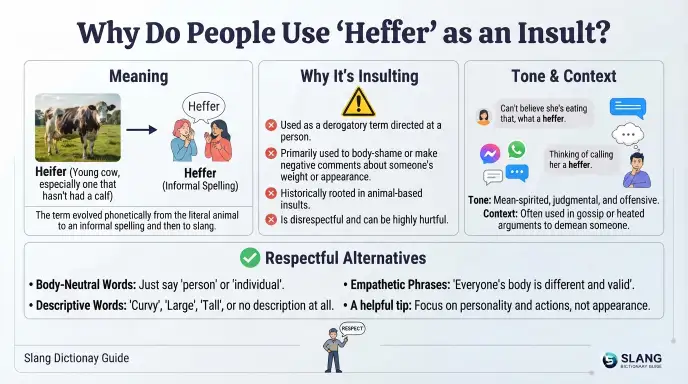
Animalifbased insults are common in many varieties of informal language. They often work by comparing a person to an animal associated with a particular characteristic.
In the case of heffer, the comparison focuses primarily on perceived body size or weight.
The insult can be used to:
- Mock someone’s appearance
- Make fun of someone’s weight
- Criticize someone’s body
- Humiliate someone during an argument
- Insult someone in an online comment
- Get a reaction from another person
Because the expression attacks someone’s physical appearance, it can be particularly disrespectful.
It is also worth remembering that slang changes over time. A term that appears frequently in one online community may be uncommon or unfamiliar somewhere else.
Where Might You See “Heffer” Online?
“Heffer” is most likely to appear in informal communication, particularly where users freely use slang, insults, jokes, and conversational language.
You might encounter it in:
- Social media comments
- Text messages
- Online arguments
- Meme captions
- Informal forums
- Casual conversations
- Videos or comment sections
The word does not have a special meaning limited to one particular platform. Its meaning generally comes from the context in which it is used.
For example, if you see:
But if you see:
“The farmer bought a heifer.”
the writer is using the standard agricultural term, even though the words look and sound similar.
What Does “Heffer” Mean When Someone Calls a Woman That?
When someone calls a woman a “heffer,” they are usually insulting her by comparing her to a large female animal.
In most contexts, the intended message is something like “woman” or “large woman,” but the word carries a much harsher tone than simply describing someone’s size.
For example:
“She is a heffer.”
This is derogatory and judgmental.
A respectful alternative would depend on what the speaker actually needs to communicate. If someone’s body size is not relevant, it is usually better not to mention it at all.
Is “Heffer” Used as a Joke?
Sometimes, yes.
A person might jokingly use an insulting nickname with a close friend, especially in a group where teasing is common. However, the same word can become offensive when used by a stranger or directed at someone who does not welcome that kind of humor.
The relationship between the speakers, tone of voice, and surrounding conversation all matter.
Context Changes the Tone
Consider these two situations:
Friendly teasing:
“Girl, you better stop eating all my snacks, heffer!”
Depending on the relationship, this could be playful teasing.
Personal attack:
“Look at that heffer over there.”
This is much more clearly insulting and demeaning.
So, understanding what does heffer mean in slang is not only about the dictionary meaning. It is also about recognizing tone, intent, and context.
Key Takeaway
“Heffer” is informal slang, usually used as a derogatory term for an or heavy woman. It is closely related to the standard word “heifer,” which refers to a young female cow.
If you encounter “heffer” online, look at the surrounding sentence before deciding what the writer means.
For respectful communication, it is best to avoid using heffer as a description of someone.
Common Examples of “Heffer” in Slang
Understanding examples makes the meaning easier to recognize in real conversations. Because heffer is generally derogatory when used for a person, these examples are mainly useful for understanding slang rather than encouraging its use.
| Example | Meaning / Tone |
| “Why did he call her a heffer?” | Someone used the term as an insult. |
| “I can’t believe she was called a heffer online.” | A woman was insulted in an online discussion. |
| “That comment calling her a heffer was rude.” | The speaker criticizes the insulting language. |
| “Heffer is not a respectful way to describe someone.” | Explains why the term can be offensive. |
| “I saw the word heffer in a comment section.” | Refers to encountering the slang online. |
Example in Texting
“He actually called her a hefferIn this sentence, the writer is reporting an insult. The emoji also suggests that the comment was considered inappropriate or uncomfortable.
Example in an Online Argument
“Stop calling people names. Calling someone a heffer isn’t okay.”
Here, heffer is being mentioned rather than used seriously by the speaker. The person is criticizing the insult.
Common Mistakes With “Heffer”
The most common mistake is confusing heffer with heifer.
Since the two forms sound very similar, people sometimes use the wrong spelling when discussing cattle. Others may intentionally use heffer because they are using the informal slang form.
Mistake: Using “Heffer” for the Animal
If you are writing about livestock, the standard spelling is heifer.
Incorrect:
“The farmer has a young heffer.”
Correct:
“The farmer has a young heifer.”
Mistake: Assuming “Heffer” Means “Woman”
“Heffer” is not a normal or respectful synonym for woman. When directed at a woman, it usually has an insulting meaning connected to body size.
Mistake: Assuming It Is Always Friendly
Some people may use the term jokingly among friends, but that does not make it universally friendly. Using it toward someone you do not know can easily cause offense.
Mistake: Ignoring Context
The spelling alone does not always tell you exactly what the writer intends.
For example:
“The heifer is in the field.”
This is clearly about an animal.
But:
“He called her a heffer.”
This is clearly about a person and is derogatory.
Is “Heffer” the Same as “Heifer”?
They are closely related, but they are not interchangeable in every situation.
Heifer is the standard English spelling for the animal. Heffer is an informal spelling commonly associated with slang, particularly when the word is used as an insult toward a person.
| Feature | Heifer | Heffer |
| Standard English word | Yes | No, generally informal/slang |
| Refers to a young female cow | Yes | May be a misspelling |
| Used as slang for a woman | Sometimes | Common informal usage |
| Can be offensive toward a person | Depending on context | Usually |
| Recommended in formal writing | Yes, for the animal | No |
If your goal is correct English, use heifer when referring to cattle.
What Is a More Respectful Alternative?
There is no need to replace heffer with another insulting word. If a person’s appearance is relevant, neutral and respectful language is generally better.
For example, instead of making a judgment about someone’s body, you can simply say:
- “woman”
- “person”
- “individual”
- “adult woman”
If someone’s physical size genuinely matters to the context, a neutral description may be more appropriate, but it should be used only when relevant.
The important difference is that describing someone neutrally is not the same as mocking or insulting them.
Why Does Slang Like “Heffer” Spread Online?
Internet communication allows slang to spread quickly between different communities. A word can appear in a meme, comment, video, or online argument and then be repeated by other users.
People may encounter heffer on social platforms, forums, messaging apps, or other informal spaces.
Online slang also frequently changes spelling. Users may deliberately alter a standard word to make it look more conversational, humorous, exaggerated, or informal.
That is one reason you may encounter heffer instead of the standard spelling heifer.
However, seeing a slang word repeatedly online does not necessarily mean it is appropriate for everyday communication.
Heffer in Modern Internet Language
Modern internet language often mixes standard English with slang, abbreviations, deliberate misspellings, memes, and informal expressions.
Heffer fits into this broader pattern because it may appear in casual posts or comments rather than formal writing.
Its meaning is generally straightforward when the context involves a person:
“He called her a heffer.”
The reader can infer that the speaker used an insulting comparison related to the woman’s body size.
When researching slang, it is useful to distinguish between:
- What a word means
- How people use it
- if it is offensive
- if it is appropriate to use
For heffer, these distinctions are particularly important because recognizing the term does not mean that it is a respectful expression.
Frequently Asked Questions
Q1. What does heffer mean in slang?
Heffer is slang commonly used as an insulting term for an or heavy woman. It is related to the standard word “heifer,” which refers to a young female cow.
Q2. Is heffer a bad word?
When heffer is directed at a person, it is generally considered offensive or derogatory. It can be used to mock someone’s body or appearance, so it is best avoided in respectful conversation.
Q3. Is “heffer” or “heifer” correct?
Heifer is the standard spelling when referring to a young female cow. Heffer is an informal spelling often associated with slang when the term is used toward a person.
Q4. Can heffer be used jokingly?
Yes, people may use insulting slang jokingly among friends, but the meaning depends on the relationship and context. Even as a joke, heffer can be hurtful, especially when used by someone who is not close to the person.
Q5. Does heffer mean a fat woman?
In slang usage, heffer commonly refers derogatorilor large. However, it is not a neutral way to describe someone’s body and can be considered bodyifshaming.
Q6. Where might I see the word heffer?
You may encounter heffer in informal conversations, social media comments, memes, texting, online arguments, and other casual communication.
Q7. Should I use heffer in formal writing?
No. If you are referring to the animal, use the standard spelling heifer. If you are talking about a person, it is better to avoid “heffer” because it is generally insulting.
Final Takeaway
“Heffer” is an informal slang term that is usually used as a derogatory reference to an or heavy woman. Its origin is closely connected to “heifer,” the standard English word for a young female cow.
The distinction between the two words is important. Heifer is a legitimate standard word used in agriculture and livestock contexts, while heffer is commonly encountered as an informal spelling and slang expression. When it is directed at a person, it can be insulting, humiliating, and bodyifshaming.
If you come across “what does heffer mean in slang” while reading social media, texting, or online conversations, the safest interpretation is usually that the speaker is making a negative comment about a woman’s size or appearance. Always consider the surrounding context, because slang can vary between communities.

I’m Dylan Foster, a slang and internet culture writer passionate about exploring how people communicate online and in everyday conversations. I write about texting abbreviations, social media expressions, and modern slang to help readers understand meanings, origins, and real-world usage in a simple way.