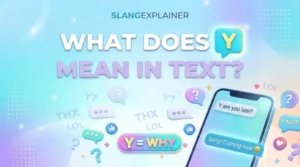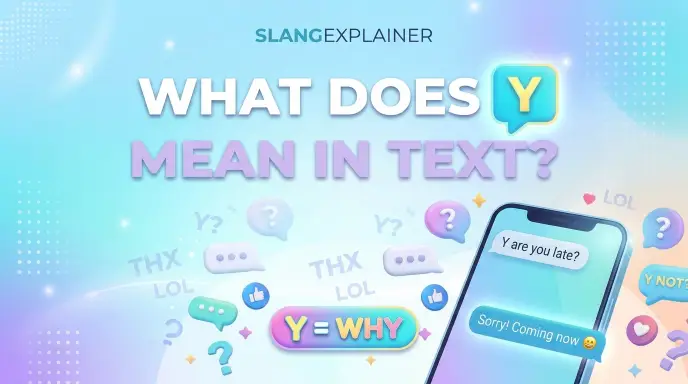
The letter Y in text messages usually means “Why?” People use it as a short way to ask a question, show confusion, or find out the reason behind something. You may see it in WhatsApp messages, Snapchat chats, TikTok comments, Instagram DMs, and regular SMS conversations.
For example, if someone texts “Y are you late?”, they are asking, “Why are you late?” It is a quick and informal way to communicate without typing the full word.
However, the meaning can sometimes change depending on the conversation. In some situations, Y may simply represent the letter itself, while in others, it can be part of an abbreviation or online expression.
If you have received a message containing just “Y”, you might wonder if the person is asking a question, expressing confusion, or trying to save time. Understanding the context makes it much easier to know what they mean.
Y Meaning in Text
The most common meaning of Y in texting is “Why?” It is a shortened version of the word that people use when they want to ask someone for a reason or explanation.
Instead of typing the complete word, someone may send a single letter. This makes the conversation faster, especially when chatting casually with friends.
For example:
- “Y u mad?” = Why are you mad?
- “Y not?” = Why not?
- “Y did u leave?” = Why did you leave?
- “Y so quiet?” = Why are you so quiet?
In all these examples, Y replaces the word Why without changing the main meaning of the sentence.
Is Y Slang, an Acronym, or an Abbreviation?
Technically, Y is an abbreviation or text shorthand, rather than a traditional acronym.
An acronym is formed from the first letters of several words, while Y is simply a shortened spelling of an existing word.
People use it because texting often involves quick messages, shortened words, and casual expressions.
Remember: Y does not always have a special hidden meaning. In ordinary texting, it most commonly stands for Why.
What Does a Single Y Mean?
When someone sends only “Y”, they are usually asking why something happened.
For example:
Person A: I’m not coming today.
Person B: Y?
Here, Person B is asking, “Why?”
The person may want more information or simply be curious about the situation.
Where Do People Use Y in Texting and Social Media?
The letter Y appears across many digital platforms. Its meaning usually stays the same, but the way people use it can depend on the platform and conversation.
1. Y on TikTok
On TikTok, people sometimes use Y in comments and private messages when they want to ask a quick question.
For example:
- “Y did you delete the video?”
- “Y is everyone talking about this?”
- “Y not post another one?”
It helps users keep comments short and casual.
You may also see Y in discussions where someone wants to understand a trend, video, or creator’s decision.
2. Y on Snapchat
Snapchat conversations are often quick and informal. Friends may use Y instead of Why when sending snaps or chatting privately.
Examples include:
- “Are you ignoring me?”
- “Y didn’t you open my snap?”
- “Y are you awake?”
Because Snapchat encourages fast communication, shortened words are common in everyday conversations.
3. Y on Instagram
Instagram users may include Y in comments, story replies, and direct messages.
For example:
- “Y did you remove that picture?”
- “Y are you laughing?”
- “Y not tag me?”
It gives messages a relaxed tone and makes questions shorter.
4. Y on WhatsApp
On WhatsApp, Y is often used when friends or family members are chatting informally.
For instance:
- “Y are you coming late?”
- “Y didn’t you call?”
- “Y not tell me earlier?”
Some people prefer typing full words, while others naturally use texting shortcuts.
5. Y in SMS Messages
Even in traditional SMS messages, Y can replace Why.
People sometimes use it when they want to send a short message without typing too much.
Example:
“Y are you not answering?”
This means “Why are you not answering?”
The abbreviation is easy to understand because the letter sounds like the beginning of the spoken word.
10 Real Chat Examples of Y in Text Messages
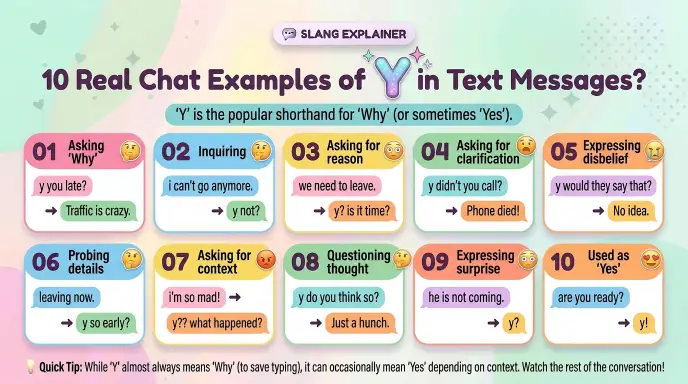
The easiest way to understand texting abbreviations is to see how people use them in everyday conversations.
Here are ten realistic examples.
Example 1: Asking About Plans
A: Are you going to the party tonight?
B: No, I have some work.
A: Y? It’s Saturday!
Meaning: A is asking why B cannot attend the party.
Example 2: Asking Why Someone Is Upset
A: I’m really annoyed today.
B: Y? What happened?
Meaning: B wants to know the reason behind A’s mood.
Example 3: Talking About School
A: I didn’t go to school today.
B: Y?
A: I wasn’t feeling well.
Meaning: B uses Y as a short way to ask why.
Example 4: Making Weekend Plans
A: Let’s go shopping tomorrow.
B: I don’t think I can.
A: Y not?
Meaning: A is asking why B cannot go shopping.
Example 5: Asking About a Missed Call
A: I called you twice.
B: Sorry, I was busy.
A: Y didn’t you text me?
Meaning: A wants to know why B did not send a message.
Example 6: Talking to a Friend
A: I’m leaving early.
B: Y? Stay a little longer.
Meaning: B is asking why A wants to leave early.
Example 7: Discussing a Photo
A: I deleted my Instagram picture.
B: Y? It looked nice!
Meaning: B wants to know why the picture was removed.
Example 8: Asking About Silence
A: You’ve been quiet all day.
B: I’m just tired.
A: Y? Didn’t you sleep well?
Meaning: A is asking why B seems tired or quiet.
Example 9: Talking About Food
A: I don’t eat pizza.
B: Y? Everyone loves pizza!
Meaning: B is curious about why A does not like pizza.
Example 10: A Casual Conversation
A: I think I’ll stay home today.
B: Y? The weather is perfect!
Meaning: B is asking why A does not want to go outside.
What do these examples teach us?
In each conversation, Y replaces Why. The meaning becomes clear when you read the complete message instead of looking at the letter alone.
How to Reply When Someone Says Y?
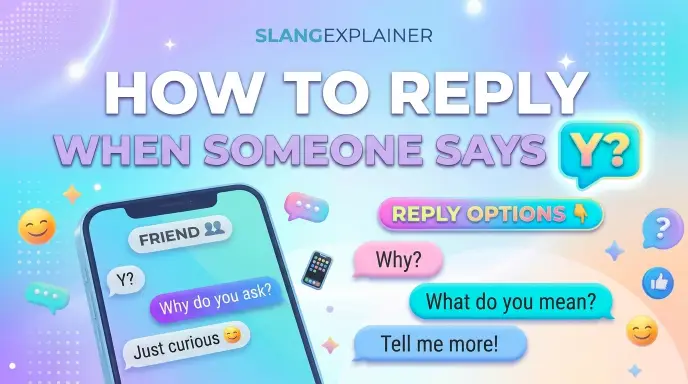
Your response depends on what the other person wants to know. If someone sends you Y, they are probably asking for a reason or explanation.
You do not need to send a complicated answer. A short and natural reply is usually enough.
Funny Replies
If you are talking to a close friend, you can make your response playful.
- “Because I said so 😂”
- “Long story, bro!”
- “Even I don’t even know!”
- “Guess what happened!”
Casual Replies
These responses work well in everyday conversations.
- “Just because.”
- “I was busy.”
- “I didn’t feel like it.”
- “Maybe another time.”
Friendly Replies
If you want to sound warm and polite, try these:
- “I’ll explain everything.”
- “Nothing serious, don’t worry.”
- “I just needed some rest.”
- “Let me tell you what happened.”
Neutral Replies
These are useful when you do not want to sound too emotional or playful.
- “I had another commitment.”
- “There was a small problem.”
- “I wasn’t available.”
- “I changed my plans.”
Tip: Always read the complete question before replying. A single Y usually asks for a reason, but the rest of the conversation tells you what explanation is needed.
Is Y Rude or Offensive?
No. Y is not generally considered rude, offensive, or inappropriate. It is simply a short way of writing Why.
However, the tone of a message can change how the other person understands it.
For example:
“Y?”
This may sound like a normal question between friends.
But:
“Y are you always doing this?”
Depending on the situation, this could sound annoyed or confrontational.
Is It Safe to Use With Friends?
Yes. You can comfortably use Y when chatting with friends who understand common texting shortcuts.
It is especially suitable for informal conversations.
Is It Appropriate at School?
In casual conversations with classmates, Y is generally fine.
However, when writing assignments, answering teachers, or sending formal school messages, use the complete word Why.
Is It Appropriate at Work?
In professional emails and workplace communication, writing full words is usually better.
For example:
Instead of:
“Y is the meeting delayed?”
Write:
“Why is the meeting delayed?”
The complete version sounds clearer and more professional.
Who Uses Y in Text Messages?
The letter Y is used by different age groups, although it is especially familiar to people who regularly communicate through text messages and social media.
Teenagers and Young Adults
Teenagers and young adults often use shortened words because they are used to quick online conversations.
They may write Y instead of Why when talking to friends, discussing plans, or asking questions.
Gen Z Usage
Gen Z is familiar with short texting expressions such as Y, U, R, IDK, and BRB.
These shortcuts help make casual messages shorter and faster.
However, Y is not exclusive to Gen Z. Older internet users also understand and use it.
Common Platforms
You may come across this abbreviation on:
- TikTok comments
- Snapchat messages
- Instagram DMs
- WhatsApp chats
- Facebook Messenger
- Traditional SMS messages
How Popular Is It?
Y is a recognizable texting shortcut, but its popularity varies.
Some people use it regularly, while others prefer typing Why because it looks clearer.
It is also common to see different forms such as “y,” “Y,” and “y not.”
Origin of Y in Texting
The use of Y as a short form of Why is connected to the wider history of internet shorthand and mobile texting.
Before smartphones became common, people often used SMS messages with limited character space. Shortening words was a practical way to communicate more information in fewer characters.
Over time, internet users developed many informal writing habits.
Words such as:
- U for You
- R for Are
- Y for Why
- C for See
- B4 for Before
became recognizable in casual digital conversations.
Did Social Media Create This Abbreviation?
Not necessarily. Shortened spellings existed in digital communication before modern social media platforms became popular.
Chat rooms, instant messaging services, and SMS texting all helped spread informal online language.
Platforms like Snapchat, Instagram, and TikTok later provided more places for people to use these shortcuts.
Is the Exact Origin Known?
There is no single confirmed person or platform credited with creating Y as a shorthand for Why.
It developed naturally from the way people shorten words in informal digital communication.
The important point is that Y is a simple texting abbreviation, not a newly invented social media trend.
Y vs. Other Popular Texting Abbreviations
Y is not the only shortcut people use in online conversations. Other abbreviations help users express feelings, ask questions, or explain what they are doing.
Here is how it compares with five familiar texting terms.
| Term | Meaning | Type | Usage | Popularity |
| Y | Why | Abbreviation | Asking for a reason | Recognizable |
| IDK | I Don’t Know | Acronym | Showing uncertainty | Very common |
| IDC | I Don’t Care | Acronym | Showing indifference | Very common |
| IMO | In My Opinion | Acronym | Sharing an opinion | Common |
| BRB | Be Right Back | Acronym | Taking a short break | Very common |
Understanding the Differences
Although these expressions are all used in texting, they do not communicate the same thing.
- Y asks someone for a reason.
- IDK tells someone that you do not know something.
- IDC expresses that something does not matter to you.
- IMO a personal opinion.
- BRB tells someone that you will return shortly.
For example, if your friend asks why you missed a party, you might reply with IDK only if you genuinely do not know the reason. But if you want to ask your friend why they missed it, you can simply send Y.
Real: World Usage Example: When Would Someone Say Y?
Imagine two friends are planning to meet at a coffee shop on Saturday afternoon.
One friend suddenly sends a message saying:
“I can’t come tomorrow.”
The other friend is surprised because they had already made plans.
Instead of typing a complete question, they send:
“Y? I thought we were meeting!”
The first friend replies:
“My family is visiting, so I need to stay home.”
This is a simple example of how Y works in everyday messaging.
It allows someone to ask a question quickly without changing the meaning of the sentence.
You might also see it in situations involving cancelled plans, missed calls, unexpected decisions, or confusing messages.
The meaning is usually easy to understand when you consider what the other person said before sending Y.
Common Mistakes People Make About Y
Even though Y is a simple abbreviation, people sometimes misunderstand it because the letter can have different meanings in different situations.
1. Thinking Y Always Means Yes
One common mistake is assuming that Y means Yes.
In ordinary texting, Y most commonly means Why, but some people may use it as a personal shorthand for Yes.
Always consider the conversation.
2. Confusing Y With Other Abbreviations
Y is different from expressions such as WYD, WYM, and WYA.
- WYD: What are you doing?
- WYM: What do you mean?
- WYA: Where are you?
- Y: Why?
These abbreviations serve different purposes.
3. Using It in Formal Writing
Although Y works in casual chats, it may look unprofessional in business emails, school assignments, and official messages.
Using the complete word is a better choice in these situations.
4. Assuming Someone Is Angry
A message containing only Y does not automatically mean the sender is angry.
They may simply be curious or asking for an explanation.
Do not judge someone’s emotions from one letter alone.
Frequently Asked Questions
1. What does Y mean in text messages?
Y usually means “Why?” It is a short texting abbreviation used to ask someone for a reason or explanation.
2. What does Y mean on TikTok?
On TikTok, Y commonly means Why in comments, captions, and direct messages. People use it to ask quick questions.
3. Is Y slang?
Y is generally considered informal texting shorthand or an abbreviation for Why, rather than a traditional slang word.
4. Is Y rude or offensive?
No. Y is not offensive by itself. However, the complete message and tone can sometimes make a question sound rude.
5. How should you reply to Y?
Reply with a short explanation. For example, “I was busy,” “Just because,” or “I’ll explain later.”
Conclusion
The letter Y usually means “Why?” in text messages. It is a simple abbreviation that people use when they want to ask questions, understand a situation, or find out the reason behind something.
You may see it in WhatsApp chats, Snapchat messages, Instagram DMs, TikTok comments, and regular SMS conversations.
It is generally safe to use with friends and in casual conversations. However, writing the complete word Why is a better choice in professional emails, school assignments, and formal communication.
The easiest way to understand Y is to read the full conversation. Context will usually tell you exactly what the sender means.

I’m Dylan Foster, a slang and internet culture writer passionate about exploring how people communicate online and in everyday conversations. I write about texting abbreviations, social media expressions, and modern slang to help readers understand meanings, origins, and real-world usage in a simple way.