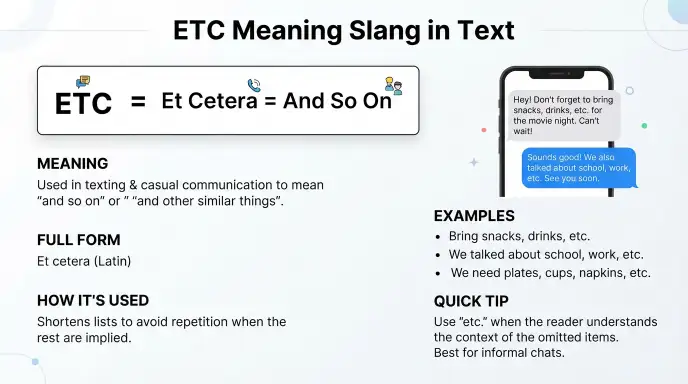
etc meaning slang is a common search because people often see “etc.” in texts, social media posts, chats, and online conversations and wonder if it is actually slang. The short answer is that “etc.” is not traditionally slang. It is an abbreviation of the Latin phrase et cetera, meaning “and other things” or “and so on.”
However, people frequently use it in casual digital communication, which can make it feel like an informal texting expression.
You may see “etc.” after a list when the writer does not want to name every item. Its meaning is usually straightforward, but its tone can change depending on the conversation.
Quick Answeretc meaning slang in text:
“Etc.” means “and so on” or “and other similar things.” It is an abbreviation rather than true slang and is commonly used in texting, writing, and online communication.
What Does Etc. Mean in Text?
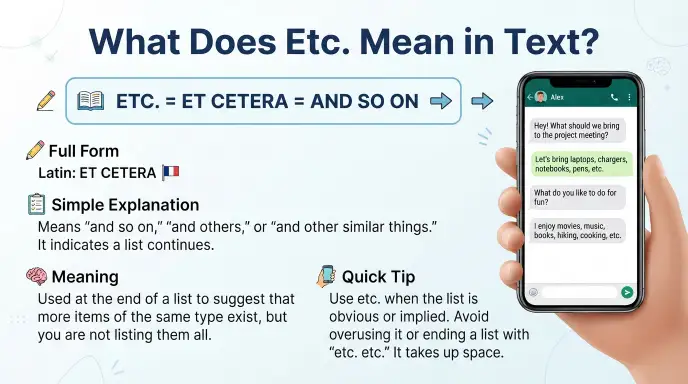
When someone writes “etc.” in a text, they normally mean “and other things like that” or “and so on.”
For example:
“I need to buy clothes, shoes, accessories, etc.”
The person is saying that they need clothes, shoes, accessories, and other related items without listing everything.
Unlike many modern slang terms, “etc.” does not usually have a hidden meaning. It is simply a convenient abbreviation that saves the writer from continuing a long list.
You may encounter it in:
- Text messages
- Social media captions
- Online discussions
- Emails
- School or work communication
- Reddit posts
- Discord conversations
- Instagram messages
- Casual chats
Because it is so widely understood, people do not normally need to explain what it means.
What Is the Full Form of Etc.?
The etc. full form is et cetera.
The phrase comes from Latin:
- et = “and”
- cetera = “the other things”
Together, et cetera means approximately “and the rest” or “and other things.”
In English, it is normally shortened to “etc.”
The period is traditionally included because it is an abbreviation. You may also see the expression written as etcetera, although “etc.” is much more common in everyday writing.
What Does Etc. Stand For?
If you are wondering “what does etc. stand for?”, it stands for et cetera.
It does not stand for a modern texting phrase or internet expression. Its use in texting simply reflects how people naturally shorten familiar words and expressions.
Is “Etc.” Actually Slang?
Not really.
This is an important distinction when searching for etc meaning slang.
“Etc.” is better described as an abbreviation than slang. Slang usually involves informal words or expressions that have meanings different from standard language.
For example:
- “LOL” = laughing out loud
- “BRB” = be right back
- “IDK” = I don’t know
- “sus” = suspicious
- “etc.” = and so on
The first examples are commonly associated with texting or internet slang. “Etc.” is different because it has been part of standard written English for a long time.
So, although you may see it in casual messages, calling it slang is technically inaccurate.
Is Etc. Rude, Offensive, or Neutral?
“Etc.” is generally neutral.
It is not normally rude, offensive, vulgar, or inappropriate. The abbreviation itself does not carry a negative meaning.
However, context can influence how a sentence feels.
For example:
“You know, work, bills, meetings, etc.”
This sounds casual and neutral.
But:
“He complained about his problems, his job, his friends, etc.”
Depending on the surrounding conversation, “etc.” could make the writer sound dismissive, as though they do not want to discuss the details.
The issue is therefore not the word “etc.” itself. It is the attitude expressed by the complete vsentence.
Where Is “Etc.” Commonly Used?
Because “etc.” is a standard abbreviation, you can find it in many different forms of communication. It is not limited to slang or internet culture. People use it whenever they want to shorten a list or avoid mentioning every similar item.
Texting
In text messages, “etc.” is useful when the writer wants to keep the message short.
“Bring snacks, drinks, plates, cups, etc.”
The writer assumes the other person understands what additional items might be needed.
Social Media
You may see “etc.” in captions, comments, and posts on platforms such as Instagram, TikTok, Facebook, and X.
“Coffee, music, good friends, etc. = perfect weekend.”
Here, “etc.” leaves room for other enjoyable things without making the caption too long.
Reddit and Online Discussions
Reddit users and other online communities may use “etc.” when giving several examples of a larger category.
“People discuss movies, games, books, TV shows, etc.”
The abbreviation tells the reader that the examples are not complete.
Discord and Gaming
In gaming conversations, “etc.” can make communication faster:
“We need armor, healing items, weapons, ammo, etc.”
The meaning is simply “and other similar gaming supplies.”
Emails and Work Messages
“Etc.” can also appear in professional communication:
“Please review the reports, invoices, receipts, etc.”
However, if the recipient needs to know exactly what documents are required, listing each item is usually better.
Real:Life Examples of “Etc.” in Text
The meaning of “etc.” becomes clearer when you see it used in different situations.
Friendly Example
Alex: “What are you bringing to the picnic?”
Sam: “Drinks, sandwiches, fruit, etc.”
Here, Sam means drinks, sandwiches, fruit, and other picnicifrelated items.
Casual Example
“I spent the morning cleaning, shopping, doing laundry, etc.”
The writer does not want to list every household task.
Social Media Example
“Weekend plans: movies, food, friends, shopping, etc.
The expression suggests that there are additional activities without spelling them all out.
Gaming Example
“We need weapons, armor, healing items, etc. before the next mission.”
Here, “etc.” refers to other useful game equipment.
Work Example
“Please check the reports, invoices, emails, etc.”
The writer is referring to additional documents or tasks of the same general type.
Argumentative Example
“He keeps making excuses about work, traffic, being tired, etc.”
The abbreviation itself is neutral, but the overall sentence can sound frustrated or dismissive because of the argumentative context.
What Tone Does “Etc.” Have?
One reason people search for etc meaning slang is that the expression can feel different depending on the conversation.
The word itself is neutral, but the surrounding language determines the tone.
| Context | Possible Tone |
| Friendly text | Relaxed |
| Casual conversation | Informal |
| Social media caption | Casual |
| Professional email | Neutral |
| Academic writing | Formal/standard |
| Argument | Potentially dismissive |
| Gaming chat | Casual and efficient |
For example:
“Bring your laptop, charger, mouse, etc.”
This sounds practical and neutral.
Compare that with:
“He always complains about work, money, his friends, etc.”
The second sentence may sound annoyed because of the surrounding wording.
So, “etc.” does not become rude by itself. The tone comes from the complete message.
Origin and Background of “Etc.”
The history of “etc.” goes back to Latin.
The original expression is et cetera, which can be understood as “and the others” or “and other things.”
English adopted the phrase centuries ago. Over time, writers commonly shortened it to “etc.”
This is important because it shows that “etc.” is not a newly created internet slang term. It existed long before smartphones, texting, TikTok, Instagram, Reddit, and other social platforms.
Modern users simply continue to use the abbreviation in digital communication because it is short, familiar, and convenient.
Etc. vs. Similar Expressions
Several expressions have meanings similar to “etc.” However, they are not always interchangeable.
| Expression | Meaning | Common Use |
| etc. | And other things | Lists |
| and so on | And similar things continue | Casual/neutral |
| and so forth | And other similar examples | Neutral/formal |
| and the rest | The remaining things or people | Specific contexts |
| e.g. | For example | Introducing examples |
| and more | Additional things | Casual writing |
Etc. vs. “And So On”
These expressions are often very similar.
“I like football, basketball, tennis, etc.”
You could also say:
“I like football, basketball, tennis, and so on.”
Both indicate that the list continues.
Etc. vs. “E.g.”
These two abbreviations are different.
E.g. means “for example.”
“I enjoy outdoor activities, e.g., hiking and cycling.”
Etc. means “and other similar things.”
“I enjoy hiking, cycling, swimming, etc.”
A simple way to remember the difference is:
e.g. = examples are coming
etc. = the list continues
When Should You Avoid Using Etc.?
Although “etc.” is useful, it is not always the clearest choice.
When the Complete List Matters
If someone needs every item, avoid using “etc.”
Instead of:
“Bring your documents, etc.”
Be specific:
“Bring your passport, ID card, application form, and payment receipt.”
The second version gives the reader the exact information they need.
When the Missing Items Are Unclear
“Etc.” works best when the reader can easily understand what other items belong to the category.
Clear:
“I bought apples, bananas, oranges, etc.”
The category is obvious: fruits.
Less clear:
“We discussed several important issues, etc.”
The reader may not know which issues you mean.
In Important Instructions
For legal, financial, technical, academic, or safetyifrelated instructions, precision is often more important than brevity.
Instead of:
“Submit the required documents, etc.”
It is better to identify exactly which documents are required.
Polite Alternatives to Etc.
There is normally no need for a “polite” replacement because “etc.” is not offensive.
However, you can choose a clearer alternative depending on your sentence.
Common options include:
- and so on
- and so forth
- and other similar items
- and other related examples
- among other things
- and more
For example:
“The course covers grammar, vocabulary, pronunciation, etc.”
A clearer version could be:
“The course covers grammar, vocabulary, pronunciation, and other language skills.”
The second sentence gives the reader more information instead of leaving the category vague.
Why Do People Use “Etc.”?
The biggest reason is convenience.
Imagine someone writing:
“Bring snacks, drinks, cups, plates, napkins, forks, spoons, ice, bags, and other related things.”
That is unnecessarily long.
A shorter version is:
“Bring snacks, drinks, cups, plates, napkins, etc.”
The reader can understand the general idea without reading a long list.
People Use “Etc.” To:
- Save time
- Shorten long lists
- Avoid unnecessary repetition
- Keep messages readable
- Show that additional examples exist
- Make casual communication more efficient
This is one reason the abbreviation remains popular even in modern digital communication.
Is “Etc.” Safe for Social Media?
Yes. “Etc.” is generally safe and neutral for social media.
It does not have an offensive, sexual, insulting, or dangerous meaning by itself. You can use it naturally in captions, comments, posts, and messages.
For example:
“Travel, good food, new places, etc. ✈️”
This simply means travel, good food, new places, and other similar experiences.
However, always consider the complete sentence. If someone uses “etc.” as part of sarcasm, criticism, or an argument, the overall message may sound negative. That is caused by the context rather than the abbreviation itself.
The Impact of Using “Etc.” in Communication
Using “etc.” can make communication faster and more concise, especially when the reader already understands the general category being discussed.
For example:
“I need groceries like milk, eggs, bread, vegetables, etc.”
There is no need to name every item in the shopping basket. The reader understands that the list contains additional grocery items.
However, convenience can sometimes come at the cost of precision. If the reader needs exact information, “etc.” may leave too much room for interpretation.
Benefits of Using Etc.
- Saves space: It shortens long lists.
- Improves readability: Readers do not have to go through unnecessary details.
- Works well in casual communication: It feels natural in everyday messages.
- Avoids repetition: Similar items do not need to be individually listed.
- Is widely understood: Most English speakers recognize its meaning.
Possible Drawbacks
- It can be vague: Readers may not know what else is included.
- It can sound dismissive: In certain arguments, it may make details seem unimportant.
- It may cause confusion: Important instructions should usually be specific.
- Overuse can weaken writing: Too many incomplete lists can make content feel imprecise.
The best approach is simple: use “etc.” when the omitted information is obvious, but provide specific details when they matter.
Common Mistakes With Etc.
Although “etc.” is easy to understand, people sometimes use it incorrectly or unnecessarily.
Mistake 1: Using Etc. Without Giving Examples
Weak:
“I bought some things, etc.”
The reader does not know what “things” means.
Better:
“I bought clothes, shoes, and accessories, etc.”
Now the reader has enough context to understand the category.
Mistake 2: Using Etc. When Every Item Is Important
If someone asks you to provide a complete list, “etc.” does not answer the question properly.
For example:
“What documents do I need?”
Not ideal:
“You need your passport, ID, etc.”
Better:
“You need your passport, ID card, application form, and two photographs.”
Mistake 3: Confusing Etc. With E.g.
These abbreviations have different purposes.
- e.g. = for example
- etc. = and other similar things
Example:
“You can use outdoor activities, e.g., hiking and cycling.”
This gives examples.
“I enjoy hiking, cycling, swimming, etc.”
This indicates that the list continues.
Mistake 4: Using Etc. Too Frequently
Consider:
“We talked about school, work, money, etc., then discussed family, relationships, etc.”
This can sound vague and repetitive.
If the details are important, explain them directly.
Etc. in Text vs. Formal Writing
The meaning of “etc.” does not change between texting and formal writing. What changes is if it is the best stylistic choice.
| Texting | Formal Writing |
| “Bring snacks, drinks, etc.” | “Bring snacks, drinks, and other refreshments.” |
| Short and convenient | More precise |
| Casual | Professional or academic |
| Context fills in missing details | More explanation may be expected |
It is not automatically incorrect to use “etc.” in professional writing. The key question is if the reader can understand the omitted information easily.
For an informal email to a coworker, this might be perfectly acceptable:
“Please send the invoices, receipts, etc.”
For a formal report, you may want to identify exactly which documents are included.
Why “Etc.” Can Sometimes Sound Dismissive
The abbreviation itself is not rude, but context can make it sound like the writer is brushing aside information.
Consider:
“He was complaining about his job, his friends, his family, etc.”
The writer may simply be summarizing. But depending on the conversation, the sentence could also imply:
“There are many other complaints, but I don’t consider them worth discussing.”
This is why tone should always be judged from the whole message, rather than from “etc.” alone.
In friendly conversations, it is rarely a problem. In sensitive discussions, however, being more specific can prevent misunderstandings.
Is Etc. Slang or an Abbreviation?
This is one of the most important points for anyone researching etc meaning slang.
“Etc.” is an abbreviation, not traditional slang.
Slang generally consists of informal expressions that may have specialized meanings within particular groups, generations, communities, or online cultures.
“Etc.” does not work that way.
It has essentially the same meaning in:
- Text messages
- School assignments
- Business emails
- Books
- Articles
- Social media
- Online forums
- Everyday conversations
Its meaning stays stable across these settings.
So, if someone asks “What does etc. mean in slang?”, the most accurate answer is that it is not really slang; it is a commonly used abbreviation meaning “and so on.”
How to Remember the Meaning of Etc.
A simple memory trick can make this abbreviation easy to remember.
Think:
Etc. = “and the rest.”
Whenever you see:
“Apples, oranges, bananas, etc.”
Think:
“Apples, oranges, bananas, and the rest of the similar things.”
Another easy phrase is:
Etc. = the list continues.
This works particularly well when reading texts or social media posts.
Related Terms You May See in Texting
Although “etc.” is not slang, it appears alongside many genuine texting abbreviations.
| Term | Meaning |
| LOL | Laughing out loud |
| IDK | I don’t know |
| BRB | Be right back |
| TBH | To be honest |
| BTW | By the way |
| IMO | In my opinion |
| e.g. | For example |
| etc. | And so on |
The important difference is that many of these expressions became especially popular through digital communication, while “etc.” has a much older history.
Is “Etc.” Appropriate for School or Work?
Generally, yes if but it depends on the type of writing.
In casual school communication, a student might write:
“We need pens, notebooks, folders, etc.”
That is perfectly understandable.
In an academic essay, however, it may be better to explain the relevant examples specifically rather than relying heavily on “etc.”
At work, the same principle applies. A casual internal message can use it naturally:
“Please bring the reports, invoices, etc.”
But an official document should usually provide exact details when the information affects decisions or responsibilities.
FAQs About Etc. Meaning Slang
Q1. What does “etc.” mean in text?
“Etc.” means “and so on” or “and other similar things.” It is normally used at the end of a list.
Q2. What is the full form of etc.?
The full form is et cetera, a Latin phrase meaning “and other things.”
Q3. Is “etc.” a slang word?
No. “Etc.” is an abbreviation rather than a slang word. It is used in both casual and formal communication.
Q4. Is etc. rude in texting?
No. “Etc.” is normally neutral. The surrounding sentence can make a message sound dismissive, but the abbreviation itself is not rude.\
Q5. Can I use etc. on Instagram or TikTok?
Yes. “Etc.” is safe and commonly understood in social media captions, comments, and messages.
Q6. What is the difference between etc. and e.g.?
E.g. introduces examples, while etc. shows that a list continues with additional similar items.
Conclusion
Etc meaning slang is easier to understand when you separate the abbreviation from actual internet slang. “Etc.” stands for et cetera and means “and so on,” “and the rest,” or “and other similar things.” Although people frequently use it in texting and social media, it is not technically a slang expression.
The abbreviation is generally neutral, harmless, and widely understood. It works particularly well when you have already provided enough examples for the reader to understand what additional items you mean.
However, avoid relying on “etc.” when complete information is necessary. In important instructions, professional documents, or situations where the missing details could cause confusion, a specific list is much better.
In everyday texting, though, using “etc.” is perfectly natural. When you see it at the end of a message or list, simply understand it as a signal that the list continues.

I’m Dylan Foster, a slang and internet culture writer passionate about exploring how people communicate online and in everyday conversations. I write about texting abbreviations, social media expressions, and modern slang to help readers understand meanings, origins, and real-world usage in a simple way.