Greek slang words can make everyday Greek conversations more interesting, natural, and easier to understand. If you are learning Greek, visiting Greece, watching Greek content, or chatting with Greek speakers online, you may come across informal words that are not usually taught in textbooks.
Some expressions can have different meanings depending on the speaker, tone, and situation. In this guide, we will explore common Greek slang words, their meanings, simple examples, and how they are used in everyday communication.
You will also learn which expressions are friendly, which ones are informal, and which slang words should be used carefully. if you are a beginner or simply curious about Greek language and culture, this guide will help you understand casual Greek with more confidence.
Greek Slang Words: Quick Answer
- Greek slang words are casual Greek expressions used in conversations, texting, social media, and other informal settings. Common examples include re, malaka, ela, halara, pame, and ti leei?
- Th meaning often depends on the context, tone, and relationship between speakers.
What Are Greek Slang Words?
Greek slang is the informal language people use when they are relaxed and speaking naturally. You may hear it between friends, in text messages, on social media, or during casual conversations.
Unlike formal Greek, slang can be playful, emotional, humorous, or even rude. Some expressions have a completely different meaning when used casually than they do when translated word for word.
For example, re can be similar to “hey,” “man,” or “dude.” Malaka is more complicated because it can be an insult, but close friends may also use it casually with each other.
This is why learning Greek slang is not only about memorizing translations. You also need to understand when and how people use each expression.
Common Greek Slang Words and Their Meanings
Here are some popular Greek slang words and casual expressions:
| Greek Slang | Meaning in English | Usage |
| Re (Ρε) | Hey, man, dude | Very informal |
| Malaka (Μαλάκα) | Dude, mate, idiot | Vulgar/contextifdependent |
| Ela (Έλα) | Come on, really?, no way | Informal |
| Halara (Χαλαρά) | Relax, chill, take it easy | Casual |
| Pame (Πάμε) | Let’s go | Casual |
| Ti leei? (Τι λέει;) | What’s up? | Informal |
| Endaxi (Εντάξει) | Okay, alright | Common/casual |
| Telio (Τέλειο) | Awesome, perfect | Casual |
| Hamos (Χαμός) | How to Learn Greek Slang Naturallychaos, wild | Informal |
| Gamoto (Γαμώτο) | Damn, damn it | Vulgar |
These expressions can be heard in everyday Greek, but not all of them are appropriate in formal situations.
Re (Ρε)
Re is one of the most common informal Greek expressions.
Depending on the situation, it can mean:
- Hey
- Man
- Dude
- Mate
For example:
Re Maria, ti kaneis?
This can naturally mean:
“Hey Maria, how are you?”
Friends often use re when talking casually. It can make a sentence sound more relaxed and familiar.
However, it is not always appropriate with strangers or in formal situations. Your relationship with the other person matters.
Malaka (Μαλάκα)
Malaka is one of the bestifknown Greek slang words, but it needs to be used carefully.
Its literal meaning is vulgar and can be insulting. However, close friends sometimes use it casually in a way similar to:
- Dude
- Mate
- Bro
- Idiot
For example:
Ti kaneis, malaka?
Among close friends, this may be understood as:
“What’s up, dude?”
But if the same word is said aggressively to a stranger, it can be offensive.
This is an important example of why Greek slang cannot always be translated literally. Tone, friendship, and situation can completely change how a word sounds.
Ela (Έλα)
Ela basically means “come,” but Greek speakers use it in many casual ways.
It can express:
- Come on
- Really?
- No way
- Seriously?
- Let’s go
For example:
Ela re!
Depending on the speaker’s tone, this could express surprise, disbelief, frustration, or encouragement.
You may also hear ela during phone conversations or casual interactions. It is a flexible expression that beginners will often encounter.
Halara (Χαλαρά)
Halara means something like:
“Relax.”
or
“Take it easy.”
It can describe a calm or relaxed attitude.
For example:
Halara, den peirazei.
A natural English meaning would be:
“Relax, it doesn’t matter.”
The expression is useful when someone is worried, rushing, or taking a situation too seriously.
Pame (Πάμε)
Pame means “let’s go.”
It is a simple and useful expression for casual conversations.
For example:
Pame!
means:
“Let’s go!”
You may hear it when friends are leaving somewhere, starting an activity, or encouraging each other.
It can also appear in longer phrases:
Pame gia kafe?
Meaning:
“Let’s go for coffee?”
Ti Leei? (Τι λέει;)
Ti leei? is a casual expression that can mean:
“What’s up?”
or
“How’s it going?”
It is commonly used as an informal conversation starter.
For example:
Ti leei?
A natural reply could be:
Kala, esy?
Meaning:
“Good, you?”
This phrase is particularly useful when you want to understand how Greek speakers casually greet friends.
Endaxi (Εντάξει)
Endaxi means:
- Okay
- Alright
- Fine
- Got it
It is very common in everyday Greek.
For example:
Endaxi, tha se paro avrio.
Meaning:
“Okay, I’ll call you tomorrow.”
Unlike stronger slang terms, endaxi is generally much safer for learners to recognize and use in ordinary conversation.
Telio (Τέλειο)
Telio means “perfect” or “awesome.”
People can use it to show approval, excitement, or satisfaction.
For example:
Telio!
means:
“Awesome!”
You might hear it when someone receives good news, sees something they like, or agrees with a suggestion.
Hamos (Χαμός)
Hamos literally has meanings connected with chaos or destruction, but informal speakers can use it to describe something that
- Wild
- Very busy
- Intense
- Chaotic
For example:
Ginetai hamos edo!
can naturally mean:
The exact meaning depends on what is happening around the speaker.
Gamoto (Γαμώτο)
Gamoto is a vulgar Greek expression used to show frustration, anger, disappointment, or surprise.
It can be roughly understood as:
- Damn!
- Damn it!
- For goodness’ sake!
For example:
Gamoto, xechasa ta kleidia!
Meaning:
“Damn, I forgot my keys!”
Because it is vulgar, learners should understand it before trying to use it.
Why Context Matters in Greek Slang
One of the most important things to remember about Greek slang is that the same word can sound friendly, funny, rude, or offensive depending on the situation.
Take malaka as an example.
Two close friends might use it jokingly with each other. But saying it angrily to someone you do not know can cause offense.
The same idea applies to re. Among friends, it can sound completely natural. With someone in a formal setting, however, it may sound too familiar.
When learning slang, pay attention to:
- Who is speaking
- Who they are speaking to
- Their tone
- The situation
- if they are joking
- if the conversation is formal or informal
This will help you understand Greek slang more accurately than simply memorizing English translations.
Greek Slang vs Formal Greek
Greek slang is mainly used in relaxed situations, while formal Greek is preferred for professional, official, or respectful communication.
| Slang Expression | General Meaning | Formality |
| Re | Hey/man | Very informal |
| Malaka | Dude/insult | Vulgar |
| Ela | Come on/really? | Informal |
| Halara | Relax/chill | Informal |
| Pame | Let’s go | Casual |
| Ti leei? | What’s up? | Informal |
| Endaxi | Okay | Common |
| Gamoto | Damn | Vulgar |
If you are a beginner, it is better to learn the meaning of stronger slang before using it yourself. Understanding a word and using it correctly are two different things.
Greek Slang Words in Texting and Social Media
Greek slang is not limited to faceiftoifface conversations. Informal Greek is also common in texting, social media, gaming chats, and online communities.
People often shorten words when they type quickly. Some Greek texting expressions use only a few letters, making messages faster and more casual.
Common examples include:
| Greek Texting Form | Meaning |
| τπτ (tpt) | Nothing |
| γτ (gt) | Why |
| λολ (lol) | LOL |
| τέσπα (tespa) | Anyway |
| μνμ (mnm) | Message |
English internet slang also appears frequently in Greek online communication. Words such as lol may be mixed naturally with Greek text.
For learners, online conversations can be useful because they show how younger speakers communicate informally. However, internet slang can change quickly, so not every abbreviation will remain popular forever.
Where Are Greek Slang Words Commonly Used?
You may encounter Greek slang in many informal situations.
Everyday Conversations
Friends commonly use slang when talking about school, work, plans, entertainment, food, or daily life.
Text Messages
Shortened expressions and informal vocabulary are common in private messages.
Social Media
Greek users may use casual expressions in comments, captions, replies, and direct messages.
Gaming and Online Chats
Players may combine Greek slang with English gaming terminology while communicating quickly.
Cafés and Social Gatherings
Relaxed environments are more likely to involve informal expressions than professional settings.
The important point is that slang is connected to social context. A phrase that sounds normal between friends may not be suitable in a workplace or formal conversation.
Greek Slang Words for Friends and Casual Conversations
Some expressions are especially useful when talking casually with friends.
Re
Re can make a conversation sound familiar and relaxed.
Example:
Re, pame!
Meaning:
“Hey, let’s go!”
Filaraki
Filaraki can mean buddy or pal.
It has a friendly feeling and can be used when talking casually to someone.
Pame
Pame means “let’s go.”
It is useful when making plans or encouraging someone.
Halara
Halara expresses the idea of relaxing or taking things easy.
Together, these expressions can make casual Greek conversations easier to understand.
Greek Slang Words for Surprise and Emotion
Greek speakers also use informal expressions to show strong emotions.
Ela!
Depending on the tone, ela can express surprise or disbelief.
Ela! Really?
Gamoto
Telio! That’s great!
These examples show how tone plays an important role in understanding Greek expressions.
Greek Slang Words and Their English Equivalents
There is not always a perfect English translation for Greek slang.
| Greek Expression | Possible English Equivalent |
| Re | Hey, man, dude |
| Malaka | Dude, mate, idiot |
| Ela | Come on, really?, no way |
| Halara | Chill, relax |
| Pame | Let’s go |
| Ti leei? | What’s up? |
| Telio | Awesome |
| Hamos | How to Learn Greek Slang Naturally wild |
| Gamoto | Damn |
These translations are only approximate. The exact meaning can change depending on the situation.
Common Mistakes When Using Greek Slang
Learning slang can be fun, but beginners often make a few mistakes.
Using Vulgar Slang Too Quickly
Words such as malaka and gamoto may be heard frequently, but that does not mean they are safe to use everywhere.
First understand how native speakers use them.
Translating Slang Literally
A literal translation may sound strange in English.
For example, an expression may have one dictionary meaning but a different conversational meaning.
Ignoring Tone
The same word can sound friendly or insulting depending on how it is spoken.
Using Slang in Formal Situations
Avoid casual slang in:
- Job interviews
- Official emails
- Formal meetings
- Academic writing
- Professional communication
Formal Greek is more appropriate in these situations.
Copying Slang From Social Media
Online slang may be exaggerated, humorous, outdated, or specific to a particular community.
Always consider the context before copying an expression.
How to Learn Greek Slang Naturally
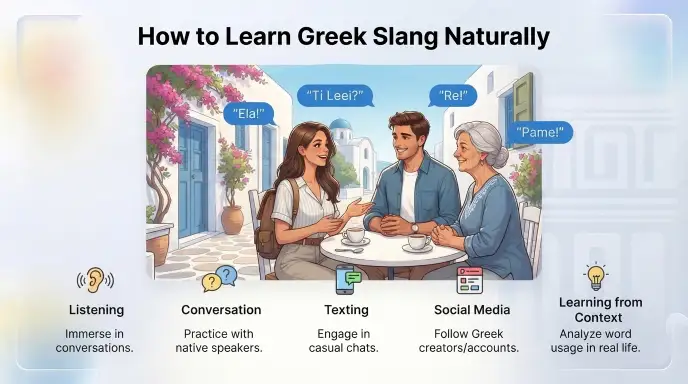
If you want to understand Greek slang better, focus on real examples rather than memorizing huge lists.
Listen to Native Speakers
Movies, interviews, videos, podcasts, and casual conversations can help you notice how expressions are actually used.
Learn the Context
Instead of memorizing:
Re = dude
learn:
Re is an informal expression often used between people who are familiar with each other.
This gives you a better understanding of when it is appropriate.
Start With Safer Expressions
Beginners can start with expressions such as:
- Endaxi
- Pame
- Telio
- Halara
Then learn stronger expressions as you become more comfortable with Greek culture and conversation.
Pay Attention to Tone
Tone can completely change the feeling of an expression. Listen carefully to if the speaker sounds friendly, annoyed, surprised, excited, or sarcastic.
Greek Slang Words Beginners Should Know
If you only want to learn a small number of expressions, start with these:
- Re hey/man
- Ela come on/really?
- Pame let’s go
- Endaxi okay
- Halara relax
- Ti leei? what’s up?
- Telio awesome
- Filaraki buddy
- Hamos How to Learn Greek Slang Naturally/chaotic
- Malaka a contextifdependent vulgar expression
The first eight are generally more useful for understanding everyday informal communication. Malaka should be approached carefully because of its vulgar and potentially insulting meaning.
Greek Slang Words in Everyday Examples
Here are some simple examples to help you understand how these expressions can work in conversation.
Re, ti kaneis?
“Hey, how are you?”
Pame gia kafe?
“Let’s go for coffee?”
Halara, re!
“Relax, man!”
Ti leei?
“What’s up?”
Ela!
“Come on!” or “No way!”
Endaxi, file.
“Okay, buddy.”
Telio!
“Awesome!”
Gamoto!
“Damn!”
Ginetai hamos edo.
Spao plaka.
“I’m joking.”
These examples demonstrate an important point: Greek slang is often more about how an expression is used than its literal dictionary definition.
Are Greek Slang Words Different From Greek Dialects?
Yes. Slang and dialect are not exactly the same.
A dialect is a regional variety of a language. It can include differences in pronunciation, vocabulary, grammar, and expressions.
Slang, on the other hand, refers mainly to informal vocabulary and expressions used by particular groups or in casual situations.
A Greek speaker can use both a regional dialect and modern slang at the same time.
This distinction is helpful because not every unusual Greek word you hear is necessarily slang.
Frequently Asked Questions About Greek Slang Words
Q1. What are the most common Greek slang words?
Common informal expressions include re, malaka, ela, halara, pame, ti leei?, endaxi, and telio. Their meanings can change depending on context and tone.
Q2. What does “malaka” mean in Greek slang?
Malaka is a vulgar expression that can function as an insult, but close friends may also use it casually in a way similar to “dude” or “mate.” It should be used carefully.
Q3. What does “re” mean in Greek?
Re is an informal expression similar to “hey,” “man,” or “dude.” It is generally associated with casual communication.
Q4. What does “ela” mean in Greek slang?
Ela literally relates to “come,” but in casual speech it can also mean “come on,” “really?” or “no way,” depending on tone.
Q5. Is Greek slang used on social media?
Yes. Informal Greek expressions and abbreviations can appear in texting, social media comments, direct messages, gaming chats, and other online communication.
Q6. What does “halara” mean?
Halara expresses a relaxed attitude and can be understood as “relax,” “chill,” or “take it easy.”
Q7. Should tourists use Greek slang?
Tourists can learn and recognize Greek slang, but they should be careful about using vulgar expressions. Start with safer casual words and observe how native speakers use stronger slang.
Final Thoughts on Greek Slang Words
Learning Greek slang words gives you a better understanding of how Greek sounds in real, everyday conversations. Textbooks can teach grammar and standard vocabulary, but slang helps you recognize the informal language people use with friends and in relaxed settings.
Expressions such as re, ela, pame, halara, ti leei?, and telio are useful examples for learners. More sensitive expressions, especially malaka and gamoto, require greater attention because their meanings and impact depend heavily on context.
The best way to learn slang is to listen first. Notice who is speaking, how they say the expression, and what is happening in the conversation. Do not assume that a direct English translation tells you everything.
Once you understand the context, tone, and social meaning, Greek slang becomes much easier to recognize and understand. if you are learning Greek, visiting Greece, or communicating with Greek speakers online, knowing these expressions can help you follow casual conversations with much more confidence.
Conclusion
Greek slang words are an important part of casual, everyday Greek. Expressions like re, ela, pame, halara, and ti leei? can help you understand how native speakers communicate with friends and in relaxed situations. Some slang words, such as malaka and gamoto, can be vulgar or offensive, so it is important to understand their context before using them.
The best way to learn Greek slang is to pay attention to tone, situation, and how native speakers use each expression. With regular practice, these words can help you better understand Greek conversations, texting, social media, and everyday communication.
Related Articles!

I’m Dylan Foster, a slang and internet culture writer passionate about exploring how people communicate online and in everyday conversations. I write about texting abbreviations, social media expressions, and modern slang to help readers understand meanings, origins, and real-world usage in a simple way.