Buddy in Spanish slang can be expressed in several different ways, depending on the Spanishifspeaking country, the relationship between people, and the tone of the conversation. If you have seen words like compa, pana, parce, cuate, or tío online, you may be wondering if they really mean “buddy,” “friend,” “bro,” or “pal.”
There is no single Spanish slang word that works everywhere. Amigo is the safest general option, while regional expressions can make your Spanish sound more natural and conversational.
For example, compa is strongly associated with informal Mexican Spanish, parce is especially common in Colombia, and tío can be used casually in Spain. Online, you may also see Englishifinfluenced terms such as bro.
Quick Answer:buddy in spanish slang
“Buddy” in Spanish slang can be compa, pana, parce, cuate, tío, colega, or bro, depending on the region and context. Amigo is the safest general equivalent.
What Does Buddy in Spanish Slang Mean in Text?
When people search for buddy in Spanish slang, they are usually looking for a casual way to say “friend,” “pal,” “mate,” “bro,” or “dude.”
The English word buddy is flexible. Consider these examples:
- “Hey, buddy!”
- “Thanks, buddy.”
- “My buddy lives nearby.”
- “My buddy helped me.”
- “Listen, buddy.”
Although all of these sentences contain the same English word, the meaning and tone can change depending on the situation.
Spanish works in a similar way. Instead of having one universal slang translation, Spanish speakers choose different expressions based on their country and relationship with the other person.
For example:
¿Qué onda, compa?
“What’s up, buddy?”
A Colombian speaker might say:
¿Qué más, parce?
“What’s up, buddy?”
In Spain, you might hear:
¿Qué pasa, tío?
“What’s up, buddy?”
These expressions communicate familiarity, but they are not interchangeable in every Spanishifspeaking community.
Is There One Spanish Slang Word for Buddy?
No. There is no single slang word for “buddy” that is equally natural throughout the Spanishifspeaking world.
Spanish is spoken across many countries, and informal vocabulary changes from place to place.
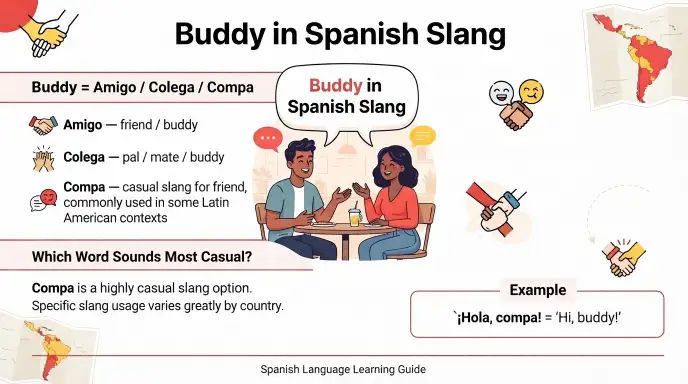
Some common possibilities include:
- Amigo friend / buddy
- Compa buddy / pal
- Cuate buddy / friend
- Pana buddy / pal
- Parce buddy / bro
- Parcero friend / buddy
- Tío dude / mate
- Colega mate / buddy
- Bro bro / buddy
The right word depends on your intended audience.
If you are writing general Spanish and do not know where your reader is from, amigo is usually the safest choice.
If you want to sound more regional and informal, choose an expression associated with the specific Spanishifspeaking community.
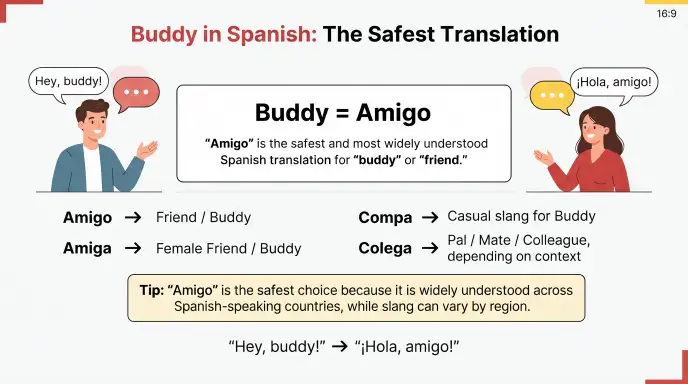
Buddy in Spanish: The Safest Translation
Amigo
The most widely understood option is amigo, which means “friend.”
For example:
Hola, amigo.
“Hey, buddy.”
You could also say:
Gracias, amigo.
“Thanks, buddy.”
Unlike some of the other expressions in this article, amigo is not necessarily slang. It is a standard Spanish word that can sound warm and informal depending on context.
There is also a feminine form:
Amiga
“Female friend” or, depending on context, “girl/buddy.”
For example:
¿Qué pasa, amiga?
“What’s up, buddy?”
If you are learning Spanish and want one word that is unlikely to confuse people, amigo is a practical starting point.
Compa: Buddy in Mexican Spanish Slang
If your search is specifically about buddy in Mexican Spanish slang, compa is one of the most useful expressions to know.
Compa is an informal shortened form associated with words such as compañero and compadre. In everyday informal usage, it can refer to a friend, companion, pal, or buddy.
For example:
¿Qué onda, compa?
“What’s up, buddy?”
Another example:
Mi compa viene mañana.
“My buddy is coming tomorrow.”
You may also hear the plural:
Mis compas
“My buddies” or “my friends.”
What Tone Does Compa Have?
Compa is casual and familiar. It is not normally a formal word you would use with a professor, government official, or someone you have never met in a professional setting.
It works much better between friends or people communicating in a relaxed environment.
You may encounter compa in:
- Mexican conversations
- Text messages
- Social media
- Memes
- Informal videos
- Music and entertainment
- Gaming conversations
However, its exact frequency can vary between regions and social groups.
Cuate: Another Mexican Word for Buddy
Cuate is another informal expression associated particularly with Mexican Spanish.
It can refer to a friend, buddy, or companion.
For example:
Él es mi cuate.
“He’s my buddy.”
Or:
¿Qué pasó, cuate?
“What’s up, buddy?”
The word has a more regional feel than amigo. If you are learning Spanish from different countries, you may encounter it frequently in Mexican content but less often elsewhere.
This is an important point about Spanish slang: a word can be perfectly natural in one country and much less common in another.
Pana: Buddy or Pal
Pana is another informal word that can mean “buddy,” “pal,” or “friend” in several Latin American varieties of Spanish.
For example:
Gracias, pana.
“Thanks, buddy.”
Or:
Ese es mi pana.
“That’s my buddy.”
The word is particularly associated with informal speech in countries and communities where pana is established local slang.
Because regional usage varies, it is better to understand pana as a regional informal expression rather than assume that every Spanish speaker uses it in exactly the same way.
Parce: Buddy in Colombian Spanish Slang
If you are interested in Colombian slang, parce is one of the most important words to recognize.
Parce is a very informal Colombian expression used for a friend, buddy, pal, dude, or bro depending on context.
For example:
¿Qué más, parce?
“What’s up, buddy?”
Another example:
Gracias, parce.
“Thanks, buddy.”
You may also come across parcero and parcera.
These expressions are strongly associated with Colombian informal speech, so using parce can give a sentence a distinctly Colombian flavor.
Is Parce the Same as Amigo?
Not exactly.
Both can refer to a friend, but parce is much more informal and regional.
Think of the difference as something like:
amigo → friend
parce → buddy / bro / mate
The exact English equivalent changes with context.
Tío: Buddy in Spanish From Spain
One of the most recognizable informal expressions in Spain is tío.
Its literal meaning is “uncle,” but in informal Spanish from Spain, tío can also be used to address a guy in a way similar to “dude,” “mate,” or “buddy.”
For example:
Oye, tío, ¿qué haces?
“Hey, buddy, what are you doing?”
You may also hear:
Gracias, tío.
“Thanks, mate.”
For a woman, tía can be used in similar informal contexts:
Oye, tía, escucha.
“Hey, girl/buddy, listen.”
Context is important because tío can still have its literal family meaning.
For example:
Mi tío vive en Madrid.
“My uncle lives in Madrid.”
But:
Oye, tío.
“Hey, dude/buddy.”
The second example is informal address rather than a reference to a family member.
Colega: A Casual Word for Buddy
Colega is another useful informal expression, particularly in Spain.
Depending on context, it can mean a colleague, associate, friend, or mate.
For example:
Es un buen colega.
“He’s a good buddy.”
Or:
Gracias, colega.
“Thanks, mate.”
Compared with highly regional slang, colega may feel somewhat more straightforward. It is often used when talking about someone you know or spend time with.
Bro: Modern Internet Slang
Spanishifspeaking internet users also use English slang.
One common example is bro.
For example:
Gracias, bro.
“Thanks, buddy.”
Or:
¿Qué haces, bro?
“What are you doing, bro?”
This kind of mixediflanguage slang is especially easy to encounter in:
- Gaming
- Discord
- TikTok
- YouTube comments
- Group chats
- Texting
- Memes
However, bro is borrowed from English. It should not be confused with traditional Spanish slang.
If your goal is to learn regional Spanish, expressions such as compa, parce, or pana can teach you more about local speech patterns.
Buddy in Spanish Slang by Country
| Country/Region | Common informal option | Approximate meaning |
| Mexico | Compa | Buddy / pal |
| Mexico | Cuate | Buddy / friend |
| Colombia | Parce | Buddy / bro |
| Colombia | Parcero | Friend / buddy |
| Several Latin American regions | Pana | Buddy / pal |
| Spain | Tío | Dude / mate |
| Spain | Colega | Mate / buddy |
| General Spanish | Amigo | Friend / buddy |
| Online/international | Bro | Bro / buddy |
This table is only a practical guide. Spanish slang is not limited by national borders, and individual speakers may use expressions differently.
Is Buddy in Spanish Slang Rude or Offensive?
In most situations, the Spanish expressions discussed here are not inherently rude or offensive.
Words such as:
- amigo
- compa
- pana
- parce
- cuate
- colega
can be friendly and casual.
However, tone and context matter.
The English word “buddy” itself demonstrates this. Compare:
“Thanks, buddy!”
with:
“Listen, buddy.”
The first usually sounds friendly. The second can sound irritated or confrontational.
Spanish informal expressions can work in a similar way. A normally friendly word can sound sarcastic or annoyed when spoken aggressively.
That means you should pay attention not only to the word but also to:
- The speaker’s tone
- The relationship between the people
- The surrounding sentence
- The situation
- Regional usage
Why Spanish Slang Changes by Region
One reason learners find Spanish slang confusing is that Spanish is spoken across a huge geographic area.
Mexico, Colombia, Spain, Argentina, Chile, Venezuela, Peru, Puerto Rico, and other Spanishifspeaking communities have their own informal vocabulary.
A word can become popular because of:
- Local culture
- Music
- Television
- Social media
- Regional history
- Youth culture
- Migration
- Internet communities
This is why asking for “the Spanish word for buddy” without specifying a country can produce several correct answers.
There is a difference between translation and natural usage.
A dictionary may tell you that amigo means “friend,” but it cannot always tell you which slang expression a teenager in Mexico, Colombia, or Spain would naturally use with a close friend.
When Should You Use Amigo Instead of Slang?
If you are not sure which regional expression is appropriate, choose amigo.
It is useful when:
- You are speaking with someone from an unknown Spanishifspeaking country.
- You are learning basic Spanish.
- You want to avoid sounding like you are copying regional slang.
- You are writing for a broad Spanishifspeaking audience.
- You want a friendly but understandable expression.
For example:
Gracias, amigo.
is much less regionifspecific than:
Gracias, parce.
The second immediately sounds more Colombian.
When Should You Avoid Regional Slang?
Regional slang is best used when you understand the community that uses it.
Avoid forcing slang when:
- You do not know what it means.
- You are in a formal situation.
- You are writing a professional message.
- You are speaking with someone you have just met.
- You are unsure if the expression is appropriate in that country.
In formal Spanish, standard words are usually a better choice.
For example, instead of using tío in a formal email, you would normally address the person appropriately by name or title.
Real:Life Examples of Buddy in Spanish Slang
Friendly Tone
¡Hola, amigo! ¿Cómo estás?
“Hey, buddy! How are you?”
This is friendly and easy to understand.
Mexican Casual Tone
¿Qué onda, compa?
“What’s up, buddy?”
This has a distinctly casual Mexican feel.
Colombian Casual Tone
¿Qué más, parce?
“What’s up, buddy?”
This is highly informal and associated with Colombian speech.
Spanish Casual Tone
Gracias, tío.
“Thanks, buddy/mate.”
This sounds natural in an informal Spain context.
Online Tone
Gracias, bro.
“Thanks, bro.”
This is especially natural in casual online communication among people comfortable with Englishifinfluenced slang.
Talking About a Friend
Él es mi compa.
“He’s my buddy.”
Here, the speaker is describing the relationship rather than directly addressing the person.
Buddy vs Similar Spanish Slang
| English idea | Spanish option | Main difference |
| Friend | Amigo | General and widely understood |
| Buddy | Compa | Casual, strongly associated with Mexico |
| Buddy | Cuate | Informal, especially Mexican |
| Pal | Pana | Regional Latin American slang |
| Bro | Parce | Strongly associated with Colombia |
| Mate | Tío | Informal Spain usage |
| Mate | Colega | Casual friend/associate, especially Spain |
| Bro | Bro | Englishifinfluenced internet slang |
The most important takeaway is that these are approximate equivalents, not exact replacements in every sentence.
Why People Use These Slang Words
People use slang because it can make communication feel more relaxed and personal.
Compare:
Hola, amigo.
with:
¿Qué onda, compa?
Both can be friendly, but the second carries more regional personality.
Slang can communicate:
- Friendship
- Familiarity
- Humor
- Local identity
- Group membership
- Informal attitude
- Cultural connection
This is one reason slang is so common in social media and everyday conversations.
Is Buddy Slang Safe for Social Media?
Generally, these expressions are safe for ordinary social media conversations because they are not inherently offensive.
Words such as amigo, compa, pana, parce, cuate, and bro are commonly used informally.
Still, context matters.
A word that is friendly among friends may not be appropriate in a professional post or formal customerifservice interaction.
If you are creating public content for a worldwide audience, amigo is easier for everyone to understand than a highly regional expression.
For a countryifspecific audience, however, regional slang can make content feel more authentic.
FAQs About Buddy in Spanish Slang
Q1. What is “buddy” in Spanish slang?
There is no single universal answer. Common options include compa, pana, parce, cuate, tío, colega, and bro, depending on the country and context.
Q2. What is the most common Spanish word for buddy?
Amigo is the safest general word because it is widely understood throughout Spanishifspeaking communities.
Q3. How do Mexicans say buddy?
Mexican informal Spanish commonly uses expressions such as compa and cuate for a buddy or friend.
Q4. What does “parce” mean?
Parce is a very informal Colombian expression that can mean buddy, friend, bro, dude, or pal depending on context.
Q5. Does “tío” mean buddy in Spanish?
In informal Spanish from Spain, tío can be used like “dude,” “mate,” or “buddy.” Literally, however, tío means “uncle.”
Q6. Can I say “bro” in Spanish?
Yes. Bro is used by some Spanish speakers, especially in informal online communication. It is borrowed from English rather than being traditional Spanish slang.
Conclusion
The meaning of buddy in Spanish slang depends more on region and context than on a single direct translation. If you want a safe and widely understood word, amigo is the easiest choice. If you want a more casual regional expression, you can use compa in Mexican contexts, parce in Colombian contexts, pana in several Latin American communities, or tío and colega in informal Spanish from Spain.
Online conversations add another layer because Spanishifspeaking users may also use Englishifinfluenced words such as bro.
The key is not to memorize one translation and use it everywhere. Instead, learn which expressions belong to which communities and pay attention to tone. That will help you understand what native speakers actually mean when they use casual language.
So, if someone asks, “What is buddy in Spanish slang?”, the most accurate answer is: there are several natural options, and the right one depends on who is speaking, where they are from, and how informal the conversation is.
More Topics to Explore!

I’m Dylan Foster, a slang and internet culture writer passionate about exploring how people communicate online and in everyday conversations. I write about texting abbreviations, social media expressions, and modern slang to help readers understand meanings, origins, and real-world usage in a simple way.