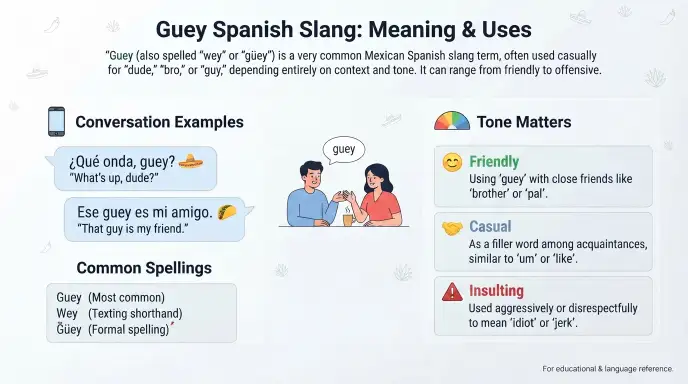
If you have watched Mexican movies, YouTube videos, TikTok clips, or Spanishiflanguage conversations, you may have heard someone say “güey” repeatedly. It is one of those expressions that can be confusing for Spanish learners because its meaning is not always obvious from a direct translation.
Sometimes güey sounds friendly, almost like “dude” or “bro.” In another situation, however, it can refer to someone as foolish or The tone and context make a big difference.
The spelling can also create confusion. You may see guey, güey, wey, or wey online. These forms are closely associated with the same Mexican slang expression, although güey is the standard spelling that most clearly shows the intended pronunciation.
In this guide, we will explain what guey Spanish slang means, where it comes from, how Mexicans use it in everyday conversation, and when you should if or should not if use it yourself.
Quick Answer Guey Spanish Slang:
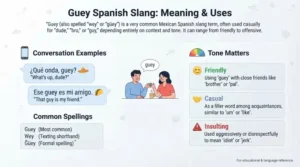
Guey (usually written güey) is Mexican Spanish slang used casually to address a friend, person, or sometimes even a stranger. In English, it can be similar to “dude,” “bro,” or “man”Its meaning depends heavily on tone. Among friends, güey can sound friendly and playful, while in an angry conversation it can sound insulting or disrespectful.
For example:
“¿Qué onda, güey?” = “What’s up, dude?”
“No seas güey.” = “Don’t be
So, guey Spanish slang is not limited to one English translation. Its meaning changes according to the speaker, relationship, and situation.
What Does Guey Mean in Spanish Slang?
The simplest way to understand güey is to think of it as a very informal way of referring to another person.
Depending on the situation, it may translate as:
- Dude
- Bro
- Man
- Guy
- Buddy
- Mate
- Fool
- Idiot
The last two meanings can sound insulting, so context matters.
For example, if two close friends say:
“Güey, vamos a comer.”
It could naturally mean:
“Dude, let’s go eat.”
But if someone says:
“¡Eres un güey!”
the expression may be much closer to:
“You’re an idiot!”
The word itself does not automatically tell you if the speaker is being friendly or rude. Tone, relationship, and context determine the meaning.
Güey as “Dude” or “Bro”
Among friends, güey is often used as a casual form of address.
For example:
“Güey, ¿viste el partido?”
Meaning:
“Dude, did you see the game?”
Here, there is no serious insult. It functions much like informal English words such as dude or bro.
Güey as “Guy” or “Person”
In some contexts, güey can refer to another person rather than directly addressing them.
For example:
“Ese güey trabaja aquí.”
Depending on context, this could mean:
“That guy works here.”
The exact English translation depends on the tone of the conversation.
Güey as an Insult
The expression can also be negative.
For this reason, Spanish learners should avoid assuming that güey always means “friend.”
Güey vs. Guey vs. Wey vs. W ey
One of the biggest questions surrounding this slang is spelling.
You may encounter several versions online:
| Spelling | What it is | Common context |
| güey | Commonly recognized spelling | Mexican Spanish |
| guey | Simplified spelling without the diaeresis | Informal writing |
| wey | Very common internet/texting form | Social media and messages |
| we | Extremely shortened informal form | Some online conversations |
The spelling güey is especially useful when learning the word because the ü helps indicate how the letters are pronounced in Spanish.
Online, however, spelling is often much less consistent. People may type wey because it is faster and easier on a keyboard.
So if you see “wey” on social media, do not automatically assume it is a completely different slang word. It is often an informal spelling of güey.
Where Does Güey Come From?
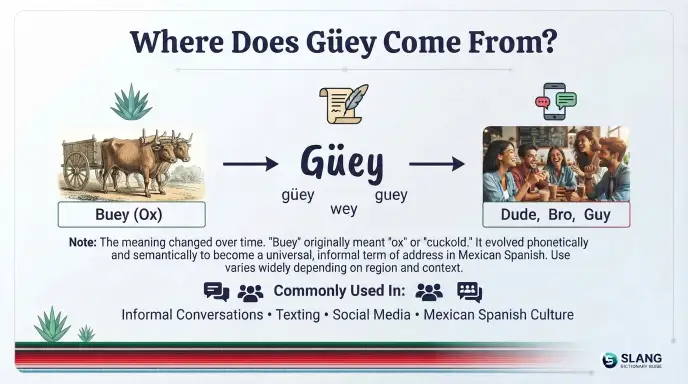
The history of güey is closely connected with the Spanish word buey, meaning “ox.” The modern slang form developed through changes in pronunciation and usage over time.
The original word buey has a literal meaning connected with an ox. Cambridge, for example, defines buey as an ox and also records traditional expressions involving the word.Over time, the expression developed a figurative association with a foolish or easily deceived person. From there, Mexican informal speech transformed its use further.
This is an important part of understanding guey Spanish slang: the modern word does not simply function as a literal translation of buey. Its everyday Mexican meaning has developed considerably.
From Insult to Everyday Address
Language changes when people use words repeatedly in social situations.
A term that once carried a negative meaning can become less offensive when used between friends. This is similar to how some English speakers use words such as “dude” or “man” in casual conversation.
As güey became increasingly common in Mexican speech, it developed into a flexible conversational word.
Today, it can be friendly, humorous, annoyed, or insulting depending on how it is delivered.
Is Güey a Bad Word?
Not necessarily.
This is one of the most important things to understand about guey Spanish slang.
Güey is very informal, but it is not automatically a swear word every time someone uses it.
Among close friends, it may be completely normal:
“Güey, ¿qué haces?”
This might simply mean:
“Dude, what are you doing?”
However, saying it to a stranger, teacher, boss, customer, or someone you need to show respect toward can sound inappropriate.
When Güey Can Sound Friendly
Güey can sound friendly when:
- Close friends use it with each other
- The conversation is relaxed
- The speaker uses a playful tone
- The people already have an informal relationship
When Güey Can Sound Offensive
It can become offensive when:
- The speaker is angry
- It is directed at a stranger
- It is combined with insults
- The tone is aggressive
- It is used in a formal setting
This is why simply memorizing “güey = dude” is not enough.
How Is Güey Used in Everyday Mexican Spanish?
Güey can appear at different points in a sentence.
It can be used to get someone’s attention:
“Güey, escucha.”
“Dude, listen.”
It can express surprise:
“¡Güey! ¿En serio?”
“Dude! Seriously?”
It can express frustration:
“Güey, ya te dije.”
“Man, I already told you.”
It can be used casually between friends:
“Vamos, güey.”
“Come on, dude.”
Notice how the basic word stays the same while the emotional meaning changes.
Common Guey Spanish Slang Examples
Here are some natural examples to help you understand the expression in context:
| Spanish phrase | Natural English meaning | Tone |
| ¿Qué onda, güey? | What’s up, dude? | Friendly |
| Güey, mira esto. | Dude, look at this. | Casual |
| No seas güey. | Don’t be | Critical |
| Ese güey es mi amigo. | That guy is my friend. | Informal |
| ¡Güey, no puede ser! | Dude, no way! | Surprised |
| Vamos, güey. | Come on, man. | Casual |
| ¿Qué haces, güey? | What are you doing, dude? | Depends on tone |
These examples show why direct translation can be misleading. Güey is highly contextifdependent.
Is Güey Used on TikTok, Instagram, and Social Media?
Yes. You may encounter variations such as güey and wey in informal digital conversations, especially when people are communicating casually.
The expression fits naturally into:
- TikTok comments
- Instagram captions and comments
- Text messages
- YouTube comments
- Memes
- Gaming chats
- Casual conversations
- Mexican social media communities
Online, wey is particularly easy to spot because users often remove accents or special characters when typing quickly.
However, seeing wey online does not mean it is appropriate in every situation. Digital communication is usually more informal than professional communication.
Why Do People Search for “Guey Spanish Slang”?
Many Spanish learners encounter güey before they formally learn it.
They may see:
“No mames, güey.”
or:
“Qué onda, wey?”
and wonder if the person is being friendly or insulting.
The confusion happens because English does not have one word that perfectly matches all uses of güey.
Depending on the situation, an English speaker might choose:
dude → bro → man → guy → buddy → fool → idiot
That flexibility is what makes the expression interesting—and sometimes difficult for beginners.
Is Güey the Same as “Dude”?
Not exactly, but “dude” is often a useful English equivalent.
Both expressions can be used casually between friends. However, güey has its own cultural and linguistic history within Mexican Spanish.
Consider this comparison:
| Expression | General feeling | Formal? |
| Güey | Very informal | No |
| Dude | Informal | No |
| Bro | Very informal | No |
| Man | Informal | Usually no |
| Friend | Neutral | Yes/No |
| Señor/Señora | Respectful | Yes |
The closest translation changes according to context rather than remaining fixed.
When Should You Use Güey?
If you are learning Spanish, it is best to understand güey before trying to use it frequently.
You can recognize it when watching Mexican content, chatting with Mexican friends, or reading informal conversations.
But if you are speaking with someone you do not know well, choose a more neutral form of address.
Better Choices for Formal Situations
Instead of güey, you can use:
- Señor if Mr./Sir
- Señora if Mrs./Ma’am
- Señoritaif Miss
- The person’s name
- A respectful title when appropriate
This is especially important in workplaces, schools, customerifservice situations, and formal introductions.
Quick Comparison: Güey and Similar Slang
| Word | Approximate English meaning | Region/Use |
| Güey | Dude, bro, guy | Strongly associated with Mexico |
| Wey | Dude, bro | Informal spelling |
| Tío | Guy, mate | Common in Spain |
| Pana | Friend, buddy | Used in several Latin American countries |
| Bro | Bro, brother | Widely used internationally |
| Amigo | Friend | General Spanish |
These words should not be treated as perfect equivalents because regional slang differs significantly.
Key Takeaway
Guey Spanish slang, usually written güey, is a highly informal Mexican Spanish expression that can mean “dude,” “bro,” “man,” “guy,” or, in some contexts, “fool” or “idiot.”
Its meaning depends heavily on tone, context, and the relationship between the speakers.
If you hear Mexican speakers saying güey casually, it does not automatically mean they are insulting someone. Among friends, it can simply be a familiar way to address another person.
The safest approach for Spanish learners is to understand its different uses first and avoid using it in formal situations.
How Do You Pronounce Güey?
Güey is commonly pronounced roughly like “way” in English.
The ü is important because it shows that the u is pronounced after g. Without the diaeresis, Spanish spelling rules could make the pronunciation confusing.
You may hear slight differences depending on the speaker, accent, and speed of conversation. In very casual speech, the word can sound shortened or blended with surrounding words.
Güey vs. Wey Pronunciation
In Mexican texting and social media, wey is extremely common. Although the spelling looks different, it is generally used to represent the same slang expression.
For a Spanish learner, these forms are worth recognizing:
| Form | Typical pronunciation | Usage |
| güey | Similar to “way” | Standardiflooking informal spelling |
| guey | Similar to “way” | Informal typing |
| wey | Similar to “way” | Very common online |
| we | Shortened casual form | Extremely informal online speech |
Is Güey Mexican Slang?
Yes. Güey is strongly associated with Mexican Spanish and is one of the most recognizable informal expressions in Mexico.
You may hear it in everyday conversations between friends, especially in relaxed settings.
It can appear in:
- Casual conversations
- Text messages
- Mexican movies and television
- Social media
- Memes
- Gaming chats
- YouTube videos
- Informal online communities
However, Mexican Spanish varies by region and individual speaker. Not every Mexican person uses slang in exactly the same way.
How the Meaning of Güey Changes With Tone
One of the most important lessons for understanding guey Spanish slang is that the same word can communicate completely different attitudes.
Friendly Tone
A friend might say:
“Güey, vamos por unos tacos.”
The expression can sound like:
“Dude, let’s go get some tacos.”
There is no serious insult intended.
Surprised Tone
Someone might react to unexpected news:
“¡Güey! ¿Qué pasó?”
This could mean:
“Dude! What happened?”
Here, güey adds emotion and emphasis.
Annoyed Tone
Now imagine someone saying:
“Güey, ya te dije que no.”
The meaning could be:
“Man, I already told you no.”
The speaker is clearly frustrated.
Insulting Tone
In a hostile conversation, güey can contribute to an insult:
“No seas güey.”
This can mean something like:
So, never judge the meaning of güey from the word alone. Listen to the whole sentence and the speaker’s tone.
Common Phrases With Güey
Learning common expressions is often more useful than memorizing a single translation.
| Mexican Spanish phrase | Approximate English meaning |
| ¿Qué onda, güey? | What’s up, dude? |
| Güey, mira. | Dude, look. |
| No seas güey. | Don’t be |
| Ese güey. | That guy / that dude |
| ¡Güey, en serio! | Dude, seriously! |
| Vamos, güey. | Come on, man. |
| Güey, no puede ser. | Dude, no way. |
| ¿Qué haces, güey? | What are you doing, dude? |
These translations are intentionally approximate because English does not reproduce every shade of meaning.
Güey vs. Amigo: Are They the Same?
No.
Amigo literally means “friend,” while güey is informal slang that can be used when addressing or referring to someone.
For example:
“Él es mi amigo.”
means:
“He is my friend.”
But:
“Ese güey es mi amigo.”
could be understood informally as:
“That dude is my friend.”
The second sentence has a much more casual feel.
This distinction matters because calling someone güey does not necessarily mean that the person is actually your friend.
Güey vs. Chico
Chico generally means “boy,” “young man,” or “guy,” depending on context.
Unlike güey, it is not specifically Mexican slang.
For example:
“Ese chico es muy amable.”
means:
“That guy/boy is very kind.”
It sounds much more neutral than:
“Ese güey…”
So if you are learning Mexican Spanish, it is useful to understand both neutral vocabulary and informal slang.
Common Mistakes Spanish Learners Make With Güey
Assuming Güey Always Means “Dude”
This is probably the most common mistake.
Although “dude” is often a useful translation, it does not cover every situation.
Depending on context, güey can be friendly, dismissive, humorous, annoyed, or insulting.
Using It With Everyone
Another mistake is using güey with strangers simply because you heard Mexican speakers using it with friends.
Informal expressions depend on relationships.
A phrase that sounds perfectly normal between close friends may sound disrespectful when directed at someone you have just met.
Using It in Professional Situations
Avoid using güey in formal conversations unless you have a very clear understanding of the social relationship and local speech style.
For example, it is generally safer to avoid it when speaking with:
- A customer
- A teacher
- A manager
- A government official
- A professional you do not know
- Someone significantly older whom you have not established an informal relationship with
Thinking “Wey” Is a Completely Different Word
Online, you may see wey instead of güey.
In many cases, wey is simply an informal digital spelling of güey.
This is particularly common because people often leave out accents and special characters while texting.
Why Is Güey So Common?
Güey works well in casual conversation because it can perform several conversational functions.
It can:
- Get someone’s attention
- Add emotion
- Show familiarity
- Express surprise
- Emphasize a statement
- Create a relaxed tone
- Show frustration
This flexibility helps explain why the expression appears so frequently in informal Mexican speech.
It is less about having one fixed dictionary definition and more about how speakers use it socially.
How Native Speakers Understand the Context
Imagine hearing:
“Güey, te tengo una noticia.”
A native speaker does not necessarily translate güey wordifforifword. Instead, they understand the conversational relationship.
It may simply sound like:
“Dude, I’ve got some news for you.”
Now compare:
“Ese güey me mintió.”
Here, the speaker may be referring to:
“That guy lied to me.”
The emotional attitude is different.
This is why context is especially important when studying slang.
Is Güey Appropriate for Spanish Learners?
It can be, but beginners should use it carefully.
If you have Mexican friends who regularly use güey with you, you may eventually use it naturally in similar informal situations.
However, copying slang without understanding its social meaning can lead to awkward situations.
A good strategy is:
Listen → Understand → Notice the context → Then use it naturally.
You do not need to force slang into every Spanish conversation to sound fluent.
Güey in Mexican Pop Culture and Online Language
Mexican slang has become increasingly visible internationally through entertainment and social media.
People outside Mexico may encounter güey through:
- Mexican films
- Television shows
- Music
- TikTok
- YouTube
- Memes
- Gaming communities
- Spanishiflearning content
Because online communication is informal, spellings such as wey can appear frequently.
Still, online slang should not automatically be treated as formal Mexican Spanish. Internet communities often create their own shortcuts and spelling variations.
What Is the Difference Between Güey and Wey?
For practical purposes, güey and wey are usually understood as variants of the same Mexican slang expression.
The major difference is spelling and context.
Güey is a more recognizable written form for someone learning Spanish, while wey is extremely common in casual digital communication.
You may also see guey without the diaeresis.
| Form | Best way to understand it |
| Güey | Common informal Mexican Spanish spelling |
| Guey | Informal spelling variation |
| Wey | Common texting/socialifmedia form |
| Dude | Useful English translation in friendly contexts |
Should You Say “Güey” Yourself?
If you’re a learner, there is no need to rush.
First become comfortable recognizing it when you hear or read it.
If you eventually use it, remember that it is very informal. Use it with people and in situations where casual Mexican Spanish is appropriate.
When you are unsure, choose neutral Spanish instead.
That simple rule will prevent most awkward situations.
Frequently Asked Questions About Guey Spanish Slang
Q1. What does güey mean in Spanish slang?
Güey is Mexican Spanish slang that can mean “dude,” “bro,” “man,” “guy,” or, depending on context, “fool” or “idiot.”
Q2. Is güey a bad word?
Not always. Between friends, güey can be friendly and casual. In an angry or insulting context, however, it can sound offensive.
Q3. Is guey the same as wey?
In most informal contexts, guey and wey are alternative spellings of the same slang expression commonly written güey.
Q4. Is güey only used in Mexico?
It is particularly associated with Mexican Spanish. You may encounter it elsewhere because of Mexican media and online communication, but its strongest cultural association is with Mexico.
Q5. Can I call my Mexican friend güey?
If your friend normally uses informal Mexican slang and the relationship is casual, it may be perfectly natural. However, avoid assuming that every Mexican speaker wants to be addressed this way.
Q6. Does güey mean “idiot”?
It can, but that is not its only meaning. Among friends, it can simply mean “dude” or “bro.” Tone and context determine the intended meaning.
Q7. How do you pronounce güey?
It is commonly pronounced roughly like “way” in English. The spelling güey indicates that the u is pronounced.
Conclusion
Guey Spanish slang, more commonly written güey, is one of the most recognizable informal expressions in Mexican Spanish. Although learners often translate it simply as “dude” or “bro,” its actual meaning is more flexible.
In a friendly conversation, güey can show familiarity and sound completely natural between friends. In another situation, the same word can express frustration or even contribute to an insult. That is why tone, context, and the relationship between speakers are essential when interpreting it.
You may also encounter guey and wey, especially in texting and social media. These spellings are commonly used to represent the same expression.
For Spanish learners, the best approach is to recognize güey first and use it carefully. It is informal slang, not a universal replacement for “friend” or “person.” Once you understand how native speakers use it in real conversations, its meaning becomes much easier to recognize.

I’m Dylan Foster, a slang and internet culture writer passionate about exploring how people communicate online and in everyday conversations. I write about texting abbreviations, social media expressions, and modern slang to help readers understand meanings, origins, and real-world usage in a simple way.