TW usually means “Trigger Warning” in text messages and online posts. It alerts people that the content coming next may be sensitive, upsetting, disturbing, or emotionally difficult.
You may see TW before a message, caption, video, or comment on TikTok, Snapchat, Instagram, WhatsApp, or other online spaces. For example, “TW: violence” tells readers that the following content discusses or shows violence.
People search for TW meaning in text because these two letters can be confusing without context. In some situations, TW can have another meaning, so the words around it matter. Dictionary.com, for example, lists “trigger warning” as a meaning of TW, while also listing other meanings outside this online context.
If you are new to internet abbreviations, the easiest way to remember it is simple: TW = Trigger Warning when it appears before potentially sensitive content.
TW Meaning in Text
In texting and social media, TW means “Trigger Warning.” It is an abbreviation used as a quick notice before content that some people may find upsetting or difficult to see or read.
Cambridge Dictionary describes a trigger warning as a statement placed before material that may be particularly upsetting, especially for people who have experienced something similar.
For example:
“TW: accident photos”
This tells the reader that the next part of the post may contain accidentifrelated material.
Another example is:
“TW: grief and loss”
Here, the writer is giving readers a headsifup before discussing a difficult subject.
Is TW Slang, an Acronym, or an Abbreviation?
TW is best described as an abbreviation for “trigger warning.” It is also commonly called an internet acronym or online shorthand because people use the shortened form in digital communication.
Unlike slang words that describe a feeling, person, or action, TW works more like a label.
It usually appears before the sensitive topic rather than as part of a normal sentence.
For example:
- “TW: blood”
- “TW: bullying”
- “TW: death”
- “TW: medical procedure”
- “TW: abuse”
The purpose is to give the reader information before they continue.
What Does TW Mean in Everyday Chat?
In everyday chat, TW can mean that the sender is about to discuss something emotionally difficult or potentially disturbing.
Imagine a friend wants to tell you about a serious accident. Instead of immediately sending graphic details, they might write:
“TW: accident if I saw something upsetting today.”
The TW gives you a moment to decide if you want to continue.
It does not automatically mean something terrible is about to happen. The actual topic following the warning explains what the reader should expect.
TW vs. CW
You may also see CW, which means “Content Warning.”
The two terms are closely related, but they are not always used in exactly the same way. Cambridge defines a content warning as a notice that some people may find the material upsetting or offensive.
Online communities can use TW and CW differently. In casual social media use, however, people may treat them as similar warning labels.
Where People Use TW
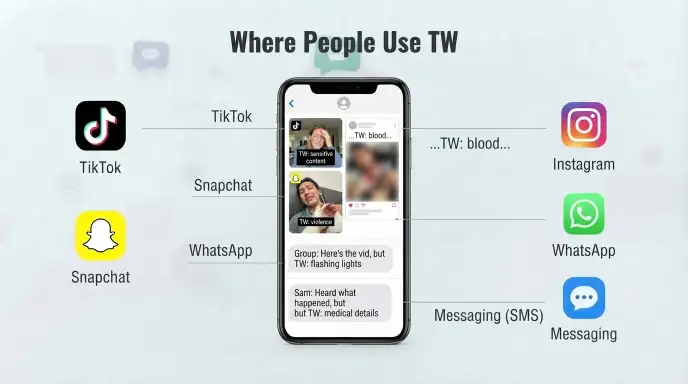
TW is common in online communication because short labels are easy to recognize and place before a post or message.
You may encounter it on TikTok, Snapchat, Instagram, WhatsApp, and ordinary text messages.
TW on TikTok
On TikTok, TW can appear in captions, text overlays, comments, or descriptions before a sensitive subject.
For example:
“TW: medical procedure”
The creator is signaling that viewers may see or hear something related to that topic.
TikTok content moves quickly, so a short warning can help viewers understand what a video contains before they continue watching. TW is commonly reported in TikTok captions, hashtags, and text overlays.
You might also see formats such as:
- “TW: blood”
- “TW // grief”
- “TW: injury”
- “TW: eating disorder discussion”
The exact formatting can vary.
TW on Snapchat
On Snapchat, TW may appear in a private chat, Story, or message before someone shares sensitive information.
For example:
“TW before you open this snap if hospital stuff.”
The sender is giving the other person a quick warning.
Because Snapchat conversations are often informal, the wording may be very casual.
TW on Instagram
Instagram users may put TW in captions, Stories, comments, or messages.
For example:
“TW: discussion of loss.”
This tells followers that the post contains emotionally difficult material.
Someone might also write:
“TW: needlesif skip this Story if you don’t like medical images.”
The warning lets the audience make their own choice about if to continue.
TW on WhatsApp
On WhatsApp, TW is often used in group chats or private conversations.
For example:
“TW: I’m going to talk about the accident.”
A friend might also send:
“TWif hospital photo in the next message.”
This is particularly useful when someone knows that a group contains people who may not want to see unexpected sensitive material.
TW in SMS or Regular Texting
TW can also appear in ordinary SMS messages.
For example:
“TW: I’m about to explain what happened at the funeral.”
The meaning does not change simply because the message is a regular text instead of a social media post.
The surrounding context is still the best clue.
Real Chat Examples of TW
The following examples show how TW can naturally appear in conversations.
Example 1: Sensitive News
A: TW: accident. I just heard what happened to Mark.
B: Thanks for warning me. Is he okay?
A: He’s in the hospital, but his family says he’s stable.
Example 2: Medical Photo
A: TW: blood. I’m sending the photo the doctor gave me.
B: Thanks for letting me know. I’ll skip the picture.
Example 3: Talking About Grief
A: TW: griefif today would have been my dad’s birthday.
B: I’m really sorry. Take care of yourself today.
Example 4: Social Media Post
A: TW: bullying. This video talks about something that happened at my school.
B: I appreciate the warning. I’ll watch it when I have time.
Example 5: Group Chat
A: TW: injury in the next picture.
B: Okay, I’m going to pass on that one.
A: No problem.
Example 6: Difficult Personal Story
A: TW: breakup. I need to tell you what happened last night.
B: You can tell me. I’m listening.
Example 7: Scary Content
A: TW: scary image. Don’t open the next snap if you’re sensitive to this stuff.
B: Good call 😂 I’ll skip it.
Example 8: Mental Health Discussion
A: TW: mental health discussion. I’ve been having a rough week.
B: I’m here if you want to talk.
Example 9: News Discussion
A: TW: violence. The article includes some disturbing details.
B: Thanks. I’ll decide if to read it.
Example 10: Friendly Warning
A: TW: spiders 😭
B: NOPE. I’m not opening that.
A: I knew you’d say that 😂
These examples show an important point: TW does not tell you exactly how to feel. It simply gives you information before the content appears.
How to Reply When Someone Says “TW”
There is no single correct response to TW.
Your reply depends on what follows the warning and how close you are to the person.
If the topic is serious, a calm and respectful response usually works best.
Funny Replies
For a harmless or playful warning, you can respond casually:
- “I’m already scared 😂”
- “Okay, I’m prepared.”
- “Oh no, what am I about to see?”
- “TW received 😭”
- “I’m backing away slowly.”
Use humor only when the situation is clearly lighthearted.
Casual Replies
If a friend sends a normal warning, you could say:
- “Got it.”
- “Okay, thanks.”
- “Thanks for the warning.”
- “I’ll skip that part.”
- “Okay, I’m ready.”
These are simple and natural.
Friendly Replies
When someone is sharing something personal, a warmer response may be better:
- “Thanks for letting me know.”
- “I’m here if you want to talk.”
- “Take your time.”
- “You can tell me when you’re comfortable.”
- “I appreciate the headsifup.”
Neutral Replies
If you are unsure how serious the conversation is, keep your answer neutral:
- “What’s the warning for?”
- “What kind of content is it?”
- “Thanks for the headsifup.”
- “Should I skip the next message?”
- “Okay, I understand.”
You do not have to continue reading or watching simply because someone gave you a TW.
Is TW Rude or Offensive?
TW itself is not normally rude or offensive. It is generally used as a warning before potentially upsetting material.
In fact, the purpose is usually to give readers more control over what they choose to view or read.
Cambridge describes trigger warnings as advance statements about content that some people may find particularly upsetting.
Is TW Safe to Use?
Yes, TW is generally safe to use when you genuinely want to warn someone about sensitive material.
For example:
“TW: graphic injury.”
That is clear and useful.
A good warning should ideally tell people what type of content is coming. Simply writing “TW” without explaining the topic may leave the reader confused.
Is TW Appropriate at School?
It can be appropriate in schoolifrelated online discussions, depending on the situation and the school’s communication style.
If you are sharing material about violence, abuse, death, or another sensitive subject, a clear warning can help readers understand what they are about to encounter.
For formal school work, however, follow your teacher’s or institution’s preferred style.
Is TW Appropriate at Work?
In professional communication, clarity matters more than internet slang.
Instead of relying only on “TW,” you may want to write:
“Content warning: the following report contains descriptions of a serious accident.”
That is clearer for a mixed audience and sounds more professional.
TW is familiar online, but not every coworker will interpret it in exactly the same way.
Who Uses This Term?
TW is especially visible in online communities where people share personal experiences, serious discussions, news, educational material, or potentially upsetting images.
You may encounter it among younger internet users, including Gen Z, but it is not limited to one age group.
People use the abbreviation because it is short, recognizable, and easy to place before a post.
Gen Z and TW
Gen Z users often communicate through short forms, abbreviations, and platformifspecific language.
TW fits naturally into that style because two letters can communicate the basic purpose without taking up much space.
You may see:
“tw: blood”
instead of:
“Warning: the following post contains an image of blood.”
The shorter version is quicker to type and easy to understand for people familiar with online conventions.
Where Is TW Most Common?
You can encounter TW in:
- TikTok posts
- Instagram captions
- Snapchat Stories
- WhatsApp chats
- Text messages
- Reddit discussions
- Discord communities
- Online forums
- Blogs and personal posts
The meaning is usually clear when TW appears directly before a sensitive topic.
How Often Does TW Appear Online?
There is no single reliable number that tells us how often every platform uses TW.
Its visibility depends heavily on the community and the kind of content being discussed. A casual meme account may rarely use it, while a community focused on personal experiences or difficult subjects may use it much more often.
Origin of the Term
The abbreviation TW comes from the phrase “trigger warning.”
The phrase itself has a documented history going back to the 1990s. Dictionary.com lists its first recorded use as 1990–95 and identifies TW as the related abbreviation.
The word “trigger” has a more specific meaning in discussions of trauma. Cambridge explains that a trigger can be something that causes a strong emotional reaction because it reminds someone of a previous bad experience.
Over time, the phrase became more familiar in online communication.
The growth of blogs, forums, social media, and communityifbased platforms gave people simple ways to label sensitive material before sharing it. Dictionary.com notes that TW was added as an abbreviation for trigger warning in a 2021 dictionary update.
Today, TW is widely recognized in online communication, although its exact use can differ between communities.
Why Did Internet Culture Adopt TW?
Internet communication often happens between people who do not know each other personally.
A reader may have no idea what is coming next in a post.
A short warning solves part of that problem.
Instead of forcing everyone to encounter the material unexpectedly, the writer can place a label before it:
“TW: violence”
The reader can then decide if to continue.
That simple choice is one reason warning labels became useful in online communities.
Does TW Always Mean Trigger Warning?
No.
Context still matters.
Dictionary.com lists TW as “trigger warning” in American English and also lists tw as an abbreviation for Taiwan in another usage.
Other websites and contexts may use TW for different phrases.
For example, if someone writes:
“I’ll finish it TW.”
the intended meaning may not be “trigger warning.”
But if you see:
“TW: blood”
or
“TW: abuse”
the intended meaning is very likely “trigger warning.”
Look at the words immediately around the abbreviation before deciding what it means.
TW, IDK, IDC, IMO, and BRB Compared
These abbreviations all appear in digital communication, but they do very different jobs.
| Term | Meaning | Type | Usage | Popularity |
| TW | Trigger Warning | Abbreviation | Warns about sensitive content | Common online |
| IDK | I Don’t Know | Initialism | Shows uncertainty or lack of knowledge | Very common |
| IDC | I Don’t Care | Initialism | Shows indifference | Very common |
| IMO | In My Opinion | Initialism | Introduces a personal view | Very common |
| BRB | Be Right Back | Initialism | Says someone will return soon | Common |
The biggest difference is that TW usually works as a content label, while IDK, IDC, IMO, and BRB function more directly inside a conversation.
For example:
“IDK what happened.”
expresses uncertainty.
“IMO, that movie was better.”
expresses an opinion.
“BRB, getting food.”
tells someone the person is temporarily leaving.
But:
“TW: blood.”
does not express the sender’s opinion. It warns the reader about what comes next.
Real:World Usage Example
Imagine that a student is working on a presentation about road safety.
They want to show an image from a real accident scene. The image may be useful for the lesson, but it could also be upsetting to some classmates.
Before showing it, the student might say:
“TW: graphic accident image. You can look away if you don’t want to see it.”
In this situation, TW is being used as a quick warning.
The same idea can happen online.
A person may want to share a personal story about grief, illness, violence, or another difficult experience. Instead of beginning the story without notice, they may write:
“TW: grief and death.”
Readers now have context before continuing.
This is the main idea behind TW: give people a headsifup before potentially sensitive content.
Frequently Asked Questions
Q1: What does TW mean in text messages?
TW most commonly means “Trigger Warning.” It tells the reader that the following message may contain sensitive, upsetting, or difficult content.
Q2: What does TW mean on TikTok?
On TikTok, TW usually means “Trigger Warning.” It may appear before sensitive material in a caption, video, comment, or text overlay.
Q3: Is TW slang?
TW is better described as an abbreviation or online shorthand for “trigger warning” rather than traditional slang.
Q4: Is TW rude or offensive?
No. TW is generally a neutral warning label. It is commonly used to alert people before potentially upsetting content.
Q5: How should you reply to TW?
A simple response such as “Thanks for the warning” works well. If the subject is serious, respond respectfully and avoid making light of it.
Conclusion
So, what does TW mean in text? In most online conversations, it means “Trigger Warning.” It is used before potentially sensitive or upsetting content so readers know what they may encounter.
You can see TW on TikTok, Instagram, Snapchat, WhatsApp, text messages, forums, and other online platforms. The abbreviation is especially useful when someone is discussing difficult subjects or sharing material that some people may prefer to avoid.
TW is generally not rude or offensive. However, context still matters, because the letters can have other meanings in different situations. If the abbreviation appears before a sensitive topic such as “TW: violence” or “TW: grief,” the intended meaning is usually clear.
The easiest rule to remember is simple: TW = Trigger Warning when it is used as a label before sensitive content. When you’re unsure, read the surrounding words before deciding what the abbreviation means.

I’m Dylan Foster, a slang and internet culture writer passionate about exploring how people communicate online and in everyday conversations. I write about texting abbreviations, social media expressions, and modern slang to help readers understand meanings, origins, and real-world usage in a simple way.