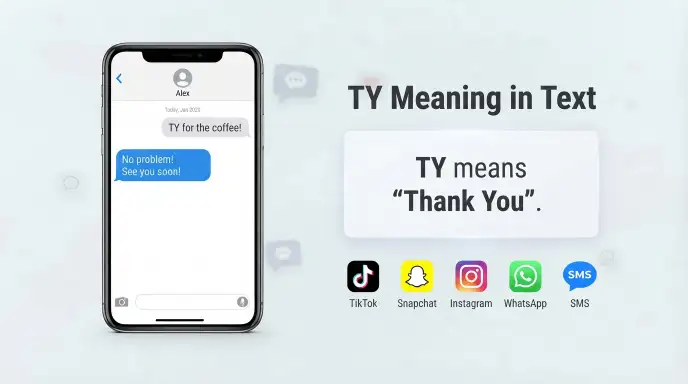
TY means “thank you” in text messages and online chats. It is a short, informal abbreviation people use to show appreciation or gratitude. You may see it on TikTok, Snapchat, Instagram, WhatsApp, gaming chats, and regular text messages.
If someone sends you “TY” after you help them, answer a question, or share something useful, they are simply saying thank you. It is usually friendly, polite, and quick.
People often search for the meaning because internet conversations are full of shortened words and abbreviations. Two letters can sometimes look confusing when you see them without knowing the context.
Once you know what TY means, though, it is quite simple. In most everyday digital conversations, there is no hidden meaning behind it.
TY Meaning in Text
The most common meaning of TY is “thank you.” People use it as a quick way to express gratitude without typing the complete phrase.
For example:
A: I sent you the notes from class.
B: TY!
The second person is simply saying, “Thank you!”
TY is especially useful when the conversation is moving quickly. Instead of typing two complete words, someone can type two letters and communicate the same basic message.
Current slang and texting references consistently identify TY as an informal abbreviation or initialism for “thank you.”
Is TY Slang, an Acronym, or an Abbreviation?
TY is commonly described as an internet abbreviation, texting abbreviation, or initialism.
It is formed from the first letters of:
- T = Thank
- Y = You
Technically, TY is better described as an initialism because the letters represent the beginning of separate words. However, everyday websites and social media users may simply call it slang or texting slang.
You do not need to worry too much about the terminology. If someone types “TY,” the practical meaning is what matters:
TY = Thank You
What Does TY Mean in Everyday Chat?
In everyday conversation, TY usually expresses appreciation for something another person has done or said.
Someone might use it after:
- Receiving help
- Getting an answer
- Receiving a compliment
- Getting information
- Receiving a file or photo
- Being given directions
- Getting a recommendation
- Receiving a favor
- Having a question answered
- Getting support
For example:
“I found the address for you.”
“TY!”
Or:
“That explanation finally makes sense.”
“TY 😊”
In both cases, TY means “thank you.”
TY Can Have Different Tones
Although the basic meaning stays the same, the tone can change depending on the conversation.
“TY 😊” can feel warm and friendly.
“TY so much!” sounds more appreciative.
A plain “ty” may simply feel quick and casual.
This does not mean that lowercase “ty” is automatically cold or rude. The surrounding conversation matters more than capitalization alone. Texting references also note that context, punctuation, emojis, and the relationship between the people can affect how a short TY is perceived.
Where People Use TY
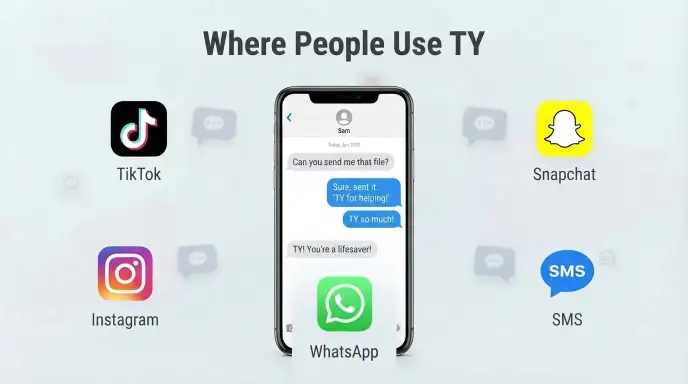
TY can appear across many forms of digital communication. The meaning usually remains the same even when the platform changes.
TY on TikTok
On TikTok, TY can appear in comments, replies, direct messages, or conversations about videos.
Someone may write:
“TY for explaining this!”
That means:
“Thank you for explaining this!”
A creator might also reply “TY!” to someone who compliments their video.
For example:
A: Your tutorial helped me so much!
B: TY! Glad it helped.
TikTok conversations are often fast and informal, so short expressions such as TY fit naturally into the platform’s communication style.
TY on Snapchat
Snapchat is another place where people may use short texting forms.
A friend might send:
“Sent you the picture.”
“TY!”
Here, the meaning is simply “thank you.”
Because Snapchat messages are usually casual and conversational, TY does not normally seem unusual or overly formal.
TY on Instagram
On Instagram, you may see TY in comments, DMs, story replies, or messages.
For example:
“Your outfit looks amazing!”
“TY 😊”
Or:
“TY for sharing my post!”
In these situations, TY is a simple way of showing appreciation.
TY on WhatsApp
WhatsApp conversations often contain abbreviations because people use the app for quick everyday communication.
For example:
A: I sent you the location.
B: TY!
Or:
A: I’ll bring the documents tomorrow.
B: TY, that helps a lot.
The second example shows how TY can also appear at the beginning of a longer message.
TY in SMS and Regular Texting
The same meaning applies to ordinary text messages.
You could receive:
“TY for picking me up.”
This means:
“Thank you for picking me up.”
It is informal, but perfectly understandable in a casual conversation.
TY is not limited to teenagers. Adults also use texting abbreviations, particularly when communicating casually or when a quick response is more convenient.
Real Chat Examples of TY
Seeing the abbreviation in realistic conversations can make its meaning much easier to understand.
Example 1: Getting Help
A: I fixed the WiifFi settings for you.
B: TY!
A: No problem.
Here, TY means “thank you” for solving the problem.
Example 2: Receiving Notes
A: I uploaded today’s class notes.
B: TY, I missed the lecture.
A: Hope they help!
The person is thanking their friend for sharing useful information.
Example 3: Responding to a Compliment
A: Your new profile picture looks great.
B: TY 😊
A: You’re welcome!
Here, TY is a short response to a compliment.
Example 4: Getting Directions
A: Take the second left after the pharmacy.
B: TY! I was completely lost.
A: Haha, you’ll find it.
TY shows appreciation for the directions.
Example 5: Online Gaming
A: I dropped some extra items for you.
B: TY!
A: Grab them before the round starts.
The abbreviation is useful because players often communicate quickly.
Example 6: Instagram DM
A: I shared your post to my story.
B: TY so much!
A: Anytime!
TY is being used to express gratitude for social media support.
Example 7: Snapchat
A: Check your snaps. I sent you the photos.
B: Got them. TY!
A: No worries.
The sender uses TY as a quick thankifyou.
Example 8: A Small Favor
A: I saved you a seat.
B: TY! That’s really nice.
A: Of course.
The abbreviation works naturally as part of a friendly conversation.
Example 9: Answering a Question
A: The store closes at 9 tonight.
B: TY, I’ll go before then.
A: Good idea.
TY acknowledges the useful information.
Example 10: Group Chat
A: I posted the meeting link in the group.
B: TY!
C: Thanks, I needed it too.
This shows how TY can be used in a group conversation as a quick acknowledgment.
How to Reply When Someone Says “TY”
If someone sends you “TY,” you usually do not need a complicated response. The best reply depends on the situation and your relationship with the person.
Funny Replies
If you are joking with a friend, you can make your response playful.
- “You’re very welcome 😎”
- “Anytime, citizen.”
- “I accept payment in snacks 😂”
- “No need to thank me!”
- “You’re welcome, obviously 😄”
These work best when the conversation is already casual.
Casual Replies
For an ordinary conversation, keep it simple.
- “Np!”
- “No problem.”
- “Anytime!”
- “Sure!”
- “Of course.”
- “You got it.”
“Np” itself means “no problem” and is another common texting abbreviation.
Friendly Replies
If you want to sound a little warmer, you can say:
- “You’re welcome 😊”
- “Happy to help!”
- “Anytime!”
- “Glad I could help!”
- “Of course!”
These replies work well with friends, classmates, relatives, and online acquaintances.
Neutral Replies
Sometimes you do not need to continue the conversation.
You can simply reply:
- “You’re welcome.”
- “Sure.”
- “No problem.”
- “Of course.”
Or you may not need to respond at all if the conversation has naturally ended.
Is TY Rude or Offensive?
TY is generally not rude or offensive. It is normally a casual way to say “thank you.”
The important point is that TY is informal. if it is appropriate depends on the situation and the person you are communicating with.
Is TY Safe to Use?
In casual texting, TY is generally safe to use.
For example, it is perfectly natural to write:
“TY for the help!”
to a friend.
It can also be used in casual social media conversations and online communities.
Is TY Appropriate at School?
For casual messages with classmates, TY is usually understandable and acceptable.
However, if you are writing a formal school assignment, essay, application, or official email, writing “Thank you” is a better choice.
For example:
Casual:
“TY for sending the homework.”
More formal:
“Thank you for sending the homework.”
The second version is more appropriate for formal communication.
Is TY Appropriate at Work?
It depends on the workplace and the type of message.
In a quick internal chat with a colleague, TY may be perfectly understandable.
For example:
“TY for sending the report.”
But in a formal email to a client, manager, professor, or professional contact, writing “Thank you” usually creates a more polished tone.
This is not because TY is offensive. It is simply because abbreviations tend to be more informal.
Who Uses This Term?
TY is used by people who communicate through texting, social media, online communities, and other digital platforms.
Teenagers and Young Adults
You may see TY frequently in casual conversations among younger internet users because short forms make quick communication easier.
However, it would be misleading to assume that only Gen Z uses it. Digital abbreviations have been used across different age groups for years.
Gen Z Usage
Gen Z commonly communicates through short messages, social media comments, DMs, group chats, and other fastifmoving online spaces.
TY fits naturally into that environment because it reduces a twoifword expression to two letters.
That said, TY is not exclusively a Gen Z expression. It is a broadly understood texting abbreviation.
Common Platforms
You can encounter TY on:
- TikTok
- Snapchat
- SMS
- Discord
- Gaming chats
- Online forums
- Direct messages
The meaning is usually unchanged across these platforms.
How Often Does TY Appear Online?
TY is a wellifestablished texting abbreviation rather than a brandifnew trend. Current reference sources describe it as a common way to say “thank you” in digital communication.
You may see it alone, such as:
“TY!”
or as part of a longer message:
“TY for helping me.”
You may also encounter related forms such as TYSM, meaning “thank you so much,” and TYVM, meaning “thank you very much.”
Origin of the Term
The exact moment when TY first became popular is not always clearly documented, but its structure is easy to understand.
It comes from the first letters of “thank you.”
As digital communication became more common, people began shortening frequently used phrases. Typing two letters instead of two words made quick conversations more efficient.
TY belongs to the same general family of online shortcuts as:
- LOL
- BRB
- IDK
- IMO
- IDC
- THX
- TYSM
The rise of texting, instant messaging, online gaming, forums, and social media helped make these short forms familiar to internet users.
Current dictionaryifstyle references identify TY as an internet/textifmessaging initialism meaning “thank you.”
Did Social Media Create TY?
Not necessarily.
TY is connected to the broader development of digital shorthand rather than being a term created specifically by TikTok or Instagram.
Social media helped keep short forms visible because users communicate quickly through comments, DMs, posts, and group conversations.
So if you see TY on TikTok today, that does not mean TikTok invented the expression.
Why Do People Shorten “Thank You”?
There is a simple reason: convenience.
When someone already understands the conversation, writing:
“TY!”
can be faster than:
“Thank you!”
The shorter version can also match the casual style of a quick conversation.
TY vs. IDK vs. IDC vs. IMO vs. BRB
TY belongs to the larger world of texting abbreviations. The following comparison helps show how it differs from other common forms.
| Term | Meaning | Type | Usage | Popularity |
| TY | Thank You | Initialism / abbreviation | Showing gratitude | Common |
| IDK | I Don’t Know | Initialism / abbreviation | Saying you do not know | Common |
| IDC | I Don’t Care | Initialism / abbreviation | Expressing indifference | Common |
| IMO | In My Opinion | Initialism / abbreviation | Giving an opinion | Common |
| BRB | Be Right Back | Initialism / abbreviation | Temporarily leaving a chat | Common |
These terms serve completely different purposes.
TY expresses gratitude.
IDK communicates uncertainty or lack of knowledge.
IDC expresses that something does not matter to the speaker.
IMO someone’s opinion.
BRB tells another person that the sender is temporarily stepping away.
Learning these common abbreviations can make online conversations much easier to understand.
RealifWorld Usage Example
Imagine you are working on a school project with a friend.
You are missing one page of the assignment, so you message your friend:
You: “Can you send me the last page?”
Friend: “Sure, one sec.”
Friend: “Send it.”
You: “TY! I was missing that part.”
Here, TY is completely natural. You are not trying to sound formal. You simply want to acknowledge your friend’s help.
Now imagine the same situation in a formal email to a teacher:
“Thank you for sending the information.”
In that situation, spelling out “Thank you” is more appropriate.
The difference is not about if TY is bad. It is about matching your language to the setting.
When TY Can Sound Different
The basic meaning of TY remains “thank you,” but the emotional tone can sometimes change.
Consider these examples:
“TY!”
This usually feels quick and positive.
“TY 😊”
This may feel warmer or friendlier.
“TY so much!”
This sounds more appreciative.
“ty”
This can be completely normal in casual texting, especially between people who regularly communicate that way.
“TY.”
Depending on the conversation, the period may make the message feel more formal or slightly more serious, but you should not automatically assume that the sender is annoyed.
Text messages do not contain the same vocal tone and facial expressions as faceiftoifface conversation. That is why context is important when interpreting very short messages.
TY, Thanks, THX, and TYSM
Several expressions can communicate the same basic idea.
TY
Short and casual:
“TY for helping!”
Thanks
A natural everyday expression:
“Thanks for helping!”
THX
Another abbreviated form:
“THX for the info.”
TYSM
A longer abbreviation meaning:
“Thank you so much.”
For example:
“TYSM for the gift!”
The choice depends on personal writing style, the relationship between the people, and the formality of the conversation.
Frequently Asked Questions
Q1. What does TY mean in text messages?
TY usually means “thank you.” It is a short, informal abbreviation used to express appreciation in texts and online chats.
Q2. What does TY mean on TikTok?
On TikTok, TY usually means “thank you.” People may use it in comments, replies, captions, or messages when showing appreciation.
Q3. Is TY slang?
TY is commonly treated as internet slang or a texting abbreviation. More precisely, it is an initialism formed from “thank you.”
Q4. Is TY rude or offensive?
No. TY is generally not rude or offensive. It is simply informal, so “thank you” is usually better for formal school or workplace communication.
Q5. How should you reply to TY?
You can reply with “You’re welcome,” “No problem,” “Anytime,” “Of course,” or “Np.” Choose a response that matches the tone of the conversation.
Conclusion
TY means “thank you” in text and online conversations. It is a short, informal way to show gratitude when someone helps you, gives you information, compliments you, or does something kind.
You can see TY on TikTok, Snapchat, Instagram, WhatsApp, SMS, gaming chats, and other online platforms. Its basic meaning usually stays the same, although the tone can depend on the surrounding conversation.
TY is generally friendly and safe for casual communication. However, if you are writing a formal email, school assignment, application, or professional message, spelling out “thank you” is usually the better choice.
Once you know the meaning, there is no need to overthink a message such as “TY!” In most everyday chats, it simply means someone is saying thanks.

I’m Dylan Foster, a slang and internet culture writer passionate about exploring how people communicate online and in everyday conversations. I write about texting abbreviations, social media expressions, and modern slang to help readers understand meanings, origins, and real-world usage in a simple way.