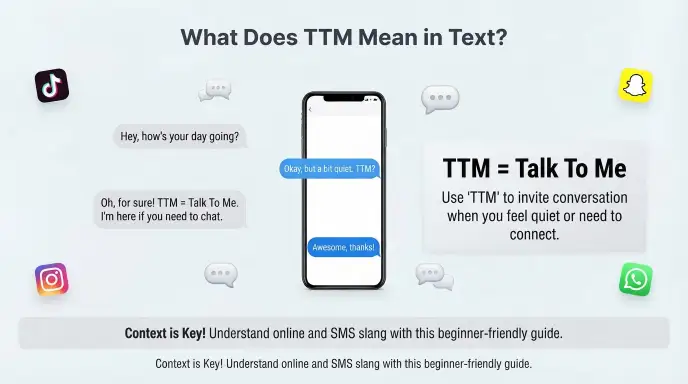
TTM usually means “Talk To Me” in text messages and social media. People use it to invite someone to chat, continue a conversation, explain something, or simply respond. You may see it in texts, DMs, TikTok comments, Snapchat, Instagram, or WhatsApp.\
If you receive a message like “TTM when you’re free” or “You seem quiet today, TTM,” the sender is generally asking you to talk. The expression is short, casual, and easy to type.
People often search for ttm mean in text because abbreviations can be confusing when they appear without context. The same three letters can also have different meanings outside casual texting, so understanding the conversation around them is important.
if you saw TTM in a private message, socialifmedia comment, or group chat, this guide explains what it means, how people use it, how to reply, and when it may not be appropriate.
TTM Meaning in Text
In everyday texting, TTM usually means “Talk To Me.” It is an informal abbreviation used when someone wants another person to start talking, keep a conversation going, or share something.
For example:
“You’ve been quiet all day. TTM.”
This simply means:
“You’ve been quiet all day. Talk to me.”
TTM can be used in several slightly different situations. Someone might want casual conversation, ask you to explain something, check on you, or encourage you to open up.
Is TTM Slang, an Acronym, or an Abbreviation?
TTM is best described as a texting abbreviation or initialism rather than a traditional slang word.
The letters come from the first letters of:
- T = Talk
- T = To
- M = Me
People shorten the phrase because it is quicker to type. Similar texting shortcuts include IDK, IDC, IMO, and BRB.
Some people may casually call TTM “slang,” especially when discussing internet language. That is understandable, but technically, it is more accurate to call it an abbreviation or initialism.
What Does TTM Mean in Everyday Chat?
In a normal conversation, TTM is usually an invitation to communicate.
For example:
“I’m bored. TTM.”
The person probably wants someone to chat with.
Another example is:
“TTM when you get home.”
Here, the sender is asking the person to talk after getting home.
The exact feeling can change depending on the situation. TTM may sound friendly, caring, curious, playful, or even slightly impatient.
Compare these:
“TTM 😊”
This may feel friendly or playful.
“Why are you ignoring me? TTM.”
This can sound more serious or demanding.
So, the letters themselves are simple. The surrounding conversation determines the tone.
Can TTM Mean “Text To Me”?
In some conversations, people may use TTM to mean “Text To Me.” However, this is less common in ordinary texting than “Talk To Me.”
Context usually makes the intended meaning clear.
For example:
“I can’t talk right now. TTM later.”
In a conversation specifically about sending messages, the sender could mean “Text To Me.”
But:
“You seem upset. TTM.”
almost certainly means “Talk To Me.”
If you are unsure, look at the words before and after TTM rather than assuming the abbreviation always has one meaning.
Where People Use TTM
TTM is mainly found in informal digital communication. It can appear in private conversations, group chats, comments, captions, and direct messages.
The meaning generally stays close to “Talk To Me,” even when the platform changes.
TTM on TikTok
On TikTok, TTM may appear in comments, direct messages, captions, or conversations between users.
For example:
“You look sad today. TTM.”
The person is inviting the other user to talk about what is going on.
TikTok conversations can move quickly, so short expressions like TTM fit naturally into informal comments and messages.
However, TTM is not an official TikTok term. It is simply an abbreviation that users can type on the platform.
TTM on Snapchat
Snapchat is another place where you may see TTM.
A friend might send:
“Bored rn, TTM.”
That means:
“I’m bored right now, talk to me.”
Depending on the relationship, TTM on Snapchat can also sound playful or slightly flirty. The abbreviation itself does not automatically indicate romantic interest.
The sender’s words, emojis, and relationship with you provide the context.
TTM on Instagram
On Instagram, TTM can appear in DMs, comments, or captions.
For example:
“Haven’t talked in forever. TTM?”
Here, the person is inviting a conversation.
Someone could also write:
“TTM about your trip!”
That means they want you to tell them about your trip.
TTM on WhatsApp
WhatsApp users may use TTM in private chats and group conversations.
A simple message could be:
“Are you free tonight? TTM.”
The abbreviation keeps the message short while making the invitation clear.
Because WhatsApp is commonly used for both casual and family communication, the tone of TTM can vary widely depending on who sends it.
TTM in SMS Text Messages
Traditional SMS texting can also contain TTM.
For example:
“TTM when you’re done with work.”
This is simply a shorter version of “Talk to me when you’re done with work.”
Unlike formal business language, texting often uses abbreviations because people want to communicate quickly.
Real Chat Examples of TTM
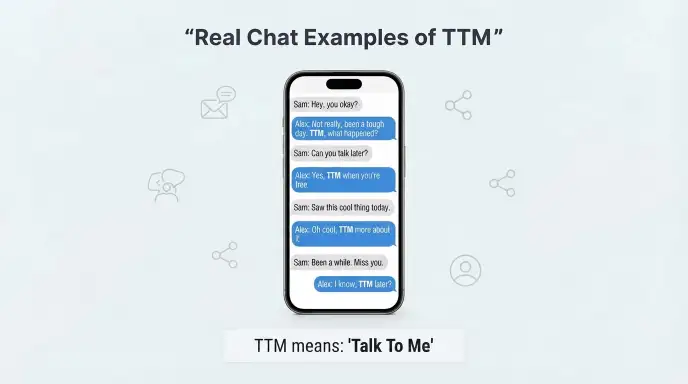
The best way to understand TTM is to see it in realistic conversations.
Example 1: Casual Conversation
A: What are you doing?
B: Nothing, just watching TV.
A: TTM, I’m bored.
B: Haha, okay. What do you want to talk about?
Here, TTM clearly means “Talk To Me.”
Example 2: Checking on a Friend
A: You seem different today.
B: I’m just tired.
A: TTM if something is bothering you.
B: Thanks. I appreciate that.
In this situation, TTM sounds supportive.
Example 3: Wanting Details
A: You won’t believe what happened at school.
B: Wait, what happened?
A: It’s a long story.
B: TTM! I want to hear it.
Here, TTM means “Talk to me” or “Tell me about it.”
Example 4: Making Plans
A: Are you free later?
B: Probably after 8.
A: TTM then?
B: Sure, I’ll message you.
The abbreviation is being used to keep the conversation open.
Example 5: Reconnecting
A: We haven’t talked in ages.
B: I know! I’ve been so busy.
A: TTM sometime this week.
B: Definitely.
This sounds friendly and relaxed.
Example 6: Asking Someone to Open Up
A: I’m fine. Don’t worry.
B: You don’t seem fine.
A: It’s nothing.
B: TTM. You can tell me.
Here, TTM has a caring tone.
Example 7: Snapchat Chat
A: Your story looked fun 😂
B: It was!
A: TTM about it later.
B: Okay, I’ll tell you everything.
The phrase asks for more conversation.
Example 8: Instagram DM
A: Hey, long time no talk.
B: Seriously!
A: TTM when you’re free.
B: I’m free now actually.
This is a straightforward invitation to chat.
Example 9: When Someone Is Quiet
A: Why aren’t you saying anything?
B: Just thinking.
A: TTM if you want to talk.
B: Maybe I will.
This example shows that TTM does not always demand an immediate response.
Example 10: A Playful Message
A: You disappeared again 😂
B: I was busy!
A: Sure you were. TTM later?
B: Fine, fine. I’ll text you later.
The abbreviation makes the conversation feel informal and playful.
How to Reply When Someone Says “TTM”
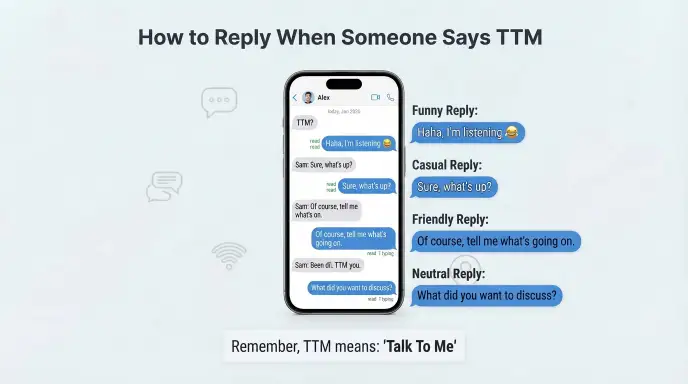
Your response depends on what the person means and how you feel about the conversation.
You do not need a special slang response. A normal sentence is perfectly fine.
Funny Replies
If the conversation is playful, you can answer with humor.
- “Okay, I’m listening 😂”
- “About what? Spill it!”
- “You have my attention now.”
- “Alright, what’s the topic?”
- “I’m here. What happened?”
These work well when you already have a friendly relationship.
Casual Replies
For an everyday conversation, keep it simple.
- “Sure, what’s up?”
- “Yeah, I’m here.”
- “What do you want to talk about?”
- “Okay, tell me.”
- “I’m free now.”
There is no need to copy the abbreviation just because someone else used it.
Friendly Replies
If the sender seems to want emotional support, a warmer response may be appropriate.
- “Of course. What’s going on?”
- “I’m listening.”
- “You can talk to me.”
- “Sure, tell me what happened.”
- “I’m here if you want to talk.”
These replies make the conversation feel open without being overly formal.
Neutral Replies
If you are unsure what the person means, ask directly.
- “Do you mean talk now?”
- “Sure. What’s up?”
- “What did you want to discuss?”
- “I can talk later if that works.”
- “Can you tell me what you mean?”
A neutral response is especially useful when the context is unclear.
Is TTM Rude or Offensive?
TTM is generally not a rude or offensive expression. It is normally a casual way to invite conversation.
However, the tone can change depending on how it is written.
For example:
“TTM when you’re free.”
sounds relaxed.
But:
“TTM NOW.”
can sound demanding.
The difference is not necessarily the abbreviation itself. Capital letters, punctuation, timing, and the relationship between the people can affect how the message feels.
Is TTM Safe to Use?
TTM is generally fine for casual communication with people who understand texting abbreviations.
You might use it with:
- Friends
- Family members
- Classmates
- Online friends
- People you regularly message
Still, it is better to consider the situation before using it.
Is TTM Appropriate at School?
In a casual message to a friend or classmate, TTM can be perfectly understandable.
For formal school communication, however, writing the complete phrase is clearer.
Instead of:
“TTM about the assignment.”
you could write:
“Can we talk about the assignment?”
The second version is more appropriate when messaging a teacher or writing an academic message.
Is TTM Appropriate at Work?
TTM is usually better kept out of formal workplace communication unless you already know the workplace culture is very casual.
A professional message such as:
“Please talk to me when you have a moment.”
is clearer than:
“TTM.”
Formal communication benefits from complete words and clear requests.
Who Uses This Term?
TTM is used by people who communicate through texting and social media, particularly in informal conversations.
There is no reliable universal statistic showing exactly how frequently every age group uses TTM. Slang databases generally describe it as an abbreviation used by teenagers and adults, while current texting references show it appearing across social platforms and messaging apps.
Gen Z Usage
You may encounter TTM in conversations involving Gen Z users because short forms are common in digital communication.
That does not mean every Gen Z user uses TTM. Internet slang varies from person to person, country to country, and platform to platform.
Common Platforms
TTM can appear on:
- TikTok
- Snapchat
- SMS
- Facebook Messenger
- Other messaging platforms
Its basic meaning generally stays the same across these platforms.
How Often Does TTM Appear Online?
TTM is recognizable as a texting abbreviation, but it is not useful to describe it as something that appears at a fixed frequency everywhere online.
Different slang sites classify it differently, and there is no single public database that measures every use across private messages and social platforms.
So if you see TTM occasionally, that is normal. Its meaning is more important than trying to determine a universal usage rate.
Origin of the Term
The exact first use of TTM as a texting abbreviation is not clearly documented.
The expression likely developed from the broader culture of shortening phrases in online chats and SMS communication. Early internet and mobile messaging encouraged users to turn common phrases into shorter forms.
Abbreviations such as BRB, IDK, and TTYL became familiar examples of this style of communication. TTM fits the same general pattern: a familiar phrase becomes a short group of letters that can be typed quickly.
Current references consistently identify “Talk To Me” as the main texting meaning of TTM.
Socialifmedia platforms later gave these abbreviations more places to appear. Messaging, comments, DMs, and group chats all make short expressions convenient.
It is important not to claim a specific website or person invented TTM unless reliable historical evidence supports that claim. The available references do not establish one definitive inventor.
TTM vs. IDK vs. IDC vs. IMO vs. BRB
TTM belongs to the wider family of texting abbreviations, but each shortcut has a different purpose.
| Term | Meaning | Type | Usage | Popularity |
| TTM | Talk To Me | Texting abbreviation | Inviting someone to talk | Commonly recognized |
| IDK | I Don’t Know | Texting abbreviation | Showing uncertainty | Very common |
| IDC | I Don’t Care | Texting abbreviation | Showing lack of concern | Common |
| IMO | In My Opinion | Texting abbreviation | Giving an opinion | Common |
| BRB | Be Right Back | Texting abbreviation | Temporarily leaving a chat | Very common |
These terms are not interchangeable.
For example:
“IDK what happened.”
means:
“I don’t know what happened.”
But:
“TTM about what happened.”
is asking someone to talk about it.
Likewise:
“IMO, the movie was good.”
expresses an opinion, while:
“BRB.”
tells someone the sender is temporarily stepping away.
Understanding the full phrase behind each abbreviation makes text conversations much easier to follow.
Real:World Usage Example
Imagine two friends have been messaging after school.
One friend notices that the other has been unusually quiet.
Friend 1: You haven’t said much today. Is everything okay?
Friend 2: Thanks. I’ll tell you what happened.
In this situation, TTM is not being used as a joke or complicated piece of slang. It is simply a short way to say, “Talk to me if you want to talk about it.”
This example also shows why context matters. The same three letters can feel casual in one conversation and more emotionally serious in another.
If someone writes “TTM 😂,” the tone may be playful.
If someone writes “TTM. Are you okay?” the tone may be supportive.
The abbreviation stays the same, but the surrounding message changes how it is understood.
Frequently Asked Questions
Q1. What does TTM mean in text messages?
TTM usually means “Talk To Me.” It is an informal abbreviation used when someone wants you to chat, reply, or continue a conversation.
Q2. What does TTM mean on TikTok?
On TikTok, TTM generally means “Talk To Me.” It can appear in comments, DMs, captions, or casual conversations.
Q3. Is TTM slang?
TTM is more accurately described as a texting abbreviation or initialism, although people often group it with internet slang.
Q4. Is TTM rude or offensive?
No. TTM is generally casual rather than rude or offensive. However, “TTM NOW” may sound demanding depending on the context.
Q5. How should you reply to TTM?
You can reply naturally with “Sure, what’s up?” or “I’m listening.” If you are unsure what the sender means, simply ask what they want to discuss.
Conclusion
So, what does ttm mean in text? In most casual conversations, TTM means “Talk To Me.” It is a short texting abbreviation used to invite someone to chat, continue a conversation, explain something, or open up.
You may see TTM on TikTok, Snapchat, Instagram, WhatsApp, SMS, and other messaging platforms. The basic meaning usually stays the same, although the tone can change depending on the conversation.
TTM is normally casual and not offensive. It works well in friendly chats, but complete words are usually a better choice for school, work, or other formal communication.
When you see TTM, look at the surrounding message before deciding exactly what the sender means. In most cases, the context will make the intended meaning clear.

I’m Dylan Foster, a slang and internet culture writer passionate about exploring how people communicate online and in everyday conversations. I write about texting abbreviations, social media expressions, and modern slang to help readers understand meanings, origins, and real-world usage in a simple way.