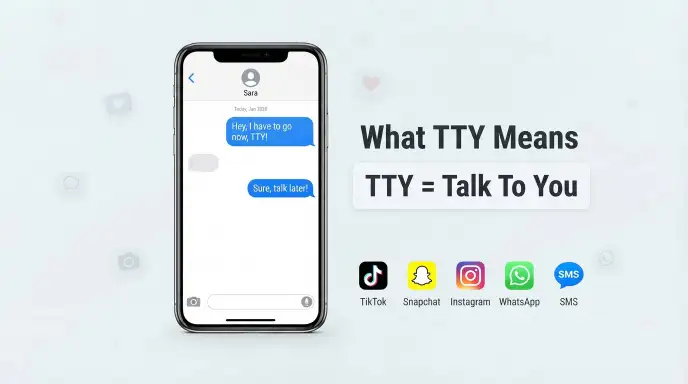
TTY usually means “Talk To You” in text messages and casual online chats. People use it as a short, informal way to end or pause a conversation, especially when they plan to talk again. You may see it in texting, TikTok, Snapchat, Instagram, WhatsApp, or other online chats.
If you received a message such as “I have to go now, tty,” the person is simply saying that they need to leave the conversation. It does not normally carry a negative meaning.
People search for tty mean in text because the abbreviation can be confusing. TTY is also used in technology and accessibility contexts, where it can mean “teletypewriter.” The context tells you which meaning is intended.
In everyday texting, however, TTY means “Talk To You.” It is casual shorthand rather than formal English, so it is most natural in conversations with friends, family, or other people you already communicate with informally.
TTY Meaning in Text
The tty mean in text is usually “Talk To You.” It is a short texting abbreviation made from the first letters of the words Talk, To, and You.
For example:
“I need to finish my homework. TTY!”
This means:
“I need to finish my homework. Talk to you!”
The sender is not necessarily promising a specific time. They are simply ending or pausing the current conversation while suggesting that they will communicate again.
What Does TTY Stand For?
TTY breaks down very simply:
| Letter | Word |
| T | Talk |
| T | To |
| Y | You |
So, TTY = Talk To You.
It is sometimes used on its own, but it can also appear with extra words that make the meaning clearer.
Examples include:
- “TTY later.”
- “TTY tonight.”
- “TTY tomorrow.”
- “Busy rn, tty!”
- “Gotta go, tty soon.”
The added words provide information that TTY itself does not provide.
For example, “TTY tomorrow” gives a clearer idea of when the person expects to communicate again.
Is TTY Slang, an Acronym, or an Abbreviation?
TTY is best described as an informal texting abbreviation or initialism.
People often casually call it slang because it belongs to online and texting language, but it is more precise to call it an abbreviation or initialism. Each letter represents the beginning of a word in the phrase “Talk To You.”
It is similar to other common digital shortcuts such as:
- IDK I Don’t Know
- IDC I Don’t Care
- IMO In My Opinion
- BRB Be Right Back
- TTYL Talk To You Later
TTY is informal, so you would normally use it in casual digital communication rather than formal writing.
What Does TTY Mean in Everyday Chat?
In everyday conversation, TTY usually works like a quick goodbye.
Someone might write:
“My bus is here, tty!”
They are saying they need to leave the chat because their bus has arrived.
Another person might write:
“I have class now. TTY later.”
Here, the sender is pausing the conversation and indicating that they expect to talk again.
The exact tone depends on the surrounding message. A friendly message can make TTY feel warm and casual, while a very short message can sometimes sound abrupt. That does not mean the abbreviation itself is rude.
TTY vs. TTYL
TTY : “Talk To You.”
TTYL means “Talk To You Later.”
The word “later” is explicitly included in TTYL. With TTY, the timing may be left unstated.
For example:
“I have to go. TTY!”
This simply means “Talk to you.”
But:
“I have to go. TTYL!”
More directly means “Talk to you later.”
That small difference can matter when interpreting a message.
Where People Use TTY
TTY can appear in many forms of casual digital communication. The meaning generally stays the same, although the style may change depending on the platform.
TTY on TikTok
On TikTok, TTY may appear in comments, direct messages, or casual conversations between users.
For example:
“I gotta finish this assignment, tty later!”
The meaning is simply that the person is leaving the conversation and expects to communicate again.
TikTok language changes quickly, so abbreviations can have different meanings in specialized communities. If TTY appears in a technical video or discussion, check the surrounding context before assuming it means “Talk To You.”
TTY on Snapchat
Snapchat is built around quick conversations, so short expressions and abbreviations fit naturally into its messaging style.
Someone might send:
“Mom wants me downstairs 😭 tty!”
Here, TTY is a casual sign-off.
You might also see:
“Gonna eat, tty soon.”
The sender is saying they are temporarily leaving the chat.
TTY on Instagram
On Instagram, TTY can appear in DMs and other informal conversations.
For example:
“Loved talking to you 😂 tty tomorrow!”
The abbreviation keeps the message short while maintaining a friendly tone.
Instagram also contains educational, business, and technical content. Because TTY has meanings outside texting, context remains important.
TTY on WhatsApp
WhatsApp conversations often contain short forms because people use the app for quick personal chats.
For example:
“Dinner is ready lol, tty!”
Or:
“I’m going to sleep now. TTY tomorrow.”
In both examples, TTY has the casual “Talk To You” meaning.
TTY in SMS Text Messages
Traditional SMS texting is another place where you may see TTY.
A message could look like:
“I’m at work rn. TTY later.”
The sender is simply saying they are busy and will talk again.
Unlike a formal sentence, texting abbreviations allow people to communicate quickly without writing every word.
Real Chat Examples of TTY
Seeing TTY in realistic conversations makes its meaning much easier to understand.
Example 1: Going to Class
A: Are you free to talk?
B: For like five minutes.
A: I have to go to class now. TTY!
B: Okay, talk later!
Here, TTY is a quick way to end the conversation.
Example 2: Dinner Time
A: Did you finish the movie?
B: Not yet.
A: Same 😂
B: Dinner’s ready. TTY later.
A: Sure!
The phrase “later” makes the intended timing clearer.
Example 3: Going to Work
A: Want to keep chatting?
B: I wish lol.
A: Work starts in five minutes. TTY tonight.
B: Sounds good.
TTY is being used with a specific time.
Example 4: Going Home
A: Are you still at the mall?
B: Nope, heading home now.
A: Okay, tty!
B: Byeee!
The conversation ends naturally.
Example 5: Study Time
A: Want to play later?
B: Maybe. I have a test tomorrow.
A: Oh right 😭
B: I need to study. TTY after.
The sender is temporarily leaving the conversation.
Example 6: Friendly Goodbye
A: Thanks for helping me today!
B: Anytime!
A: I’m going to bed now. TTY tomorrow.
B: Good night!
TTY keeps the goodbye casual.
Example 7: Busy at Work
A: Can you talk?
B: Not right now, I’m in a meeting.
A: No worries.
B: TTY when I’m done.
The abbreviation signals that the person cannot continue chatting at the moment.
Example 8: Gaming
A: One more game?
B: I can’t, my battery is almost dead.
A: 😂 TTY later then.
B: Deal!
Here, TTY is part of a relaxed online conversation.
Example 9: Going to Sleep
A: Still awake?
B: Barely lol.
A: Same.
B: I’m going to sleep. TTY tomorrow.
A: Night!
The context makes the meaning obvious.
Example 10: Short Message
A: You free?
B: Not rn.
A: Okay.
B: TTY!
This is a very short, casual sign-off.
How to Reply When Someone Says “TTY”
There is no single correct response to TTY. Your reply can match the tone of the conversation.
Funny Replies
If the conversation is playful, you could answer:
- “Don’t disappear 😂”
- “Okay, mysterious person 😂”
- “TTY when you survive the day!”
- “Fine, I’ll allow it 😭”
- “Later, alligator!”
These replies work best with friends who already understand your humor.
Casual Replies
For an ordinary conversation, keep your response simple:
- “Okay!”
- “Sure!”
- “Talk later!”
- “Sounds good.”
- “Bye!”
You do not need to overthink a short texting abbreviation.
Friendly Replies
If you want to sound warm, you can say:
- “Sure, talk to you later!”
- “Okay, take care!”
- “Talk soon 😊”
- “Have a good day!”
- “Catch you later!”
These responses make it clear that you are comfortable ending the conversation.
Neutral Replies
If you are not very close to the person, a neutral response is usually safest:
- “Okay.”
- “Sure.”
- “No problem.”
- “Talk later.”
- “Take care.”
The best response depends more on the relationship and context than on the abbreviation itself.
Is TTY Rude or Offensive?
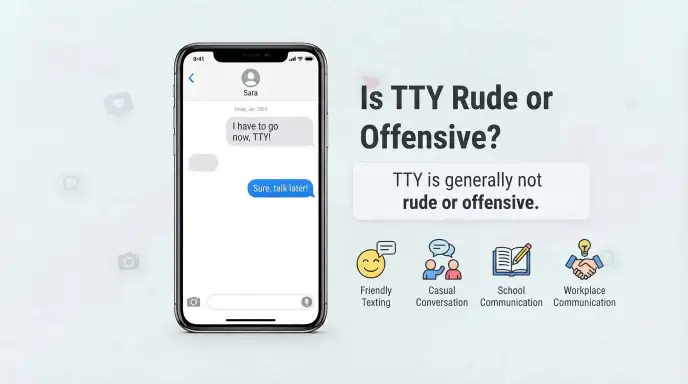
TTY is generally not rude or offensive. It is simply an informal way to say “Talk To You.”
However, tone can depend on the situation.
For example:
“Sorry, I have to go. TTY!”
sounds friendly.
But if someone suddenly sends:
“TTY.”
after a serious conversation, you might wonder whether they are being distant or dismissive.
That does not mean TTY has a rude definition. It simply shows that short messages can sometimes feel different depending on the conversation.
Is TTY Safe to Use?
Yes, TTY is generally safe to use in casual conversations.
It is appropriate when chatting with:
- Friends
- Family
- Online friends
- Classmates you know well
- Gaming friends
- Casual social-media contacts
The important thing is knowing your audience.
Is TTY Appropriate at School?
For casual messaging with a friend or classmate, TTY is usually fine.
For an assignment, essay, presentation, or formal communication with a teacher, it is better to write the complete phrase.
Instead of:
“TTY tomorrow.”
you could write:
“I’ll talk to you tomorrow.”
Clear, complete language is more appropriate for schoolwork.
Is TTY Appropriate at Work?
TTY is usually better avoided in formal workplace communication.
If you are messaging a close coworker through an informal team chat, short forms may sometimes be acceptable depending on the workplace culture.
But in a formal email, client message, application, or professional document, use complete wording.
For example:
“I’ll talk to you later about the project.”
is clearer and more professional than:
“TTY about the project.”
Who Uses This Term?
TTY is associated with casual digital communication, including texting and online chat. It can be used by different age groups, although the exact frequency varies by community and platform.
Teenagers and Young Adults
You may encounter TTY among teenagers and young adults who regularly use texting, DMs, gaming chats, and social media.
However, it is important not to assume that every young person uses the term. Digital language changes constantly, and some abbreviations become less common over time.
Gen Z Usage
Gen Z users frequently communicate with shortened words, abbreviations, emojis, and other forms of digital shorthand.
TTY can fit naturally into that style because it turns “Talk To You” into only three letters.
Still, TTY is not exclusive to Gen Z. Older internet users who are familiar with texting abbreviations may recognize or use it as well.
Common Online Platforms
The abbreviation may appear in:
- Text messages
- TikTok
- Snapchat
- Online chats
- Gaming conversations
- Direct messages
The exact frequency can vary widely. TTY is recognizable as a texting abbreviation, but it is not necessarily one of the most frequently used abbreviations in every online community. Some people may prefer TTYL, “talk later,” or simply “bye.”
Origin of the Term
The texting use of TTY comes from the broader tradition of shortening phrases in digital communication.
People have long used abbreviations to make online conversations faster. Early internet chat and SMS culture encouraged users to reduce longer phrases into short forms.
TTY belongs to the same general family of expressions as TTYL, BRB, and other chat abbreviations.
The exact point at which people first began using TTY as “Talk To You” is not clearly established. Online slang often develops gradually across chat rooms, messaging services, forums, and personal conversations rather than appearing from one identifiable source.
This is also why slang histories can be difficult to trace with complete certainty.
Internet Culture and Shorter Messages
Digital communication encouraged a practical habit: say more with fewer characters.
Typing:
“Talk to you”
takes longer than:
“TTY”
For people having fast conversations, especially on older mobile phones or chat platforms, abbreviations were convenient.
Even though modern phones make typing much easier, the habit of using short forms remains part of online communication.
Why TTY Can Be Confusing
There is another reason the abbreviation sometimes causes confusion: TTY has an older technical meaning.
In telecommunications and accessibility contexts, TTY can refer to a teletypewriter or related text-based telephone communication system. It can also appear in computing contexts with meanings unrelated to texting.
So:
“TTY, I’ll talk to you later.”
is clearly a texting use.
But:
“The phone has TTY accessibility settings.”
is referring to a technical feature.
Context is the key.
TTY vs. IDK, IDC, IMO, and BRB
TTY belongs to a much larger group of internet and texting abbreviations.
| Abbreviation | Meaning | Type | Usage | Popularity |
| TTY | Talk To You | Texting abbreviation | Ending or pausing a casual conversation | Commonly recognized |
| IDK | I Don’t Know | Texting abbreviation | Showing uncertainty or lack of knowledge | Very common |
| IDC | I Don’t Care | Texting abbreviation | Showing indifference | Very common |
| IMO | In My Opinion | Texting abbreviation | Introducing a personal opinion | Very common |
| BRB | Be Right Back | Texting abbreviation | Temporarily leaving a conversation | Very common |
These abbreviations have different jobs.
TTY is mainly connected with talking again or ending a conversation.
IDK is useful when you do not know something.
IDC expresses indifference.
IMO introduces an opinion.
BRB tells someone that you expect to return shortly.
TTY and BRB Are Not the Same
Consider these two messages:
“I need to answer the door. BRB.”
This suggests the person expects to return soon.
Now compare:
“I have to leave for work. TTY later.”
This suggests the current conversation is ending and may continue later.
The difference is small but useful.
TTY and IMO Are Completely Different
IMO means “In My Opinion.”
For example:
“IMO, that movie was great.”
TTY has nothing to do with opinions.
It means “Talk To You.”
Understanding the surrounding sentence usually makes these abbreviations easy to distinguish.
Real-World Usage Example
Imagine two friends are chatting on WhatsApp after school.
One friend says:
“Are you coming to the game tonight?”
The other replies:
“I think so! I have to help my brother first.”
They continue chatting for a few minutes. Then the second friend receives a call from a family member and needs to leave.
They might write:
“Gotta go help him now. TTY tonight!”
The first friend understands that the conversation is ending for the moment, not that anything is wrong.
A simple reply could be:
“Okay, tty later!”
This is a normal example of how TTY can work in everyday digital communication.
The abbreviation saves time without changing the basic meaning of the sentence.
When Should You Avoid Using TTY?
TTY is easy to understand in casual conversations, but there are situations where complete wording is better.
Avoid using it in:
- Formal school assignments
- Academic essays
- Job applications
- Formal business emails
- Official letters
- Professional documents
- Important customer communications
The reason is not that TTY is offensive. It is simply informal.
If your goal is clarity and professionalism, write the full phrase instead.
For example:
Casual:
“I gotta go. TTY!”
Formal:
“I need to leave now. I’ll speak with you later.”
Both communicate a similar idea, but the second is more appropriate for formal writing.
Frequently Asked Questions
Q1. What does TTY mean in text messages?
TTY usually means “Talk To You.” It is an informal abbreviation used to end or pause a casual conversation.
Q2. What does TTY mean on TikTok?
On TikTok, TTY can mean “Talk To You” when it appears in casual chats or comments. Always check the surrounding context.
Q3. Is TTY slang?
TTY is an informal texting abbreviation or initialism. It is often grouped with internet slang because it is commonly used in casual digital communication.
Q4. Is TTY rude or offensive?
No. TTY is generally not rude or offensive. It simply provides a short way to say “Talk To You,” although tone can depend on the conversation.
Q5. How should you reply to TTY?
You can reply with “Okay,” “Talk later,” “Sure,” “Take care,” or another casual goodbye. Match your response to the tone of the conversation.
Conclusion
The tty mean in text is usually “Talk To You.” It is a short, informal abbreviation people use when ending or pausing a conversation and expecting to communicate again.
You may see TTY in text messages, TikTok chats, Snapchat, Instagram, WhatsApp, gaming conversations, and other casual online spaces. The abbreviation is simple, but the surrounding message can provide more information about when the person expects to talk again.
TTY is generally safe and friendly to use with people you know. However, it is better to avoid it in formal schoolwork, professional emails, applications, and other situations where complete English is expected.
One final point is worth remembering: TTY does not always mean “Talk To You.” In telecommunications, accessibility, and some technology contexts, it can refer to a teletypewriter or related technical system.
So when you see TTY, look at the context. In an ordinary text from a friend, “Talk To You” is usually the meaning you are looking for.

I’m Dylan Foster, a slang and internet culture writer passionate about exploring how people communicate online and in everyday conversations. I write about texting abbreviations, social media expressions, and modern slang to help readers understand meanings, origins, and real-world usage in a simple way.