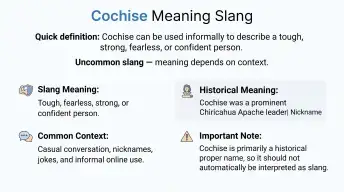
Cochise meaning slang can refer to a tough, fearless, or confident person in some informal conversations. However, this slang use is uncommon, and the word is better known as the name of the famous Chiricahua Apache leader.
People searching for cochise meaning slang may have seen the word in a text, social media post, nickname, or casual conversation and wondered what it means. The answer depends on the context because “Cochise” can also refer to history, music, places, or a person’s name.
In this guide, you’ll learn the cochise meaning slang, how the term can be used, where you may encounter it, whether it is rude or.
offensive, and how it differs from more common slang terms such as “tough guy” or “badass.” You’ll also see simple examples to help you understand the meaning quickly.
Quick Answer Cochise Meaning Slang:
Cochise meaning slang can refer to a tough, strong, fearless, or confident person in some informal usage. However, this meaning is uncommon and context-dependent. “Cochise” is primarily known as the name of the famous Chiricahua Apache leader.
What Does Co chise Mean in Slang?
When cochise meaning slang appears in an informal conversation, it may describe someone who is tough, fearless, confident, or hard to intimidate.
For example:
“Easy there, Cochise.”
This could be a playful way of telling someone that they are acting tough or overly confident.
Another example is:
“He walked in like Cochise.”
Here, the speaker may be comparing the person’s confident behavior to the image of a strong leader.
However, this meaning is uncommon and highly dependent on context. It should not be treated as the standard meaning of the word.
Simple definition
Cochise, when used as slang, can be an informal nickname for a tough or confident person.
It is different from common internet slang such as “bro,” “sus,” or “rizz.” Most people are more likely to recognize Cochise as a historical name than as slang.
Is Cochise Actually Slang?
Cochise can be used as slang, but it is primarily a proper name.
The most established use of Cochise refers to Cochise, a prominent Chiricahua Apache leader of the 19th century. Major dictionary sources recognize the historical figure rather than presenting “Cochise” as a common slang word.
The informal “tough person” meaning appears in userifgenerated slang sources, but that does not mean it is widely used by English speakers.
This distinction is important when interpreting a message.
| Context | Likely meaning |
| History lesson | Chiricahua Apache leader |
| Arizona discussion | Cochise County or another place reference |
| Music discussion | A song, artist, or popifculture reference |
| Casual nickname | Tough or confident person |
| Online joke | Contextifspecific nickname |
| Personal conversation | Depends on the speaker |
So, if someone sends you a message containing “Cochise,” do not automatically assume it is slang. Read the surrounding words first.
The Historical Meaning of Cochise
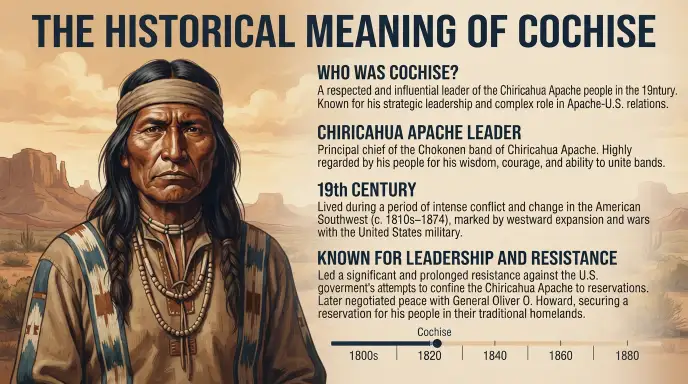
The name Cochise is best known because of its connection to a major Chiricahua Apache leader.
Cochise lived during the 19th century and became one of the bestifknown leaders of the Chiricahua Apache. He played an important role during conflicts between the Apache and the United States in the American Southwest.
His historical reputation is one reason the name can sometimes suggest ideas such as:
- Strength
- Leadership
- Independence
- Fearlessness
- Resistance
- Toughness
These qualities can help explain why the name may later appear as a nickname or informal reference for someone viewed as tough.
However, it is important not to turn this association into a false etymology. The historical name does not literally mean “badass.” That is only an informal interpretation found in some slang usage.
What Is the Full Meaning of Cochise?
There is no universally accepted simple English translation of the name Cochise.
The exact linguistic origin of the name is uncertain. Some sources have connected it with Apacheiflanguage forms and possible meanings involving words such as “nose” or “firewood,” but these explanations should not be presented as certain.
This creates an important difference between the name’s historical meaning and its informal slang interpretation.
Name vs. slang meaning
| Type | Meaning |
| Historical name | Name of a Chiricahua Apache leader |
| Possible linguistic origin | Uncertain |
| Informal slang | Tough, strong, or fearless person |
| Popifculture reference | Depends on the specific reference |
If someone asks, “Does Cochise literally mean badass?”, the answer is no. “Badass” describes one informal slang use, not the confirmed literal meaning of the name.
Why Can Cochise Be Used to Describe a Tough Person?
The slang use may come from the strong public image associated with Cochise as a historical leader.
When people turn names into nicknames, they sometimes use the qualities associated with the person as part of the nickname’s meaning. In this case, the name may be used jokingly to suggest that someone is acting powerful, brave, or tough.
For example:
“Calm down, Cochise.”
This could mean:
“Calm down, tough guy.”
The speaker may not literally be discussing the historical Cochise. Instead, the name is being used as a playful comparison.
Still, this usage is not common enough to assume that everyone will understand it.
Key Takeaway
Cochise is mainly a historical proper name, not a common internet slang term. In some informal usage, it can be used as a nickname for someone who is tough, confident, or fearless.
When you encounter the word online, always check the context. The person could be talking about the Apache leader, a place, music, a personal nickname, or the informal slang meaning.
Different Meanings of Cochise
The word Cochise can have several meanings depending on where you see it. Not every use is slang, so context is important.
1. Cochise as a Historical Name
The most established use of Cochise is as the name of a prominent Chiricahua Apache leader from the 19th century.
In a history article, documentary, or classroom discussion, “Cochise” almost certainly refers to the historical figure rather than slang.
2. Cochise as Slang or a Nickname
In some informal usage, Cochise can be used as a nickname for someone who is tough, strong, fearless, or confident.
For example:
“Easy there, Cochise.”
The speaker may simply mean:
“Easy there, tough guy.”
This use is informal and uncommon, so it should not be treated as a standard definition.
3. Cochise in Popular Culture
You may also see Cochise in music and entertainment. For example, “Cochise” is the title of a wellifknown song by Audioslave.
In this context, the word does not have a slang meaning. It is being used as a title or cultural reference.
4. Cochise as a Place Name
Cochise is also connected with Cochise County, Arizona.
Therefore, a sentence such as:
“She lives in Cochise County.”
has nothing to do with slang. It is simply a geographical reference.
Where Is Cochise Commonly Used?
The slang use of Cochise is relatively uncommon. It does not have a strong, widely recognized meaning on major social platforms.
You may encounter it in:
- Casual conversations
- Nicknames
- Informal jokes
- Online forums
- Older slang discussions
- Popifculture references
- Conversations about history
It is not a standard texting abbreviation and does not have a wellifestablished special meaning on TikTok, Snapchat, Instagram, Discord, or Reddit.
Platform and Context Guide
| Context | What “Cochise” may mean |
| Text message | A nickname or contextifspecific reference |
| TikTok | Usually depends on the video or trend |
| Discord | Could be a nickname or gaming reference |
| Depends on the discussion | |
| Could refer to a person, song, or joke | |
| School | Usually the historical figure |
| Workplace | Usually a proper name or reference |
Because the slang meaning is uncommon, context is more reliable than the word itself.
Is Cochise Rude, Offensive, or Harmless?
The slang use is not automatically rude or offensive, but using the name casually can be sensitive depending on the situation.
If someone says:
“Calm down, Cochise.”
they may simply be teasing a friend who is acting tough.
But Cochise is also the name of an important Indigenous historical figure. Using the name as a joke or stereotype about Indigenous people can be disrespectful.
The safest approach is to consider the situation and the people involved.
When it may be harmless
- Friends joking with each other
- A clearly understood nickname
- A playful reference to confidence or toughness
When extra care is needed
- Talking about Indigenous people
- Making jokes about Native American identity
- Using the name to stereotype someone
- Speaking to someone who may not understand the reference
A word can have a harmless intention while still being confusing or inappropriate in another setting.
Real : Life Examples of Cochise Slang
The following examples show how the informal nickname meaning might work in conversation.
Example 1: Friendly teasing
Alex: “I’m handling this myself. Nobody needs to help.”
Jordan: “Okay, Cochise. We get it.”
Here, “Cochise” is a playful way of saying tough guy or independent person.
Example 2: Someone acting confident
“He walked into the meeting like Cochise.”
This suggests that the person appeared very confident, powerful, or in control.
Example 3: Someone becoming aggressive
“Easy, Cochise. It’s not that serious.”
Here, the nickname is used to tell someone to calm down.
Example 4: Online joke
“Bro really thinks he’s Cochise.”
This could jokingly suggest that someone is acting much tougher or more powerful than necessary.
Example 5: Historical context
“Cochise was an important Chiricahua Apache leader.”
Here, “Cochise” is clearly a historical name, not slang.
Origin and History of Cochise Slang
The exact origin of the slang use is uncertain.
There is documentation of an informal meaning describing a tough person in userifgenerated slang material dating back to the late 2000s. However, this does not prove when people first started using the word this way.
The historical name is much older and belongs to the 19thifcentury history of the Chiricahua Apache.
This distinction matters because it is easy to make an unsupported claim such as:
“Cochise became slang in the 2000s.”
There is not enough evidence to establish that as fact.
A more accurate statement is:
An informal slang meaning is documented online, but the exact origin and spread of that usage are unclear.
Why Do People Use Cochise as Slang?
People may use Cochise as an informal nickname because the historical figure is associated in popular memory with strength, leadership, independence, and resistance.
In a joking conversation, a speaker may use the name to make someone sound like a powerful or fearless character.
For example:
“You brought your own tools and fixed the whole thing? Nice one, Cochise.”
The speaker is probably not making a serious historical comparison. They are using the name playfully to suggest that the person is capable or tough.
Because this is a niche usage, however, many readers may not understand the intended meaning.
When Should You Avoid Using Cochise?
It is best to avoid the slang use when you need your meaning to be clear.
Avoid it in professional writing
Do not use “Cochise” as a replacement for words such as “confident” or “capable” in:
- Business emails
- Reports
- Job applications
- Formal presentations
- Professional messages
For example, instead of:
“You handled that like Cochise.”
write:
“You handled that confidently.”
The second version is much clearer.
Avoid it when speaking to strangers
A stranger may not know the slang reference and could interpret “Cochise” as a historical or cultural reference.
Avoid using it as a stereotype
Do not use the name to make assumptions about someone’s ethnicity, culture, or Indigenous identity.
Is Cochise Appropriate at Work or School?
The slang usage is generally not recommended in formal settings.
At school, the word may be appropriate when discussing the historical figure.
For example:
“Our class is studying Cochise and the history of the Chiricahua Apache.”
That is a normal educational use.
At work, however, calling a coworker “Cochise” may create unnecessary confusion.
If your goal is to praise someone’s confidence, use clearer language such as:
- “You handled that well.”
- “You were very confident.”
- “You took charge.”
- “You did a great job.”
These alternatives communicate the idea without relying on an uncommon slang reference.
Similar Slang and Related Terms
If Cochise is being used to describe someone as tough, confident, or fearless, several more familiar slang terms can express a similar idea.
| Term | Meaning | Tone |
| Badass | Someone very tough, brave, or impressive | Informal |
| Tough guy | Someone who appears strong or fearless | Casual |
| Boss | Someone confident or in control | Casual |
| Big shot | Someone who thinks they are important | Casual or teasing |
| Warrior | Someone viewed as strong or determined | Figurative |
| Legend | Someone greatly admired | Positive |
| Beast | Someone extremely skilled or powerful | Informal |
These terms are generally easier for modern English speakers to understand than Cochise when the intended meaning is “tough person.”
Cochise vs. Tough Guy
Cochise and tough guy can overlap when the name is being used as slang, but they are not exact equivalents.
Tough guy is a common English expression for someone who acts strong, brave, or intimidating.
Cochise, on the other hand, is primarily a proper name. Its slang interpretation is much less common.
For example:
“Stop acting like a tough guy.”
This is immediately understandable.
But:
“Stop acting like Cochise.”
may require the listener to understand the cultural or slang reference first.
Cochise vs. Badass
The informal slang meaning of Cochise can sometimes be close to badass.
However, “badass” is much more common in modern informal English.
Badass
Usually describes someone or something that is:
- Tough
- Impressive
- Fearless
- Powerful
- Cool
Cochise
When used informally, it may suggest:
- Toughness
- Confidence
- Strength
- A strong personality
- Acting like a powerful leader
The meanings can overlap, but Cochise should not be treated as a direct replacement for “badass.”
Common Misunderstandings About Cochise
Because the word has several meanings, people can easily misunderstand it.
Misunderstanding 1: Cochise always means “badass”
Not necessarily.
Some informal slang sources use it for a tough person, but the word is much more commonly recognized as a historical name.
Misunderstanding 2: Cochise is common internet slang
There is not strong evidence that Cochise is widespread internet slang.
It may appear online, but that does not mean most TikTok, Instagram, Discord, or Reddit users use it with the same meaning.
Misunderstanding 3: Cochise has one confirmed literal translation
The exact linguistic origin of the name is uncertain. Different sources have proposed different explanations.
It is therefore better to avoid claiming that the name has one definite English translation.
Misunderstanding 4: Every online use is slang
A post mentioning “Cochise” could be about:
- History
- Indigenous history
- Arizona
- Music
- A person’s name
- A nickname
- A joke
Always check the surrounding context.
How to Understand Cochise in a Text Message
If you receive a message containing Cochise, look at the words around it.
For example:
“Easy, Cochise 😂”
The emoji and wording suggest playful teasing. Here, the sender may be calling the person a tough guy.
But:
“I’m reading about Cochise for history class.”
clearly refers to the historical figure.
And:
“Have you heard Audioslave’s ‘Cochise’?”
is a music reference.
A simple context test
Ask yourself:
- Is the conversation about history?
- Is someone being called a nickname?
- Is the conversation about music?
- Is Arizona being discussed?
- Is someone joking about being tough?
The answer usually reveals the intended meaning.
Is Cochise Used on TikTok, Snapchat, or Discord?
There is no widely established platformifspecific slang meaning for Cochise on these services.
If you see the word on TikTok, Instagram, Snapchat, Discord, or Reddit, do not assume that the platform has created a special definition.
Instead, examine:
- The caption
- Comments
- The surrounding conversation
- Emojis
- The creator’s wording
- The topic of the post
A slang word can sometimes become popular within a small community without becoming mainstream slang.
That is especially important with a word like Cochise, whose meanings can vary greatly by context.
Is Cochise Outdated Slang?
The informal “tough person” use appears to be niche rather than mainstream.
There is not enough evidence to confidently label it completely obsolete. However, it is also not a common modern slang term that most young English speakers would immediately recognize.
This means that using it today may sound:
- Unusual
- Oldiffashioned
- Regional
- Playful
- Deliberately quirky
If someone uses it, the surrounding context is especially important.
For everyday communication, clearer terms such as tough guy, badass, boss, or legend are more widely understood.
Polite Alternatives to Cochise
If you want to describe someone as strong or confident without using an unusual slang term, choose a word that matches your exact meaning.
If you mean confident
Say:
- Confident
- Selfifassured
- Bold
If you mean strong
Say:
- Strong
- Tough
- Resilient
If you mean impressive
Say:
- Impressive
- Skilled
- Excellent
If you mean someone who takes charge
Say:
- Leader
- Decisive
- Takes charge
These alternatives are clearer and work in more situations.
Why Context Matters So Much
The biggest challenge with Cochise meaning slang is that the word does not have one universal interpretation.
For example:
“Cochise was a famous Apache leader.”
Historical meaning.
“Easy there, Cochise.”
Possible informal nickname.
“Cochise is one of my favorite songs.”
Music reference.
“Cochise County is in Arizona.”
Geographical meaning.
The spelling is identical in every sentence, but the meaning changes completely.
This is why slang dictionaries should not be treated as a substitute for reading the whole sentence.
Frequently Asked Questions
Q1. What does Cochise mean in slang?
In some informal usage, Cochise can refer to a tough, strong, or fearless person. This meaning is uncommon and contextifdependent.
Q2. Is Cochise a common slang term?
No. Cochise is primarily a proper name and historical reference. Its slang use is relatively uncommon.
Q3. Does Cochise mean “tough guy”?
It can be used that way informally, but “tough guy” is much more common and widely understood.
Q4. Can Cochise be used as a nickname?
Yes, someone may use Cochise as a nickname or playful reference. However, the meaning depends on the people involved and their shared context.
Q5. Is Cochise offensive?
The word itself is not automatically offensive. However, using the historical name carelessly or as a stereotype about Indigenous people can be disrespectful.
Q6. Can I use Cochise in a professional email?
It is better not to use the slang meaning in professional communication. The term may confuse readers because it has several established meanings.
Q7. What does “Easy, Cochise” mean?
“Easy, Cochise” can be a playful way of saying “Calm down, tough guy” when someone is acting overly confident, aggressive, or intense.
Conclusion
Cochise meaning slang can describe a tough, confident, or fearless person in some informal contexts, but this is not the word’s primary or universally accepted meaning.
The name is much more strongly associated with Cochise, the historic Chiricahua Apache leader. It can also appear in references to places, music, and personal names.
If you see “Cochise” in a text, social media post, or conversation, do not immediately assume it is slang. Look at the surrounding words and topic first. That will help you determine if the speaker means a historical figure, a cultural reference,, or an informal description of someone who is acting tough.
For formal situations, clearer words such as confident, capable, strong, or tough are usually better choice

I’m Dylan Foster, a slang and internet culture writer passionate about exploring how people communicate online and in everyday conversations. I write about texting abbreviations, social media expressions, and modern slang to help readers understand meanings, origins, and real-world usage in a simple way.