Have you ever seen someone write “PSA:” before a message and wondered what it means? You are not alone. The abbreviation appears frequently in social media posts, text messages, online discussions, and casual conversations.
In its traditional sense, PSA stands for “Public Service Announcement,” a message created to inform the public about something important. Online, however, the expression has become much more flexible.
People use it to highlight a useful tip, give a quick warning, correct a common misunderstanding, or simply get attention before saying something they think everyone should know.
The interesting part is that a PSA does not always have to be serious. On social media, someone might use “PSA” before a funny observation, a life hack, or even a playful complaint.
This guide explains what PSA slang means, where it comes from, how people use it online, and how you can use it naturally in your own messages.
Quick Answer psa slang
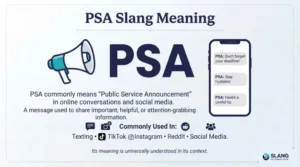
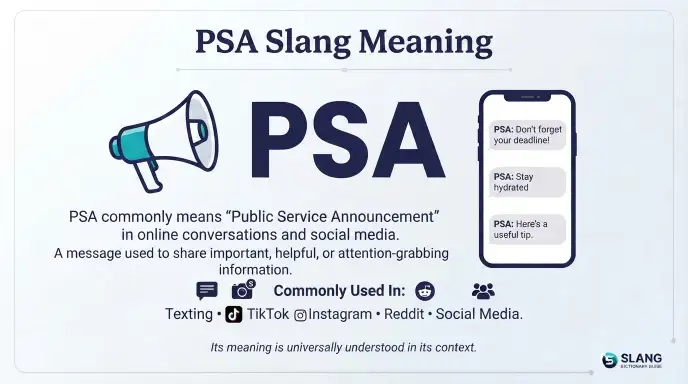
PSA slang means “Public Service Announcement.” In texting and social media, it is commonly used to introduce an important reminder, helpful tip, warning, or announcement.
For example, “PSA: Don’t forget to charge your phone before traveling.”
The term can sound serious, but online it is often used casually or humorously. You may see PSA on TikTok, Instagram, Reddit, Discord, Snapchat, X, and in everyday text messages.
What Does PSA Mean in Slang?
In slang and online communication, PSA usually means “Public Service Announcement.” It is used to introduce information that the writer believes other people should notice.
The phrase originally had a formal and public purpose. A public service announcement might warn people about safety, health, emergencies, or other issues that affect the community.
Internet users have made the abbreviation much more casual.
Someone might write:
“PSA: The new update is available now.”
Or:
“PSA: Always check the weather before leaving for a hike.”
In both examples, PSA tells readers, “Here is something you should know.”
Why Does PSA Sound Like Slang?
Technically, PSA is an abbreviation rather than traditional slang. However, its casual use online has given it a slangiflike quality.
People often use it humorously or dramatically to make an ordinary statement sound like an official announcement.
For example:
“PSA: Wearing headphones does not mean you have to ignore everyone.”
The subject is not a serious public issue, but the writer uses PSA for emphasis and humor.
What Does PSA Stand For?
PSA stands for Public Service Announcement.
The meaning stays basically the same online, but the tone can change depending on the situation.
| Context | Meaning of PSA | Typical Tone |
| Public information | Public Service Announcement | Formal |
| Social media | Important information or reminder | Casual |
| Texting | Something the sender wants you to know | Informal |
| TikTok or Instagram | Tip, warning, or announcement | Casual/Funny |
| Reddit or Discord | Information for a community | Informal |
The abbreviation is especially useful because it is short. Instead of writing “I have an important announcement for everyone,” someone can simply write “PSA:” and get straight to the point.
How Is PSA Used on Social Media?
Social media has helped make PSA a common expression in everyday online language.
You may see it at the beginning of a post, caption, comment, or video. The writer generally wants to draw attention to what comes next.
PSA on TikTok
On TikTok, creators may use PSA before sharing a tip, warning, recommendation, or opinion.
For example:
“PSA: You can save this video and come back to it later.”
It can also be used for humorous content:
“PSA: If you order dessert, you automatically need coffee too.”
Here, PSA is not a literal public announcement. It simply adds emphasis.
PSA on Instagram
Instagram users may use PSA in captions, Stories, comments, and messages.
For example:
“PSA: This sale ends tonight.”
Or:
“PSA: Stop using someone else’s photo without giving credit.”
The first example is promotional, while the second communicates a social reminder.
PSA on Reddit
On Reddit, PSA can be particularly useful when someone wants to share information with a specific community.
For example:
“PSA: The store closes earlier on Sundays.”
A Reddit user might also use it before sharing an experience that could help others avoid a problem.
PSA in Texting
In texting, PSA is usually informal and conversational.
For example:
“PSA: Bring an umbrella today.”
Or:
“PSA: The meeting starts at 9, not 10.”
The sender is essentially saying, “Just letting you know something important.”
PSA Slang Examples
Understanding PSA becomes easier when you see it in realistic conversations.
| Example | What PSA Means |
| “PSA: Drink some water.” | A friendly reminder |
| “PSA: The deadline is tomorrow.” | Important information |
| “PSA: This app has a dark mode.” | Helpful tip |
| “PSA: Don’t click that suspicious link.” | Warning |
| “PSA: Pizza tastes better when it’s hot.” | Humorous statement |
The meaning does not change much in these examples. What changes is the tone.
A PSA can be serious, helpful, friendly, dramatic, or funny.
Is PSA Always Slang?
No. PSA is not always slang.
The abbreviation can be used in formal communication as well. Organizations, schools, government agencies, charities, and businesses may use “public service announcement” in its original sense.
For example, a community organization might create a PSA about road safety.
Online, however, people frequently shorten the phrase to PSA and use it casually.
This distinction is useful because calling every use of PSA “slang” would not be completely accurate. It is better to describe it as an abbreviation that has developed a casual internet usage.
Why Do People Say “PSA” Online?
People use PSA online because it quickly signals that the following information deserves attention.
It can serve several purposes:
To Share a Reminder
Someone might write:
“PSA: Check your passport before your trip.”
The abbreviation immediately frames the message as a reminder.
To Give a Warning
PSA can introduce a warning:
“PSA: Never share your password in a public chat.”
To Share a Useful Tip
People also use it for helpful information:
“PSA: You can freeze leftover bread.”
To Make a Joke
One of the most common modern uses is humor.
“PSA: Monday should be optional.”
The writer is obviously not making an official announcement. The exaggerated formal tone makes the joke more entertaining.
PSA vs. Other Common Internet Abbreviations
PSA is sometimes confused with other short forms because many online abbreviations are used to introduce information.
| Abbreviation | Meaning | Common Use |
| PSA | Public Service Announcement | Reminder, warning, announcement |
| FYI | For Your Information | Sharing information |
| IMO | In My Opinion | Giving an opinion |
| TBH | To Be Honest | Expressing honesty |
| BTW | By The Way | Adding information |
| TL;DR | Too Long; Didn’t Read | Giving a short summary |
The main difference is that PSA often suggests that the information is useful or important for other people to know.
For example, “FYI” simply provides information, while “PSA” can make the information sound more like a public reminder.
Is PSA Positive or Negative?
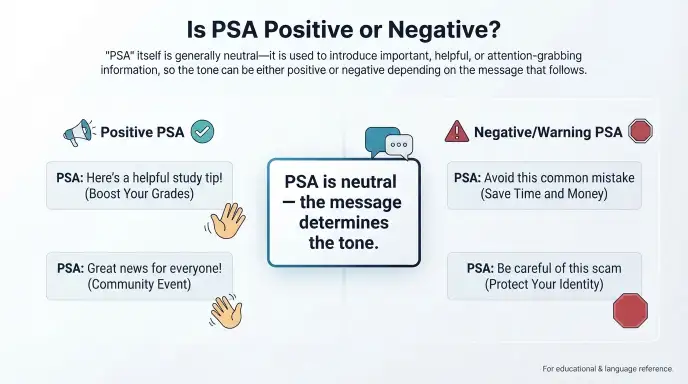
PSA can be either positive or negative. The abbreviation itself does not indicate an emotion.
The message following PSA determines the tone.
A positive example:
“PSA: Free coffee today!”
“PSA: The website is currently down.”
A neutral example:
“PSA: The library closes at 6 PM.”
A humorous example:
“PSA: Sleep is not optional.”
So, when you see PSA, focus on the sentence that follows it to understand the writer’s actual meaning.
Key Takeaway
PSA slang means “Public Service Announcement,” but online users often use it casually to introduce a reminder, warning, tip, announcement, or joke.
It is common in texting, TikTok, Instagram, Reddit, Discord, Snapchat, and other online communities. While the original phrase can be formal, internet users often use PSA in a playful or conversational way.
The Origin of PSA
The expression Public Service Announcement has been used for many years to describe messages designed to inform or educate the public. Traditional PSAs have covered subjects such as safety, health, emergency information, education, and community awareness.
As internet communication became more casual, people began shortening the phrase to PSA. The abbreviation became especially useful online because it allows someone to introduce an important point without writing a long introduction.
Over time, social media users also changed the tone. A PSA no longer had to be about a serious public issue. It could introduce almost any reminder, opinion, tip, or joke that the writer wanted others to notice.
That is why you may see PSA slang used in a sentence about something as simple as food, school, work, shopping, or daily life.
PSA in Modern Internet Language
Today, PSA is often used as an attentionifgrabbing expression.
Someone can place “PSA:” at the beginning of a sentence to make readers stop and pay attention.
For example:
“PSA: The new episode is out.”
Or:
“PSA: Save your work before closing the app.”
The abbreviation creates the feeling that the information is being announced to a group of people.
This is one reason PSA works so well on social media. Posts move quickly, so short expressions that immediately establish context are useful.
Serious PSA
A serious PSA may communicate an important warning:
“PSA: Be careful when sharing personal information online.”
Helpful PSA
A helpful PSA may share a practical tip:
“PSA: Take a screenshot of your booking confirmation.”
Funny PSA
A funny PSA uses the formalifsounding expression for something trivial:
“PSA: Snacks taste better after midnight.”
The humorous effect comes from treating an ordinary statement as if it were an official announcement.
PSA vs. FYI: What’s the Difference?
PSA and FYI are similar, but they are not exactly the same.
FYI means “For Your Information.” It is normally used when someone wants to pass information to another person.
PSA, on the other hand, often has a stronger “everyone should know this” feeling.
| Feature | PSA | FYI |
| Full form | Public Service Announcement | For Your Information |
| Main purpose | Highlight information or a reminder | Share information |
| Tone | Can be serious, casual, or humorous | Usually neutral |
| Common online use | Posts, captions, comments, messages | Emails, chats, messages |
| Example | “PSA: The deadline is Friday.” | “FYI, the deadline is Friday.” |
For example, “FYI, the store closes at 8” simply gives someone information.
“PSA: The store closes at 8” makes the information sound more like a reminder that everyone should notice.
How to Use PSA Correctly
Using PSA is simple. In casual online communication, put PSA before the information you want people to notice.
The most common format is:
PSA: + your message
For example:
“PSA: Bring your charger tomorrow.”
You can also use it in a longer sentence:
“Just a quick PSA: the office will be closed tomorrow.”
The abbreviation is especially natural when talking to a group or posting publicly.
In Text Messages
“PSA: We’re meeting at 7 instead of 8.”
In Social Media Captions
“PSA: This recipe takes less than 20 minutes.”
In Online Communities
“PSA: Read the community rules before posting.”
In Casual Conversations
“Quick PSA if don’t forget your keys.”
Common Mistakes When Using PSA
Although PSA is easy to understand, there are a few mistakes people sometimes make.
Treating Every PSA as Serious
Not every PSA is an official announcement.
Online, the word can be humorous or exaggerated. Always consider the context before assuming the message is serious.
Confusing PSA With FYI
Both expressions introduce information, but they have slightly different purposes.
PSA emphasizes something people should notice, while FYI mainly provides information.
Assuming PSA Is Only Used by Organizations
Traditional public service announcements often come from organizations or authorities. Online, ordinary users can use PSA in posts, comments, and messages.
Using PSA Without Useful Information
The expression works best when the following message actually gives readers something worth noticing.
For example:
“PSA: The event starts at 6 PM.”
This gives useful information.
PSA in Everyday Conversations
PSA has become flexible enough to fit many everyday situations.
Imagine a group chat where everyone has forgotten an upcoming event:
“PSA: Don’t forget we have dinner tonight.”
A friend might use it jokingly:
“PSA: Nobody wants to hear your alarm at 6 AM.”
A coworker might use it for a reminder:
“PSA: Please submit your timesheets today.”
A social media creator might use it before sharing advice:
“PSA: Always read the return policy before buying something online.”
In each case, PSA functions as an attention signal.
When Should You Use PSA?
PSA is a good choice when you want to make a message noticeable without sounding overly formal.
It works especially well for:
- Helpful reminders
- Quick warnings
- Community information
- Online tips
- Announcements
- Funny observations
- Social media posts
- Group chats
However, in a highly formal document, it is usually better to write “Public Service Announcement” or use more professional wording instead of relying on the casual abbreviation.
PSA Meaning: Quick Examples
| Situation | Example | Meaning |
| Reminder | “PSA: Bring your ID.” | Important reminder |
| Warning | “PSA: Avoid that suspicious link.” | Alert |
| Tip | “PSA: You can use this shortcut.” | Helpful information |
| Announcement | “PSA: The event starts at 5.” | Notice |
| Humor | “PSA: Mondays need more coffee.” | Funny statement |
Is PSA Still Common Online?
Yes. PSA remains recognizable in online communication, especially when users want to introduce a reminder, warning, tip, or announcement.
Its exact popularity can vary between platforms and communities, but the abbreviation is widely understandable to Englishifspeaking internet users.
One reason it has lasted is its versatility. It can sound serious when necessary but can also be adapted for casual and humorous conversations.
That flexibility makes PSA useful in everything from a community announcement to a funny social media caption.
FAQs About PSA Slang
Q1. What does PSA mean in slang?
PSA usually means “Public Service Announcement.” In online slangiflike usage, people use it to introduce an important reminder, warning, tip, announcement, or humorous statement.
Q2. Is PSA a slang word?
PSA is technically an abbreviation, not a traditional slang word. However, its casual use on social media and in texting gives it an informal, slangiflike quality.
Q3. What does PSA mean in texting?
In texting, PSA generally means “Public Service Announcement.” A person may use it before sharing information they want another person or group to notice.
Q4. What does PSA mean on TikTok?
On TikTok, PSA is often used before a tip, warning, reminder, opinion, or announcement. Creators may also use it humorously to make an ordinary statement sound official.
Q5. What is the difference between PSA and FYI?
PSA usually emphasizes information that people should notice, while FYI simply means “For Your Information” and is commonly used to pass information along.
Q6. Can PSA be used humorously?
Yes. Online users frequently use PSA humorously. For example, someone might say, “PSA: Dessert is always a good idea.” The formalifsounding abbreviation makes the casual statement playful.
Q7. Should I use PSA in formal writing?
It depends on the context. PSA is widely understood, but formal documents may benefit from writing “Public Service Announcement” in full or using a more formal phrase.
Conclusion
PSA slang is a casual internet use of the abbreviation “Public Service Announcement.” While the original phrase refers to messages intended to inform the public, online users have expanded its meaning. Today, PSA can introduce a reminder, warning, helpful tip, announcement, opinion, or even a joke.
You may encounter PSA in texting, social media captions, TikTok videos, Instagram posts, Reddit discussions, Discord communities, and other online conversations. Its meaning is usually easy to understand from the words that follow it.
The key thing to remember is that PSA signals “pay attention to this information.” It does not automatically mean that the message is serious. Context determines if the statement is informative, practical, cautior a wider group should know.
onary, or humorous.
So, if someone sends you “PSA:” followed by a sentence, they are generally highlighting something they think you if

I’m Dylan Foster, a slang and internet culture writer passionate about exploring how people communicate online and in everyday conversations. I write about texting abbreviations, social media expressions, and modern slang to help readers understand meanings, origins, and real-world usage in a simple way.