Have you ever seen someone say “shucks” in a text, comment, movie, or social media post and wondered what they actually meant? The word can be confusing because its meaning depends heavily on the situation.
In modern casual English, shucks is usually a soft and friendly expression. People may use it when they are disappointed, surprised, embarrassed, or trying to sound modest after receiving praise. It is much less harsh than many other slang expressions.
You may come across “shucks” in texting, online conversations, movies, TV shows, books, and everyday speech. It can also have a humorous or oldiffashioned feel, depending on how it is used.
This guide explains the shucks meaning slang, its different uses, examples, tone, and where you may see it online.
Quick Answer
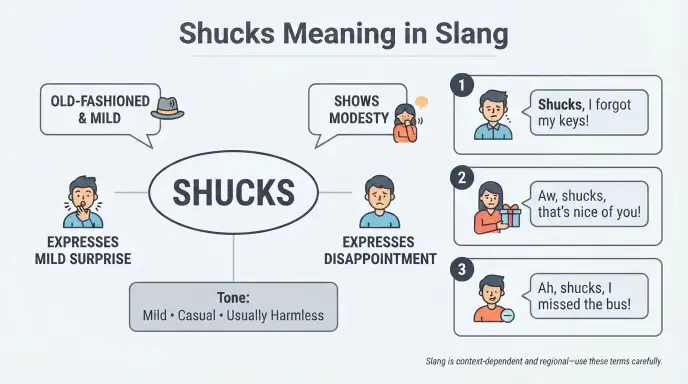
Shucks is a mild slang expression used to show surprise, disappointment, embarrassment, or modesty. It is often similar to saying “darn,” “oh no,” or “gosh.” The word is usually considered harmless and polite.
For example, if someone says, “Shucks, I forgot my keys,” they are expressing mild frustration. If someone receives a compliment and says, “Aw, shucks,” they may be showing modesty or playful embarrassment.
What Does “Shucks” Mean in Slang?
In slang and casual conversation, shucks is an informal expression used to communicate a mild emotional reaction.
The exact meaning changes according to context. Someone might say “shucks” because something went wrong. Another person might use “aw, shucks” after receiving praise.
Shucks Meaning When Showing Disappointment
One common use is to express mild disappointment.
For example:
“Shucks, the concert is sold out.”
Here, the speaker is disappointed, but they are not using strong or offensive language.
Another example is:
“Shucks, I missed the last bus.”
The person is saying something like “Oh no” or “That’s unfortunate.”
Shucks Meaning When Showing Modesty
“Aw, shucks” can also be used when someone receives a compliment.
For example:
“You did an amazing job!”
“Aw, shucks. Thanks!”
In this situation, the speaker is not necessarily upset. They are responding in a modest, shy, or playful way.
It can communicate the idea of “You’re making me feel embarrassed, but thank you.”
Shucks Meaning When Showing Mild Surprise
Sometimes “shucks” expresses surprise when something unexpected happens.
For example:
“Shucks, I didn’t know you were coming!”
The expression makes the reaction sound casual and friendly.
Is “Shucks” Actually Slang?
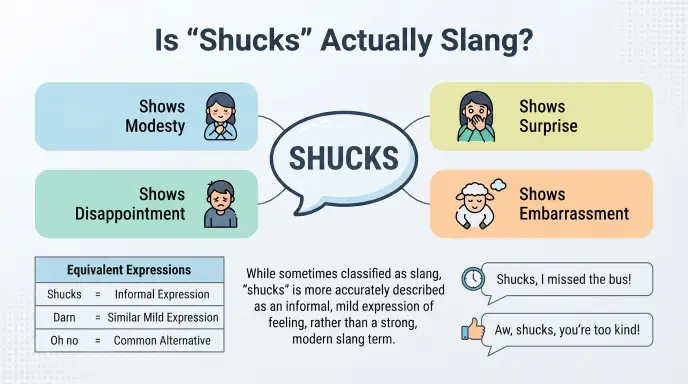
Yes, shucks can function as an informal expression or slangiflike interjection, especially in casual speech.
However, it is important to understand that it is very mild. It is not the type of slang associated with profanity, offensive language, or internetifonly vocabulary.
“Shucks” has also been used in American English for a long time. Because of this, it can sometimes sound oldiffashioned, playful, wholesome, or humorous.
The tone depends on the speaker.
Why Does “Shucks” Sound So Mild?
One reason is that “shucks” can work as a euphemistic expression. In other words, it can replace a stronger word or phrase with something softer.
Instead of using an angry or vulgar expression after making a mistake, someone might simply say:
“Shucks!”
This keeps the conversation friendly and avoids profanity.
Shucks vs. “Aw, Shucks”
The phrase “aw, shucks” has a slightly different feeling from simply saying “shucks.”
| Expression | Common Meaning | Tone |
| Shucks! | Mild disappointment or surprise | Casual |
| Aw, shucks! | Modesty or embarrassment | Friendly |
| Oh, shucks! | Disappointment or surprise | Mild |
| Well, shucks | Resignation or disappointment | Playful |
For example, imagine someone says:
“You are the best player on the team.”
You might respond:
“Aw, shucks!”
Here, the expression is being used playfully to accept the compliment while pretending to feel embarrassed.
How Is “Shucks” Used in Texting?
People can use shucks in texting when they want their reaction to sound relaxed and harmless.
For example:
Friend: “Sorry, I can’t come tonight.”
You: “Aw, shucks. Maybe next time!”
In this conversation, “shucks” shows disappointment, but it does not sound angry.
Another example:
Friend: “I forgot to send you the photo.”
You: “Shucks, I was waiting for it!”
Again, the speaker is mildly disappointed.
Because texting often relies on short expressions to communicate emotion, “shucks” can make a message feel softer and more conversational.
Is “Shucks” Used on TikTok, Reddit, Instagram, or Snapchat?
You can see shucks across casual online communication, although it is not one of the newest internet slang terms.
It may appear in:
- TikTok comments
- Instagram captions
- Reddit discussions
- Snapchat messages
- Discord chats
- Text messages
- Online jokes and memes
Its use is often humorous because the word sounds innocent or slightly oldiffashioned.
For example, someone might jokingly comment:
“Shucks, I guess I have to buy another pair.”
The person may be pretending to be disappointed when they are actually happy about buying something.
This playful use is especially common when people want their message to sound exaggerated but harmless.
Examples of “Shucks” in Everyday Conversation
Context is the easiest way to understand the word.
Example 1: Mild Disappointment
“Shucks, I forgot my wallet.”
Meaning: The speaker is mildly frustrated or disappointed.
Example 2: Receiving a Compliment
“Your presentation was fantastic.”
“Aw, shucks. Thank you!”
Meaning: The speaker is responding modestly to praise.
Example 3: Bad Luck
“Shucks, it started raining right when we left.”
Meaning: The speaker is disappointed about the situation.
Example 4: Friendly Surprise
“Shucks, you’re here already!”
Meaning: The speaker is pleasantly surprised.
Example 5: Playful Online Use
“Shucks, I guess I’ll have to eat the last cookie.”
Meaning: The person is jokingly pretending to be disappointed.
What Is the Tone of “Shucks”?
The tone of shucks is usually mild, friendly, harmless, and sometimes humorous.
It is generally not an aggressive expression. However, the exact tone depends on context and delivery.
Friendly Tone
“Aw, shucks, you’re too kind!”
This sounds warm and modest.
Disappointed Tone
“Shucks, we missed the movie.”
This sounds mildly disappointed.
Humorous Tone
“Shucks, I accidentally finished the whole pizza.”
This can be playful or sarcastic.
OldifFashioned Tone
In some conversations, “shucks” may sound somewhat oldiffashioned. A younger speaker might use it intentionally for humor.
Is “Shucks” a Bad Word?
No. Shucks is generally not considered a swear word or offensive term.
It is a very mild expression. Parents, teachers, writers, and speakers can use it without the strong impact associated with profanity.
That makes it useful when someone wants to express frustration without sounding rude.
For example:
“Shucks, I made a mistake.”
is much softer than using an offensive exclamation.
This is one reason the word has remained recognizable in casual English.
Shucks Meaning in Different Situations
| Situation | Meaning of “Shucks” | Example |
| Something went wrong | Mild disappointment | “Shucks, I missed it.” |
| Receiving praise | Modesty | “Aw, shucks, thanks!” |
| Unexpected event | Mild surprise | “Shucks, you’re early!” |
| Bad luck | Frustration | “Shucks, it broke.” |
| Joke or meme | Playful reaction | “Shucks, more pizza for me.” |
What Does “Aw, Shucks” Mean?
“Aw, shucks” usually means that someone feels modest, embarrassed, or pleasantly uncomfortable after receiving praise.
For example:
“You are such a talented singer.”
“Aw, shucks. That’s nice of you to say.”
The phrase can also be used jokingly. Someone may say “aw, shucks” while pretending that a compliment is making them shy.
The expression is therefore often more positive than a simple “shucks!”
Summary
The shucks meaning slang is usually connected to mild disappointment, surprise, embarrassment, or modesty. The expression is harmless and often sounds friendly or playful.
The phrase “aw, shucks” is especially common when someone responds modestly to a compliment. In texting and social media, people may also use “shucks” humorously because it has a soft or slightly oldiffashioned sound.
In, we can cover more practical examples, similar slang expressions, if “shucks” is still commonly used, FAQs, and the final conclusion.
Similar Expressions to “Shucks”
There are several casual expressions that can communicate a feeling similar to shucks. The best choice depends on if you want to show disappointment, surprise, frustration, or modesty.
| Expression | Main Meaning | Tone |
| Oh no | Disappointment or concern | Neutral |
| Darn | Mild frustration | Casual |
| Gosh | Surprise or emotion | Mild |
| Gee | Surprise or emphasis | Casual |
| Aw, shucks | Modesty or embarrassment | Friendly |
| Well, that’s too bad | Disappointment | Polite |
| Bummer | Disappointment | Casual |
For example, “Darn, I missed the train” and “Shucks, I missed the train” have a similar basic meaning. However, “shucks” can sound more playful or oldiffashioned.
“Shucks” vs. “Darn”
Shucks and darn are both mild expressions, but they are not always interchangeable.
“Darn” is often used when someone is annoyed or frustrated:
“Darn, I forgot my password.”
“Shucks” can express the same type of disappointment:
“Shucks, I forgot my password.”
However, “shucks” can sound softer and more cheerful.
“Shucks” vs. “Gosh”
“Gosh” is usually associated with surprise, excitement, or strong emotion.
For example:
“Gosh, that’s beautiful!”
“Shucks” is more commonly connected with disappointment or modesty:
“Aw, shucks, you’re making me blush.”
Both words are mild, but they serve different purposes in many conversations.
Common Mistakes When Using “Shucks”
Although “shucks” is easy to understand, some people misunderstand its tone.
Mistake: Thinking It Is Always Negative
“Shucks” does not always mean that something bad happened.
Consider:
“Aw, shucks, you’re too kind.”
This is not a complaint. The speaker is responding modestly to a compliment.
Mistake: Assuming It Is Modern Internet Slang
“Shucks” is not a newly created socialifmedia abbreviation. It has a much longer history in English.
People can still use it online, but its older background gives it a different feel from newer expressions such as “delulu,” “rizz,” or “no cap.”
Mistake: Using It in Very Formal Writing
“Shucks” is casual. It is generally better suited to conversation, dialogue, texting, informal posts, and humorous writing.
For a formal business document, a more direct phrase such as “unfortunately” or “I regret that” may be more appropriate.
When Should You Use “Shucks”?
You can use shucks when you want your reaction to sound mild rather than angry or offensive.
It works particularly well when:
- You are mildly disappointed.
- You want to react to bad luck.
- Someone gives you a compliment.
- You want to sound modest.
- You are making a playful joke.
- You want an intentionally wholesome or oldiffashioned expression.
For example:
“Shucks, I was hoping you’d come.”
This sounds disappointing but friendly.
Another example:
“Aw, shucks, you really like my drawing?”
This sounds modest and slightly embarrassed.
When Should You Avoid “Shucks”?
There are situations where another expression will communicate your meaning more clearly.
If you are discussing a serious problem, “shucks” may sound too lighthearted.
For example, if someone tells you about a major emergency, responding with:
“Shucks.”
could sound insensitive because the situation requires a more serious response.
Similarly, in professional communication, a direct phrase may be better.
Instead of:
“Shucks, the meeting has been canceled.”
you could write:
“Unfortunately, the meeting has been canceled.”
The right expression depends on the seriousness of the situation.
Is “Shucks” Still Used Today?
Yes, people still understand and use shucks, although it is not among the most dominant forms of modern internet slang.
Its current use is often conversational, humorous, nostalgic, or deliberately wholesome.
Someone might use it because they genuinely speak that way, while another person might use it as a joke because the expression sounds oldiffashioned.
For example:
“Shucks, I guess I won!”
The speaker may intentionally choose “shucks” to make the sentence sound funny or exaggerated.
This gives the word a useful place in modern casual communication even though it has been around for a long time.
Why Do People Use Mild Slang Like “Shucks”?
Mild expressions give speakers a way to communicate emotion without sounding aggressive.
Imagine someone accidentally drops their phone. They could simply say:
“Shucks!”
The listener immediately understands that something went wrong.
The word also helps control the emotional tone of a conversation. Instead of sounding angry, the speaker sounds disappointed, amused, or playful.
That is particularly useful in friendly conversations and online communication, where tone can sometimes be difficult to understand.
Can “Shucks” Be Sarcastic?
Yes. Like many conversational expressions, shucks can be sarcastic depending on context.
Imagine someone says:
“Shucks, I have to spend the weekend at the beach.”
If the person loves going to the beach, they are probably pretending to be disappointed.
The actual meaning could be closer to:
“I’m definitely not upset about this!”
This humorous contrast is what makes the expression useful in jokes and socialifmedia posts.
“Shucks” in Pop Culture and Casual Speech
The expression has appeared in American entertainment, literature, movies, television dialogue, and everyday speech. It can be used to create a character who sounds innocent, humble, folksy, or oldiffashioned.
Because of this, people may recognize the word even if they do not personally use it.
When it appears in dialogue, the surrounding sentence is usually the best clue to its meaning.
For example:
“Aw, shucks, I didn’t do anything special.”
This clearly communicates modesty.
But:
“Shucks, we missed our flight.”
clearly communicates disappointment.
Shucks Meaning in Social Media and Online Chats
On platforms such as TikTok, Instagram, Reddit, Snapchat, and Discord, the word can be used in several ways.
A person may use it genuinely:
“Shucks, I missed your message.”
They may also use it ironically:
“Shucks, I guess I have to order dessert.”
In memes and comments, the second style can be especially effective because the mild expression contrasts with the situation.
The word therefore works both as a genuine reaction and as a humorous choice of wording.
Is “Shucks” Appropriate for Kids?
Generally, shucks is considered a mild and harmless expression. It does not normally carry the offensive meaning associated with profanity.
Its mild nature is one reason it has historically appeared in familyiffriendly speech and entertainment.
However, context still matters. Teaching children to choose language according to the situation is more useful than simply labeling individual words as good or bad.
How to Reply When Someone Says “Shucks”
Your response depends on what the person means.
If they are disappointed, you could say:
“Don’t worry. Maybe next time.”
If they are being modest after a compliment, you could say:
“I’m serious if you really did a great job!”
If they are joking, you can respond playfully:
“Yeah, what a terrible problem!”
The surrounding conversation will normally make the intended meaning clear.
Quick Reference: Shucks Meaning
| Question | Answer |
| Is “shucks” slang? | It can function as a casual slangiflike expression or interjection. |
| Is “shucks” a bad word? | No, it is generally considered very mild. |
| What does “aw, shucks” mean? | It often shows modesty or playful embarrassment. |
| Can “shucks” mean disappointment? | Yes. |
| Can it be sarcastic? | Yes, depending on context. |
| Is it used online? | Yes, especially in casual or humorous conversations. |
| Is it formal English? | No, it is better suited to informal communication. |
FAQs About Shucks Meaning Slang
Q1. What does “shucks” mean in slang?
“Shucks” is a mild informal expression used to show disappointment, surprise, embarrassment, or modesty. Its meaning depends on the context.
Q2. Is “shucks” a swear word?
No. “Shucks” is generally considered a harmless expression. It can be used instead of stronger language when someone wants to express mild frustration without being offensive.
Q3. What does “aw, shucks” mean?
“Aw, shucks” commonly expresses modesty or playful embarrassment after receiving praise. For example, someone might say “Aw, shucks, thanks!” after being complimented.
Q4. Does “shucks” mean disappointment?
Yes. Someone can say “Shucks!” when something goes wrong or when they experience mild disappointment. For example, “Shucks, I missed the bus.”
Q5. Is “shucks” still used today?
Yes. Although it is not one of the newest internet slang terms, people still use it in casual conversation, texting, online comments, humorous posts, and entertainment.
Q6. Can “shucks” be used sarcastically?
Yes. A speaker can use “shucks” sarcastically when pretending to be disappointed about something they actually enjoy.
For example, “Shucks, I have to take another vacation” could jokingly mean that the person is very happy about the vacation.
Q7. Is “shucks” American slang?
“Shucks” is strongly associated with American English and has a long history in informal American speech. It may sound particularly American, casual, or oldiffashioned depending on the context.
Conclusion
The shucks meaning slang is simple but flexible. It is a mild expression that can communicate disappointment, surprise, frustration, modesty, or playful embarrassment. The exact meaning depends on the situation and the words around it.
One of the most recognizable forms is “aw, shucks,” which is commonly used when someone responds modestly to praise. In other situations, “shucks” can simply mean something like “oh no,” “darn,” or “that’s unfortunate.”
Today, you may still encounter the expression in everyday speech, texting, social media comments, movies, television, and humorous online conversations. It is generally harmless and does not carry the force of a swear word.
The most important thing to remember is that context determines tone. “Shucks” can sound genuinely disappointed, warmly modest, intentionally oldiffashioned, or completely sarcastic. Once you understand the situation, its intended meaning is usually easy to recognize.

I’m Dylan Foster, a slang and internet culture writer passionate about exploring how people communicate online and in everyday conversations. I write about texting abbreviations, social media expressions, and modern slang to help readers understand meanings, origins, and real-world usage in a simple way.