If you have seen someone type “TT” in a text message, comment, or DM, you may have wondered what those two letters are supposed to mean. Unlike simple abbreviations such as “BRB” or “IDK,” TT does not always have one fixed meaning.
TT in text means crying, sadness, or an emotional reaction, especially as a shortened form of the text emoticon “Tif T.” On social media, TT can also mean TikTok, so the surrounding message helps reveal the intended meaning.
In many casual conversations, TT is used to show that someone feels sad, disappointed, emotional, or dramatically upset. It can be serious, but it is also often playful. For example, “You ate the last cookie TT” could be a joking way to say, “I’m sad!”
You may also see TT when people talk about TikTok. A sentence such as “I saw that dance on TT” is usually referring to TikTok rather than crying. This is why context matters when you are trying to understand the phrase.
TT Meaning in Text
The most common meaning of TT in text is a crying or sad reaction. It comes from the older emoticon Tif T, where the two “T” characters can look like eyes with tears coming down.
For example:
“You’re leaving tomorrow TT”
Here, TT adds an emotional reaction to the message. It can mean something like “I’m sad,” “I’m crying,” or “That hurts.”
TT is not always a traditional acronym. In its emotional use, it works more like a text emoticon or internet expression than a shortened phrase with a fixed full form. The meaning comes from the visual appearance of the letters.
What Does TT Stand For?
When TT is used as a crying expression, it does not necessarily “stand for” a longer phrase.
Instead, it is connected to Tif T, a textifbased crying face. The characters are meant to suggest eyes with tears.
That makes TT different from abbreviations such as:
- IDK = I don’t know
- IDC = I don’t care
- IMO = in my opinion
- BRB = be right back
With TT, the letters themselves create the emotional expression.
What Does TT Mean in Everyday Chat?
In everyday texting, TT can communicate several closely related feelings:
- Sadness
- Disappointment
- Missing someone
- Emotional reactions
- Playful crying
- Dramatic frustration
- Feeling touched or overwhelmed
For example:
“I finished the whole series TT”
This could mean the person is sad that the series ended.
Another example is:
“You forgot my birthday TT”
Depending on the relationship, this could be genuine sadness or playful guiltiftripping.
TT is therefore highly dependent on tone. It does not automatically mean that someone is seriously upset.
TT vs. Tif T
You may see TT, Tif T, or T.T used for a similar emotional purpose.
The longer version, Tifr T, makes the cryingifface idea more obvious. The simplified TT version is faster to type and can look more casual.
For example:
- “I miss summer TT”
- “I miss summer TT”
- “I miss summer T.T”
All three can communicate sadness or emotional frustration.
Where People Use TT
TT can appear across many online platforms, but the intended meaning can change depending on where you see it.
A useful rule is simple: look at the words around TT before deciding what it means.
TT on TikTok
On TikTok, TT can mean TikTok itself, especially when people are discussing videos, trends, creators, sounds, or viral content. Current online slang references specifically note this platformifrelated use.
For example:
“I saw this recipe on TT.”
Here, TT almost certainly means TikTok.
Another example:
“That sound is everywhere on TT.”
Again, the person is talking about TikTok.
But if someone comments:
“This ending TT”
the meaning may instead be emotional or tearful.
So on TikTok, both meanings can appear.
TT on Snapchat
Snapchat conversations tend to be quick and informal, so short expressions such as TT can fit naturally into messages.
Someone might write:
“I can’t believe we have homework tomorrow TT”
Here, TT expresses disappointment.
However, if the conversation is about socialifmedia videos, TT could refer to TikTok.
The surrounding sentence is the best clue.
TT on Instagram
On Instagram, TT may appear in DMs, comments, captions, or conversations about videos and trends.
For example:
“That ending was so cute TT”
This likely expresses an emotional reaction.
But:
“I saw your reel on TT”
would most likely use TT to mean TikTok.
Because Instagram users often discuss content from other platforms, the abbreviation can have more than one interpretation.
TT on WhatsApp
WhatsApp is commonly used for personal conversations, group chats, and quick messages.
In a personal conversation, TT may be used as a crying or emotional reaction:
“You really ate without me TT”
The sender probably means something like “I’m sad” in a playful way.
A WhatsApp message about TikTok could use it differently:
“Did you see this on TT?”
In that case, the intended meaning is likely TikTok.
TT in SMS
Traditional SMS texting can also contain TT, especially when people use internetifstyle slang with friends.
For example:
“My favorite character died TT”
Here, TT communicates sadness.
In formal SMS messages, however, it is better not to assume the recipient understands internet slang. If the message is important, writing the emotion in normal words is clearer.
How to Tell Which Meaning of TT Someone Intended
Because TT has multiple uses, context is more useful than the letters themselves.
Look at three things: the topic, the sentence, and the tone.
If the conversation is about feelings, bad news, disappointment, or something emotional, TT probably represents crying or sadness.
If the conversation is about videos, creators, trends, sounds, or social media, TT may mean TikTok.
Consider these two messages:
“I can’t believe the movie ended like that TT”
This is probably an emotional reaction.
Now compare:
“I found that creator on TT.”
This almost certainly refers to TikTok.
The same two letters can therefore have completely different meanings.
Real Chat Examples of TT
Here are realistic examples showing how people might use TT in everyday conversations.
Example 1: Missing a Friend
A: I wish you were coming with us.
B: Same, I’m gonna miss everyone TT
A: We’ll call you tonight.
Here, TT shows sadness about missing the group.
Example 2: A Funny Disappointment
A: Who ate the last slice of pizza?
B: Me 😭
A: TT I was saving that.
B: Sorryyy 😂
Here, TT is playful rather than serious.
Example 3: A Sad Movie
A: Did you watch the new movie?
B: Yes TT that ending destroyed me.
A: I know! I wasn’t ready.
TT adds emotion to the reaction.
Example 4: Missing Someone
A: Are you coming home this weekend?
B: No, probably next week.
A: TT I miss you already.
The expression communicates sadness or longing.
Example 5: School Stress
A: Did you finish the assignment?
B: Not even close TT
A: Same. I’m staying up late tonight.
Here, TT expresses frustration.
Example 6: Playful Complaint
A: I ordered fries but forgot yours.
B: TT wow, fake friend.
A: I’ll buy you some tomorrow.
The expression is joking and dramatic.
Example 7: TikTok Meaning
A: Where did you find that video?
B: On TT. It came up on my feed.
A: Ohh, send it to me.
Here, TT means TikTok.
Example 8: TikTok Trend
A: Have you seen that new dance?
B: Yeah, it’s everywhere on TT.
A: I keep seeing it too.
Again, TT refers to TikTok.
Example 9: Emotional Compliment
A: She finally graduated!
B: I know TT I’m so proud of her.
A: Same. She worked so hard.
TT expresses strong emotion.
Example 10: Small Mistake
A: I just sent the message to the wrong person.
B: NO TT 😭
A: I know. I’m embarrassed.
B: What did you send?
Here, TT shows sympathy and dramatic reaction.
How to Reply When Someone Says “TT”
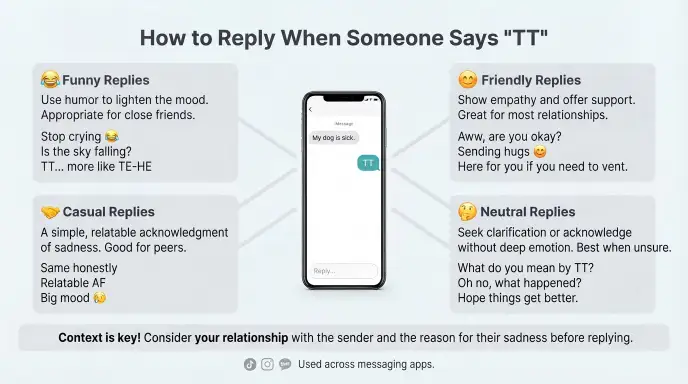
Your reply depends on what the sender means.
If TT is being used to show sadness, you can respond with sympathy, humor, or reassurance. If it means TikTok, simply respond to the topic.
Funny Replies
If your friend is using TT dramatically, you can answer with humor:
- “Stop crying 😂”
- “It’s not that serious!”
- “You’ll survive 😭”
- “Drama level: 100.”
- “I’ll send help 😂”
These replies work best when the original message is clearly playful.
Casual Replies
For an everyday conversation, keep your response simple:
- “Aww, I know.”
- “Same honestly.”
- “I feel you.”
- “Yeah, that was sad.”
- “I know right?”
These replies keep the conversation natural.
Friendly Replies
If the person genuinely seems upset, a warmer response is better:
- “Aww, are you okay?”
- “I understand. That sounds rough.”
- “Don’t worry, it’ll be okay.”
- “I’m here if you want to talk.”
- “I hope things get better.”
The important thing is to read the tone before joking.
Neutral Replies
If you are not sure what TT means, you do not have to guess.
You can simply ask:
“What do you mean by TT?”
Or:
“Do you mean TikTok or crying? 😂”
This is especially useful when the message is only “TT” with no other context.
Is TT Rude or Offensive?
TT is generally not considered rude or offensive. In casual online communication, it is usually an emotional expression or shorthand.
Its tone depends more on the situation than on the letters themselves.
For example:
“I miss you TT”
is normally harmless and emotional.
Meanwhile:
“You lost again TT 😂”
could be playful teasing between friends.
Is TT Safe to Use?
In casual texting, TT is generally fine when the people involved understand internet slang.
It can work well in:
- Text messages
- Friend group chats
- Socialifmedia comments
- DMs
- Casual conversations
- Gaming chats
However, slang is not always appropriate everywhere.
Can You Use TT at School?
That depends on the situation.
If you are texting a friend about school, TT is perfectly understandable as casual internet language.
But if you are submitting an assignment, writing an essay, or communicating formally with a teacher, spelling out your meaning is better.
For example, instead of:
“The ending was sad TT”
a formal piece of writing would simply say:
“The ending was very emotional.”
Can You Use TT at Work?
For professional communication, it is usually safer to avoid unexplained slang.
A message such as:
“The project got delayed TT”
may sound too informal in a workplace email.
With coworkers you know well, casual chat may be different. Still, professional communication should prioritize clarity over internet shorthand.
Who Uses This Term?
TT is most natural in informal online communication, especially among people who are already familiar with textifbased expressions.
Gen Z and Younger Internet Users
Younger internet users often communicate with abbreviations, emojis, reaction phrases, and short expressions. TT fits this style because it communicates an emotion without requiring a full sentence.
However, it would be misleading to say that only Gen Z uses TT. Internet slang can spread across different age groups, especially when people regularly use social media or messaging apps.
Common Platforms
You may encounter TT in:
- TikTok
- Snapchat
- SMS
- Group chats
- Online communities
- Gaming conversations
Its meaning can vary from platform to platform, so users should avoid assuming that every TT has the same definition.
How Often Does TT Appear Online?
There is no single universal measurement that can tell us how often every use of TT appears across all platforms. Different communities use the expression differently.
What is clear is that TT remains recognizable in online conversations, particularly as an emotional text expression and as shorthand for TikTok in socialifmedia contexts.
Origin of the Term
The emotional use of TT is connected to the older text emoticon Tif T.
Before modern emojis became common, people often used keyboard characters to create simple facial expressions. These were called emoticons.
Examples include:
- 🙂 for happiness
- 🙁 for sadness
- 😉 for a wink
- Tif T for crying
In Tif T, the “T” characters can visually resemble eyes with tears. Over time, internet users sometimes shortened the expression to TT.
The exact history of every version of TT is difficult to pin down because internet slang develops across many communities rather than from one official source. The cryingifface interpretation is, however, strongly associated with T if Tifstyle emoticons.
The TikTok use has a different logic. In that context, TT is simply a shortened way of referring to TikTok, particularly in casual socialifmedia discussions.
This is a good example of how the internet language evolves. A short combination of letters can develop different meanings in different online communities.
TT vs. Other Common Text Abbreviations
Understanding TT becomes easier when you compare it with familiar texting abbreviations.
| Term | Meaning | Type | Usage | Popularity |
| TT | Crying/sad reaction or TikTok, depending on context | Emoticon / abbreviation | Casual texting and social media | Common in relevant contexts |
| IDK | I don’t know | Abbreviation | Texting, DMs, chats | Very common |
| IDC | I don’t care | Abbreviation | Casual texting and social media | Very common |
| IMO | In my opinion | Initialism | Texting, comments, discussions | Common |
| BRB | Be right back | Abbreviation | Chats and messaging | Common |
One important difference is that TT is more contextifdependent than many of these abbreviations.
If someone writes “IDK,” its meaning is normally obvious. With TT, you may need to read the sentence around it.
For example:
“I found it on TT.”
versus:
“I can’t believe you did that TT.”
The first is likely about TikTok. The second is likely emotional.
Real:World Usage Example
Imagine two friends are chatting after watching a movie together.
One friend messages:
“I can’t believe they killed my favorite character TT.”
The other person immediately understands that TT is being used as an emotional reaction. They might answer:
“I know 😭 That scene was so sad.”
There is no need for TT to literally mean “I am crying.” It simply adds emotional tone to the sentence.
Now imagine a different conversation:
“Where did you see that video?”
The response is:
“I found it on TT.”
In this situation, TT most likely means TikTok because the conversation is about finding a video.
This shows why context is so important. The abbreviation itself does not provide enough information in every situation.
How to Understand TT Without Guessing
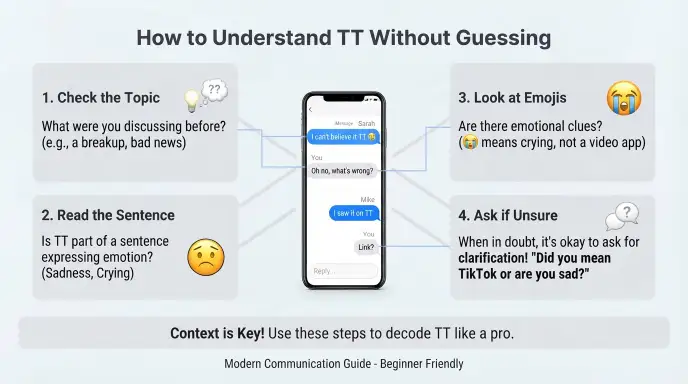
If someone sends you TT and you are unsure what they mean, use the surrounding words as clues.
Look at the Topic
Is the conversation about:
- Sadness?
- A disappointing event?
- A funny mistake?
- A movie or show?
- TikTok videos?
- Trends or creators?
The topic often gives you the answer.
Look at the Placement
If TT appears at the end of an emotional sentence, it may be a crying reaction:
“You really forgot my birthday TT”
If it appears after a reference to an app or video, it may mean TikTok:
“I saw it on TT.”
Look at Emojis
People may combine TT with emojis.
For example:
“I can’t believe it TT 😭”
This strongly suggests an emotional meaning.
But:
“That video is going viral on TT 😂”
is clearly talking about TikTok.
Ask if You Are Still Unsure
There is nothing wrong with asking.
A simple:
“What does TT mean here?”
can prevent a misunderstanding.
When Should You Avoid Using TT?
Although TT is harmless in most casual contexts, there are situations where clearer language is better.
Avoid relying on TT when:
- You are writing a formal email.
- You are submitting schoolwork.
- You are writing for a professional audience.
- The recipient may not know internet slang.
- The message involves an important instruction.
- The meaning could easily be misunderstood.
For casual conversations, though, TT can be a quick way to express emotion.
Frequently Asked Questions
Q1. What does TT mean in text messages?
TT usually expresses crying, sadness, disappointment, or an emotional reaction. It is linked to the older Tif T crying emoticon.
Q2. What does TT mean on TikTok?
On TikTokifrelated posts and conversations, TT can simply mean TikTok. Context tells you if it means the platform or an emotional reaction.
Q3. Is TT slang?
Yes. TT is commonly used as an informal internet language. When it represents crying, it is better described as a text emoticon or internet expression.
Q4. Is TT rude or offensive?
No. TT is generally harmless and is usually used to express emotion, playful sadness, or disappointment.
Q5. How should you reply to TT?
If it expresses sadness, you can respond with sympathy or humor depending on the tone. If you are unsure, simply ask what the person means.
Conclusion
So, what does TT mean in text? Most often, TT is a short emotional expression connected to crying, sadness, disappointment, or playful dramatic emotion. It comes from the older Tif Tifstyle crying emoticon.
However, TT can also mean TikTok when the conversation is about videos, trends, creators, or the platform. That is why context is the key to understanding this twoifletter expression.
You can comfortably use TT in casual texts, DMs, group chats, and socialifmedia conversations when the people you are talking to understand the slang. For school assignments, professional messages, and other formal situations, clearer standard English is usually the better choice.
The easiest rule to remember is simple: if the conversation is emotional, TT may mean crying; if the conversation is about videos or trends, TT may mean TikTok. When in doubt, look at the surrounding wordsif or just ask.

I’m Dylan Foster, a slang and internet culture writer passionate about exploring how people communicate online and in everyday conversations. I write about texting abbreviations, social media expressions, and modern slang to help readers understand meanings, origins, and real-world usage in a simple way.