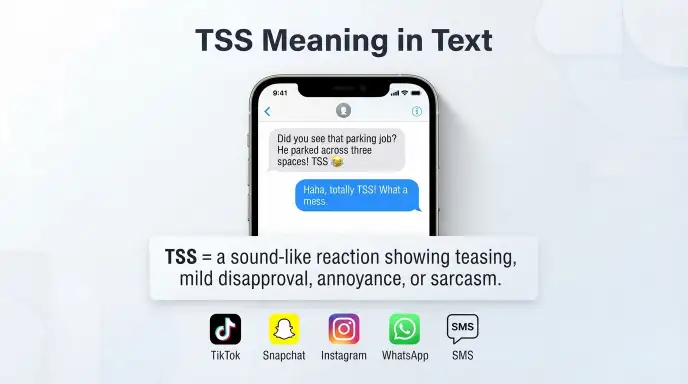
TSS in text usually works as a soundlike reaction, similar to “tsk” or “tss,” and can show mild disapproval, teasing, annoyance, sarcasm, or playful judgment. You may see it in TikTok comments, Snapchat chats, Instagram DMs, WhatsApp messages, and casual texts.
If you received a message containing “tss” and wondered if it was an abbreviation, slang word, or typo, you are not alone. The expression can be confusing because it does not have one universally accepted meaning in casual texting.
In many online conversations, tss represents a sound rather than a fixed acronym. The exact feeling can change depending on the conversation, punctuation, emojis, and relationship between the people chatting. Current explanations of the term commonly describe it as similar to “tsk tsk,” especially when expressing playful disapproval or annoyance.
That is why people search for the TSS meaning in text. They want to know what the sender actually meant and if the message was funny, annoyed, sarcastic, or simply playful.
TSS Meaning in Text
In casual texting, TSS usually represents a short reaction sound rather than a standardized acronym. It can resemble “tsk,” “tch,” or a quick sound someone makes when they are unimpressed.
For example:
“You forgot your homework again? Tss 😭”
Here, the sender is probably not using TSS as a formal abbreviation. They are creating a written reaction that communicates something like, “Come on!” or “Really?”
The meaning can include:
- Mild disapproval
- Playful disappointment
- Teasing
- Sarcasm
- Annoyance
- A dismissive reaction
- An exaggerated “really?” response
Several current slang references describe this soundifbased interpretation as the common casual use of tss online.
Is TSS an Acronym or Abbreviation?
This is where things can get confusing.
Unlike LOL, which conventionally means “laughing out loud,” or BRB, which means “be right back,” lowercase tss usually does not have one fixed expansion in everyday texting.
It behaves more like an onomatopoeic expression. In simple terms, that means the written form represents a sound.
Think about expressions such as:
- “Hmm”
- “Ugh”
- “Psh”
- “Tsk”
- “Tch”
- “Tss”
These expressions communicate attitude or emotion without necessarily standing for a group of words.
Some online sources list alternative interpretations such as “That’s So Sweet” or “That’s So Sad.” Such uses may occur in particular conversations or communities, but they should not automatically be treated as the universal texting meaning of TSS.
So, if someone simply sends “TSS 😂”, context is much more useful than trying to find one official full form.
What Does TSS Feel Like in a Conversation?
The easiest way to understand it is to imagine the sound being made in person.
Someone might hear:
“I told everyone I knew the answer, but I was completely wrong.”
A friend could reply:
“Tss 😂”
The response might mean:
“Oh, come on!”
or:
“You really did that?”
It does not necessarily mean the person is genuinely angry. Between friends, it can be a playful reaction.
Where People Use TSS
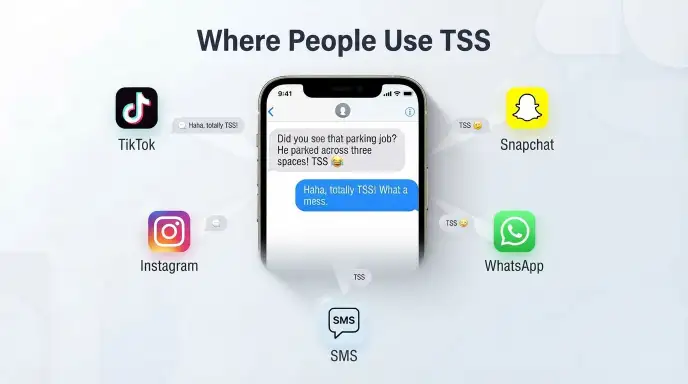
TSS can appear in several forms of casual online communication. The basic reaction is usually similar, but the tone can change depending on the platform.
TSS on TikTok
On TikTok, short expressions are often used in comments and replies to react quickly to a video.
Someone might comment:
“Tss, bro really thought that was going to work 😂”
The writer may be expressing playful disbelief or teasing.
TikTok comments also tend to exaggerate reactions for humor, so tss may appear alongside laughing, crying, or other reaction emojis.
However, TikTok communities can develop their own meanings for abbreviations. If TSS appears repeatedly in a particular niche or fandom, look at the surrounding comments before deciding what it means.
TSS on Snapchat
Snapchat conversations are generally informal, so a short reaction like “tss” can fit naturally into a private chat.
For example:
“You seriously forgot my birthday? Tss 😒”
The message could communicate mild disappointment.
Among close friends, however, the same expression could be playful:
“You ate the last slice? Tss 😂”
The relationship between the two people matters.
TSS on Instagram
On Instagram, you may see TSS in DMs, comments, replies, or reactions.
For example:
“Tss, nice try 😂”
Here it could have a teasing or sarcastic tone.
Because Instagram combines public comments with private conversations, the same expression can carry different meanings depending on who posted it and what came before it.
TSS on WhatsApp
WhatsApp is commonly used for personal conversations and group chats, making informal reactions especially natural.
A person might write:
“Tss… you forgot again.”
or:
“Tss 😂 I knew you would do that.”
In a private chat, the sender’s usual writing style can help you understand if the expression is serious or playful.
TSS in SMS Texting
Traditional SMS messages can also contain TSS, although people may simply use other expressions such as “lol,” “ugh,” “hmm,” or “really?”
Because SMS usually gives you fewer visual clues than faceiftoifface conversation, punctuation and emojis can be useful.
For example:
- “Tss.” potentially more serious or dismissive
- “Tss 😂” probably playful
- “Tss…” could suggest disappointment or disbelief
- “TSS!!” stronger or exaggerated reaction
These are clues, not strict rules.
Real Chat Examples of TSS
The best way to understand internet slang is to see it in realistic conversations.
Example 1: Playful Teasing
A: I accidentally sent the message to the wrong group.
B: Tss 😂
A: Don’t laugh at me!
B: I’m sorry, but that’s hilarious.
Here, TSS shows playful amusement and mild teasing.
Example 2: Mild Disappointment
A: I forgot to bring your book.
B: Tss…
A: I’m really sorry.
B: It’s okay. Just bring it tomorrow.
The expression shows mild disappointment rather than serious anger.
Example 3: Sarcastic Reaction
A: I totally planned everything perfectly.
B: You forgot the tickets.
A: Oh.
B: Tss 😂
Here, TSS adds a sarcastic “sure you did” feeling.
Example 4: Friendly Judgment
A: I ordered pizza at 2 a.m.
B: Tss 😭
A: Don’t judge me.
B: I’m definitely judging you.
The expression is humorous rather than hostile.
Example 5: “Really?”
A: I finished your snacks.
B: TSS?!
A: I was hungry!
B: You owe me another bag.
The capital letters and punctuation make the reaction stronger.
Example 6: Playful Scolding
A: I didn’t study for the test.
B: Tss, you knew about it all week.
A: I know 😭
B: Good luck tomorrow.
Here, TSS has a “you should have known better” tone.
Example 7: Disbelief
A: He said he can run 20 miles without training.
B: Tss 😂
A: Exactly what I thought.
The expression signals disbelief.
Example 8: Friendly Conversation
A: I finally cleaned my room.
B: Tss, look at you being responsible 😂
A: It was about time.
B: I’m proud of you.
Here, TSS is clearly affectionate and playful.
Example 9: Mild Annoyance
A: You changed the plan again?
B: Yeah, sorry.
A: Tss… okay.
B: I promise this is the last change.
The expression communicates frustration without necessarily becoming rude.
Example 10: Funny Reaction
A: I tried cooking and somehow burned water.
B: TSS 😭😂
A: Don’t ask how.
B: I have so many questions.
In this example, TSS is simply part of an exaggerated humorous reaction.
How to Reply When Someone Says “TSS”
There is no single correct response. Your reply should match the tone of the original message.
Funny Replies
If the person is clearly joking, you can answer with humor.
- “What was that sound? 😂”
- “Don’t tss me!”
- “I know, I know 😭”
- “Stop judging me!”
- “Tss right back at you 😂”
These work best with friends or people you already know well.
Casual Replies
If you want to keep the conversation relaxed:
- “What? 😂”
- “I know lol.”
- “My bad.”
- “Seriously though.”
- “Okay, okay.”
A simple response is usually enough.
Friendly Replies
If the message feels playful but you want to stay warm:
- “Haha, I know you’re teasing.”
- “Okay, I deserve that one 😂”
- “Fair enough!”
- “You got me.”
- “I’ll do better next time.”
Neutral Replies
If you are not sure what the sender means, avoid guessing.
You can say:
- “What do you mean?”
- “Haha, what’s that supposed to mean?”
- “Are you joking?”
- “Did I do something?”
This is especially useful if you do not know the person well.
Is TSS Rude or Offensive?
TSS is not inherently rude or offensive. Its tone depends heavily on context.
Among friends, it can be harmless teasing. In a serious conversation, however, the same expression might sound dismissive or judgmental.
For example:
“Tss 😂 you really did that?”
sounds playful.
But:
“Tss. Whatever.”
could sound irritated or dismissive.
Is TSS Safe to Use?
In casual conversations, it is generally lowifrisk. You can use it with friends when the tone is clear.
Still, internet slang can be misunderstood. A person who is unfamiliar with the expression might not understand what you intended.
Is TSS Appropriate at School?
It is better suited to casual communication than formal school writing.
A text to a friend is different from an essay, assignment, presentation, or formal email.
Instead of writing:
“Tss, that answer is wrong.”
in a formal context, use clearer language such as:
“I don’t think that answer is correct.”
Is TSS Appropriate at Work?
Generally, avoid using slang like TSS in formal workplace communication unless you already know the communication style is very casual.
In a professional email, clarity is more important than internetifstyle reactions.
For example, instead of:
“Tss, you forgot the file.”
you could write:
“It looks like the file was not attached.”
The second version is clearer and more professional.
Who Uses This Term?
TSS is most likely to appear in informal digital communication rather than formal writing.
Younger Internet Users
Younger users, including people familiar with internet slang and socialifmedia communication, may be more comfortable using short expressive reactions.
That does not mean every Gen Z or younger user uses TSS. Slang varies widely by country, community, age, and personal style.
Gen Z Usage
Gen Z communication often uses short expressions, emojis, abbreviations, and deliberately exaggerated reactions.
TSS can fit into that style because it communicates an attitude without requiring a complete sentence.
Still, it is not as universally recognizable as expressions such as LOL, OMG, or BRB.
Common Platforms
You may encounter TSS in:
- TikTok comments
- Snapchat chats
- Instagram DMs
- WhatsApp conversations
- SMS texts
- Group chats
- Online communities
The expression is informal, so it is much more likely to appear in casual digital communication than in professional writing.
How Often Does TSS Appear Online?
There is no reliable universal frequency measure that can show exactly how often people use TSS across every platform.
Current slang references consistently describe it as a contextifdependent expression rather than a universally standardized abbreviation.
That distinction is important. Seeing TSS online does not necessarily mean it has one fixed definition everywhere.
Origin of the Term
The exact origin of tss as a modern texting expression is not clearly documented.
The most useful explanation is that it represents a sound associated with expressions such as “tsk,” “tch,” or a quick tongueif clicking sound used to show disapproval.
When people communicate faceiftoifface, a small sound can convey an attitude without words. Texting cannot reproduce that physical reaction directly, so users sometimes spell the sound.
In this sense, TSS is better understood as a form of digital expression than as a traditional acronym.
Internet culture has helped spread this kind of communication. Texting encourages short, quick reactions, while social media encourages users to communicate emotion with very few characters.
It is also important not to claim a precise historical origin without evidence. Different communities can independently develop similar spellings for sounds and reactions.
Some online sources propose alternate acronym meanings, including “That’s So Sweet,” but these meanings are not consistently standardized across texting references.
So if you are trying to understand a specific TSS message, the conversation around it is more useful than assuming one universal origin or full form.
TSS vs. IDK vs. IDC vs. IMO vs. BRB
TSS is different from common texting abbreviations such as IDK, IDC, IMO, and BRB.
| Term | Meaning | Type | Usage | Popularity |
| TSS | Usually a “tsk/tss” reaction showing teasing, disapproval, or annoyance | Sound expression / slang | Casual chats and social media | Contextifdependent |
| IDK | I Don’t Know | Initialism | Everyday texting and online chats | Very common |
| IDC | I Don’t Care | Initialism | Casual texting and social media | Very common |
| IMO | In My Opinion | Initialism | Texting, comments, discussions | Very common |
| BRB | Be Right Back | Initialism | Texting and instant messaging | Common |
The biggest difference is that TSS usually communicates a reaction or attitude, while the other terms directly represent words.
For example:
“IDK what happened.”
means:
“I don’t know what happened.”
But:
“Tss 😂”
does not translate into one exact sentence. It communicates a feeling.
This is why TSS can be harder to interpret than conventional abbreviations.
RealifWorld Usage Example
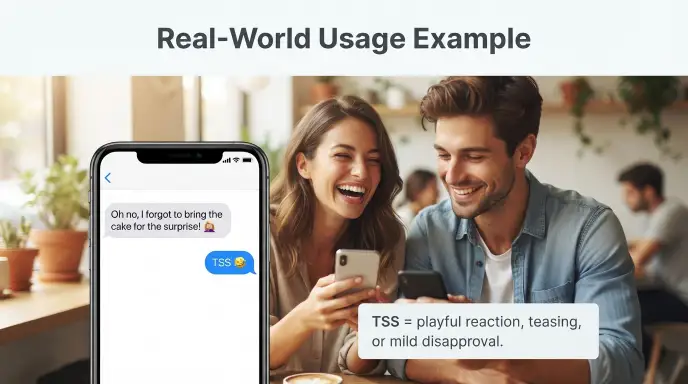
Imagine two friends are sitting together after school and chatting on WhatsApp.
One friend tells the other:
“I told my teacher I had finished the assignment, but I actually forgot it at home.”
The other friend might reply:
“Tss 😂”
The first friend immediately understands the tone because they know each other. The message is probably not serious criticism. It is more like a playful reaction saying, “Really? You did that?”
Now imagine the same message appearing during an argument:
“You promised you wouldn’t do that again.”
“Tss.”
The meaning could feel very different. It may sound dismissive or annoyed.
This example shows why context matters more than the letters themselves.
When interpreting TSS, look at:
- What was said immediately before it?
- Is there an emoji?
- Does the person normally joke this way?
- Are you friends or strangers?
- Is the conversation serious or casual?
- Is TSS written as “tss,” “TSS,” or “tss…”?
These clues can help you understand the intended tone.
Frequently Asked Questions
What does TSS mean in text messages?
TSS usually represents a sound similar to “tsk” or “tss,” often expressing playful disapproval, teasing, mild annoyance, or sarcasm.
What does TSS mean on TikTok?
On TikTok, TSS can be used as a short reaction to a video or comment, often showing disbelief, teasing, sarcasm, or playful judgment.
Is TSS slang?
Yes, when used casually online, TSS can function as internet slang or a soundif
based expression. It does not have one universally accepted texting full form.
Is TSS rude or offensive?
Not usually. It can be harmless among friends, but in a serious conversation it may sound dismissive or judgmental.
How should you reply to TSS?
Match the sender’s tone. With friends, you can joke back, while a neutral response such as “What do you mean?” works if you are unsure.
Conclusion
The TSS meaning in text is usually a short, soundiflike reaction similar to “tsk” or “tss.” People can use it to show mild disapproval, playful teasing, sarcasm, disappointment, or annoyance.
You may see it in TikTok comments, Snapchat messages, Instagram DMs, WhatsApp chats, and regular texting. Its meaning is not always fixed, so the surrounding conversation matters.
TSS is generally informal and is best suited to casual conversations. It can work well between friends who understand each other’s humor, but it is not a good choice for formal school assignments, professional emails, or serious workplace communication.
Most importantly, do not assume that every TSS is a formal acronym. In many casual messages, it is simply a written reaction sound. When in doubt, look at the contextif or ask the sender what they meant.

I’m Dylan Foster, a slang and internet culture writer passionate about exploring how people communicate online and in everyday conversations. I write about texting abbreviations, social media expressions, and modern slang to help readers understand meanings, origins, and real-world usage in a simple way.