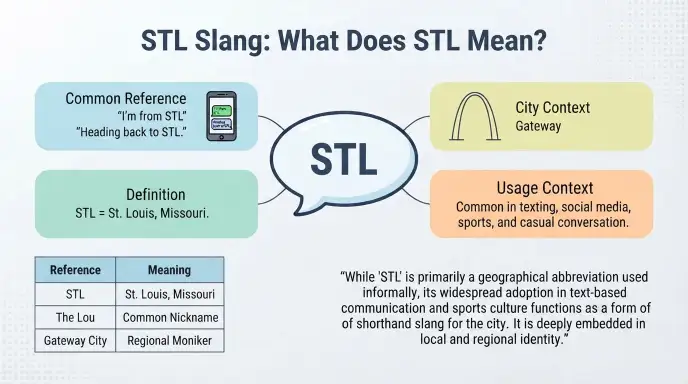
Have you ever seen “STL slang” online and wondered what people in St. Louis actually mean when they use certain words or phrases? St. Louis has a distinctive local culture, and its everyday language is part of that identity.
STL slang can appear in casual conversations, social media captions, music, sports discussions, texting, and conversations between people who know the city well. Some expressions are strongly connected to St. Louis, while others are broader American slang that locals use in their own way.
The interesting part is that local language is not always easy to understand from a standard dictionary. A word can have one meaning nationally but carry a more specific cultural meaning in St. Louis.
This guide explains STL slang, what “STL” means, where local expressions come from, and how St. Louisifrelated slang is used in real conversations.
Quick Answer
STL slang refers to the unique words, phrases, expressions, and informal language associated with St. Louis, Missouri. “STL” is a common abbreviation for St. Louis, and local slang can reflect the city’s neighborhoods, culture, food, music, sports, and everyday conversations.
Some STL expressions may sound unfamiliar to people outside the area. Understanding them can make conversations, social media posts, and references to St. Louis culture much easier to follow.
What Does STL Mean in Slang?
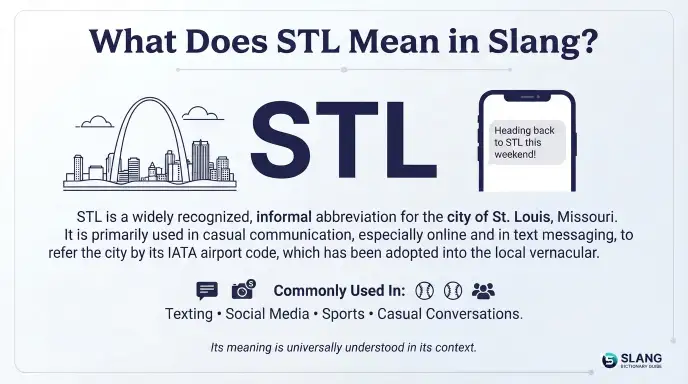
STL is commonly used as a short form for St. Louis, a city in Missouri. The abbreviation is especially common online, in social media usernames, sports discussions, local businesses, music, and casual texting.
For example, someone might write:
- “I’m from STL.”
- “Best food spots in STL?”
- “STL has its own vibe.”
- “Heading back to STL this weekend.”
In these examples, STL is not necessarily slang by itself. It is primarily an abbreviation for St. Louis. However, when people search for “STL slang,” they are usually looking for the local vocabulary and expressions associated with the city.
The meaning is therefore highly dependent on context. If you see STL in a locationifbased conversation, it almost always refers to St. Louis.
What Is STL Slang?
STL slang is informal language associated with St. Louis and its surrounding communities. It can include local nicknames, shortened words, neighborhood references, cultural expressions, foodifrelated terms, and phrases that have become familiar among local speakers.
Local slang develops naturally. People hear expressions from family members, friends, musicians, athletes, coworkers, and communities around them. Over time, certain words become recognizable as part of the local speech style.
Not every phrase used by someone from St. Louis is exclusive to St. Louis. American slang spreads quickly through music, television, TikTok, Instagram, Reddit, and other online platforms. Because of that, it is useful to distinguish between St. Louisifspecific language and general slang that is simply popular among St. Louis residents.
This distinction matters when learning STL slang. A phrase may be common in St. Louis without actually originating there.
Why Does St. Louis Have Its Own Slang?
Every major city develops its own vocabulary and speech patterns. St. Louis is no different.
The city’s history, neighborhoods, migration patterns, music scene, sports culture, and relationship with surrounding communities have all influenced the way people communicate.
Local language can also vary from one neighborhood or social group to another. Younger speakers may use expressions influenced by internet culture, while older generations may recognize regional terms that are less common among younger people.
This creates layers of language rather than one single “STL dictionary.”
Local Identity
Slang can become a way for people to show where they are from. Using a familiar local expression can immediately create a sense of connection between speakers.
Music and Pop Culture
Music has played an important role in spreading regional expressions. Artists can introduce local words and phrases to audiences far beyond the city.
Social Media
Platforms such as TikTok, Instagram, Snapchat, Reddit, and X can take a local expression and expose it to people across the country. Some terms may eventually lose their regional identity as they become mainstream.
Everyday Conversation
Some local expressions survive simply because people hear them at home, at school, at work, or around their neighborhood.
Common Places Where You May See STL Slang
STLifrelated slang is not limited to faceiftoifface conversations. It can appear in several online and offline settings.
| Place | How STL Slang May Appear |
| Texting | Short, casual expressions between friends |
| TikTok | Videos about St. Louis culture and local humor |
| Captions, comments, and local content | |
| Discussions about St. Louis neighborhoods and culture | |
| Discord | Casual conversations among local gaming or community groups |
| Music | Lyrics, interviews, and artist conversations |
| Sports | Fan discussions and local team references |
| Everyday speech | Conversations with friends, family, and coworkers |
The exact slang you encounter depends on the community and context. A phrase popular among teenagers may not be common among older speakers, while a longifestablished local expression may be widely recognized across generations.
STL Slang vs. General American Slang
One of the biggest sources of confusion is assuming that every informal word used in St. Louis is uniquely local.
That is not necessarily true.
A person from St. Louis may use nationwide internet slang such as “lowkey,” “bet,” “cap,” or “bro,” but that does not make those expressions STL slang.
The difference is regional association.
| Type | Meaning |
| STLifspecific slang | Strongly associated with St. Louis or its local culture |
| Regional slang | Used across a wider geographic area |
| Internet slang | Popular mainly through online communication |
| General American slang | Informal language used throughout the United States |
| Personal slang | Expressions used by a particular person or social group |
This distinction makes it easier to research local language accurately.
How STL Slang Changes Over Time
Slang is never completely fixed. Words that are popular today may become less common in a few years.
This is especially true because modern slang spreads through social media at an extremely fast pace. A phrase can begin in one community, become popular among young people, appear in videos and memes, and eventually reach users around the world.
St. Louis slang can change in the same way.
Older residents may recognize expressions that younger speakers rarely use. At the same time, younger St. Louis residents may combine local expressions with newer internet slang.
That means there is no single permanent list of “all STL slang.” Instead, local language continues to evolve.
Why Context Matters
The same word can mean different things depending on who says it and where it is used.
For example, a term may have a normal dictionary meaning but take on a humorous, ironic, or culturally specific meaning in a local conversation.
Before assuming that a phrase is uniquely St. Louis, consider:
- Who is using it?
- Where did the conversation happen?
- Is the speaker talking about St. Louis?
- Is the phrase common nationally?
- Is it associated with a particular age group or community?
These questions can prevent misunderstandings.
How to Understand STL Slang Correctly
If you encounter unfamiliar STL slang, don’t rely only on a literal dictionary definition. Slang is strongly influenced by context.
A good approach is to look at the entire sentence and the situation in which the expression was used.
For example, a phrase used in a joke may not have the same meaning when used seriously. Similarly, a word used in a St. Louis music discussion could have a cultural meaning that is different from its ordinary English definition.
Pay attention to the speaker’s tone, the surrounding words, and if the conversation is about local culture.
Listen to Real Usage
Real conversations are often more useful than isolated word lists. Look at how locals use a phrase rather than simply memorizing its definition.
Consider the Audience
A phrase that sounds natural among close friends may sound unusual in a professional conversation. Slang is generally informal, so it should be used carefully.
Check the Local Connection
Not every slang word used by a St. Louis resident is necessarily STL slang. Some words are simply part of modern American or internet vocabulary.
Why People Search for STL Slang
People search for STL slang for many different reasons.
Someone moving to St. Louis may want to understand local conversations. A visitor may encounter unfamiliar expressions while exploring the city. Someone researching American regional language may be interested in how St. Louis differs from other cities.
Social media is another major reason. A person may see a phrase in a TikTok comment, Instagram post, Reddit discussion, or text message and search for its meaning.
There is also a cultural reason. Local slang gives people insight into how communities develop their own identity through language.
Understanding STL slang is therefore more than memorizing unusual words. It can provide a small window into St. Louis culture and everyday communication.
Is STL Slang Used Outside St. Louis?
Yes. Some expressions associated with St. Louis can be understood or used outside the city, especially when they spread through music, social media, sports, or popular culture.
However, familiarity does not always mean widespread usage.
A person outside Missouri may recognize a St. Louis expression without naturally using it in everyday conversation. Likewise, some local terms may remain strongly connected to St. Louis even when people elsewhere have heard them.
The internet has made this boundary less clear. Regional slang can now travel thousands of miles in a matter of days.
Final Thoughts on STL Slang
STL slang is a broad term for informal language and expressions connected with St. Louis and its communities. “STL” itself is mainly an abbreviation for St. Louis, while the larger category of STL slang includes local expressions, cultural references, and language shaped by the city’s history and people.
The most important thing to remember is that slang changes. Not every expression used in St. Louis is unique to the city, and not every local term is used by every generation or community.
If you want to understand STL slang naturally, always consider context, location, age group, and the situation in which a phrase appears. That approach gives you a much clearer picture than simply memorizing a list of words.
Popular STL Slang and Local Expressions
St. Louis has a rich local culture, and some words or expressions are strongly connected with the city. However, it is important to remember that slang changes between generations, neighborhoods, and social groups.
The following examples help explain the kinds of language and references people may encounter when researching STL slang.
STL
STL is the most common abbreviation for St. Louis. You may see it in social media posts, usernames, hashtags, sports conversations, and text messages.
Example:
“I’m flying back to STL tomorrow.”
Here, STL simply means St. Louis.
The Lou
The Lou is a wellifknown informal nickname for St. Louis. It is often used casually by locals and people familiar with the city.
Example:
“I grew up in the Lou.”
The expression gives the city a more informal and personal identity than simply saying “St. Louis.”
STL Area References
People may also use neighborhood names, local landmarks, and regional references as shorthand for particular parts of the St. Louis area.
These references can sometimes feel like slang because locals understand them immediately while someone unfamiliar with the area may not.
St. Louis Slang and Local Culture
Language is closely connected to culture. In St. Louis, local speech can reflect the city’s food, music, sports, neighborhoods, and history.
A person who has lived in the area for years may recognize a local reference immediately, while a visitor may need additional context.
This is one reason STL slang can be difficult to define as one fixed list.
Local language often works through shared knowledge. A particular neighborhood name, food reference, nickname, or phrase may communicate much more than its literal meaning.
Food Culture
St. Louis is known for distinctive food traditions, and foodifrelated terms can become part of everyday local conversation.
One famous example is toasted ravioli, often shortened to “tifravs” in casual St. Louis conversation.
Example:
“Let’s get some tifravs before the game.”
Someone unfamiliar with the local expression might not immediately understand that “tifravs” refers to toasted ravioli.
Sports Culture
Sports also influence local vocabulary. St. Louis residents may use team names, player references, stadium names, and fan expressions as everyday shorthand.
These references are not necessarily slang in the strict linguistic sense, but they can function like local language because residents share an understanding of them.
STL Slang in Texting and Social Media
Modern STL slang is not restricted to spoken conversations. Local expressions and abbreviations frequently appear online.
Someone might use “STL” in a caption, comment, text message, or profile description simply to identify their connection to the city.
For example:
“STL born and raised.”
Or:
“Anybody in STL going to the game?”
The abbreviation is particularly convenient online because it saves space and is immediately recognizable to many people familiar with St. Louis.
TikTok and Instagram
Shortifform video platforms can help local expressions spread quickly. A phrase that was once primarily recognized by local residents can reach viewers across the United States.
Reddit discussions about St. Louis can contain neighborhood references, local humor, food terminology, and regional expressions.
Texting
Friends may use abbreviations and shortened expressions because casual texting naturally favors quick communication.
Discord and Gaming
Local gaming groups or communities may combine general internet slang with St. Louis references. In these spaces, it can sometimes be difficult to tell if a term is genuinely local or simply popular online.
STL Slang vs. St. Louis Accent
STL slang and the St. Louis accent are not the same thing.
Slang refers to informal words, expressions, or meanings. An accent refers to pronunciation and speech patterns.
A person can have a St. Louis accent without using much local slang. Similarly, someone can learn St. Louis expressions without having a local accent.
This distinction is important when researching regional language.
| Feature | What It Means |
| STL slang | Informal local words and expressions |
| St. Louis accent | Regional pronunciation and speech patterns |
| STL abbreviation | Short form of St. Louis |
| Local reference | A place, person, food, or cultural reference familiar to locals |
Are STL Slang Words the Same for Everyone?
No. There is no single list that every person in St. Louis uses.
Language varies according to age, location, social group, interests, and exposure to different forms of media.
A teenager who spends a lot of time on TikTok may use completely different slang from an older resident. Someone involved in local music may know expressions that are unfamiliar to someone who rarely follows that scene.
This is normal for regional slang.
Generational Differences
Younger speakers often mix local expressions with current internet slang. Older speakers may use expressions that have been around for decades.
Community Differences
Different communities can develop their own vocabulary. A word that is common in one social group may be unfamiliar to another.
Online Influence
Because social media connects people across regions, local slang can mix with national internet language.
Common Mistakes When Understanding STL Slang
When researching STL slang, people sometimes make a few predictable mistakes.
Assuming Every Local Word Is Unique to St. Louis
A word may be popular in St. Louis but also widely used elsewhere. Regional popularity does not automatically prove that a phrase originated in the city.
Treating a Nickname as Slang
Expressions such as “STL” and “The Lou” are informal ways of referring to St. Louis, but they do not necessarily represent the entire category of local slang.
Ignoring Context
Slang can change meaning depending on the conversation. Always look at the complete sentence rather than interpreting one word in isolation.
Assuming Slang Never Changes
Slang evolves constantly. A term popular several years ago may be less common today, while a newer internet expression can become popular very quickly.
How to Use STL Slang Naturally
If you are learning St. Louis expressions, the safest approach is to understand them before trying to use them.
You do not need to force local slang into every sentence. Natural usage usually comes from understanding the context and communicating with people who actually use the expression.
For example, using STL in a text message about St. Louis is straightforward:
“Are you still living in STL?”
But using a highly specific local expression without knowing its cultural context can sound unnatural.
Keep the Setting in Mind
Slang works best in informal situations. A casual conversation with friends is very different from a job interview, academic paper, or professional email.
Learn the Meaning First
Do not use a slang term simply because it looks popular online. Make sure you understand what it means and how people actually use it.
Pay Attention to Tone
Some expressions are humorous or playful. Others may be associated with particular communities or situations. Tone matters.
Why Local Slang Matters
Local slang provides more than an interesting collection of words. It shows how communities create identity through language.
When people share an expression, nickname, or reference, they also share a piece of cultural knowledge.
That is why learning STL slang can be useful for:
- Visitors learning about St. Louis
- People moving to the St. Louis area
- Students studying regional American English
- Language learners
- Researchers interested in slang
- People trying to understand social media posts
- Anyone curious about St. Louis culture
The value of slang is often found in the context behind the words.
Frequently Asked Questions About STL Slang
Q1. What does STL mean in slang?
STL usually means St. Louis, Missouri. It is commonly used as an abbreviation in texting, social media, sports conversations, usernames, and casual online communication.
Q2. What does “The Lou” mean?
“The Lou” is an informal nickname for St. Louis. It is commonly associated with casual references to the city and can be used by people who are familiar with St. Louis.
Q3. Is STL actually slang?
STL is better described as an abbreviation than traditional slang. However, people often search for it as slang because it is an informal shorthand for St. Louis.
Q4. Where is STL slang used?
STLifrelated expressions can appear in everyday conversations, texting, social media, music, sports discussions, Reddit, TikTok, Instagram, and other informal settings.
Q5. Is STL slang used outside St. Louis?
Yes. Some St. Louis expressions can spread outside the region through social media, music, sports, and popular culture. However, their recognition and frequency can vary significantly outside the area.
Q6. Is every slang word used in St. Louis considered STL slang?
No. St. Louis residents use plenty of general American and internet slang. A term is not automatically STL slang simply because someone in St. Louis uses it.
Q7. Does STL slang change over time?
Yes. Like other forms of slang, local expressions evolve. Social media, younger generations, music, migration, and cultural changes can all influence which terms people use.
What Makes STL Slang Different?
The most interesting feature of STL slang is its connection to local identity. Instead of being one fixed vocabulary, it is a combination of regional expressions, cultural references, abbreviations, neighborhood language, and broader slang used by local communities.
This means that understanding STL slang requires more than memorizing words.
You also need to understand where the expression comes from, who uses it, and what situation it appears in.
For someone new to St. Louis, learning these details can make local conversations easier to follow. For someone studying American English, they demonstrate how language changes from one community to another.
Conclusion
STL slang reflects the informal language, abbreviations, cultural references, and expressions connected with St. Louis. The abbreviation “STL” is widely used for the city, while expressions such as “The Lou” give St. Louis a more casual local identity.
However, STL slang should not be treated as a permanent dictionary. Language changes with generations, neighborhoods, social groups, music, and online culture. Some expressions are strongly local, while others are general American slang that happens to be popular among St. Louis residents.
The best way to understand an unfamiliar STL expression is to look at its context. Consider who is using it, where the conversation takes place, and if the term is genuinely regional or simply part of modern internet language.
if you are researching regional English, visiting St. Louis, or simply came across “STL” online, understanding the local context can make the meaning much clearer.

I’m Dylan Foster, a slang and internet culture writer passionate about exploring how people communicate online and in everyday conversations. I write about texting abbreviations, social media expressions, and modern slang to help readers understand meanings, origins, and real-world usage in a simple way.