When you see someone write “my moots,” “looking for moots,” or “let’s be moots” on social media, it can be confusing if you have never come across the term before. Unlike many traditional English words,comes from online community culture, where people use short and casual expressions to describe social connections.
On platforms such as TikTok, Instagram, X, Tumblr, Reddit, and other online communities, “moots” usually refers to mutuals if people who follow each other or.
interact with each other online. The term is especially common when users want to describe their online friends, followers, or mutual connections without using a longer phrase.
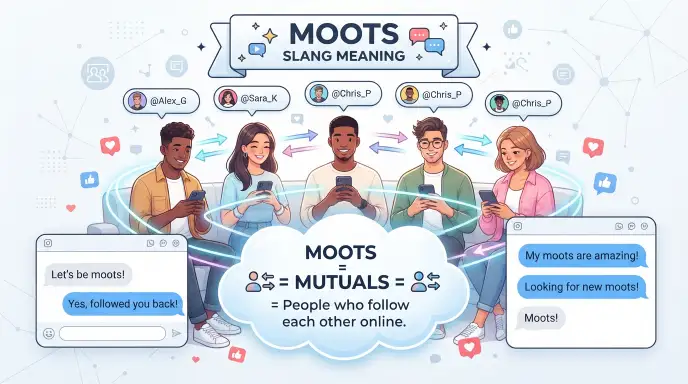
For example, someone might post, “I love my moots,” meaning they appreciate the people they interact with online. Another person may write, “Anyone want to be moots?” when they are looking for new mutual followers or online friends.
Understandingis useful because the word can appear in comments, captions, profiles, messages, and online conversations. Its exact meaning can also depend slightly on the platform and the relationship between the people using it.
In this guide, we’ll explain what “moots” means, where it came from, how people use it, examples, related terms, and common misunderstandings.
Quick Answer Moots Slang Meaning:
Moots means “mutuals” in internet slang. It usually refers to people who follow you and whom you also follow, or people with whom you have a mutual online connection.
For example, if someone says, “My moots are amazing,” they are talking about their online mutuals, followers, or socialifmedia connections.
You may see “moots” used in phrases such as:
- “Anyone want to be moots?”
- “Looking for new moots.”
- “My moots understand me.”
- “I met some great moots online.”
- “Which of my moots likes gaming?”
The word is informal and is mainly used in socialifmedia conversations. It can appear on platforms such as TikTok, Instagram, X, Tumblr, Discord, and other online communities, although usage varies from one platform and community to another.
In simple terms:
Moots = mutual online connections
A moot does not necessarily have to be a close friend. It can simply be someone you follow who also follows you. Over time, however, a moot can become an online friend or even a close personal friend.
What Does “Moots” Mean?
In online slang, “moots” is a shortened, informal form of “mutuals.”
A mutual is generally someone who follows you while you also follow them. In everyday internet language, people may call that person a moot.
For example, imagine you follow someone on TikTok because you both enjoy gaming content. They notice your account and follow you back. You occasionally comment on each other’s videos and share similar interests.
You could describe that person as:
“One of my moots.”
If you’re talking about several people, you might say:
“My moots love gaming.”
The term does not automatically mean that these people are close friends. It simply highlights a mutual online connection.
This distinction is important because socialifmedia relationships can exist at different levels. Someone can be a follower without being a mutual, while a mutual can eventually become an online friend.
The Origin of “Moots”
The slang use of “moots” comes from the online shortening of “mutuals.”
Internet communities frequently shorten words and phrases to make communication quicker and more casual. Social media encourages this type of language because users often communicate through short comments, captions, direct messages, replies, and posts.
Instead of writing:
“Does anyone want to become mutual followers?”
a user can simply write:
“Anyone want to be moots?”
The shorter version is faster and sounds more natural within internet culture.
There is not necessarily one specific person or event responsible for creating the slang. Like many internet expressions, “moots” developed through repeated use within online communities and gradually became familiar to more users.
Its popularity is also connected to the way social media allows strangers with similar interests to form communities. Two people may never have met in real life, but they can still interact regularly, follow each other, and build a social connection online.
Why Do People Say “Moots” Instead of “Mutuals”?
The biggest reason is simplicity.
Internet users often prefer language that is:
- Short
- Easy to type
- Casual
- Friendly
- Easy to recognize within a community
Compare these two sentences:
“I want to meet more mutual followers who like books.”
and:
“I want more bookifloving moots.”
The second sentence is much shorter and fits naturally into socialifmedia culture.
“Moots” also has a community feel. When someone says “Hey, moots!”, they are addressing people who already have some kind of online connection with them.
The word can therefore create a sense of belonging.
For example:
“Good morning, moots! What are you all reading today?”
This sounds like someone talking casually to their online community rather than making a formal announcement.
Moots vs. Mutuals: Are They the Same?
For most socialifmedia conversations, moots and mutuals have essentially the same meaning.
The main difference is style.
| Term | Meaning | Style |
| Mutuals | People with a mutual online connection | Informal |
| Moots | Short slang form of mutuals | Very casual/internet slang |
| Follower | Someone who follows an account | General |
| Online friend | Someone you have developed a friendship with online | More personal |
| Friend | Someone you have a social or personal friendship with | General |
For example:
“She is my mutual.”
and
“She is my moot.”
can mean roughly the same thing in an online conversation.
“Moot” is simply more associated with internet slang and casual socialifmedia language.
What Does “Let’s Be Moots” Mean?
One of the most common phrases you may encounter is:
“Let’s be moots.”
This usually means:
“Let’s become mutuals.”
In practical terms, the person is suggesting that you follow each other or connect online.
For example:
Person A: “You love fantasy books too?”
Person B: “Yes! Let’s be moots.”
Here, Person B is suggesting that they connect through social media because they share the same interest.
The phrase is generally friendly and casual. It does not automatically mean that the person is asking to become a close friend. It usually starts with a simple online connection.
What Does “Looking for Moots” Mean?
If someone writes “looking for moots,” they are usually saying that they want to meet new mutual online connections.
The person may be interested in finding users who share similar interests, hobbies, fandoms, or communities.
For example:
“Looking for book moots!”
means:
“I’m looking for people who love books and want to connect with me online.”
Similarly:
“Looking for gaming moots.”
means the person wants to connect with other people who enjoy gaming.
Other examples include:
- “Looking for anime moots.”
- “I need more music.”
- “Looking for art moots.”
- “Does anyone want to be fashion moots?”
- “I need more reading moots.”
The specific interest changes, but the basic idea stays the same: the person wants new mutual online connections.
How Is “Moots” Used on TikTok?
TikTok is one of the socialifmedia environments where internet slang can spread quickly.
Users may use “moots” in captions, comments, direct messages, or conversations about their followers.
For example:
“My moots are going to love this.”
This means the person expects their mutual online connections to enjoy the content.
Another example is:
“Any Swiftie moots here?”
The user is looking for mutuals who share an interest in that music community.
You might also see:
“Let’s be moots!”
This is generally an invitation to connect and follow each other.
The exact use depends on the community, but the underlying meaning remains connected to mutual online relationships.
How Is “Moots” Used on Instagram?
Instagram users can also use “moots” when talking about mutual followers or people they regularly interact with.
For example:
“My moots always support my posts.”
Here, “moots” refers to the user’s mutual online connections.
Another example:
“I want more fashion moots.”
This means the user would like to connect with people who share an interest in fashion.
Because Instagram is highly visual and communityifdriven, users can develop mutual connections through posts, Stories, Reels, comments, and direct messages.
How Is “Moots” Used on X?
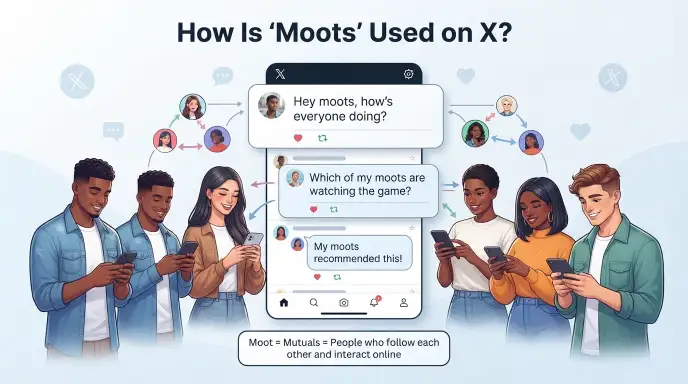
On X, formerly known as Twitter, users often interact with people through replies, reposts, quotes, likes, and shared interests.
“Moots” can be used to describe accounts that mutually follow each other.
For example:
“Which of my moots are watching the game tonight?”
The user is addressing their mutual online connections.
Another example:
“One of my moots recommended this book.”
This means someone with whom the user has a mutual online connection recommended the book.
How Is “Moots” Used in Other Online Communities?
Although “moots” is strongly associated with social media, its use is not limited to one platform.
It may appear in communities built around:
- Gaming
- Books
- Music
- Movies
- Anime
- Art
- Fashion
- Sports
- Technology
- Fan communities
- Creative hobbies
The word is especially useful when people meet online because of a shared interest.
For example, a gamer might say:
“I met three of my moots through this game.”
A reader might say:
“My book moots recommended some amazing novels.”
An artist might say:
“I love seeing what my art moots are creating.”
In each example, “moots” refers to people connected through an online social network or community.
Moots vs. Online Friends
One of the most important things to understand is that a moot is not necessarily an online friend.
These terms can overlap, but they are not identical.
A moot may simply be someone who follows you and whom you follow back.
An online friend usually involves a stronger personal connection. You might regularly chat, share experiences, play games together, or support each other.
For example:
“I have hundreds of moots but only a few close online friends.”
This sentence makes the distinction clear.
You can have many mutual connections without personally knowing every person.
At the same time, a moot can become a close friend over time.
A relationship might develop like this:
Follower → Mutual/Moot → Regular Interaction → Online Friend
Not every relationship follows this path, but it shows how the terms can relate to one another.
Is “Moots” a Positive or Negative Word?
In most online conversations, “moots” is neutral or positive.
The word itself is not an insult. It simply describes a type of online connection.
For example:
“I love my moots.”
has a positive meaning.
“My moots helped me choose an outfit.”
also has a positive meaning.
However, like almost any slang term, its meaning can be influenced by the surrounding sentence, tone, and community.
The safest way to understand it is to look at the context in which it appears.
Important: “” Has a Different Traditional English Meaning
There is another reason the word can be confusing.
The word “moot” already exists in standard English. You may have heard the phrase “moot point.”
That traditional meaning is different from the socialifmedia slang.
When you see:
“This is a moot point.”
you should not interpret “moot” as “mutual.”
But when you see:
“My moots are online.”
the word is being used as internet slang for mutual online connections.
Context is therefore extremely important.
Key Takeaway
Moots = mutuals.
In internet slang, “moots” usually describes people who have a mutual online connection, especially people who follow each other on social media.
The term is casual, friendly, and commonly associated with online communities. A moot may be a stranger, follower, mutual connection, or someone who eventually becomes an online friend.
If someone says “Let’s be moots,” they are generally asking to connect mutually online.
If someone says “My moots,” they are usually referring to their group of mutual online connections.
Understanding this simple meaning makes many socialifmedia posts and conversations much easier to understand.
Moots Slang Meaning in RealifWorld Online Conversations
The best way to understand moots slang meaning is to see how people actually use the word in online conversations. Unlike formal vocabulary, internet slang often depends on context, tone, and the type of community where it appears.
A person might use “moots” to address a group of mutual followers, describe an online connection, or invite new people into their social circle.
Here are some natural examples.
Example 1: “My moots are so funny.”
This means:
“My online mutuals are so funny.”
The speaker is probably talking about people they follow who also follow them back.
Example 2: “Anyone want to be moots?”
This means:
“Does anyone want to become mutuals and connect online?”
It is often an invitation to follow each other.
Example 3: “I made some new moots today.”
This means:
“I connected with some new mutuals today.”
The people may have discovered each other through similar interests or socialifmedia content.
Example 4: “My moots recommended this.”
This means:
“Someone I have a mutual online connection with recommended this.”
The recommendation might have come through a comment, post, direct message, or another social interaction.
Example 5: “Where are my gaming moots?”
This means:
“Where are the people I’m connected with online who also enjoy gaming?”
The phrase can be a way of starting a conversation with people who share the same interest.
Example 6: “I haven’t talked to my moots in forever.”
This suggests that the speaker has not interacted with their online mutual connections for a long time.
It can also show that “moots” are sometimes more than just passive followers. Some people regularly chat with their mutuals and develop genuine friendships.
What Does “Moot” Mean in the Singular Form?
Moot can refer to one mutual online connection.
For example:
“She’s one of my moots.”
Here, the speaker is referring to one person.
The plural form is:
“They’re my moots.”
So the basic pattern is:
- Moot = one mutual
- Moots = multiple mutuals
This is similar to how many online slang terms change between singular and plural forms.
However, users may not always follow strict grammatical rules when using internet slang. Socialifmedia language tends to be flexible and conversational.
What Does “Mutual” Mean on Social Media?
To understand moots slang meaning, it helps to understand the word “mutual.”
A mutual is generally a person who follows you and whom you follow back.
For example, imagine Person A follows Person B. Later, Person B follows Person A.
They now have a mutual connection.
Instead of saying:
“Person B is someone who follows me and whom I also follow,”
a user can simply say:
“Person B is my mutual.”
“Moot” is a casual slang version of this idea.
Is a Moot the Same as a Follower?
No. A follower and a moot are not necessarily the same thing.
A follower is someone who follows your account.
A moot usually suggests that the connection is mutual.
For example:
You follow Sarah, but Sarah does not follow you.
Sarah is your follower? No if f Sarah doesn’t follow you, she is not your follower. If Sarah follows you but you don’t follow her, she is your follower.
But if:
You follow Sarah and Sarah follows you back,
Sarah can be described as your moot or mutual.
A simple comparison is:
| Relationship | Description |
| Follower | Someone who follows your account |
| Following | An account you follow |
| Mutual | Someone you follow who also follows you |
| Moot | Informal slang for a mutual |
| Online friend | Someone with whom you’ve developed a friendship online |
This distinction is particularly useful when reading socialifmedia conversations.
Can You Have a Moot You Don’t Know Personally?
Yes.
In fact, this is very common.
A moot can be someone you’ve never met in person. You may know them only through their socialifmedia account, posts, comments, or shared community.
For example, two people might both enjoy the same video game. They follow each other, occasionally comment on each other’s posts, and share gaming content.
They may consider themselves moots even if they have never met offline.
This is one of the reasons internet slang is useful. It gives people a simple way to describe relationships that are real but exist primarily online.
Can Moots Become Real Friends?
Absolutely.
An online mutual connection can develop into a genuine friendship.
Two people might initially become moots because they share an interest in music or gaming. After talking regularly, they may start messaging each other, playing games together, sharing personal experiences, or supporting one another.
At that point, “moot” may still describe how they met, but “friend” may better describe the relationship.
For example:
“My moot from two years ago is now one of my closest friends.”
This sentence shows how online relationships can grow naturally.
Not every moot becomes a friend, of course. Some mutuals may remain casual connections, and that’s perfectly normal.
Common Mistakes About “
Although the word is simple once you know it, several misunderstandings are common.
Mistake 1: Thinking “moots” Means “Friends”
A moot can be a friend, but the two words are not automatically interchangeable.
Someone can be your moot without being someone you regularly talk to.
Better understanding:
Moot = mutual online connection
Friend = someone with whom you have a friendship
The relationship can overlap, but the words describe different things.
Mistake 2: Thinking Every Follower Is a Moot
Not every follower is mutual.
If someone follows you but you do not follow them, they are generally a follower rather than a moot.
The word “mutual” suggests that the connection goes both ways.
Mistake 3: Thinking Moots Must Live Nearby
They don’t.
Moots can live in completely different cities or countries. Social media allows people to build connections across geographic boundaries.
You could have moots from:
- Your own city
- Other parts of your country
- Different countries
- Different time zones
- Different cultural backgrounds
This is one reason online communities can be so diverse.
Mistake 4: Thinking “Moot” Always Means Close Relationship
It doesn’t.
A moot can be someone you barely know.
For one person, “moot” might mean someone they occasionally interact with. For another person, it might refer to a close online friend.
The context and individual relationship matter.
Mistake 5: Using “Moots” in Formal English
“Moots” is casual internet slang.
You would generally not use it in:
- Academic essays
- Formal reports
- Job applications
- Business letters
- Professional emails
- Official documents
Instead, use clearer terms such as mutual connections, mutual followers, or online contacts, depending on what you mean.
How to Use “Moots” Naturally
If you’re using the word yourself, keep the context casual.
Here are some natural examples:
“Hey, moots! How’s everyone doing?”
“I need more book moots.”
“My moots are obsessed with this show too.”
“Anyone here want to be moots?”
“I met one of my best online friends through my moots.”
“Which of my moots plays this game?”
These examples sound natural because they use “moots” in a socialifmedia setting.
Moots in Fandom Communities
The word is particularly useful in online fandoms.
People who love the same musician, TV show, movie, book series, anime, game, or fictional universe may connect with one another through social media.
For example:
“Looking for more anime moots!”
The user is probably looking for people who share an interest in anime and want to connect online.
Similarly:
“My music moots understand my playlist.”
This means the speaker’s online mutuals share or understand their musical interests.
Fandom communities can turn simple mutual connections into active friendships because people already have a shared topic to discuss.
Moots in Gaming Communities
Gaming communities are another environment where the term can appear.
Players may follow each other on social media, communicate through gaming communities, share clips, discuss games, or play together.
For example:
“I need more gaming moots.”
This means:
“I want to connect with more people who enjoy gaming.”
A gaming moot may remain a casual socialifmedia connection, or the relationship may grow into a regular gaming friendship.
The important point is that “moot” describes the online connection, not the strength of the friendship.
Moots and Online Community Culture
The popularity of terms like “moots” reflects a broader change in how people communicate online.
Traditional friendship language does not always describe modern digital relationships perfectly.
For example, you might:
- Follow someone you’ve never met
- Talk to them every week
- Share the same hobby
- Comment on each other’s posts
- Play games together
- Never meet offline
Calling this person a “moot” provides a simple way to describe that relationship.
It recognizes that online connections can exist somewhere between strangers, followers, acquaintances, and friends.
Why “Moots” Can Feel More Friendly Than “Followers”
The word “follower” can sound oneifsided.
A follower follows an account.
A mutual relationship suggests that both people have chosen to connect.
That’s why phrases such as:
“My moots”
can feel warmer than:
“My followers.”
It emphasizes community rather than audience.
For creators and ordinary socialifmedia users alike, this distinction can matter. Someone may see their mutuals as people who actively participate in their online community rather than simply people who subscribe to their content.
Is “Moots” Used by Everyone Online?
No.
Internet slang is highly dependent on age, platform, community, country, and personal preference.
Some users may use “moots” frequently, while others may have never heard the word.
You might also encounter people who prefer:
- Mutuals
- Online friends
- Friends
- Followers
- Internet friends
- Mutual followers
- Online connections
Therefore, if someone does not understand “moots,” there is no need to assume they are unfamiliar with social media. Slang varies considerably between communities.
Related Internet Slang Terms
If you’re learning moots slang meaning, you may also encounter several related expressions.
Mutuals
The original and more straightforward term for people with a mutual online connection.
Mutual
The singular form of mutuals.
Example:
“She’s my mutual.”
Follower
Someone who follows your socialifmedia account.
Online Friend
Someone you have developed a friendship with primarily through the internet.
IRL
Short for “in real life.”
Someone might distinguish between an online moot and an IRL friend.
DM
Short for “direct message.”
Moots may communicate through DMs when they want to have a private conversation.
Fandom
A community of fans who share an interest in a particular person, work, franchise, hobby, or subject.
Moots are often found within fandom communities.
Easy Memory Trick moots slang meaning
If you have trouble remembering what “moots” means, use this simple trick:
Moots → Mutuals → Mutual connection
Think of two arrows pointing toward each other:
You → Them
Them → You
That is the basic idea behind a mutual.
So when you see:
“My moots”
think:
“My mutual online connections.”
This simple association makes the slang much easier to remember.
FAQs About Moots Slang Meaning
Q1. What does “ mean in slang?
Moots means “mutuals” in internet slang. It usually refers to people who follow you and whom you also follow, or people who share a mutual online connection.
Q2. What does “let’s be moots” mean?
“Let’s be moots” usually means “let’s become mutuals.” The person is suggesting that you connect online, often by following each other on social media.
Q3. What does “looking for moots” mean?
“Looking for moots” means someone wants to meet or connect with new mutual online followers. They may be looking for people who share similar interests, hobbies, fandoms, or communities.
Q4. Is a moot the same as an online friend?
Not necessarily. A moot is usually a mutual online connection, while an online friend is someone with whom you have developed a friendship. A moot can eventually become an online friend.
Q5. Is “moots” a positive word?
Yes. “Moots” is generally a neutral or friendly internet slang term. It does not have a negative meaning by itself. The tone depends on how it is used in the conversation.
Q6. Can “moots” mean followers?
Sometimes people may use the word loosely when talking about their online audience, but its more specific slang meaning is mutuals—people with whom the online connection goes both ways.
Q7. Is “moots” formal English?
No. “Moots” is informal internet slang. It is best suited to casual conversations, socialifmedia posts, comments, messages, and online communities rather than professional or academic writing.
Q8. Can a moot become a realiflife friend?
Yes. A person may first become your moot through social media and later become an online friend or even a realiflife friend. The term describes the original or continuing online connection rather than the complete depth of the relationship.
Q9. What is the singular form of moots?
The singular form is generally “moot.”
For example:
“She is one of my moots.”
or:
“He is my moot.”
Q10. Why do people use “moots” instead of “mutuals”?
“Moots” is shorter, quicker to type, and fits the casual style of internet communication. It has also become recognizable within many online communities.
Conclusion:
The moots slang meaning is simple once you understand the idea behind online mutual connections. In most socialifmedia conversations, “moots” means “mutuals” if people who follow you and whom you also follow, or people who have a mutual online relationship with you.
The word is casual and communityiffocused. You may see it in phrases such as “my moots,” “looking for moots,” and “let’s be moots.” These expressions are especially useful when people are making connections around shared interests such as gaming, books, music, anime, art, fashion, or other online communities.
It is also important to remember that a moot is not automatically a close friend. Some moots may simply be casual mutual followers, while others can become trusted online friends over time.
If you come across “moots” on social media, the easiest way to remember it is:
Explore More!

I’m Dylan Foster, a slang and internet culture writer passionate about exploring how people communicate online and in everyday conversations. I write about texting abbreviations, social media expressions, and modern slang to help readers understand meanings, origins, and real-world usage in a simple way.