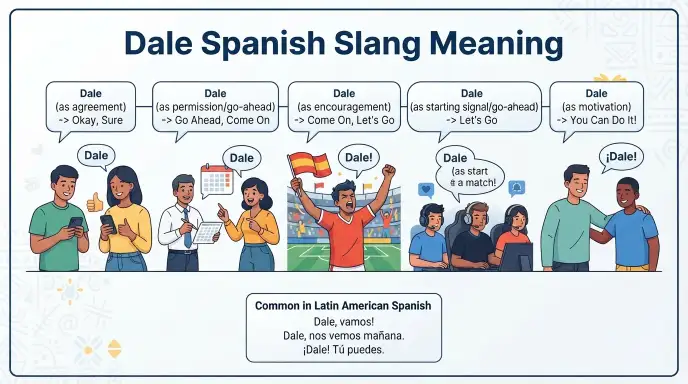
Dale Spanish slang is a common and highly flexible expression that appears in casual Spanish conversations, text messages, social media, music, sports, and online communities. If you have seen someone reply with simply “dale,” you may wonder if it means “okay,” “sure,” “go ahead,” or “let’s go.”
The interesting thing about dale is that there is no single English translation that works in every situation. Its meaning changes with the conversation, tone, and country where Spanish is being spoken. In one message, it can show agreement. In another, it can encourage someone to act. It can even be used to push someone to hurry up.
Dale is especially familiar in Latin American Spanish and is strongly associated with informal communication.
Quick Answer
Dale can mean “okay,” “sure,” “go ahead,” “come on,” “let’s go,” or “go for it,” depending on context. It is generally casual, friendly, and nonifoffensive.
What Does Dale Mean in Text?
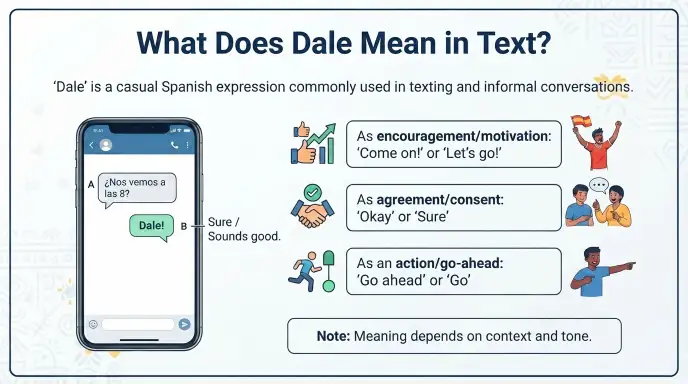
In texting, dale is often a quick response showing agreement or acceptance.
For example:
Friend: “¿Nos vemos a las ocho?”
You: “Dale.”
A natural English translation would be:
“Sure.”
“Okay.”
“Sounds good.”
This is one of the most common ways English speakers may encounter dale in a casual Spanish conversation.
However, dale is much more flexible than the English word “okay.” It can also encourage someone to continue, start an activity, or take action.
For example:
“Dale, vamos.”
Depending on context, this can mean:
“Okay, let’s go.”
Another example is:
“¡Dale!”
This could mean:
“Go for it!”
“Come on!”
“Let’s go!”
The surrounding conversation tells you which meaning makes the most sense.
What Does Dale Stand For?
Unlike abbreviations such as “LOL” or “BRB,” dale does not stand for an English phrase.
It is an actual Spanish word and conversational expression connected to the verb dar, which means “to give.”
In some grammatical situations, dale has a literal grammatical function. But in casual speech, it is also used as an established expression with meanings that cannot always be translated wordifforifword.
For example, when a friend says:
“Dale.”
they are usually not literally telling you “give it.”
Instead, depending on context, they may be saying:
- “Okay.”
- “Sure.”
- “Go ahead.”
- “Let’s do it.”
- “Come on.”
- “Go for it.”
This is why translating slang wordifforifword can sometimes create confusion.
What Is the Dale Spanish Slang Full Form?
There is no special full form or acronym for dale.
The word comes from the Spanish verb dar (“to give”), and its conversational meanings developed through common Spanish usage.
If someone searches for the dale slang full form, they may expect something similar to an internet abbreviation. That is not how dale works.
A more useful way to understand it is to learn its common conversational functions:
| Dale in Context | Natural English Meaning |
| “Dale.” | Okay / Sure |
| “Dale, vamos.” | Okay, let’s go |
| “¡Dale!” | Come on! / Go for it! |
| “Dale, hazlo.” | Go ahead, do it |
| “Dale, nos vemos.” | Sure, see you |
| “¡Dale, equipo!” | Come on, team! |
The exact translation depends on what is happening in the conversation.
Is Dale Rude, Offensive, or Neutral?
Dale is generally neutral, informal, and positive.
It is not normally a rude or offensive word. In many conversations, it sounds friendly and natural.
For example:
“¿Quieres venir con nosotros?”
“Dale.”
This is simply an informal way to say:
“Sure.”
However, dale can become more forceful depending on tone and the words around it.
For example:
“¡Dale, apúrate!”
can mean:
“Come on, hurry up!”
Here, the speaker may sound impatient.
This does not mean Dale itself is offensive. Rather, the context and delivery make the expression sound more demanding.
Friendly Tone
“Dale, nos vemos mañana.”
Meaning:
“Sure, see you tomorrow.”
Excited Tone
“¡Dale! ¡Vamos!”
Meaning:
“Let’s go!”
Impatient Tone
“¡Dale, apúrate!”
Meaning:
“Come on, hurry up!”
So, when interpreting dale in a text message, pay attention to punctuation, surrounding words, and the relationship between the speakers.
Is Dale a Positive Word?
Most of the time, yes.
Dale frequently communicates:
- Agreement
- Encouragement
- Approval
- Excitement
- Motivation
- Willingness
- Support
For example:
“¿Jugamos otra partida?”
“Dale.”
The response shows that the person agrees to play.
Another example:
“No sé si debería participar.”
“¡Dale! Tú puedes.”
Here, Dale is encouraging the person to take part.
Because it can communicate enthusiasm in a very short form, it is especially useful in casual conversations.
Where Is Dale Commonly Used?
Dale is widely recognized in Spanishifspeaking communities, especially in Latin America. Its frequency and exact conversational use can vary from one country to another.
It is particularly associated with informal speech in places such as Argentina and Uruguay, where you may hear it frequently in everyday conversations.
You can also encounter it in digital communication, including:
- Text messages
- TikTok
- YouTube comments
- Group chats
- Sports discussions
- Gaming conversations
- Music and entertainment
Dale in Text Messages
A friend may simply write:
“Dale.”
This can be equivalent to:
“Okay.”
or:
“Sure.”
Dale on Social Media
A creator might write:
“¿Hacemos parte 2?”
Someone may comment:
“¡Dale!”
Meaning:
“Yes, do it!”
Dale in Gaming
A player might ask:
“¿Jugamos otra?”
A teammate replies:
“Dale.”
Meaning:
“Sure, let’s play another.”
Dale Meaning in Different Contexts
The most important thing about dale is that its meaning changes according to context.
1. Dale Meaning “Okay”
This is a common conversational use.
“Te escribo después.”
“Dale.”
Meaning:
“Okay.”
The speaker is acknowledging the plan.
2. Dale Meaning “Sure”
When someone accepts an invitation or suggestion, dale can mean “sure.”
“¿Quieres venir a cenar?”
“Dale.”
Meaning:
“Sure.”
This sounds relaxed and informal.
3. Dale Meaning “Go Ahead”
Dale can give someone encouragement or permission to proceed.
“¿Empiezo?”
“Dale.”
Meaning:
“Go ahead.”
This is useful when someone is waiting for confirmation before doing something.
4. Dale Meaning “Let’s Go”
When used enthusiastically, dale can motivate people to begin.
“¡Dale, vamos!”
Meaning:
“Come on, let’s go!”
The expression can carry excitement and energy.
5. Dale Meaning “Go for It”
If someone is unsure about taking an action, another person may respond:
“¡Dale!”
Meaning:
“Go for it!”
For example:
“¿Le mando el mensaje?”
“¡Dale!”
The speaker is encouraging them to send it.
6. Dale Meaning “Come On”“¡Dale, vamos!”
Depending on tone, this may mean:
“Come on, let’s go!”
This use can be enthusiastic or impatient.
Real:Life Examples of Dale Spanish Slang
Friendly Example
Person A: “¿Quieres venir mañana?”
Person B: “Dale.”
English: “Sure.”
Tone: Friendly and relaxed.
Casual Texting Example
Person A: “Te mando la ubicación después.”
Person B: “Dale.”
English: “Okay, sounds good.”
Tone: Casual and cooperative.
Encouraging Example
“¡Dale! Inténtalo una vez más.”
English: “Come on! Try it one more time.”
Tone: Supportive and motivating.
Sports Example
“¡Dale, equipo!”
English: “Come on, team!”
Tone: Energetic and motivational.
Gaming Example
Player 1: “¿Otra partida?”
Player 2: “Dale.”
English: “Another game?” / “Sure.”
Tone: Casual and enthusiastic.
Social Media Example
Creator: “¿Quieren otro video?”
Comment: “¡Dale!”
English: “Absolutely!” or “Yes, do it!”
Tone: Excited and supportive.
Impatient Example
“¡Dale, apúrate!”
English: “Come on, hurry up!”
Tone: Impatient or demanding.
This example is useful because it shows that dale does not automatically sound friendly. The surrounding words and situation influence the emotional tone.
Origin and Background of Dale
The word dale is connected to the Spanish verb dar, which generally means “to give.”
In standard Spanish grammar, dale can appear as a verb form combined with a pronoun. For example, in a literal context, it can be understood as an instruction related to giving something to someone.
But its use as a conversational expression developed into something broader.
In informal Latin American Spanish, dale can function almost like a conversational signal. Instead of focusing on the literal meaning of the verb, speakers use it to communicate agreement, encouragement, urgency, or willingness to proceed.
The expression is particularly familiar in Rioplatense Spanish, especially in Argentina and Uruguay. It has also become widely recognizable outside those regions through sports, music, television, and online culture.
Latin music and social media have helped expose international audiences to expressions such as dale. As a result, even people who do not speak Spanish fluently may recognize the word from songs, videos, memes, and sports content.
Why Do People Use Dale?
One major reason dale is so popular is its flexibility.
In English, you might need several different phrases to communicate the ideas dale can express:
- “Okay.”
- “Sure.”
- “Sounds good.”
- “Go ahead.”
- “Come on.”
- “Let’s go.”
- “Go for it.”
Dale can communicate several of these ideas depending on context.
It is also quick. In a fast conversation, saying “dale” is much easier than giving a long response.
For example:
“Nos vemos a las siete.”
“Dale.”
The second speaker does not need to write a complete sentence to show agreement.
This makes dale especially natural in texting and other informal communication.
Dale vs. Vamos
Dale and vamos can sometimes both communicate the idea of “let’s go,” but they are not identical.
Vamos comes from the verb ir, meaning “to go,” and directly communicates movement or a suggestion to leave or go somewhere.
For example:
“Vamos al cine.”
means:
“Let’s go to the movies.”
Dale is broader.
For example:
“¿Vamos al cine?”
“Dale.”
Here, dale means:
“Sure, let’s go.”
So, vamos focuses more directly on going, while dale can express agreement with the suggestion.
Dale vs. Sí
Another useful comparison is dale vs. sí.
Sí simply means “yes.”
For example:
“¿Quieres café?”
“Sí.”
This is a straightforward yes.
Dale can sound more conversational:
“¿Quieres café?”
“Dale.”
Depending on the regional context, this could communicate agreement or acceptance, although the exact phrasing may vary among Spanish speakers.
In other words, sí is a direct “yes,” while dale has a broader conversational role.
Dale vs. Vale
English learners may also confuse dale with vale.
Vale is especially common in Spain and often means:
- Okay
- Alright
- Fine
- Got it
For example:
“Nos vemos a las ocho.”
“Vale.”
Dale can serve a similar conversational purpose in some Latin American contexts:
“Nos vemos a las ocho.”
“Dale.”
Both can communicate agreement, but they are associated with different regional patterns of Spanish usage.
A simple rule is:
Vale is strongly associated with Spain, while dale is especially common in Latin American informal speech.
When Should You Avoid Using Dale?
Dale is not offensive, but it is informal slang or conversational language, so it may not fit every situation.
You should be careful with it in:
- Academic writing
- Formal business communication
- Official documents
- Professional reports
- Formal presentations
- Job applications
For example, writing:
“Dale, we can continue with the project.”
would not be appropriate in a formal English business document.
A professional version could be:
“Yes, we can continue with the project.”
Similarly, if you are learning Spanish and speaking to someone in a very formal situation, a more standard expression may be preferable depending on what you want to communicate.
Is Dale Safe for Social Media?
Yes. Dale is generally safe and nonifoffensive for social media.
You can commonly encounter it in casual comments, captions, chats, videos, and conversations.
Its meaning is usually positive or encouraging, but you should still consider the context.
For example:
“¡Dale!
may communicate:
“Let’s go!” or “Go for it!”
Meanwhile:
“Dale, apúrate.”
can sound like:
“Come on, hurry up.”
The word itself is not the problem. The surrounding language determines the tone.
Key Takeaway
The easiest way to remember dale Spanish slang is:
Dale = okay / sure / go ahead / come on / let’s go, depending on context.
It is a highly flexible expression used mainly in informal Spanish. It is especially common in Latin American contexts and can be heard in everyday conversations, texting, sports, music, and social media.
When you see “dale” in a message, do not automatically translate it wordifforifword. Instead, look at what the speaker is responding to. If someone is making plans, it may mean “sure.” If someone is encouraging another person, it may mean “go for it.“
How Is Dale Used in Everyday Spanish?
One reason dale can be confusing for Spanish learners is that native speakers do not always use it in exactly the same way. The expression can function as a response, an encouragement, a command, or an enthusiastic reaction.
The situation usually provides the missing information.
For example, if someone asks:
“¿Nos vemos mañana?”
and the answer is:
“Dale.”
the natural interpretation is “Sure” or “Okay.”
But if someone shouts:
“¡Dale!”
during a sports match, it may be closer to:
“Come on!”
“Let’s go!”
This flexibility is one reason the word appears so often in informal conversation.
Dale as a Way to Agree
One of the most useful meanings for English learners is agreement.
Imagine that a friend suggests a plan:
“¿Vamos a comer después?”
You could respond:
“Dale.”
The speaker is agreeing with the suggestion.
Depending on the country and situation, English translations could include:
- Sure
- Okay
- Sounds good
- Alright
- Let’s do it
The word does not necessarily show excitement. Sometimes it is simply a quick confirmation.
Example
“Te llamo después del trabajo.”
“Dale.”
Natural meaning:
“Okay, call me later.”
This is especially common in casual conversations between friends or people who are already familiar with each other.
Dale as Encouragement
Another important use is encouragement.
Someone might be nervous about trying something new, and a friend can say:
“¡Dale!”
Here, the speaker is encouraging the person to take action.
Natural English translations might be:
- Go for it!
- Do it!
- Come on!
- You can do it!
Example
“No sé si debería participar en la competition.”
“¡Dale! Va a estar bueno.”
The second person is encouraging the first person to participate.
This version of dale is usually energetic and supportive.
Dale as “Come On”
Dale can also be used when someone wants another person to move faster or continue an activity.
For example:
“¡Dale, tenemos que irnos!”
A natural English translation would be:
“Come on, we have to go!”
This can be friendly, excited, or impatient depending on the speaker’s tone.
If a friend says it while laughing, it may simply be playful.
If someone says it angrily, it can sound demanding.
That is why tone matters as much as the word itself.
Dale as “Let’s Go!”
In sports, gaming, parties, and other energetic situations, dale can communicate excitement.
For example:
“¡Dale, equipo!”
This can be translated as:
“Come on, team!”
or:
“Let’s go, team!”
You may hear similar uses when people are celebrating a victory or encouraging someone during a competition.
The expression works particularly well in these situations because it is short and energetic.
Dale in Argentine Spanish
Dale is strongly associated with Argentine Spanish, where it can be heard in many informal conversations.
In Argentina, a speaker may use dale to agree to plans, encourage someone, express impatience, or move a conversation forward.
For example:
“¿Tomamos un café?”
“Dale.”
This can mean:
“Sure.”
Another example:
“Dale, contame.”
This can be understood as:
“Come on, tell me.”
The exact meaning depends on the conversation.
Because Argentine Spanish has its own vocabulary, rhythm, and expressions, learners may encounter dale more frequently when watching Argentine videos, listening to Argentine speakers, or consuming Latin American entertainment.
Dale in Uruguayan Spanish
Dale is also familiar with Uruguayan Spanish.
As in Argentina, it can be used in informal situations to show agreement or encouragement.
For example:
“¿Vamos después?”
“Dale.”
The response indicates agreement.
A learner should remember that Spanish is not completely uniform across countries. A word can be common in one Spanishifspeaking region while being less common or slightly different elsewhere.
So, if you hear dale repeatedly in Argentine or Uruguayan content, that does not necessarily mean every Spanish speaker uses it in exactly the same way.
Dale in Latin American Pop Culture
Dale has become widely recognizable outside everyday conversation because of Latin music, sports, entertainment, and social media.
People may encounter the word in songs, interviews, videos, memes, and captions.
In entertainment, dale often has an energetic quality. It can help communicate excitement, encouragement, or momentum.
This is one reason Englishifspeaking audiences may recognize the word even without speaking much Spanish.
However, hearing dale in a song does not necessarily mean it has one fixed translation. The lyrics and surrounding phrases determine the intended meaning.
Is Dale Spanish Slang or a Regular Spanish Word?
This is an important distinction.
Dale is a real Spanish word, but its conversational uses can be considered informal or slangiflike depending on the context.
It is not simply an internet invention.
Native speakers use dale in everyday spoken communication, and it has grammatical as well as idiomatic uses.
That means it is different from newer internet expressions that exist mainly on social media.
Calling it “Spanish slang” is useful when discussing its informal meanings, but learners should understand that the word has a broader linguistic history.
Dale and Its Literal Meaning
The conversational meaning of dale can seem strange if you only know the literal meaning of dar, which means “to give.”
In certain grammatical contexts, dale can literally function as a form related to “give” plus a pronoun.
For example, a phrase such as:
“Dale el libro.”
means:
“Give him/her the book.”
Here, dale is being used in a literal grammatical construction.
But in a message such as:
“¿Nos encontramos a las seis?”
“Dale.”
the expression is not being understood as “give him/her.”
Instead, it functions as an informal response meaning something like:
“Sure.”
This distinction is important for language learners.
Why Literal Translation Can Be Misleading
Slang and conversational expressions rarely translate perfectly wordifforifword.
If you put dale into a translation tool without considering the surrounding sentence, you may get a literal meaning that does not fit the conversation.
For example:
“¡Dale!”
could be interpreted in different ways depending on context:
- “Go ahead!”
- “Come on!”
- “Let’s go!”
- “Go for it!”
- “Do it!”
The best translation is the one that preserves the speaker’s intention, not necessarily the exact individual words.
This is true of slang in every language.
Dale in Text Messages
Texting makes dale particularly useful because people often prefer short responses.
Instead of:
“Yes, that sounds good. I agree with your plan.”
a person may simply write:
“Dale.”
The meaning is immediately understood by someone familiar with the expression.
Example Conversation
Ana: “¿Te paso a buscar a las siete?”
Luis: “Dale.”
Ana: “Perfecto.”
Here, dale means:
“Sure.”
It is concise and natural.
Dale With Emojis
On social media and in text messages, dale may appear alongside emojis.
For example:
“¡Dale
This can emphasize excitement.
Another example:
“Dale
Depending on context, this might communicate playful agreement.
Or:
“¡Dale!
This can suggest encouragement or motivation.
The emoji does not change the basic meaning of dale, but it can make the speaker’s emotional intention easier to understand.
Dale in Sports
Sports are a particularly good example of how dale can become energetic.
Imagine fans supporting a team:
“¡Dale, dale!”
This may function similarly to:
“Come on!”
“Let’s go!”
“Keep going!”
The repetition adds energy.
You might also hear:
“¡Dale campeón!”
This is an enthusiastic expression of support.
In this environment, translating every instance of dale as “okay” would be completely wrong.
The surrounding situation tells you that the word is being used as encouragement.
Dale in Gaming
Gaming conversations are another place where short expressions are useful.
A player might ask:
“¿Jugamos otra partida?”
A teammate responds:
“Dale.”
Meaning:
“Sure.”
During an intense moment, someone might shout:
“¡Dale!”
Meaning:
“Come on!”
The same word therefore works both as an agreement and as an encouragement.
Gaming also tends to encourage informal language, making expressions such as dale feel natural.
Dale vs. Bueno
English learners may sometimes encounter bueno in situations where they would expect dale.
Bueno can mean:
- Good
- Well
- Okay
- Alright
For example:
“Bueno, vamos.”
can mean:
“Okay, let’s go.”
Dale can also communicate agreement:
“Dale, vamos.”
But the emotional feeling may be different.
Bueno is a very broad Spanish word with many functions, while dale often has a more active or encouraging quality in informal conversation.
Dale vs. Está Bien
Another useful comparison is dale vs. está bien.
Está bien literally means “it is fine” or “it is okay.”
For example:
“¿Está bien si llego tarde?”
“Sí, está bien.”
This is a direct and relatively neutral way to say that something is acceptable.
Dale can sound more casual:
“Dale.”
It can communicate agreement without explaining anything further.
In everyday informal communication, that shortness is part of its appeal.
Dale vs. De Acuerdo
De acuerdo means “agreed,” “alright,” or “in agreement.”
It can be used in both neutral and formal contexts.
For example:
“Nos reunimos a las diez.”
“De acuerdo.”
This is a clear confirmation.
Dale is generally more informal:
“Nos reunimos a las diez.”
“Dale.”
Both can show agreement, but they create different tones.
If you are writing a formal email, de acuerdo or another standard expression may be more appropriate than dale.
Common Mistakes English Speakers Make With Dale
Mistake 1: Assuming Dale Always Means “Okay”
Although “okay” is a common translation, it is not the only one.
If someone says:
“¡Dale!”
during a football match, they may be encouraging the team rather than agreeing to something.
Mistake 2: Translating It Literally Every Time
The word has conversational meanings that cannot always be understood through literal translation.
Mistake 3: Ignoring Regional Differences
Spanish differs across countries. An expression that sounds extremely natural in Argentina may not be equally common in every Spanishifspeaking region.
Mistake 4: Using It in Formal Writing
Dale is informal. It is usually better suited to friends, casual conversations, social media, and relaxed communication.
Mistake 5: Missing Sarcasm or Impatience
“Dale” can sound encouraging or impatient depending on tone.
Compare:
“¡Dale! Tú puedes.”
with:
“¡Dale, apúrate!”
The first is supportive. The second may be demanding.
How to Reply When Someone Says Dale
If someone sends you “dale” in a Spanish conversation, your response depends on what they mean.
If they are agreeing with your plan, you can continue the conversation normally.
For example:
You: “Nos vemos a las ocho.”
Them: “Dale.”
You: “Perfecto.”
If they are encouraging you, you can respond with an action or acknowledgment.
Them: “¡Dale, hacelo!”
You: “Okay, voy.”
The important thing is to understand the context rather than treating dale as a fixed phrase.
FAQs About Dale Spanish Slang
Q1. What does dale mean in Spanish slang?
Dale can mean “okay,” “sure,” “go ahead,” “come on,” “let’s go,” or “go for it.” The exact meaning depends on context and tone.
Q2. Is dale a Spanish swear word?
No. Dale is not a swear word. It is generally a casual and nonifoffensive expression.
Q3. Is dale used in Argentina?
Yes. Dale is particularly common in informal Argentine Spanish and is also familiar in other parts of Latin America.
Q4. Does dale mean “okay”?
It can. In a casual conversation, dale is often used to show agreement, similar to “okay,” “sure,” or “sounds good.”
Q5. Can dale mean “come on”?
Yes. When used to encourage someone or urge them to act, dale can mean “come on” or “go for it.”
Q6. Is dale formal Spanish?
Generally, dale is associated with informal conversation. More neutral or formal expressions may be preferable in professional and academic settings.
Final Takeaway: Understanding Dale in Context
Dale Spanish slang is a flexible expression that can communicate agreement, encouragement, approval, excitement, or urgency.
The simplest way to understand it is not to memorize one English translation. Instead, look at what the speaker is trying to accomplish.
If someone responds to a suggestion with:
“Dale.”
think “Sure” or “Okay.”
If someone encourages another person with:
“¡Dale!”
think “Go for it” or “Come on.”
If a sports fan shouts:
“¡Dale!”
think “Let’s go!”
And if someone says:
“¡Dale, apúrate!”
think “Come on, hurry up.”
The word is generally safe and friendly, but its tone can shift with the situation. It is especially useful to recognize when watching Spanishiflanguage content or communicating casually with Latin American Spanish speakers.
Most importantly, dale is a contextifdependent expression. Learning its different uses will help you understand natural Spanish far better than simply memorizing a single dictionary translation.
Conclusion
Dale Spanish slang is a versatile expression that can mean “okay,” “sure,” “go ahead,” “come on,” or “let’s go,” depending on the context. It is commonly used in informal conversations, texting, social media, sports, and everyday Latin American Spanish. While generally friendly and nonifoffensive, its tone can change based on the situation. Understanding the context is the best way to know what “dale” means in a conversation.
Popular Slang Words!

I’m Dylan Foster, a slang and internet culture writer passionate about exploring how people communicate online and in everyday conversations. I write about texting abbreviations, social media expressions, and modern slang to help readers understand meanings, origins, and real-world usage in a simple way.