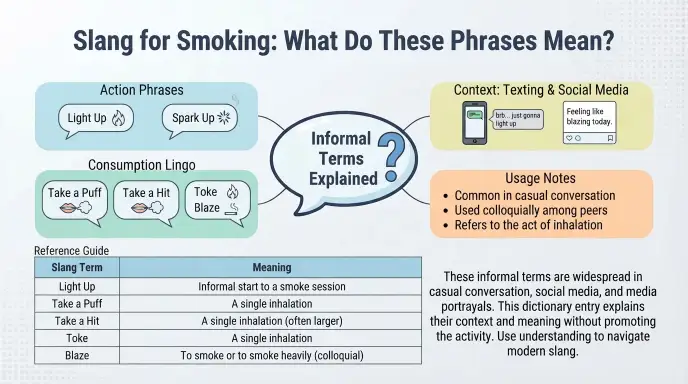
If you have ever seen someone write “let’s light up,” “take a hit,” or “burn one,” you may have wondered what they actually mean. These expressions are examples of slang for smoking, and they are often used in casual speech rather than formal writing.
Smoking slang can appear in texting, social media conversations, music, movies, online communities, and everyday conversations. However, not every expression means exactly the same thing. Some phrases simply mean smoking, while others refer to taking a puff, sharing a cigarette, or using cannabis.
Understanding these expressions can make online conversations easier to follow. It can also help you recognize when a phrase is being used literally and when it has a slang meaning. This guide explains common smokingifrelated slang in simple English, along with examples and context.
Quick Answer
People use many informal expressions for smoking, and the exact slang can depend on the type of smoking, location, age group, and social context. Common examples include smoke, light up, puff, blaze, toke, hit, chief, burn one, and spark up. Some expressions refer generally to smoking, while others can describe taking a puff or smoking cannabis specifically. Because slang changes quickly, the meaning should always be understood from the surrounding conversation.
What Does “Slang for Smoking” Mean?
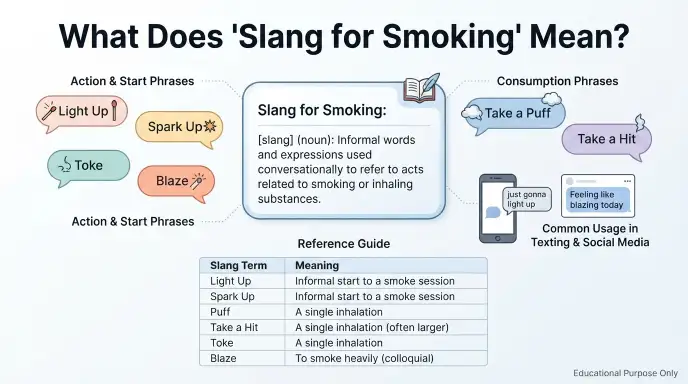
“Slang for smoking” means informal language used to describe smoking or activities associated with it.
Unlike formal vocabulary, slang is often shaped by culture, location, age, music, entertainment, and online communities. A phrase that is common in one group may sound unusual or unfamiliar to another.
For example, “light up” can mean to begin smoking, while “take a hit” generally describes inhaling from a cigarette, vape, pipe, or other smoking device depending on context.
The word “smoke” itself is not always slang. It is a standard English word. But phrases built around it can become informal expressions.
Common Slang for Smoking
Here are some widely recognized expressions and what they usually mean.
| Slang term | Common meaning | Typical context |
| Light up | Start smoking | Casual conversation |
| Spark up | Start smoking | Informal speech |
| Puff | Take a small amount of smoke | Casual speech |
| Hit | Take an inhalation | Smoking or vaping contexts |
| Toke | Take a puff, often cannabisifrelated | Informal/cannabis context |
| Blaze | Smoke, often cannabis | Informal slang |
| Chief | Smoke or take repeated puffs | Older/casual slang |
| Burn one | Smoke, often cannabis | Informal slang |
| Smoke up | Smoke, especially cannabis | Casual slang |
| Have a smoke | Go smoke | Everyday informal speech |
The meaning of these expressions can vary considerably depending on the speaker and context.
“Light Up” as Smoking Slang
“Light up” is one of the most recognizable informal expressions connected with smoking.
When someone says “light up,” they generally mean to start smoking by lighting a cigarette or another smoking product.
For example:
“He went outside to light up.”
Here, the phrase suggests that the person went outside to begin smoking.
The expression can also be used more generally in casual conversation. It does not necessarily indicate cannabis; the context may determine if the speaker means a cigarette or something else.
“Spark Up” Meaning
“Spark up” is another informal phrase meaning to start smoking.
The word “spark” refers to the action of producing a flame, which connects naturally with lighting a cigarette or similar item.
Example:
“They went outside and sparked up.”
The expression is particularly informal and may appear in conversations, lyrics, entertainment, or social media posts.
Because it is slang, it is better suited to casual communication than formal writing.
“Puff” and “Take a Puff”
The word “puff” can describe a small inhalation of smoke.
Someone might say:
“He took a puff and put it down.”
In this context, “puff” focuses on the individual inhalation rather than the entire act of smoking.
You may also see “take a puff” in conversations about cigarettes, cigars, cannabis, or other smoking products. The exact meaning depends on the surrounding discussion.
“Hit” in Smoking Slang
“Hit” is a very common informal word in smokingifrelated conversations.
To “take a hit” generally means to inhale from something being smoked or inhaled.
For example:
“She took a hit and passed it to her friend.”
The phrase can refer to different substances or devices depending on context. Therefore, you should not automatically assume that “hit” refers to cannabis.
“Hit” also has many completely unrelated meanings in English, which makes context especially important.
“Toke” Meaning in Slang
“Toke” is an informal term strongly associated with taking a puff from cannabis.
For example:
“He took a toke.”
In many contexts, “toke” specifically suggests cannabis rather than an ordinary cigarette.
The word has been used in informal English for decades and remains recognizable in conversations where cannabis is being discussed.
Because its meaning is strongly contextifdependent, a reader should consider the surrounding words before interpreting it.
“Blaze” as Smoking Slang
“Blaze” is another informal expression often associated with smoking cannabis.
When someone says:
“They were blazing.”
the phrase may mean that they were smoking cannabis.
The expression is particularly recognizable in music, entertainment, online conversations, and informal speech.
However, slang is flexible. A person’s intended meaning can depend on their community and the context in which the word appears.
“Chief” Meaning in Smoking Slang
“Chief” has been used as informal smoking slang, especially in phrases such as “chiefing.”
In this context, it can refer to smoking or taking repeated puffs.
Example:
“They were chiefing.”
This usage is informal and may sound less familiar to people who are not exposed to older or cannabisifrelated slang.
It is a good example of why slang dictionaries need context: “chief” has many standard meanings unrelated to smoking.
“Burn One” Meaning
“Burn one” is an informal expression that can mean to smoke, particularly when cannabis is being discussed.
For example:
“They wanted to burn one after hanging out.”
The phrase is highly conversational and may appear in music, movies, social media, or casual speech.
It should not be interpreted literally as simply “burning one.” In slang contexts, the phrase can carry a specific smokingifrelated meaning.
Smoking Slang in Texting and Social Media
Smokingifrelated slang can appear frequently in informal digital communication. People may use short expressions because they are quicker, more conversational, or familiar within a particular online community.
Examples include:
- light up
- spark up
- take a hit
- take a puff
- toke
- blaze
- burn one
- smoke up
On platforms such as TikTok, Reddit, Instagram, Discord, Snapchat, and private messaging, the meaning can depend heavily on the conversation.
For example, a message saying “wanna spark?” could be understood differently depending on what the people involved normally smoke or discuss.
This is why slang should always be interpreted alongside the surrounding messages.
Cigarette Slang vs. Cannabis Slang
One of the biggest sources of confusion is that some smoking expressions are general, while others are strongly associated with cannabis.
| Expression | Often associated with | Meaning |
| Have a smoke | Cigarettes/general | Go smoke |
| Light up | General smoking | Start smoking |
| Spark up | General/cannabis | Start smoking |
| Take a puff | General | Take an inhalation |
| Take a hit | Various | Take an inhalation |
| Toke | Cannabis | Take a puff |
| Blaze | Cannabis | Smoke cannabis |
| Burn one | Cannabis | Smoke cannabis |
| Chief | Cannabis | Smoke/take repeated puffs |
These associations are not absolute. Slang changes across regions and social groups, so the same expression can have different meanings.
Why Smoking Slang Can Be Confusing
Smoking slang is difficult to understand because many words have several meanings.
Take “hit” as an example. In ordinary English, a hit can mean striking something, a successful song, or an impact. In a smoking conversation, however, it can refer to an inhalation.
Similarly, “blaze” normally relates to a strong flame or fire, but in certain informal contexts it can refer to smoking cannabis.
This makes context one of the most important parts of understanding slang.
The same word can have a completely different meaning when it appears in a different conversation.
Regional Differences in Smoking Slang
Smoking slang can change from one country, city, generation, or social group to another. A phrase that sounds normal in the United States may be less familiar in the United Kingdom, Canada, Australia, or elsewhere.
For example, “have a smoke” is a straightforward informal expression that can be understood in many Englishifspeaking communities. Other terms, such as “toke” or “blaze,” are more strongly associated with cannabisifrelated conversations.
This does not mean every speaker uses these words in exactly the same way. Slang is constantly changing, and younger internet users may create or popularize new expressions.
Smoking Slang in Different Online Communities
Different online communities often develop their own vocabulary.
TikTok and Instagram
On visual social platforms, informal expressions may appear in captions, comments, memes, or conversations. Users may shorten phrases or use indirect language because slang feels more casual.
Reddit discussions can contain a wide variety of regional and communityifspecific terminology. The meaning of a smoking expression is often easier to understand by reading the surrounding comments.
Discord
Discord slang is especially dependent on the individual server or community. Gaming communities, social servers, and hobby groups may use different terminology.
Texting
Text messages often contain very short expressions such as “smoke,” “hit,” “puff,” or “spark up.” Because there is little context in a short message, these terms can sometimes be ambiguous.
Examples of Smoking Slang in Everyday Conversations
Understanding slang becomes easier when you see it in context.
| Expression | Example | Meaning in context |
| Light up | “He went outside to light up.” | Started smoking |
| Spark up | “They sparked up outside.” | Started smoking |
| Take a puff | “Can I take a puff?” | Take an inhalation |
| Take a hit | “He took a hit.” | Took an inhalation |
| Toke | “She took a toke.” | Took a puff, often cannabisifrelated |
| Blaze | “They were blazing.” | Smoking, often cannabis |
| Burn one | “They went to burn one.” | Informally, smoke |
| Have a smoke | “I’m going to have a smoke.” | Go smoke |
These examples explain how the words can function in conversation without assuming that every speaker uses them identically.
Common Mistakes When Understanding Smoking Slang
Assuming Every Term Means Cannabis
This is one of the most common mistakes.
Words such as “smoke,” “puff,” “hit,” and “light up” can refer to smoking generally. The surrounding conversation is needed to determine what the speaker means.
Taking Slang Literally
Some expressions have meanings that are very different from their individual words.
For example, “burn one” does not necessarily mean literally burning an object. In an informal smoking context, it can refer to smoking.
Ignoring Regional Usage
A slang term may be common in one community and unfamiliar in another. Avoid assuming that every English speaker understands the same slang.
Treating Slang as Formal English
Most smoking slang belongs to informal communication. It may be suitable for casual conversations, but it is generally not appropriate for formal academic or professional writing.
Why Does Smoking Slang Change So Often?
Slang develops naturally through social interaction. Music, movies, television, online communities, and changing cultural trends can all influence the vocabulary people use.
A phrase can become popular quickly and then disappear just as quickly. Social media can speed up this process because expressions can spread between communities almost instantly.
This is also why slang dictionaries sometimes contain multiple words for the same basic idea. Different generations may prefer different expressions.
Is “Smoke” Itself Slang?
Not necessarily.
“Smoke” is a standard English word with several meanings. It can refer to the visible substance produced by burning something, and it can also function as a verb meaning to inhale smoke from a cigarette or another product.
For example:
“He smokes.”
This is ordinary English rather than specialized slang.
However, informal phrases built around smoke can become slang depending on their usage and context.
Is Smoking Slang Appropriate in Formal Writing?
Generally, no.
If you are writing an essay, business document, academic assignment, medical document, or professional report, it is better to use clear and standard terminology.
Smoking slang is more appropriate for:
- Casual conversations
- Text messages
- Social media
- Fiction and dialogue
- Informal online discussions
- Explaining slang itself
When writing formally, clarity is usually more important than sounding conversational.
Smoking Slang vs. Standard English
| Informal expression | More neutral wording |
| Light up | Begin smoking |
| Spark up | Begin smoking |
| Take a hit | Take an inhalation |
| Take a puff | Take a puff/inhalation |
| Toke | Take a puff, often cannabisifrelated |
| Blaze | Smoke cannabis |
| Burn one | Smoke |
| Have a smoke | Go smoke |
The neutral alternative may be preferable when precision matters.
How to Understand an Unfamiliar Smoking Slang Word
When you encounter a word you do not recognize, look at the context first.
Ask yourself what the conversation is about. Is the person discussing cigarettes, vaping, cannabis, music, gaming, or something completely unrelated?
Then look at the words around the slang term. Nearby words often provide clues about the intended meaning.
It is also useful to remember that slang can have multiple meanings. A word should not automatically be assigned a smokingifrelated definition simply because it sometimes appears in smoking conversations.
Related Slang Terms
Several expressions are closely connected to the broader topic of smoking.
“Smoke Break”
A smoke break is a short break taken to smoke. The expression is common in workplace and everyday conversations, although workplace smoking policies vary.
“Smoker”
A smoker can simply mean a person who smokes.
“Smoking”
Smoking is the standard term for the act itself and is not necessarily slang.
“Puff”
A puff can describe a small inhalation and is often used informally.
Why Context Matters With Slang
Context is especially important when interpreting slang because words rarely have only one possible meaning.
For example, “hit” could refer to an impact, a successful song, a baseball action, or an inhalation in a smokingifrelated conversation.
Likewise, “blaze” can refer to fire in standard English but can have a smokingifrelated meaning in informal speech.
This is why simply memorizing a slang list is not enough. Understanding who is speaking, where the conversation happens, and what they are discussing gives you a much more accurate interpretation.
Frequently Asked Questions
Q1. What is the most common slang for smoking?
There is no single slang word used by everyone. Expressions such as “light up,” “spark up,” “take a puff,” “take a hit,” and “have a smoke” are widely recognizable informal expressions.
Q2. What does “light up” mean in slang?
In a smokingifrelated context, “light up” means to begin smoking, usually by lighting a cigarette or another smoking product.
Q3. What does “spark up” mean?
“Spark up” is an informal expression meaning to start smoking. The exact type of smoking depends on the context.
Q4. What does “take a hit” mean in slang?
“Take a hit” generally means taking an inhalation from something being smoked or inhaled. The specific substance or device depends on the conversation.
Q5. Is “toke” slang for smoking?
Yes. “Toke” is an informal term commonly associated with taking a puff, particularly in cannabisifrelated contexts.
Q6. Is “blaze” a slang word for smoking?
Yes. In informal contexts, “blaze” can mean smoking, particularly smoking cannabis. It also has several unrelated standard meanings.
Q7. Can smoking slang have different meanings?
Yes. Slang is highly dependent on context, location, and social group. The same word may have a smokingifrelated meaning in one conversation and a completely different meaning somewhere else.
Conclusion
Slang for smoking includes a wide range of informal words and expressions, from familiar phrases such as “light up” and “have a smoke” to more specialized terms such as “toke,” “blaze,” and “burn one.” Their meanings can vary depending on the speaker, region, generation, and conversation.
The most important thing to remember is that smoking slang is contextifdependent. A word like “hit” or “puff” does not automatically identify a particular substance, while expressions such as “toke” and “blaze” may have stronger associations with cannabis in many contexts.
If you encounter unfamiliar slang online, look at the surrounding conversation before deciding what it means. This approach gives you a more accurate understanding than relying on a single dictionary definition. Slang also changes over time, so today’s popular expression may eventually become outdated or take on a new meaning.

I’m Dylan Foster, a slang and internet culture writer passionate about exploring how people communicate online and in everyday conversations. I write about texting abbreviations, social media expressions, and modern slang to help readers understand meanings, origins, and real-world usage in a simple way.