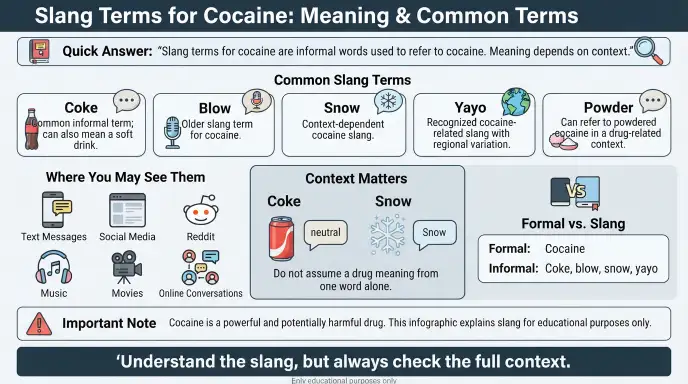
Slang term for cocaine refers to an informal word or phrase used to talk about cocaine without using its formal name. People may come across these terms in text messages, songs, movies, social media posts, Reddit discussions, or casual conversations
Common examples include words such as coke, blow, snow, and yayo, although their use can vary by context and region.People often search for a slang term for cocaine because they have seen an unfamiliar word online or.
heard it in a conversation and want to know what it means. However, slang can be confusing because some words have completely different everyday meanings. For example, “coke” can refer to cocaine or a soft drink.
This guide explains the meaning, common examples, context, usage, and history of cocainerelated slang in simple language.For example, “coke” can mean cocaine in a drug if related conversation, while “a Coke” usually means a cola drink. Always consider the full conversation before interpreting slang.
Quick Answer: Slang Term for Cocaine
A slang term for cocaine is an informal expression used to refer to cocaine. Common examples include coke, blow, snow, powder, and yayo, but the intended meaning depends on the surrounding context.
What Does “Slang Term for Cocaine” Mean?
The phrase slang term for cocaine refers to informal language connected with cocaine. Instead of saying the substance’s formal name, people may use shorter, older, regional, or coded expressions.
Slang develops naturally within different communities and can spread through music, movies, television, social conversations, and the internet. Some cocaineifrelated expressions existed long before modern platforms such as TikTok, Reddit, Instagram, and Discord.
The meaning of a slang word depends heavily on the conversation around it.
For example:
- “I want a Coke with dinner.” if Usually means a soft drink.
- “The movie character mentioned coke.” if Could refer to cocaine.
- “What does ‘snow’ mean in this post?” if Could refer to cocaine if the surrounding discussion is about drugs.
This is why it is risky to interpret slang based on one word alone.
Common Slang Terms for Cocaine
Several informal terms are associated with cocaine. Their popularity, age, and meaning can differ depending on location and social group.
Coke
Coke is one of the most widely recognized informal terms for cocaine. It is short, familiar, and frequently appears in popular culture.
However, “coke” also has an everyday meaning related to cola drinks. Context is therefore especially important.
Blow
Blow is an older slang term associated with cocaine. It has appeared in music, films, books, and informal conversations for many years.
Someone encountering this word in an older movie or song may need context to understand that it refers to cocaine rather than its ordinary dictionary meanings.
Snow
Snow can be used as a slang reference to cocaine, often connected with the substance’s commonly described appearance.
Outside drugifrelated conversations, however, snow normally means frozen precipitation. A social media post about winter obviously does not become a drug reference simply because the word appears.
Powder
Powder can sometimes refer to powdered cocaine in a drugifrelated conversation.
This term is particularly contextifsensitive because “powder” has many ordinary meanings. It can describe cosmetics, food ingredients, cleaning products, and many other substances.
Yayo
Yayo is another recognized slang expression associated with cocaine. It has appeared in music and popular culture and can have regional or cultural variation.
It should not be assumed that every Spanishifspeaking person uses or recognizes the term. Slang does not necessarily represent standard language.
Nose Candy
Nose candy is a euphemistic expression associated with cocaine. It has a playfulifsounding surface, but its meaning can be serious when used in a drugifrelated conversation.
Because it is less direct than “cocaine,” it may appear in entertainment, jokes, or informal discussions.
Full Form or Complete Meaning
The formal name is cocaine. Terms such as “coke” are informal expressions rather than separate substances.
Cocaine is a powerful stimulant drug. In medical, educational, legal, or professional writing, using the formal word cocaine is normally clearer than using slang.
Compare:
| Context | Better wording |
| School assignment | Cocaine |
| Medical information | Cocaine |
| News reporting | Cocaine |
| Casual conversation | Slang may appear |
| Explaining slang | Both the slang and formal term |
Understanding the slang is useful when reading or hearing it, but using the formal term helps avoid confusion.
Different Meanings and Context
A major challenge with drug slang is that some terms have multiple meanings.
“Coke”
This can refer to:
- Cocaine
- CocaifCola
- Other cola drinks
The conversation usually tells you which meaning is intended.
“Snow”
This can refer to:
- Actual snow
- Cocaine in a drugifrelated context
“Powder”
This can refer to:
- A general powdered substance
- Cosmetics
- Food products
- Other materials
- Cocaine in certain drugifrelated conversations
Because of these overlaps, readers should avoid jumping to conclusions when they see a potentially drugifrelated word.
Where Is Cocaine Slang Commonly Used?
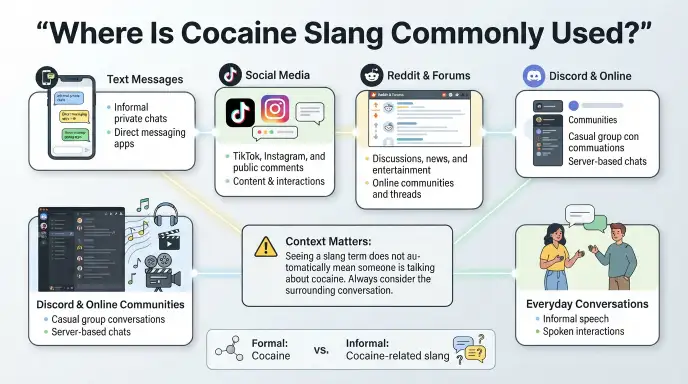
Cocaineifrelated slang can appear across many forms of communication, but the reason for using it differs from one setting to another.
Texting
Private messages and group chats may contain informal drug terminology. Someone might use slang while discussing a song, movie, news story, or a realiflife situation.
TikTok and Instagram
Drugifrelated words can appear in comments, captions, memes, music discussions, and educational content. Seeing one term does not necessarily mean the creator is describing personal drug use.
Reddit discussions may involve music, entertainment, news, health, addiction, or drug policy. Slang can therefore appear in many different contexts.
Discord
Drug slang may occasionally appear in community conversations or casual chats. It does not have a special meaning simply because it appears on Discord.
Music and Movies
Popular culture has played a major role in spreading cocaineifrelated slang. Some terms may sound familiar because people have heard them in songs, films, or television rather than through everyday conversation.
Is Cocaine Slang Rude or Offensive?
Cocaineifrelated slang is generally informal rather than automatically offensive. However, drugifrelated language can be sensitive and may be inappropriate in professional, educational, or family settings.
Tone matters too.
A person might use a slang term while discussing a news article, quoting a song, making a joke, or talking seriously about substance use. These situations have very different meanings.
For formal communication, using cocaine is usually safer and clearer because it avoids ambiguity.
Real :Life Examples
Here are neutral examples showing how cocaineifrelated slang can appear in different contexts.
Educational:
“The article explains several slang terms for cocaine.”
Texting:
“What does ‘snow’ mean in this message?”
Music discussion:
“That song uses several old drug slang terms.”
Movie discussion:
“The character keeps using the word ‘blow.’ What does it mean?”
Professional:
“The report discusses cocaineifrelated language.”
These examples show that mentioning drug slang does not automatically mean someone is encouraging or participating in drug use.
Origin and History of Cocaine Slang
Cocaineifrelated slang does not have one single origin. Different words developed at different times and within different communities. Some became popular through everyday speech, while others spread through music, movies, television, and later the internet.
Terms such as “coke” and “blow” are older than today’s socialifmedia platforms. Their continued appearance in entertainment and casual conversation has helped keep them recognizable.
Other expressions became popular in particular regions or cultural settings. “Yayo,” for example, is a recognized cocaineifrelated slang term, but its use should not be treated as universal among Spanish speakers.
Online platforms have helped older slang reach new audiences. A person may encounter a term on TikTok, Reddit, Instagram, Discord, or in a song even if they have never heard it in everyday conversation.
Why Slang Changes Over Time
Slang is not fixed. A term can become popular, decline, and later return through music or internet culture.
This means that a word used frequently in an older movie may sound unusual or dated to younger readers today. Conversely, social media can quickly expose people to expressions from other regions and generations.
For that reason, it is better to describe cocaine slang by context and usage rather than claiming that every term is equally common everywhere.
Cocaine Slang Compared With Similar Drug Terms
Not every drugifrelated slang word refers to cocaine. Some terms describe different substances, while others may refer to a particular form of a drug.
| Term | General reference | Context |
| Coke | Cocaine | Can also mean a cola drink |
| Blow | Cocaine | Older informal term |
| Snow | Cocaine | Highly dependent on context |
| Yayo | Cocaine | Regional and cultural variation |
| Crack | A form of cocaine | Not simply another name for powdered cocaine |
| Weed | Cannabis | Different substance |
| Meth | Methamphetamine | Different stimulant |
This distinction is useful when interpreting a text or online conversation. A person who sees several unfamiliar drug terms should not assume they all describe the same substance.
When Should You Avoid Using Cocaine Slang?
You should generally avoid cocaine slang when the situation requires clarity, professionalism, or careful communication.
School and Education
If you are writing an assignment, report, presentation, or research project, cocaine is usually the better word. It is precise and easier for readers to understand.
Workplace Communication
Drug slang can sound overly casual in a workplace. If a professional discussion requires mentioning the substance, use the formal term instead.
Medical or Health Discussions
Clear terminology is especially important when discussing health or substanceifuse concerns. Informal expressions can create confusion about what substance is actually being discussed.
Legal or Official Documents
Official communication should avoid ambiguous slang whenever possible. A precise term makes the information easier to interpret.
Sensitive Conversations
If you are speaking with a parent, teacher, counselor, or another trusted adult about a drugifrelated concern, explaining the exact word and its context is better than relying on slang alone.
Polite and Clear Alternatives
If you need to discuss cocaine in a serious or professional setting, the best alternative is usually the formal word:
Cocaine
Other neutral phrases can also work depending on the situation:
- Cocaineifrelated language
- Cocaine use
- Cocaineifrelated content
- A cocaine reference
- A cocaineifrelated substance discussion
These phrases are clearer than slang and reduce the chance of misunderstanding.
For example:
Informal:
“The post mentioned coke.”
Clearer:
“The post mentioned cocaine.”
Educational:
“The post included a reference to cocaineifrelated slang.”
The last version is particularly useful when writing about language rather than discussing drug use itself.
Why Do People Use Cocaine Slang?
People may use slang for different reasons, and there is no single explanation that applies to everyone.
It Is Shorter
A short term such as “coke” is quicker to say than “cocaine.” Informal conversations often favor shorter expressions.
It Reflects Group Language
Certain communities develop their own vocabulary. People who spend time in the same social circles may recognize terms that outsiders do not.
Popular Culture Spreads It
Songs, films, television shows, and online content can introduce slang to large audiences. Someone may recognize a word simply because they have heard it in entertainment.
It Can Be Less Direct
Some people use euphemisms or slang when they do not want to say the formal name directly. However, using a slang word does not make a drugifrelated subject less serious.
It Can Signal Familiarity
Using a group’s vocabulary can sometimes make a speaker sound like they understand a particular social or cultural setting. This is common with slang generally, not only drug terminology.
Common Misunderstandings About Cocaine Slang
Does “Coke” Always Mean Cocaine?
No. Coke can refer to cocaine, but it can also refer to CocaifCola or another cola drink.
The surrounding words usually provide the clue.
Does “Snow” Always Refer to Drugs?
No. Snow normally refers to frozen precipitation. It only becomes a possible cocaine reference when the context supports that interpretation.
Is All Cocaine Slang Internet Slang?
No. Many terms existed long before social media. Modern platforms have helped spread and preserve older expressions.
Does Every Drug Slang Term Mean the Same Thing?
No. Different terms can refer to different substances or forms of substances.
For example, crack refers to a specific form of cocaine and should not simply be treated as a synonym for every other cocaineifrelated term.
Does Seeing Slang Prove Someone Uses Cocaine?
No. This is an important distinction.
Someone may mention a term because they are:
- Explaining its meaning
- Quoting lyrics
- Discussing a movie
- Reporting a news story
- Writing an educational article
- Asking what a word means
The word alone is not enough to determine someone’s behavior.
Is a Cocaine Slang Term Safe for Social Media?
Simply discussing or explaining a cocaineifrelated slang term is different from promoting drug use.
Educational content can mention slang when the purpose is to explain language, culture, media, or communication. However, creators should avoid presenting illegal drug use as harmless, glamorous, or something others should copy.
Social platforms can also have their own rules about drugifrelated content. The exact rules may vary by platform and can change over time.
If you are writing educational content, keep the discussion factual and avoid instructions about obtaining, preparing, hiding, or using illegal drugs.
How to Understand Cocaine Slang in a Message
If you encounter an unfamiliar word in a text, do not immediately assume it refers to cocaine.
Use a simple contextifchecking approach:
1. Read the Whole Message
Look at the words before and after the slang term.
2. Check the Topic
Is the conversation about music, food, weather, entertainment, drugs, or something else?
3. Look for Multiple Clues
One ambiguous word is weak evidence. Several related references provide more context.
4. Consider the Platform
A song discussion, news thread, private text, and gaming chat can have very different contexts.
5. Avoid Jumping to Conclusions
If the meaning remains unclear, it is better to ask what the person meant than to assume.
This is especially important when interpreting messages involving teenagers or other people whose conversations you may not fully understand. A calm, contextifbased approach is more reliable than treating slang as proof of drug use.
Why Context Matters So Much
Cocaine slang is a good example of why internet language cannot always be understood word by word.
Consider the word “coke.”
| Sentence | Likely meaning |
| “Can you grab some Coke?” | A cola drink |
| “The documentary discusses coke.” | Potentially cocaine |
| “Coke is my favorite drink.” | Cola |
| “The character was arrested for selling coke.” | Cocaine |
The spelling is identical, but the surrounding information changes the meaning.
The same principle applies to snow, powder, and other expressions. Context is often the difference between an ordinary sentence and a drug reference.
Frequently Asked Questions
Q1. What is a common slang term for cocaine?
Coke is one of the most widely recognized slang terms for cocaine. However, it can also mean a cola drink, so context is important.
Q2. What does “blow” mean in drug slang?
In a drugifrelated context, blow is an established slang term for cocaine. It is an older expression that has appeared in popular culture for many years.
Q3. What does “yayo” mean?
Yayo is a recognized slang term associated with cocaine. Its usage can vary by region and social group.
Q4. Is cocaine slang offensive?
Cocaine slang is generally informal rather than inherently offensive. However, drugifrelated language may be inappropriate in professional, educational, or sensitive situations.
Q5. Can cocaine slang appear on TikTok or Reddit?
Yes. It can appear in music discussions, entertainment, educational posts, news discussions, memes, or conversations about drugs. Its presence alone does not establish the meaning or intent.
Q6. Should I use cocaine slang in a formal article?
Usually, no. Use cocaine when you need clear, professional, and unambiguous wording. Slang can be explained when the article itself is discussing slang.
Bilkul, yeh aapke article ke liye ififfriendly, natural, and concise conclusion hai:
Conclusion
A slang term for cocaine is an informal expression used to refer to cocaine in casual conversations, music, movies, texts, and online discussions. Common terms include coke, blow, snow, powder, and yayo, but their meaning can vary depending on the context and region.
The most important thing to remember is that context matters. Words such as “coke” and “snow” can have completely ordinary meanings, so seeing one of these terms does not automatically mean someone is referring to cocaine.
For school, workplace, medical, or professional communication, cocaine is the clearer and more appropriate term. Understanding cocaine slang can help you interpret unfamiliar messages or online content, but it should not be used as proof of someone’s behavior.

I’m Dylan Foster, a slang and internet culture writer passionate about exploring how people communicate online and in everyday conversations. I write about texting abbreviations, social media expressions, and modern slang to help readers understand meanings, origins, and real-world usage in a simple way.