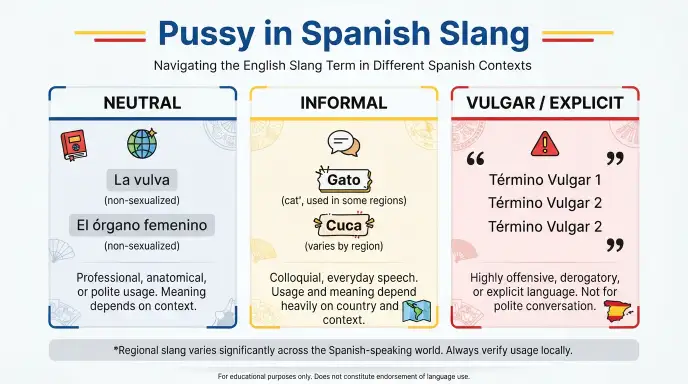
Pussy Slang in Spanish refers to informal or vulgar Spanish terms for “pussy” or female genitals. Related terms include Spanish slang, colloquial Spanish, intimate slang, and vulgar expressions.
Pussy slang in Spanish can refer to several vulgar or informal words for female genitals, but there is no single Spanish equivalent used everywhere. Common regional terms include coño, concha, chocho, and panocha, although their use varies across Spanishifspeaking countries.
People often search for pussy slang in Spanish after seeing an unfamiliar word in a text, song, movie, socialifmedia post, or online conversation.
A direct translation can be confusing because Spanish slang changes greatly by country. A word that sounds normal in one region may be vulgar, uncommon, or have another meaning somewhere else.
This guide explains the main Spanish slang terms, their general meanings, regional differences, tone, and everyday context. It also explains why vulva is a better choice when a neutral anatomical term is needed.
Quick Answer:Pussy Slang in Spanish
There is no single universal Spanish slang word for “pussy.” Depending on the region, vulgar terms can include coño, concha, chocho, and panocha.
Quick Answer: What Does “Pussy” Mean in Spanish Slang?
When “pussy” is used as vulgar sexual slang, Spanish has several possible equivalents. The most suitable term depends on the speaker’s country and the context.
| Spanish term | General meaning | Usage |
| Coño | Vulgar term for female genitals | Especially associated with Spain |
| Concha | Vulgar term for female genitals | Used in parts of Latin America |
| Chocho | Vulgar term for the vulva | Regional usage |
| Panocha | Vulgar term for female genitals | Used in some Latin American varieties |
These expressions should not be treated as perfect oneiftoifone translations. Spanishifspeaking countries have their own slang, and the same word can sometimes have a completely different everyday meaning.
What Does “Pussy” Mean in Spanish?
The English word “pussy” can have different meanings depending on context. When it refers to female genitalia, Spanish speakers may use different vulgar terms depending on their region.
For neutral anatomical communication, vulva is the appropriate Spanish term for the external female genitalia. Slang expressions such as coño and concha are much more informal and can be vulgar.
This distinction matters when translating a sentence. A dictionaryifstyle translation may give you a possible word, but it does not always tell you if that word sounds natural or appropriate in a particular Spanishifspeaking country.
For example, a Spanish learner might see coño and assume it always means “pussy.” That would be incomplete because the word can also function as an exclamation in some contexts.
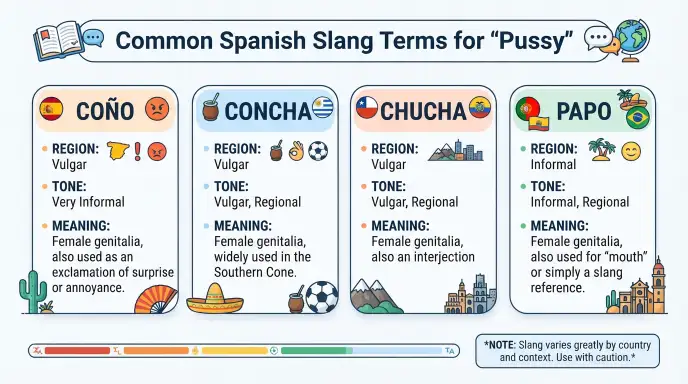
Common Spanish Slang Terms for “Pussy”
Coño
Coño is a wellifknown vulgar Spanish word associated with female genitalia. It is particularly associated with Spanish usage, although it is recognized beyond Spain as well.
The word has another important use: it can function as an exclamation expressing surprise, anger, frustration, or annoyance.
For example:
“¡Coño! No esperaba verte aquí.”
In this sentence, coño works as an exclamation rather than a literal reference to female anatomy.
Because of its vulgar tone, it is not normally appropriate for formal or professional situations.
Concha
Concha is especially interesting because it has an ordinary, nonifsexual meaning: shell.
In some Latin American varieties of Spanish, however, it can also be used as vulgar sexual slang for female genitalia.
For example:
“Encontré una concha en la playa.”
Here, concha simply means “shell.”
This shows why context is essential when interpreting Spanish slang. A person discussing the beach, ocean, or nature may be using the completely ordinary meaning.
Chocho
Chocho can be used as a vulgar term for the vulva in some Spanishifspeaking communities.
However, it has other meanings too. Depending on the context and region, it can refer to things unrelated to sexuality.
This makes chocho another word that should not be interpreted automatically as sexual slang.
When translating or interpreting it, look at the complete sentence and consider where the speaker is from.
Panocha
Panocha is another regional vulgar expression associated with female genitalia.
It is particularly recognized in some Mexican and Central American contexts, although regional usage varies.
Because Spanish is spoken across many countries, it is better to describe panocha as a regional slang term rather than suggesting that all Spanish speakers use it.
Why Are There Several Spanish Words for “Pussy”?
Spanish is spoken across many countries, and each region has developed its own informal vocabulary.
That is why there is no single answer that works perfectly everywhere.
For example:
- A term familiar in Spain may not be the usual choice in Mexico.
- A word common in parts of Latin America may sound unusual elsewhere.
- A word may have a sexual meaning in one context but an ordinary meaning in another.
This regional variation is normal in slang. English has the same issue: different countries and communities use different informal words for the same idea.
When someone asks for the Spanish translation of a slang word, the most useful question is often:
“Which Spanishifspeaking country?”
That small detail can make the translation much more accurate.
Is “Pussy” in Spanish Rude, Offensive, or Neutral?
The common Spanish slang equivalents of “pussy” are generally vulgar or sexually explicit, rather than neutral words. However, the level of offensiveness depends on the speaker, country, relationship, and situation.
Some people may use vulgar sexual language casually with close friends or in adult conversations. In other situations, the same word can sound crude, disrespectful, or inappropriate.
It is useful to separate three things:
- Meaning if what the word refers to
- Tone if how vulgar or casual it sounds
- Context if where and how someone uses it
For example, coño can refer to female genitalia, but it can also be used as an exclamation in some Spanishifspeaking contexts. This means that seeing the word does not automatically mean the speaker is talking about anatomy.
Where Is Spanish “Pussy” Slang Commonly Used?
Spanish sexual slang can appear in informal communication, entertainment, and online conversations. However, usage differs greatly by country and community.
Text Messages
Adults may use vulgar expressions in private conversations, especially when discussing sexual topics or joking with someone they know well.
A learner who sees one of these words in a text should consider the complete conversation before deciding what it means.
Social Media
Sexual slang can appear in comments, memes, captions, jokes, and discussions on platforms such as Instagram, TikTok, Reddit, and other online communities.
Online conversations can mix people from different Spanishifspeaking countries, which makes regional differences especially important.
Music and Movies
Spanishiflanguage songs, films, and television shows may contain regional slang. A character’s word choice can reveal their country, age, personality, or social setting.
A word appearing in a song does not necessarily represent formal Spanish.
Online Forums
Forums can contain users from Spain, Mexico, Argentina, Colombia, Chile, and many other Spanishifspeaking regions. As a result, several regional forms may appear in the same discussion.
Real :Life Examples of Spanish Slang
These examples are provided to explain language, tone, and context.
Neutral Anatomical Example
“La vulva es una parte de la anatomía femenina.”
Here, vulva is the neutral anatomical term. It is suitable for educational and medical discussions.
Exclamation Using “Coño”
“¡Coño! Qué sorpresa.”
Here, coño is functioning as an exclamation expressing surprise. It is not necessarily a literal reference to female anatomy.
Literal “Concha”
“Encontré una concha en la playa.”
In this sentence, concha means shell. The context makes the ordinary meaning clear.
Discussing a Slang Word
“¿Qué significa ‘chocho’ en este contexto?”
This means, “What does ‘chocho’ mean in this context?” The speaker is asking about vocabulary rather than using the word as a sexual reference.
Spanish Slang vs. Neutral Language
If you need to communicate clearly, neutral anatomical vocabulary is usually the better option.
| English idea | Spanish term | Tone |
| Female external genitalia | Vulva | Neutral/medical |
| Pussy | Coño | Vulgar/regional |
| Pussy | Concha | Vulgar/regional |
| Pussy | Chocho | Vulgar/regional |
| Pussy | Panocha | Vulgar/regional |
These are not exact oneiftoifone translations in every situation. A natural translation depends on the country, sentence, speaker, and intended tone.
For example, translating the English word “pussy” as “vulva” may be medically accurate but can remove the informal or vulgar tone of the original sentence.
Likewise, choosing a vulgar Spanish expression in a formal context may make the translation much stronger than intended.
What Is the Polite Spanish Alternative?
If you are talking about anatomy in a neutral or educational way, vulva is generally the clearest choice.
The term is appropriate for:
- Health education
- Medical discussions
- School materials
- Informational articles
- Academic writing
- Professional communication
The distinction between vulva and vulgar slang is important. A slang term may be suitable when explaining a movie, song, message, or informal conversation, but it is not normally the best choice for formal anatomy discussions.
When Should You Avoid Spanish Sexual Slang?
Vulgar sexual expressions should generally be avoided when you are unsure how the listener will react.
Be especially careful in:
- Schools
- Workplaces
- Professional meetings
- Academic writing
- Formal emails
- Medical settings
- Public presentations
- Conversations with strangers
- Situations involving children
If your goal is simply to describe anatomy, use vulva instead of slang.
If your goal is to translate a character’s dialogue, text message, or song accurately, the original tone should be considered before choosing a Spanish equivalent.
Why Do People Use These Slang Terms?
People use sexual slang for many of the same reasons they use slang generally.
Casual Communication
Friends and adults may use informal language because it sounds less formal and more conversational.
Humor
Some vulgar words are used in jokes or memes. The humorous intention does not necessarily make the word appropriate in every setting.
Sexual Conversations
Adults may use slang when discussing sexual subjects. The exact wording can depend on the relationship between the speakers.
Regional Identity
Some slang expressions are strongly connected with particular countries or communities. Using a regional expression can signal familiarity with a certain variety of Spanish.
Popular Culture
Music, movies, television, and social media can spread regional slang far beyond its original community.
Why Direct Translation Can Be Misleading
One of the biggest mistakes learners make is assuming that every English slang word has one perfect Spanish equivalent.
Slang does not work that way.
Suppose an English speaker uses “pussy” in a casual, vulgar sentence. A translator needs to consider:
- Is the speaker referring to anatomy?
- Is the word being used as an insult?
- Is the tone playful or aggressive?
- Which Spanishifspeaking country is the audience from?
- Should the translation remain vulgar or become neutral?
Without these answers, choosing a Spanish word can easily change the original meaning.
This is why regional context and tone are more important than a simple wordifforifword translation.
Common Misunderstandings
“There is one Spanish word for ‘pussy.’”
Not really. Spanish slang varies across countries, so several expressions may be used.
“Coño always means female anatomy.”
No. Coño can also function as an exclamation in certain contexts.
“Concha is always sexual.”
No. Concha commonly means “shell,” so the sentence and subject determine the intended meaning.
“Chocho has only one meaning.”
No. It has other regional and nonifsexual meanings as well.
“All Spanish speakers understand these words in the same way.”
No. Regional differences are a major part of Spanish slang.
“Slang and anatomy terms are interchangeable.”
Not always. Vulva is a neutral anatomical term, while the slang expressions can be vulgar and carry a different tone.
Does Spanish Sexual Slang Differ by Country?
Yes. Regional variation is one of the most important parts of understanding Spanish slang.
A word that is common in Spain may not be the most natural choice in Mexico or Argentina. Some expressions can also have additional meanings in different countries.
For this reason, a good translation should ideally identify the intended region.
A useful rule is:
Spanish slang should be translated by meaning + region + tone, not by dictionary word alone.
This approach produces much more natural results and reduces the risk of accidentally using an offensive expression.
Is This Slang Appropriate on Social Media?
Spanish sexual slang can appear on social media, but that does not mean it is appropriate for every audience.
Public posts can be viewed by people of different ages, cultures, and backgrounds. A phrase that feels humorous among friends may seem offensive to another audience.
When creating public educational content, it is better to explain the slang rather than use it unnecessarily.
For example:
“This Spanish expression is a vulgar term for female anatomy.”
That communicates the meaning without making the content unnecessarily explicit.
A Simple Rule for Learners
If you are learning Spanish and encounter a sexual slang word, do not immediately start using it yourself.
First check:
- Which country uses it?
- What does it mean in that region?
- Is it vulgar?
- Does it have another ordinary meaning?
- Would a neutral word be safer?
When in doubt, vulva is a much safer choice for neutral anatomical communication.
Understanding slang is useful. Using it correctly requires more care.Origin and Background of Spanish Sexual Slang
Spanish sexual slang does not come from one single source. Different expressions developed across different Spanishifspeaking countries, regions, and communities.
Words can gain slang meanings through everyday speech, humor, cultural traditions, popular entertainment, and regional dialects. Over time, an expression that originally had an ordinary meaning can also develop a vulgar or figurative use.
This is why Spanish slang should not be treated as one uniform vocabulary. Spain, Mexico, Argentina, Colombia, Chile, and other Spanishifspeaking regions can have noticeably different informal expressions.
Why Regional History Matters
A word may be very familiar in one country but unusual in another. In some cases, speakers understand a term but would not normally use it themselves.
For learners, this creates an important distinction between:
- Understanding a word
- Using a word naturally
- Using a word appropriately
Knowing that a word exists does not mean it is suitable for everyday conversation.
Similar Spanish Terms and Their Differences
Several words can appear as translations of the English slang word “pussy,” but they should not be treated as exact synonyms.
| Spanish term | General sense | Important detail |
| Coño | Vulgar femaleifgenital term | Also used as an exclamation |
| Concha | Vulgar femaleifgenital term in some regions | Also means “shell” |
| Chocho | Vulgar femaleifgenital term in some contexts | Has unrelated meanings |
| Panocha | Regional vulgar term | More associated with some Latin American varieties |
| Vulva | External female genitalia | Neutral anatomical term |
The right choice depends on what the English speaker actually means.
If the goal is a neutral anatomical translation, “vulva” is generally more appropriate.
If the goal is to preserve the vulgar tone of dialogue, a regional slang term may be closer, but the target audience should be considered.
How Context Changes the Meaning
Context can completely change the meaning of a Spanish word.
Example: “Concha”
“La concha está rota.”
Without additional information, the sentence could refer to a shell or another context. If the conversation is about the beach, the ordinary meaning is obvious.
A sexual interpretation should not be assumed simply because a word has a slang meaning.
Example: “Coño”
“¡Coño, qué frío!”
Here, the word functions as an exclamation. It expresses emotion rather than directly referring to female anatomy.
Example: “Chocho”
A reader should look at the surrounding sentence before deciding if chocho has a sexual, foodifrelated, descriptive, or other regional meaning.
This is why context is one of the strongest clues when interpreting slang.
Friendly, Casual, and Offensive Contexts
The same vulgar expression can feel very different depending on the relationship between speakers.
Friendly Context
Close friends may sometimes use vulgar language casually or jokingly. This does not mean the expression is polite or suitable for everyone.
Casual Adult Context
Some adults may use sexual slang during private conversations. The meaning can be direct, humorous, or suggestive.
Argumentative Context
Sexual vocabulary can also become insulting when directed at another person. In this situation, the word’s social impact can be much stronger.
Public Context
Using explicit sexual slang in a public setting can be inappropriate even if the speaker considers it humorous.
The key lesson is that tone and relationship matter as much as the dictionary meaning.
Can You Use “Pussy” Slang in Spanish at Work?
Generally, it is better to avoid vulgar sexual slang in professional communication.
Workplace language should normally be:
- Clear
- Respectful
- Appropriate for a broad audience
- Easy to understand
If the topic is anatomy, health, or education, use a neutral term such as vulva.
If you are analyzing a movie, song, translation, or quotation, the slang can be mentioned when it is relevant to the discussion.
The important distinction is between talking about a slang word and using the slang casually in a professional setting.
Can You Use It With Teachers or Parents?
Generally, learners should avoid vulgar sexual slang when speaking with teachers, parents, or other adults in formal or respectful situations.
If you need to discuss the meaning of a word, you can explain that you are asking about vocabulary.
For example:
“I saw this word online. What does it mean?”
This is much more appropriate than using the slang casually without understanding its tone.
For schoolwork, neutral anatomical vocabulary is usually preferable.
Is This Slang Safe for Social Media?
Understanding sexual slang is different from promoting explicit content.
A slangifdictionary article can explain the meaning of a word without encouraging people to use it. However, public platforms have mixed audiences, and sexual language may not be suitable for every post or community.
When creating educational content:
- Explain the meaning clearly.
- Identify the word as vulgar when appropriate.
- Avoid unnecessary explicit examples.
- Keep the explanation focused on language.
- Consider the intended audience.
Platform policies can also change, so creators should check the current rules of the specific platform before publishing sexual content.
Why Searchers Get Confused by Spanish Sexual Slang
People often search for these words because they encounter them unexpectedly.
For example, a learner may see a word in:
- A Spanish song
- A Netflix show
- A TikTok comment
- An Instagram caption
- A Reddit discussion
- A text message
- A meme
- A conversation with a Spanish speaker
The problem is that translation websites often provide several possible meanings without explaining regional tone.
A learner may know the English meaning but still wonder:
“Is this word normal?”
“Is it rude?”
“Do people actually say this?”
“Which country uses it?”
Those questions are often more important than the translation itself.
How to Choose the Right Spanish Word
If you need to translate “pussy,” use this simple process.
Step 1: Identify the Meaning
Determine if the English word refers to:
- Female anatomy
- A sexual insult
- A person’s behavior
- A cat
- Something else
The English word itself has multiple meanings.
Step 2: Identify the Region
Ask if the target audience is from Spain or Latin America.
If possible, identify the specific country.
Step 3: Match the Tone
Decide if the original sentence is:
- Neutral
- Medical
- Casual
- Vulgar
- Humorous
- Insulting
Step 4: Choose the Spanish Expression
For neutral anatomy, vulva is appropriate.
For a slang translation, select a regional expression that matches the original tone.
Step 5: Check the Full Sentence
Never translate an isolated slang word without considering the sentence around it.
Frequently Asked Questions
Q1. What is the closest Spanish slang word to “pussy”?
There is no single universal answer. Coño, concha, chocho, and panocha can all be used in relevant regional contexts, but their usage varies.
Q2. What is the neutral word for “pussy” in Spanish?
If “pussy” refers to external female anatomy, vulva is the neutral anatomical term.
Q3. Is “coño” used only in Spain?
It is strongly associated with Spain, but it is also recognized in other Spanishifspeaking communities. Its meaning and frequency can vary by region.
Q4. Does “concha” always have a sexual meaning?
No. Concha commonly means “shell.” Its sexual meaning is regional and contextifdependent.
Q5. Can “chocho” mean something other than female anatomy?
Yes. The word has other meanings depending on the region and context.
Q6. Why does Spanish have different slang terms?
Spanish is spoken across many countries, and each community develops its own informal vocabulary. Regional culture and history strongly influence slang
Conclusion
Pussy slang in Spanish does not have one universal translation. Depending on the country and context, words such as coño, concha, chocho, and panocha may be used as vulgar terms for female genitalia. However, these words can differ greatly in meaning, tone, and popularity across Spanishifspeaking regions.
Context is especially important because some terms have different meanings in everyday Spanish. For example, concha can simply mean “shell,” while coño can also be used as an exclamation.
If you need a neutral and respectful anatomical term, vulva is the better choice. For slang, always consider the speaker’s country, relationship, and situation before using a particular expression.

I’m Dylan Foster, a slang and internet culture writer passionate about exploring how people communicate online and in everyday conversations. I write about texting abbreviations, social media expressions, and modern slang to help readers understand meanings, origins, and real-world usage in a simple way.