Mexico slang words are a fascinating part of everyday communication, reflecting Mexican culture, humor, friendships, and regional identity. Many people search for Mexican slang because they hear these expressions in movies, music, TikTok videos, social media posts, or conversations with Spanish speakers but do not always understand their real meaning.
Unlike formal Spanish, slang changes depending on the region, age group, and situation. Some words are friendly and commonly used among friends, while others may sound rude or inappropriate if used with strangers. Understanding the context behind slang helps you communicate naturally and avoid misunderstandings.
if you are learning Spanish, traveling to Mexico, chatting online, or exploring Mexican culture, knowing common slang expressions can make conversations easier and more authentic.
Quick Answer: Mexico Slang Words:
Mexico slang words are informal Spanish expressions commonly used in Mexico to show friendliness, humor, emotions, or cultural identity. Their meaning often depends on the situation and tone.
What Are Mexico Slang Words?
Mexico slang words are informal expressions used by Mexican speakers in daily conversations. They are different from standard Spanish because they often include shortened words, playful meanings, regional phrases, and cultural references.
Slang is especially common among:
- Friends and family conversations
- Text messages and online chats
- Social media platforms like TikTok and Instagram
- Music, movies, and television
- Gaming communities and online groups
For example, a person may say “¿Qué onda?” instead of the formal “¿Cómo estás?”. Both ask how someone is doing, but “¿Qué onda?” sounds more casual and friendly.
Mexican slang is not one single language style. Different areas of Mexico have their own expressions, and some words may have different meanings depending on the region.
Popular Mexico Slang Words and Their Meanings
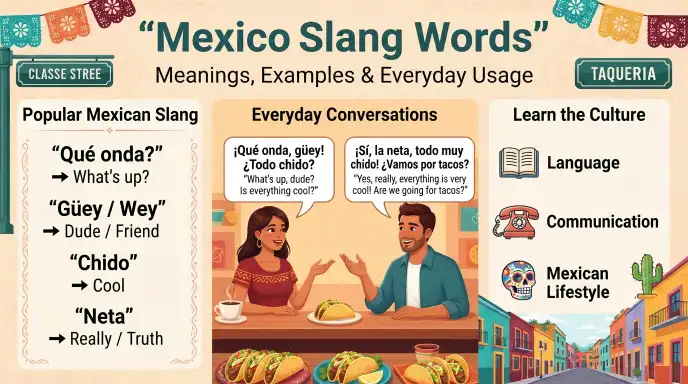
1. ¿Qué onda? :“What’s up?”
Meaning:
“¿Qué onda?” is one of the most common Mexican slang expressions. It is a casual way to greet someone or ask what is happening.
Tone:
Friendly, relaxed, and informal.
Examples:
- “¡Qué onda! ¿Cómo estás?”
- “What’s up! How are you?”
- “¿Qué onda con ese nuevo juego?”
- “What’s up with that new game?”
It is usually used with friends, classmates, or people you know well.
2. Chido :“Cool” or “Awesome”
Meaning:
“Chido” describes something good, impressive, or enjoyable.
Tone:
Positive and casual.
Examples:
- “Ese carro está muy chido.”
- “That car is really cool.”
- “Tu idea está chida.”
- “Your idea is awesome.”
This word is very common in Mexican conversations, especially among younger speakers.
3. Güey / Wey: “Dude” or “Bro”
Meaning:
“Güey” (often written as “wey” online) originally had negative meanings but is now commonly used like “dude” or “bro.”
Tone:
Usually friendly, but tone matters.
Examples:
- “Güey, mira esto.”
- “Dude, look at this.”
- “No inventes, güey.”
- “No way, dude.”
However, using it with strangers, older people, or formal situations may sound disrespectful.
4. Neta :Seriously? or The truthMeaning:
“Neta” is used when asking if something is true or expressing honesty.
Tone:
Casual and conversational.
Examples:
- “¿Neta?”
- “Seriously?”
- “La neta, me gusta esa canción.”
- “Honestly, I like that song.”
This phrase is often used when someone wants to emphasize that they are being truthful.
5. Aguas: Watch out!”
Meaning:
“Aguas” is a warning telling someone to be careful.
Tone:
Helpful or alerting.
Examples:
- “¡Aguas con el perro!”
- “Watch out for the dog!”
- “Aguas, está caliente.”
- “Careful, it’s hot.”
6. Órale : “Wow,” “Okay,” or “Let’s go”
Meaning:
“Órale” is a flexible Mexican slang word that can express surprise, agreement, encouragement, or excitement. Its meaning changes depending on the tone and situation.
Tone:
Energetic, casual, and expressive.
Examples:
- “¡Órale! Qué bonito lugar.”
- “Wow! What a beautiful place.”
- “Órale, vamos.”
- “Alright, let’s go.”
- “¡Órale, qué rápido!”
- “Wow, that was fast!”
Because it has several meanings, understanding the speaker’s emotion is important.
7. No manches :“No way” or “You’re kidding”
Meaning:
“No manches” is a popular phrase used to show surprise, disbelief, or shock. It is often considered a softer alternative to a stronger expression.
Tone:
Usually friendly and casual.
Examples:
- “¡No manches! ¿Ganaste la competencia?”
- “No way! You won the competition?”
- “No manches, está muy caro.”
- “Seriously, it’s very expensive.”
It is commonly used among friends and appears frequently in Mexican movies, videos, and online conversations.
8. Padre:“Cool” or “Great”
Meaning:
In Mexican slang, “padre” does not only mean “father.” It can also describe something impressive or enjoyable.
Examples:
- “La fiesta estuvo muy padre.”
- “The party was really cool.”
- “Ese diseño está padre.”
- “That design looks great.”
This expression is common in many parts of Mexico, especially in casual conversations.
9. Fresa :“Preppy” or “Fancy Person”
Meaning:
“Fresa” literally means strawberry, but in Mexican slang it describes someone who acts wealthy, sophisticated, or upperifclass.
Tone:
Can be neutral, playful, or slightly negative depending on context.
Examples:
- “Ella es un poco fresa.”
- “She is a little preppy.”
- “Ese restaurante es muy fresa.”
- “That restaurant is very fancy.”
The word may describe someone’s style, accent, clothing, or attitude.
10. Carnal :“Brother” or “Close Friend”
Meaning:
“Carnal” is used to describe a close friend, like saying “brother” or “my buddy.”
Tone:
Warm and friendly.
Examples:
- “¿Cómo estás, carnal?”
- “How are you, brother?”
- “Gracias por ayudarme, carnal.”
- “Thanks for helping me, buddy.”
It creates a feeling of closeness and friendship.
Is Mexican Slang Rude, Offensive, or Neutral?
Not all Mexico slang words are rude. Many expressions are completely normal in everyday conversations. However, some slang can become offensive depending on:
- The relationship between speakers
- The situation
- The tone of voice
- The region of Mexico
For example:
| Slang Word | Meaning | Tone |
| Chido | Cool | Positive |
| ¿Qué onda? | What’s up? | Friendly |
| Güey/Wey | Dude | Casual (can be rude in some situations) |
| No manches | No way | Casual |
| Fresa | Fancy/preppy | Depends on context |
A word that sounds friendly between close friends may sound disrespectful when used with a stranger or in a professional environment.
Where Are Mexico Slang Words Commonly Used?
Mexican slang appears in many areas of modern communication.
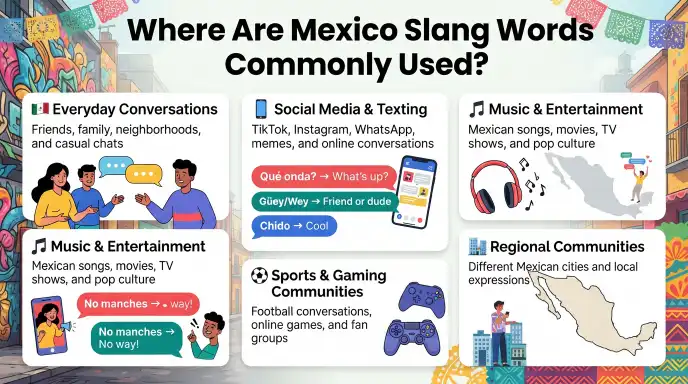
Social Media
Platforms like TikTok, Instagram, and Snapchat have helped Mexican slang spread globally. Users often include slang in captions, comments, and videos to sound natural and connected with Mexican culture.
Examples:
Texting and Online Chats
Young people often use shortened spellings of slang when messaging.
Examples:
- “wey” instead of “güey”
- “q onda” instead of “qué onda”
These shortened forms are common in casual online conversations.
Gaming Communities
Mexican gamers often use slang while communicating during online games.
Examples:
- “Vamos, carnal!”
- “Let’s go, bro!”
- “Qué onda, equipo.”
- “What’s up, team?”
Gaming chats usually use informal and quick expressions.
Music and Entertainment
Mexican slang is strongly connected with music genres, movies, and television. Many people learn these expressions through songs, shows, and internet content.
However, listeners should remember that entertainment slang may sometimes be exaggerated or specific to certain communities.
RealifLife Examples of Mexico Slang Words
Friendly Conversation
Person A:
“¿Qué onda, carnal?”
Person B:
“Todo bien, ¿y tú?”
Meaning:
“What’s up, buddy?”
“Everything good, and you?”
Casual Social Media Example
Caption:
“Esta comida está bien chida 🔥”
Meaning:
“This food is really awesome.”
Surprise Example
Friend:
“Compré boletos para el concierto.”
Response:
“¡No manches!”
Meaning:
“No way!”
Gaming Example
Player:
“Vamos, güey, podemos ganar.”
Meaning:
“Come on, dude, we can win.”
Origin and Background of Mexico Slang Words
Mexico slang words developed through centuries of cultural changes, regional traditions, and interactions between different communities. Mexican Spanish has been influenced by Indigenous languages, European Spanish, and modern global culture.
Many slang expressions come from everyday life rather than formal language rules. People create new words and meanings to express humor, friendship, emotions, and identity.
For example, words like “güey” changed over time. It was once considered an insult, but many Mexican speakers now use it casually among friends, similar to saying “dude” or “bro.” This shows how language evolves based on social use.
Regional differences also play an important role. A slang word commonly used in Mexico City may not be equally common in northern or southern Mexico. Younger generations also continue creating new expressions through music, internet culture, and social media.
Comparison With Similar Spanish Slang
Mexican slang often has similar expressions in other Spanishifspeaking countries, but the words and meanings may change.
| Mexico Slang | Meaning | Similar Expression Elsewhere |
| ¿Qué onda? | What’s up? | ¿Qué tal? |
| Güey | Dude/Bro | Tío (Spain) |
| Chido | Cool | Bacán (some South American countries) |
| Padre | Great/Cool | Genial |
| Neta | Honestly/Really | De verdad |
Although Spanish speakers from different countries can understand each other, local slang helps identify cultural backgrounds.
When Should You Avoid Using Mexican Slang?
Learning slang can improve your understanding of Mexican culture, but it is important to know when not to use it.
Avoid using casual slang in:
- Job interviews
- Formal meetings
- Academic writing
- Professional emails
- Conversations with people you do not know well
For example, saying “¿Qué onda, güey?” to a business partner may sound too informal.
Instead, use more neutral Spanish:
- “Hola, ¿cómo está?”
- “Mucho gusto.”
- “¿Cómo le va?”
The best approach is to understand slang first and use it only when the situation feels appropriate.
Polite Alternatives to Informal Mexican Slang
If you want to communicate respectfully, you can replace slang with standard Spanish expressions.
| Informal Slang | Polite Alternative | Meaning |
| ¿Qué onda? | ¿Cómo estás? | How are you? |
| Güey | Amigo | Friend |
| No manches | ¿En serio? | Really? |
| Chido | Excelente | Excellent |
| Aguas | Ten cuidado | Be careful |
Using polite alternatives helps when speaking with teachers, employers, or unfamiliar people.
Why Do People Use Mexico Slang Words?
People use slang because it creates a sense of connection and belonging. Informal expressions can make conversations feel warmer and more natural.
Common reasons include:
1. Showing Friendship
Slang helps people sound closer to each other.
Example:
“Gracias, carnal.”
sounds more personal than simply saying:
“Gracias.”
2. Expressing Emotions
Slang often communicates feelings better than formal words.
Example:
“¡No manches!”
shows stronger surprise than a simple “Really?”
3. Creating Cultural Identity
Mexican slang reflects local traditions, humor, and community. Using these expressions can show familiarity with Mexican culture.
4. Making Communication Faster
Short expressions are easier to use in texting and online conversations.
Impact of Using Slang in Communication
Slang can have both positive and negative effects.
Positive Effects
- Makes conversations more natural
- Builds stronger social connections
- Shows cultural understanding
- Helps people communicate casually
Possible Negative Effects
- May cause misunderstandings
- Some words may sound offensive
- Meanings can change by region
- Formal situations may require standard language
Understanding context is the key to using slang correctly.
Is Mexico Slang Safe for Social Media?
Yes, most Mexican slang is commonly used on social media, especially in casual posts, comments, and videos. Platforms like TikTok, Instagram, Reddit, and Discord often feature slang because users prefer relaxed and expressive communication.
However, users should be careful with:
- Offensive expressions
- Words with double meanings
- Regional insults
- Slang taken out of cultural context
A phrase that is funny among Mexican friends may not have the same effect when used by someone unfamiliar with the culture.
Frequently Asked Questions
Q1:What are the most common Mexico slang words?
Some popular Mexican slang words include ¿Qué onda?, chido, güey, neta, no manches, órale, and carnal. Their meanings depend on the situation and relationship between speakers.
Q2: Is Mexican slang the same everywhere in Mexico?
No. Different regions of Mexico have their own expressions. Some slang may be common in one city but uncommon in another.
Q3: Is “güey” a bad word?
Not always. Among friends, “güey” often means “dude” or “bro.” However, it can sound disrespectful depending on the tone and situation.
Q4: Can I use Mexican slang if I am learning Spanish?
Yes, but learn the context first. Understanding when and where to use slang is more important than memorizing individual words.
Q5: Why is Mexican slang popular online?
Mexican slang spreads online because of social media, music, movies, gaming communities, and international interest in Mexican culture.
Conclusion
Mexico slang words are more than just informal expressions; they represent culture, friendship, humor, and everyday communication. From “¿Qué onda?” to “chido” and “carnal,” these phrases help speakers express emotions in a more natural and personal way.
However, slang is always connected to context. A word that sounds friendly between close friends may not be suitable in professional or formal situations. Learning the meaning, tone, and background of each expression helps you communicate more confidently.
if you are learning Spanish, traveling to Mexico, watching Mexican content, or chatting online, understanding these slang terms can give you a deeper appreciation of the language and culture behind them. Use them naturally, respect regional differences, and remember that language is always changing.

I’m Dylan Foster, a slang and internet culture writer passionate about exploring how people communicate online and in everyday conversations. I write about texting abbreviations, social media expressions, and modern slang to help readers understand meanings, origins, and real-world usage in a simple way.