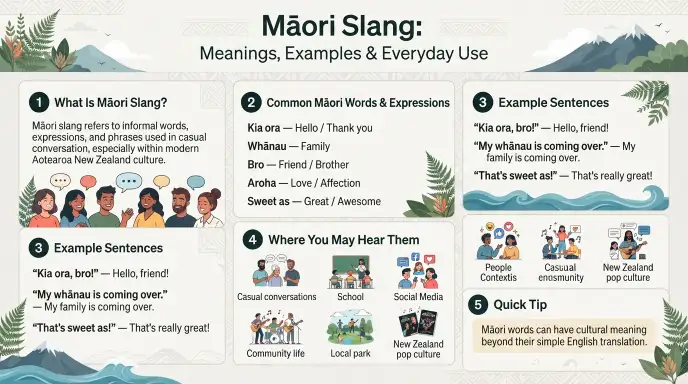
Māori slang common refers to informal Māori words and expressions used in casual conversation. Related terms include Māori informal language, Kiwi slang, colloquial Māori, and everyday Māori expressions.Māori slang usually refers to informal expression.
s associated with Māori communities or Māoriifinfluenced New Zealand English. Some expressions come directly from te reo Māori, while others are Kiwi slang shaped by Māori and English language contac
If you are searching for Māori slang, you may have heard words such as chur, tu meke, bro, cuz, or kai and wondered what they mean the important thing to.
understand is that not every Māori word is slang. Te reo Māori is a complete language with its own grammar and vocabulary, so it should not be treated simply as a collection of slang terms.
This guide explains common Māoriifrelated slang and expressions in simple English. You will learn their meanings, how they are used, where you may hear them, if they are appropriate in formal situations, and how Māori expressions differ from general New Zealand slang.
Quick Answer:Māori Slang Common:
- Māori slang is a broad term for informal expressions associated with Māori communities, Māoriifinfluenced New Zealand English, or casual speech in Aotearoa New Zealand.
- Some commonly mentioned examples include chur, tu meke, bro, cuz, and kai, although these expressions do not all have the same linguistic origin or status.
What Does Māori Slang Mean?
The phrase Māori slang can be confusing because it is often used online as a general label for casual words connected with Māori culture or New Zealand speech.
In reality, several different categories can overlap.
Te reo Māori is the Māori language. It is an official language of New Zealand and has formal, informal, traditional, and modern vocabulary.
New Zealand English is the variety of English spoken in Aotearoa New Zealand. It contains many Māori words and expressions.
Slang is informal language commonly used by particular groups or communities.
Because these categories overlap, a Māori word that is commonly used in New Zealand English does not automatically become slang.
For example, kai means food and is a Māori word that is also widely understood in New Zealand. It is not necessarily slang every time someone uses it.
Understanding this difference helps prevent common mistakes when discussing Māori language.
Common Māori Slang and Related Expressions
1. Chur
Chur is a casual New Zealand expression commonly used to show thanks, appreciation, agreement, or approval.
It can sometimes feel similar to:
- Thanks
- Cheers
- Awesome
- Sweet
- Thanks, mate
For example:
“I brought your jacket back.”
“Chur, bro!”
The exact meaning depends on the conversation. It is informal and is strongly associated with New Zealand speech.
2. Tu Meke
Tu meke is a Māori expression that literally means “too much.”
In casual New Zealand use, it can express strong appreciation or praise.
For example:
“You cooked dinner for everyone? Tu meke!”
In this situation, the speaker is not complaining that there is “too much.” Instead, they are expressing appreciation for someone’s generous action.
It can be understood in context as something like:
“That’s amazing!” or “You’re too kind!”
This is a good example of why translating an expression wordifforifword does not always explain how people actually use it.
3. Bro
Bro is an informal way to address a friend, mate, or another person.
It is common in New Zealand English and is not exclusively Māori slang.
For example:
“Hey bro, are you coming?”
Or:
“Thanks, bro.”
The word usually creates a relaxed and friendly tone.
Because bro is also common in other Englishifspeaking communities, it should not be described as uniquely Māori.
4. Cuz
Cuz is a shortened form of cousin.
In informal New Zealand speech, it can also be used for a close friend or someone who is treated like family.
For example:
“How are you, cuz?”
It is friendly and casual. You would normally use it with someone you know rather than in a formal situation.
5. Kai
Kai is a Māori word meaning food and is also commonly used in New Zealand English.
For example:
“There’s plenty of kai for everyone.”
Or:
“What are we having for kai?”
Although many online lists place kai under “Māori slang,” calling it slang in every situation is not accurate. It is an actual Māori vocabulary word that has become familiar to many New Zealand English speakers.
Māori Slang vs. Te Reo Māori
One of the most important points to remember is that Māori slang and te reo Māori are not the same thing.
Te reo Māori is a complete language. It includes everyday vocabulary, formal language, traditional expressions, modern terminology, grammar, and different styles of communication.
Māori slang, in contrast, refers to informal expressions or casual usage.
| Te reo Māori | Māoriifrelated slang / Kiwi usage |
| A complete language | Informal expressions |
| Has its own grammar | Often mixed with English |
| Used formally and informally | Mainly casual |
| Includes traditional vocabulary | Often associated with everyday speech |
| Used by Māori speakers and learners | Some expressions are widely used by nonifMāori speakers |
This distinction is especially important for anyone writing about Māori language for educational purposes.
Where Is Māori Slang Commonly Used?
Māoriifrelated expressions can appear in several types of communication.
Everyday Conversation
Friends and family may use casual words such as bro, cuz, or chur during relaxed conversations.
Text Messages
Informal expressions are common in texting because they make messages shorter and more personal.
For example:
“Thanks for helping me today.”
“Chur!”
Social Media
Māori words and Kiwi expressions may appear in comments, captions, videos, and online conversations.
A person might use tu meke to praise someone’s effort or say chur after receiving help.
School and Community
Students may hear Māori expressions in everyday conversations, school activities, or community events.
However, casual language should not automatically be used in formal assignments.
Workplace Chat
Some informal expressions may be perfectly natural between coworkers who know each other well. Formal emails and professional documents generally call for clearer, more neutral wording.
Is Māori Slang Rude or Offensive?
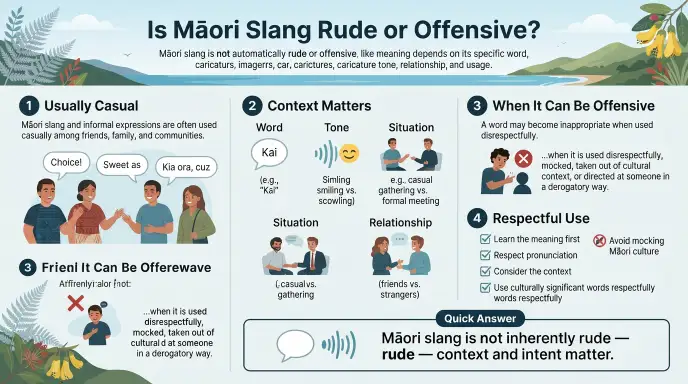
Māoriifrelated slang is not automatically rude or offensive. Most expressions are simply informal.
However, context matters.
A word can sound friendly when used naturally by someone familiar with the expression. The same word can sound awkward or disrespectful when someone uses it without understanding its meaning or cultural context.
It is also important not to imitate a Māori accent or pronunciation as a joke.
If you want to use Māori words, learn their meaning and pronunciation instead of treating them as trendy internet slang.
Key Takeaway
Not every Māori word is slang. Some words are part of everyday te reo Māori, while others have become common in New Zealand English.
Knowing this difference makes it easier to understand Māori expressions accurately and use them respectfully.
Māori Slang Examples in Real Conversations
Understanding Māori slang becomes much easier when you see how expressions work in real conversations. The same word can feel different depending on who is speaking, the relationship between the people, and the situation.
Example 1: Saying Thanks
Person A: “I brought your charger back.”
Person B: “Chur!”
Here, chur is being used as a casual way to say thanks or show appreciation.
Example 2: Showing Appreciation
Person A: “I cooked dinner for everyone.”
Person B: “Tu meke!”
Here, tu meke expresses strong appreciation. The speaker is praising the other person’s generous action.
Example 3: Talking About Food
Person A: “Is there anything to eat?”
Person B: “Yeah, there’s plenty of kai.”
Here, kai simply means food.
This is a good example of why Māori slang should not be treated as one fixed group. Kai is a Māori word that is also commonly used in New Zealand English.
Example 4: Talking to a Friend
Person A: “Hey bro, are you coming to the game?”
Person B: “Yeah, bro. I’ll be there.”
In this example, bro creates a relaxed and friendly tone.
Example 5: Using “Cuz”
Person A: “You coming over later, cuz?”
Person B: “Yeah, probably around seven.”
Here, cuz is a casual way to address a friend or someone who feels like family.
Māori Slang Across Different Platforms
The way people use informal Māoriifrelated expressions can change depending on the platform.
| Platform | Typical usage |
| Texting | Short, casual replies such as “chur” |
| TikTok | Comments, captions, jokes, and reactions |
| Captions and friendly comments | |
| Discord | Casual conversations between friends or gaming communities |
| Informal discussions and New Zealandiffocused conversations | |
| Workplace chat | Possible in relaxed teams, depending on the workplace |
| Formal writing | Usually better to use standard wording |
On social platforms, informal language can spread quickly. A person may see a Māori expression in a video or comment and start using it without knowing its original meaning.
That is why context is important.
Origin and History of Māori Slang
There is no single date when Māori slang began.
The phrase covers many different words, and each word can have a different history. A more accurate way to understand the topic is to look at the long relationship between te reo Māori and New Zealand English.
Māori is the indigenous language of Aotearoa New Zealand. As Māori and European communities interacted, Māori vocabulary entered New Zealand English.
Over time, Māori words became increasingly visible in everyday New Zealand speech. The Māori cultural revival from the 1970s onward also helped increase awareness and use of te reo Māori.
This history means that modern New Zealand English contains many Māori words and expressions.
However, it would be inaccurate to say that all Māoriifrelated expressions are slang or that all New Zealand slang comes from Māori.
Some expressions developed as part of New Zealand English, while others come directly from te reo Māori.
Why Do People Use Māori Slang Common:
People use Māoriifrelated informal expressions for several reasons.
To Show Friendship
Words such as bro and cuz can make conversations sound relaxed and personal.
To Say Thanks
Expressions such as chur can communicate appreciation without sounding formal.
To Show Appreciation
Tu meke can be used when someone has done something generous or impressive.
To Reflect New Zealand Identity
Māori words have become an important part of the linguistic identity of Aotearoa New Zealand.
To Connect With Māori Culture
Using te reo Māori appropriately can help people learn about and engage with the language.
The important word here is appropriately. Learning a language is different from copying expressions simply because they sound trendy.
When Should You Avoid Using Māori Slang?
You do not need to avoid Māoriifrelated expressions completely. Instead, think about the situation before using them.
It may be better to avoid casual slang when:
- You are writing a formal academic paper.
- You are preparing an official document.
- You are writing a formal business email.
- You do not understand the expression.
- You are unsure how the word should be pronounced.
- You are using the expression to imitate a culture or accent.
- You are joking about Māori language or pronunciation.
- You are presenting a normal Māori word as “slang” without checking its meaning.
In a formal setting, standard wording is usually the safest choice.
For example, instead of writing:
“Chur for your help.”
A professional email could simply say:
“Thank you for your help.”
Both communicate appreciation, but the second is more suitable for formal communication.
Can You Use Māori Slang at Work?
Yes, some informal expressions can be used at work, but the situation matters.
A relaxed workplace where coworkers regularly use casual New Zealand English is different from a formal presentation, job interview, or official report.
For example, if a coworker helps you carry some equipment, saying:
“Chur!”
may sound friendly and natural in an informal environment.
But in a formal email, you would normally write:
“Thank you for your assistance.”
The issue is not that one phrase is good and the other is bad. They simply belong to different levels of formality.
Similar New Zealand Slang and Māori Expressions
People searching for Māori slang often encounter other New Zealand expressions as well.
Sweet as
Sweet as is a wellifknown New Zealand expression meaning something like great, okay, or no problem.
Example:
“Can you pick me up at six?”
“Sweet as.”
It is Kiwi slang rather than a Māori word.
Choice
Choice can mean excellent, great, or very good in informal New Zealand English.
Example:
“That was a choice meal.”
Bro
As explained earlier, bro is a casual way to address a friend or mate. It is widely used in New Zealand and is not exclusively Māori.
Chur
Chur is used to express thanks, appreciation, or agreement.
Tu Meke
Tu meke is a Māori expression that can be used casually to show strong appreciation.
Māori Slang vs. New Zealand Slang
These terms are related, but they are not identical.
| Māoriifrelated expression | General Kiwi slang |
| Tu meke | Sweet as |
| Kai | Choice |
| Some Māori words used casually | Bro |
| Māori expressions used in NZ English | Mate |
| Connected with te reo Māori | Developed within NZ English |
Some expressions can cross these categories because language changes through everyday contact.
This is why a simple online list of “Māori slang words” can sometimes be misleading.
Common Misunderstandings About Māori Slang
“Every Māori word is slang.”
No. Te reo Māori is a complete language. A Māori word does not become slang simply because it is unfamiliar to an English speaker.
“All Kiwi slang comes from Māori.”
No. New Zealand English has developed through many linguistic and cultural influences.
“Māori slang is only used by Māori people.”
Not necessarily. Some Māori words and expressions are now widely used by people throughout New Zealand.
However, widespread use does not remove the cultural importance of te reo Māori.
“I can use any Māori word casually.”
Not necessarily.
You should understand the meaning, pronunciation, and context before using an unfamiliar Māori expression.
“Māori slang is the same as te reo Māori.”
No. Te reo Māori is the Māori language. Slang is only one possible type of informal language.
Frequently Asked Questions About Māori Slang Common:
Q1. What is the most common Māori slang?
There is no single official “most common” Māori slang word because the phrase covers different types of language. Expressions such as chur and tu meke are commonly discussed in relation to informal New Zealand speech.
Q2. What does “chur” mean?
Chur is an informal New Zealand expression commonly used to mean thanks, cheers, or appreciation.
Q3. What does “tu meke” mean?
Tu meke literally means “too much” in Māori. In casual use, it can express strong appreciation or praise.
Q4. What does “kai” mean?
Kai means food and is a Māori word that is also commonly used in New Zealand English.
Q5. Is Māori slang used on TikTok?
Yes. Māori words and New Zealand expressions can appear in TikTok videos, captions, comments, and conversations. Their meaning depends on context.
Q6. Is Māori slang appropriate at school?
Informal expressions may be fine in casual conversations with friends, but formal assignments should use language appropriate to the assignment and audience.
Q7. Can nonifMāori people use Māori words?
People can learn and use te reo Māori, but they should make an effort to understand the meaning, pronunciation, and cultural context rather than using words as jokes or stereotypes.
Conclusion About Māori Slang Common:
Māori slang is a useful search term, but it should not be treated as the name of one fixed group of words. Some expressions are genuine Māori vocabulary, some are informal New Zealand English, and some sit between these categories because Māori and English have influenced each other over time.
Words such as chur, tu meke, kai, bro, and cuz can all appear in conversations associated with New Zealand, but they do not all have the same origin or linguistic status.
The safest approach is simple: learn the meaning, understand the context, and use Māori expressions respectfully. Most importantly, remember that te reo Māori is a complete language, not simply a collection of slang terms.
If you understand that distinction, you can better recognize Māori expressions in texting, social media, conversations, and everyday New Zealand English without confusing informal slang with the Māori language itself.

I’m Dylan Foster, a slang and internet culture writer passionate about exploring how people communicate online and in everyday conversations. I write about texting abbreviations, social media expressions, and modern slang to help readers understand meanings, origins, and real-world usage in a simple way.