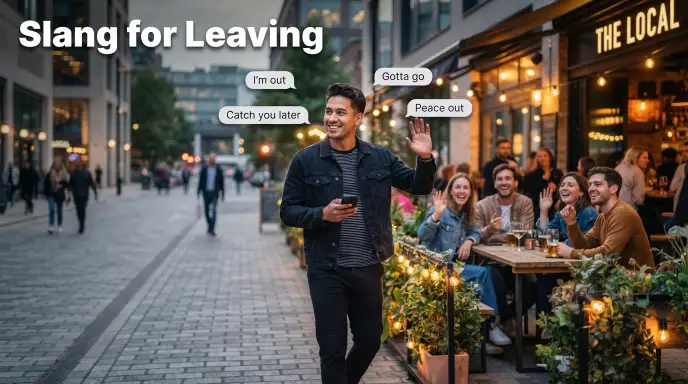
Slang for leaving refers to casual words and phrases people use when they are about to leave a place, end a conversation, or sign off from an online chat. Common examples include “I’m out,” “I’m dipping,” “I’m heading out,” “I gotta bounce,” and “catch you later.”
People often search for slang for leaving because saying “goodbye” can sound too formal in a casual conversation. Friends, gamers, socialifmedia users, and people texting often use shorter and more playful expressions instead.
The right phrase depends on the situation. Some expressions are friendly and widely understood, while others are more regional, humorous, or associated with certain age groups. This guide explains what these phrases mean, how they sound, where they are used, and which ones are better avoided in professional settings.
Quick Answer: Slang for Leaving
Slang for leaving includes casual expressions such as “I’m out,” “I’m dipping,” “I gotta bounce,” “I’m heading out,” “I’m off,” and “catch you later.” They usually mean that someone is leaving a place or ending a conversation.
The tone can range from relaxed and friendly to funny or very casual. Your choice should match the people and situation.
What Does Slang for Leaving Mean?
Slang for leaving is informal language used to tell someone that you are going away, ending a conversation, or signing off.
Unlike a simple “goodbye,” these expressions can communicate extra feeling. For example, “I’m out” can sound quick and confident, while “catch you later” sounds friendly and suggests that you expect to talk again.
Common phrases include:
| Slang phrase | Basic meaning | Tone |
| I’m out | I’m leaving | Casual |
| I’m dipping | I’m leaving | Very casual |
| Gotta bounce | I have to leave | Casual |
| I’m heading out | I’m leaving now | Casual/neutral |
| I’m off | I’m leaving | Casual |
| Catch you later | Goodbye for now | Friendly |
| Peace | Goodbye | Casual |
| Later | Goodbye | Very casual |
| I’m gonna roll | I’m leaving | Casual |
| I’m outta here | I’m leaving | Casual/playful |
These phrases do not all carry exactly the same feeling. Some work almost anywhere in casual speech, while others are more strongly associated with slang.
Popular Slang for Leaving
1. I’m Out
“I’m out” is one of the simplest casual ways to announce that you are leaving.
For example:
“It’s getting late. I’m out.”
It can also mean that someone is quitting or refusing to take part in something, so context matters.
Tone: Casual and direct.
2. I’m Dipping
“I’m dipping” means “I’m leaving,” usually in a relaxed or informal way.
Example:
“I’ve got an early class tomorrow, so I’m dipping.”
This phrase is more slangifheavy than “I’m heading out,” so it fits better with friends and casual online conversations.
Tone: Very casual.
3. Gotta Bounce
“Gotta bounce” means “I have to leave.”
Example:
“I gotta bounce. See you tomorrow.”
It has a friendly, relaxed sound and is often used when someone needs to leave without making the goodbye feel formal.
Tone: Casual and friendly.
4. I’m Heading Out
“I’m heading out” is less slangifheavy than some other expressions on this list.
It simply means that someone is about to leave.
Example:
“I’m heading out now. Do you need anything before I go?”
Because it is fairly neutral, it can work in many everyday situations.
Tone: Casual to neutral.
5. Catch You Later
“Catch you later” is a friendly way to say goodbye.
It usually suggests that the speaker expects to see or speak to the other person again.
Example:
“Thanks for hanging out. Catch you later!”
Tone: Friendly and relaxed.
Slang for Leaving in Texting
Text messages often use short phrases because people want to communicate quickly.
Common choices include:
- “Gotta go”
- “I’m out”
- “Later”
- “Peace”
- “I’m off”
- “GTG” if got to go
- “TTYL” if talk to you later
- “Catch you later”
Some of these are slang phrases, while others are texting abbreviations.
For example, someone might text:
“GTG, my ride is here.”
This simply means they need to leave because their transportation has arrived.
Texting language is usually more relaxed than workplace communication, but the relationship between the people still matters.
Slang for Leaving on Social Media
On platforms such as TikTok, Instagram, Reddit, Snapchat, and Discord, people may use casual expressions when ending a conversation or leaving a digital space.
Examples include:
- “I’m out”
- “Peace”
- “Later”
- “I’m dipping”
- “Gotta bounce”
- “I’m logging off”
- “I’m outta here”
Online, the phrase can sometimes be humorous rather than literal.
For example, someone might comment:
“Okay, I’ve seen enough. I’m out.”
They may not physically be leaving anywhere. They are simply saying they are done with the conversation, video, or topic.
Slang for Leaving in Gaming
Gaming communities have their own casual ways of saying goodbye or announcing that a player is leaving.
A gamer might say:
“I gotta bounce. GG!”
Here, “GG” means “good game.”
Other common expressions include:
- “I’m hopping off”
- “I’m logging off”
- “I’m out”
- “I’m done for tonight”
- “Catch you tomorrow”
- “I’m calling it”
“Hopping off” is especially useful in gaming because it usually means leaving the game or ending the current gaming session.
Is Slang for Leaving Rude?
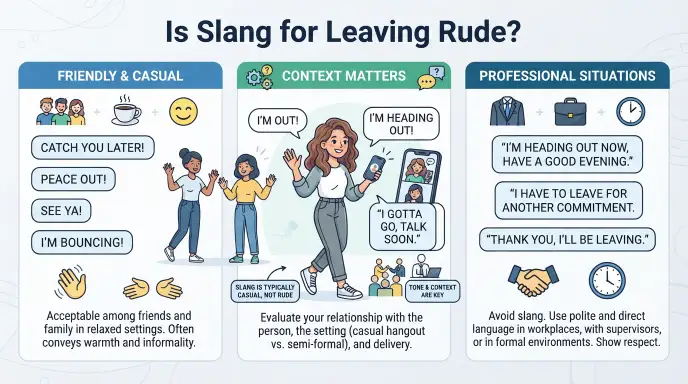
Most slang for leaving is not automatically rude. The tone depends on the phrase, situation, and relationship between the speakers.
For example:
“I’m heading out. See you tomorrow.”
sounds polite and relaxed.
By contrast:
“I’m out.”
can sound abrupt if someone says it in the middle of an important conversation.
That does not necessarily make it offensive. It simply means the phrase may feel less considerate in some situations.
When speaking with someone you respect, adding a short explanation can make a casual goodbye sound friendlier.
When Should You Avoid Slang for Leaving?
Casual leaving phrases are usually best with friends, family members, classmates, gaming groups, and informal online communities.
Use more neutral language in situations such as:
- Job interviews
- Professional emails
- Business meetings
- Formal presentations
- Academic communication
- Speaking with an important client
- Official customerifservice conversations
Instead of:
“Gotta bounce.”
you could say:
“I need to leave now. Thank you for your time.”
The second version is clearer and more professional.
Slang for Leaving: Casual vs. Formal
Choosing the right phrase is mostly about matching the setting.
| Situation | Casual choice | More formal choice |
| Friend | “I’m out.” | “I’m going to head out.” |
| Gaming | “I’m hopping off.” | “I’m going to end my session.” |
| Texting | “GTG.” | “I need to go now.” |
| Workplace | “I’m heading out.” | “I’ll be leaving now.” |
| Meeting | “Gotta bounce.” | “I need to step away.” |
| Family | “I’m off.” | “I’ll see you later.” |
The goal is not to avoid slang completely. It is to know when casual language fits.
Part 2 continues with the remaining meanings, usage contexts, examples, comparisons, FAQs, and conclusion.
Different Ways to Say You Are Leaving
There is no single best slang phrase for leaving. Different expressions can show urgency, friendliness, humor, or simply a desire to end a conversation.
“I’m Outta Here”
“I’m outta here” means “I’m leaving this place.”
It can sound playful or dramatic, especially when someone has had enough of a situation.
Example:
“This meeting is finally over. I’m outta here!”
It is usually casual and should not be confused with formal workplace language.
“I’m Off”
“I’m off” is a short way to say that you are leaving.
Example:
“I’m off now. See you tomorrow.”
This expression is especially common in British English and is generally easy to understand.
“Peace”
“Peace” can be used as a casual goodbye.
Example:
“Alright, I’m heading home. Peace!”
It can sound relaxed and friendly, although its popularity varies by speaker and social group.
“Later”
“Later” is a very short way to say goodbye.
Example:
“I’ve got to go. Later!”
It is informal and usually works best with friends or people you know well.
“I’m Gonna Roll”
“I’m gonna roll” can mean “I’m going to leave.”
Example:
“It’s getting late, so I’m gonna roll.”
This is casual slang and may sound more natural in some groups than others.
Slang for Leaving When You Are in a Hurry
Sometimes you are not simply saying goodbye. You need to leave quickly.
In that situation, people might say:
- “I gotta go.”
- “I gotta run.”
- “I’m out.”
- “I need to bounce.”
- “I’m heading out.”
- “I’ve gotta take off.”
For example:
“I gotta run. My bus is here.”
Here, “run” does not necessarily mean physically running. It means the person needs to leave quickly.
“I gotta go” is one of the safest casual choices because most English speakers understand it immediately.
Slang for Leaving a Party
At a party or social event, people often want to leave without making the goodbye sound too formal.
You might hear:
“I’m gonna bounce.”
“I’m calling it a night.”
“Calling it a night” is useful when someone has decided to end their evening.
Example:
“I’ve had a great time, but I’m calling it a night.”
This sounds casual while still being polite.
Slang for Leaving a Group Chat
Online conversations sometimes need a different kind of goodbye.
Someone leaving a group chat or ending an online conversation might say:
- “I’m out.”
- “I’m logging off.”
- “I’m dipping.”
- “I’m heading out.”
- “Catch you later.”
- “I’m calling it.”
In a group chat, the phrase can sometimes be humorous.
For example:
“Okay, you guys are arguing about this again. I’m out
The person may simply be joking that they no longer want to participate.
Slang for Leaving Work
Workplace communication needs more care.
With close coworkers in a casual workplace, phrases such as “I’m heading out” may be perfectly normal.
For example:
“I’m heading out. See everyone tomorrow.”
However, “I’m dipping” or “Gotta bounce” may sound too casual in many professional settings.
A safer workplace option is:
“I’m heading out for the day. Have a good evening.”
It communicates the same basic idea without sounding overly informal.
RealifLife Examples of Slang for Leaving
Friendly Conversation
Alex: “Are you staying for another game?”
Sam: “Nah, I’m out. I’ve got an early morning.”
Here, “I’m out” simply means Sam is leaving.
Text Message
“GTG, my parents are waiting. Talk later!”
“GTG” is a texting abbreviation meaning “got to go.”
Gaming
“I’m hopping off after this match. GG!”
The player is ending the gaming session.
Discord
“I gotta bounce. Catch you guys tomorrow.”
This sounds friendly and informal.
TikTok Comment
“I’m outta here after seeing that
This can be humorous rather than a literal announcement that someone is physically leaving.
Workplace
“I’m heading out for the day. See you tomorrow.”
This is casual but still professional enough for many everyday workplace situations.
Family
“Alright, I’m off. I’ll call you later.”
This is a simple and natural goodbye.
Slang for Leaving: Platform Comparison
The same phrase can feel different depending on where it appears.
| Platform or setting | Common style | Example |
| Texting | Short and casual | “GTG” |
| TikTok | Playful or humorous | “I’m out 😂” |
| Casual | “Later!” | |
| Snapchat | Very informal | “Gotta bounce” |
| Discord | Communityiffocused | “I’m hopping off” |
| Gaming | Sessionifrelated | “I’m logging off” |
| Casual or humorous | “I’m outta here” | |
| Workplace | Neutral | “I’m heading out” |
These are general patterns, not strict rules. People use different expressions based on personality, age, location, and social group.
Similar Slang and Goodbye Expressions
Slang for leaving overlaps with slang for saying goodbye, but the two ideas are not always identical.
| Expression | Meaning | Best context |
| I’m out | I’m leaving | Casual |
| I’m dipping | I’m leaving | Very casual |
| Gotta bounce | I need to leave | Casual |
| I’m heading out | I’m leaving | Casual/neutral |
| Catch you later | Goodbye for now | Friendly |
| Later | Goodbye | Very casual |
| Peace | Goodbye | Casual |
| TTYL | Talk to you later | Texting |
| GTG | Got to go | Texting |
| I’m logging off | Ending an online session | Gaming/online |
This table also shows why there is no single phrase that works in every situation.
Why Do People Use Slang for Leaving?
People use casual expressions because they make conversations feel relaxed and natural.
A phrase such as “I’m dipping” can feel more conversational than “I am leaving now.”
Slang can also communicate personality. Someone might choose “I’m outta here” because it sounds humorous, while another person may prefer “I’m heading out” because it is simple and neutral.
Online, short expressions are also useful because they make messages quick to type.
Is Slang for Leaving Appropriate at Work?
Some expressions are appropriate at work, while others are better avoided.
Usually Fine
- “I’m heading out.”
- “I’m leaving for the day.”
- “I’ll see you tomorrow.”
- “I need to head out.”
More Casual
- “I’m off.”
- “I’m out.”
- “Later.”
Usually Too Informal for Professional Messages
- “Gotta bounce.”
- “I’m dipping.”
- “I’m outta here.”
The safest choice is to use neutral language when you are unsure about the workplace culture.
Common Misunderstandings
Does “I’m Out” Always Mean Leaving?
No. “I’m out” can also mean that someone is no longer participating in something.
For example:
“If everyone is paying that much, I’m out.”
Here, the speaker means they are refusing to participate, not necessarily walking away.
Does “I’m Dipping” Mean Literally Dipping Something?
Usually not in a conversation about leaving. It is slang that can mean going away or leaving.
Is “Gotta Bounce” About Bouncing?
No. In this context, “bounce” is an informal way of saying leave.
Is “Later” Short for “See You Later”?
Often, yes. It functions as a casual goodbye.
Is GTG Slang?
GTG is a texting abbreviation for “got to go.” It is common in casual digital communication but is not appropriate for every formal setting.
When to Choose a Polite Alternative
If you are speaking with someone you do not know well, a simple goodbye is often better than heavy slang.
Instead of:
“I’m dipping.”
you can say:
“I’m going to head out now. Have a good day.”
Instead of:
“Gotta bounce.”
you can say:
“I need to leave now. I’ll talk to you later.”
These alternatives are still natural, but they reduce the chance of sounding too casual.
Frequently Asked Questions
Q1. What is the best slang for leaving?
“I’m out,” “I’m heading out,” “I gotta bounce,” and “I’m dipping” are common casual choices. The best option depends on your audience and situation.
Q2. What is slang for leaving a party?
“I’m heading out,” “I’m dipping,” “I gotta bounce,” and “I’m calling it a night” can all work in casual settings.
Q3. What does “I’m dipping” mean?
“I’m dipping” is informal slang meaning “I’m leaving” or “I’m going away.”
Q4. What does “I gotta bounce” mean?
It means “I have to leave.” It is casual and usually used with friends or people you know.
Q5. What does GTG mean?
GTG means “got to go.” It is commonly used in texting and online chats.
Q6. Can I use slang for leaving at work?
Some phrases, such as “I’m heading out,” can be fine at work. More slangifheavy expressions such as “I’m dipping” or “I gotta bounce” may be too informal.
Conclusion
Slang for leaving gives people many casual ways to say they are going away or ending a conversation. Expressions such as “I’m out,” “I’m dipping,” “I gotta bounce,” “I’m heading out,” and “catch you later” all communicate the basic idea of leaving, but they have different levels of informality.
The most important thing is context. A phrase that sounds natural with friends may sound too casual in a workplace or school setting. Online, some expressions can also be used humorously rather than literally.
If you want a safe everyday option, “I’m heading out” is a strong choice. With close friends, you have more freedom to use playful expressions such as “I’m dipping” or “I gotta bounce.”

I’m Dylan Foster, a slang and internet culture writer passionate about exploring how people communicate online and in everyday conversations. I write about texting abbreviations, social media expressions, and modern slang to help readers understand meanings, origins, and real-world usage in a simple way.