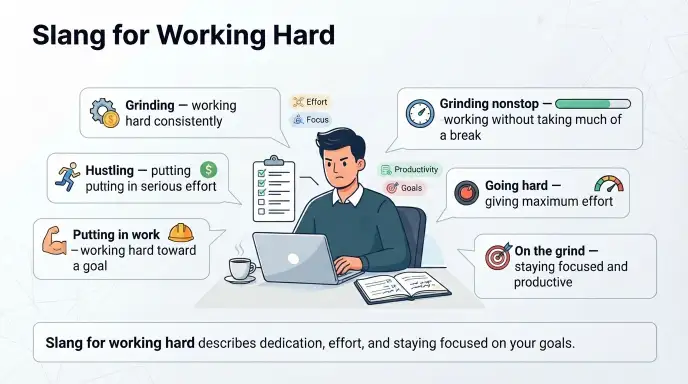
“Slang for working hard” refers to casual expressions people use to describe putting in a lot of effort, staying busy, or working toward a goal. Common examples include grinding, hustling, putting in work, going hard, and working your butt off.
If you searched for slang for working hard, you may be looking for a phrase that sounds more natural and energetic than simply saying “I’m working hard.” The right expression depends on the situation, because some phrases are friendly and motivational while others are very informal.
In this guide, you’ll learn the most useful slang for working hard, what each expression means, where people commonly use it, and if it is suitable for school, work, texting, gaming, or social media.
Quick Answer: Slang for Working Hard
The most common slang for working hard includes grinding, on the grind, putting in work, hustling, going hard, working your butt off, and going all out. “Grinding” is one of the most flexible choices for describing steady effort toward a goal.
What Does “Slang for Working Hard” Mean?
Slang for working hard means informal words and phrases that describe someone making a strong effort, working for a long time, or staying focused on a goal.
There is no single slang expression that works in every situation. The best choice depends on what kind of effort you want to describe.
For example:
- “I’m grinding.” → I’m working hard and staying focused.
- “She’s putting in work.” → She is making a serious effort.
- “He’s hustling.” → He is working actively to achieve something.
- “I’m going hard.” → I’m giving something a lot of energy.
- “I’m working my butt off.” → I’m working extremely hard.
Most of these expressions are casual, so they are more common in conversations, texts, social media, sports, gaming, and informal workplace chats than in formal writing.
Best Slang for Working Hard
Here are some of the most useful expressions to know:
| Slang | Simple meaning | Tone |
| Grinding | Working steadily and persistently | Casual |
| On the grind | Staying focused on work or a goal | Casual |
| Putting in work | Making a strong effort | Casual |
| Hustling | Working energetically toward a goal | Casual |
| Going hard | Giving something intense effort | Very casual |
| Working your butt off | Working extremely hard | Informal |
| Busting your butt | Working very hard | Informal |
| Going all out | Giving maximum effort | Casual |
| Giving it your all | Using your best effort | Neutral |
| Crushing it | Doing extremely well | Casual |
| Killing it | Performing very well | Casual |
1. Grinding
“Grinding” is one of the most common modern expressions for working hard.
When someone says “I’m grinding,” they usually mean they are putting in consistent effort and staying focused on a goal. It can describe a job, schoolwork, exercise, business, creative work, or personal goals.
For example:
“I’ve been grinding all week to finish this project.”
This means the person has been working consistently and putting in serious effort.
You may also hear:
“Keep grinding!”
This is usually encouragement to continue working toward a goal.
Tone: Casual, positive, and motivational.
Common settings: Texting, social media, fitness, school, work, gaming, and online communities.
2. On the Grind
“On the grind” means actively working hard toward a goal.
It is similar to “grinding,” but it often emphasizes an ongoing routine of effort.
Examples:
“Back on the grind after the weekend.”
“She’s on the grind trying to build her business.”
“I’m on the grind studying for finals.”
The phrase can sound motivational, but “the grind” can also suggest work that feels repetitive, tiring, or demanding.
Tone: Casual and motivational.
3. Putting in Work
“Putting in work” means making a serious effort to improve, accomplish something, or reach a goal.
This expression is especially common in sports, fitness, school, music, business, and other goaliffocused settings.
Examples:
“He’s been putting in work at the gym.”
“Our team has been putting in work before the tournament.”
“You can tell she’s putting in work on her new project.”
The expression focuses more on effort and dedication than simply being busy.
Tone: Casual, confident, and energetic.
4. Hustling
“Hustling” can mean working energetically, moving quickly, or actively trying to achieve a goal.
For example:
“She’s hustling to get her business started.”
Here, hustling has a positive meaning: she is working hard and trying to make things happen.
However, hustle has other meanings, including meanings connected with dishonest or deceptive activity. Because of this, the surrounding sentence matters.
Tone: Casual and energetic.
Best for: Business, moneyifmaking goals, personal projects, and informal conversations.
5. Going Hard
“Going hard” means putting a lot of energy or effort into something.
Examples:
“I’m going hard on this project tonight.”
“She’s going hard in the gym.”
“The team is going hard during practice.”
This expression is very casual and can sound especially natural among friends or in sports and fitness conversations.
Tone: Very casual and energetic.
Slang for Working Hard at School
Students often use slang to describe studying for exams, completing assignments, or preparing for important tests.
Common expressions include:
- Grinding
- Putting in work
- Going hard
- Working my butt off
- Giving it my all
Examples:
“I’m grinding for my final exam.”
“I’ve been putting in work all week.”
“I’m working my butt off to pass this class.”
Among friends, these phrases can sound natural. In a formal school assignment, however, standard language is usually a better choice.
Slang for Working Hard at the Gym
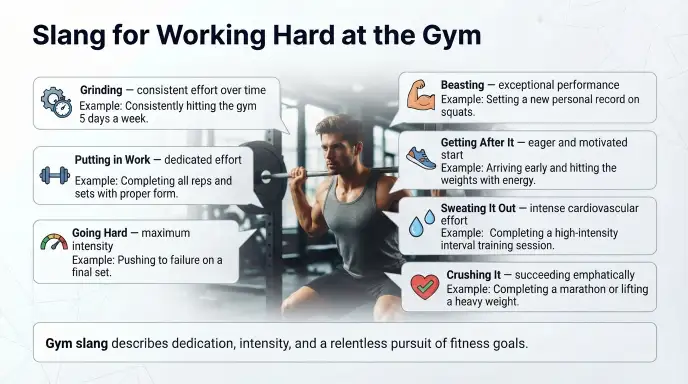
Fitness communities also use many of the same expressions.
You might hear:
“Time to put in work.”
“Been grinding at the gym for months.”
“He’s going hard before the competition.”
“She’s been putting in serious work.”
These phrases usually communicate effort, discipline, and consistency rather than simply saying that someone exercises.
Slang for Working Hard in Gaming
“Grinding” has an especially important meaning in gaming.
In games, grinding can mean repeatedly completing activities to gain experience, levels, items, money, or other progress.
For example:
“I’m grinding for XP.”
This means the player is repeatedly doing tasks to earn experience points.
Another example:
“I’ve been grinding all night to unlock this character.”
Here, the person is putting in repeated effort inside the game rather than doing traditional employment.
This is one reason “grinding” is especially common in gaming communities and Discord conversations.
Is Slang for Working Hard Rude or Offensive?
Most expressions for working hard are harmless and casual, but some are more informal than others. The main issue is usually tone, not offensiveness.
For example, “grinding,” “putting in work,” and “going all out” are generally safe in casual conversations. Expressions such as “working my ass off” contain profanity and are better saved for close friends or very informal settings.
| Expression | Rude? | Formal? | Best setting |
| Grinding | No | Somewhat informal | Friends, school, work chat |
| Putting in work | No | Informal | Sports, work, fitness |
| Going all out | No | Fairly safe | Most casual situations |
| Hustling | Usually no | Informal | Business, goals, casual talk |
| Working your butt off | No | Very informal | Friends and family |
| Working your ass off | Mild profanity | No | Very casual conversations |
When in doubt, choose “working hard” or “putting in a lot of effort.”
Real :Life Examples of Slang for Working Hard
The meaning becomes easier to understand when you see these expressions in normal conversations.
Text Message Example
Friend: “Are you coming out tonight?”
You: “Probably not. I’m grinding for my exam.”
Meaning: You are studying hard and staying focused.
Workplace Chat Example
Coworker: “How’s the project going?”
You: “We’re putting in work and should have it ready soon.”
Meaning: The team is making a serious effort.
This is acceptable in a relaxed workplace chat, but a more formal report might say “The team is making strong progress.”
Fitness Example
“Three months of grinding finally paid off.”
Meaning: The person has worked consistently toward a fitness goal.
Gaming Example
“I’m grinding until I unlock the new weapon.”
Meaning: The player is repeatedly completing tasks to make progress.
Social Media Example
“No shortcuts. Just putting in work.”
Meaning: The person is emphasizing consistent effort and dedication.
Where Is Slang for Working Hard Commonly Used?
These expressions appear across many online and offline settings, but the preferred phrase can change depending on the community.
Texting
In texts between friends, you may see:
- “I’m grinding.”
- “I’m going hard.”
- “Working my butt off.”
- “I’m on the grind.”
TikTok and Instagram
Social media posts often use motivational expressions such as:
- On the grind
- Keep grinding
- Putting in work
- Hustle
- Crushing it
These phrases are often used with posts about fitness, business, school, careers, or personal goals.
Discord
On Discord, especially in gaming communities, “grinding” can refer to repeatedly playing to make progress.
For example:
“Anyone want to grind the rankings tonight?”
Here, grind means spending time playing repeatedly to improve or progress.
Reddit users may use expressions such as grinding, hustling, putting in work, or working their butt off, depending on the community.
Workplace
Casual workplace chats may include:
“The team is crushing it.”
or:
“Everyone is putting in work this week.”
However, formal emails and documents usually benefit from clearer standard English.
Origin and History
The expressions used for working hard do not all come from modern internet slang. Many are based on much older English words and idioms.
The History of “Grind”
The word grind has a long history connected with physically crushing or rubbing something. Over time, it developed figurative meanings related to difficult or tiring work.
Modern dictionaries also record grind as an informal term for working or studying hard. In gaming, the word developed another specialized use for repeated activities that help a player make progress.
So, saying that “grind” was invented by TikTok or Gen Z would be misleading. Social media has helped spread current casual uses, but the word itself is much older.
The History of “Hustle”
Hustle is also much older than modern internet culture. It has had several meanings throughout its history.
Today, casual speakers may use hustle positively to mean working energetically or pursuing opportunities. However, it can also have negative meanings involving dishonest behavior.
That is why context is especially important with hustle and hustling.
Similar Slang and Related Expressions
If you want alternatives to slang for working hard, these expressions can help.
“Get After It”
Get after it means to start working hard or take action.
“Enough talking. Let’s get after it.”
It is casual and motivational.
“Crushing It”
Crushing it means doing extremely well.
“You’re crushing it at your new job.”
It does not literally mean destroying something. It is a positive expression about strong performance.
“Killing It”
Killing it also means performing very well.
“She’s killing it in her new role.”
This is figurative slang and is generally understood as praise.
“Going All Out”
Going all out means giving something your maximum effort.
“He went all out for the final presentation.”
This expression is casual but is less slangifheavy than some alternatives.
“Giving It Your All”
Giving it your all means using your best effort.
“She gave it her all during the competition.”
This is a useful option when you want something encouraging without sounding too informal.
When Should You Avoid Slang for Working Hard?
Slang can make casual speech sound natural, but it is not always the right choice.
Consider avoiding slang when:
- Writing a school essay
- Applying for a job
- Sending a formal business email
- Writing a professional report
- Talking with a client
- Writing official documents
- Speaking in a formal presentation
For example, this sounds casual:
“I’m grinding like to finish this report.”
A professional alternative would be:
“I’m working hard to complete the report on time.”
The second version is clearer and more appropriate for formal communication.
Polite Alternatives to Slang for Working Hard
If you want to express the same idea without slang, try these phrases:
- Working hard
- Making a strong effort
- Putting in a lot of effort
- Working diligently
- Making steady progress
- Giving my best effort
- Working consistently
- Working toward my goal
These alternatives work well with teachers, managers, customers, employers, and other people in formal situations.
Why Do People Use Slang for Working Hard?
People often use slang because it makes ordinary statements sound more energetic, personal, and conversational.
Compare:
“I am working hard.”
with:
“I’m grinding.”
Both communicate effort, but the second sounds more casual and motivational.
Slang can also help people show that they belong to a particular community. Gamers, athletes, students, entrepreneurs, and online communities may develop shared expressions that make communication feel more natural.
Still, slang is not automatically better. The audience and setting should determine which expression you choose.
Common Misunderstandings
Does “grinding” always mean working at a job?
No. Grinding can describe studying, exercising, gaming, practicing a skill, or working toward almost any goal.
For example:
“I’m grinding for finals.”
means studying hard, not working a paid job.
Does “hustling” always mean scamming?
No. Hustling can mean working energetically or pursuing opportunities. However, hustle also has negative meanings related to dishonest activity.
That is why the surrounding context matters.
Is “putting in work” professional?
It can be understood in a workplace, especially in casual team conversations. However, it remains informal.
For a formal report, “making a strong effort” or “making significant progress” is usually better.
Is “working your ass off” rude?
It contains profanity, so it is very informal. It may be fine between close friends but is not suitable for most professional or formal situations.
Which slang is best for working hard?
“Grinding” is one of the most flexible choices. “Putting in work” is another strong option when you want to emphasize effort and dedication.
Frequently Asked Questions
Q1. What is the best slang for working hard?
“Grinding” is one of the most common choices. It means working consistently and putting serious effort into a goal.
Q2. What does “on the grind” mean?
“On the grind” means staying busy and working toward a goal. It can describe work, studying, fitness, business, or another longifterm activity.
Q3. What does “putting in work” mean?
“Putting in work” means making a serious effort. It is especially common in sports, fitness, school, business, and personal development.
Q4. Is “hustling” positive or negative?
It can be either. Hustling can mean working energetically toward a goal, but hustle also has negative meanings connected with dishonest activity. Context determines the meaning.
Q5. Can I say “grinding” at work?
Yes, particularly in casual conversations or workplace chats. For formal emails, reports, and documents, “working hard” is usually more appropriate.
Q6. What slang means working extremely hard?
Common options include grinding, putting in work, going hard, working your butt off, busting your butt, and going all out.
Q7. Is “grinding” still used as slang?
Yes. It remains a common casual expression for persistent effort. It is also widely used in gaming, where grinding can mean repeating activities to gain progress, levels, experience, or rewards.
Conclusion
Slang for working hard includes expressions such as grinding, on the grind, putting in work, hustling, going hard, and going all out. Each phrase has a slightly different tone, so the best choice depends on your audience and situation.
For casual conversations, texting, gaming, fitness, and social media, “grinding” is a particularly flexible choice. “Putting in work” is useful when you want to highlight effort, while “hustling” can suggest energetic action toward a goal.
For professional or formal communication, simple phrases such as “working hard,” “making steady progress,” or “putting in a strong effort” are usually safer.
The simple rule is: use slang when the setting is casual, and use standard English when clarity and professionalism matter most.
Master Popular!

I’m Dylan Foster, a slang and internet culture writer passionate about exploring how people communicate online and in everyday conversations. I write about texting abbreviations, social media expressions, and modern slang to help readers understand meanings, origins, and real-world usage in a simple way.