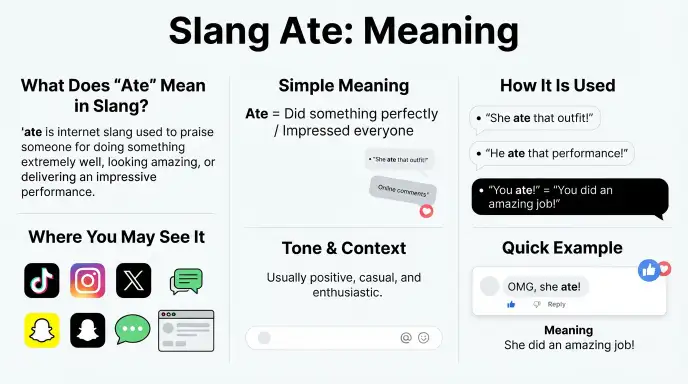
Slang Ate Meaning refers to someone doing something exceptionally well or impressively. Synonyms include “killed it,” “nailed it,” “slayed,” and “did an amazing job.” Slang ate is a popular informal expression that means someone did something extremely well, looked amazing, or made a strong impression.
When someone says “you ate” in a text or social media comment, they are usually giving you a strong compliment. You may see ate in comments about outfits, makeup, dancing, singing, jokes, performances, arguments, or creative work. For example, if a friend.
posts an amazing outfit, you might reply, “You ate!” This does not mean the person actually ate something. It means they looked great or completely nailed what they were doing.
The expression is especially common in casual online communication, including social media and texting. It can also appear in forms such as “ate that,” “ate that up,” and “ate and left no crumbs.”
Quick Answer:Slang Ate Meaning:
In text slang, ate means “did an excellent job,” “looked amazing,” or “completely nailed it.” It is usually a positive and enthusiastic compliment.
What Does Slang Ate Mean in Text?
In text messages, ate usually means that someone did something really well.
If someone sends:
“You ate!”
they are most likely saying:
“You did an amazing job!”
The expression can be used for many different situations. Someone might “ate” a dance, outfit, performance, joke, comeback, presentation, or creative project.
For example:
“Your new outfit is so good. You ate!”
Here, ate means the person looks stylish or impressive.
Another example is:
“That comeback was perfect. You ate.”
In this case, the person gave a strong or clever response.
The slang is therefore not limited to appearance. It can describe almost anything that someone handles exceptionally well.
What Does “Ate” Mean in Slang?
As slang, ate is a positive expression of approval.
A simple definition is:
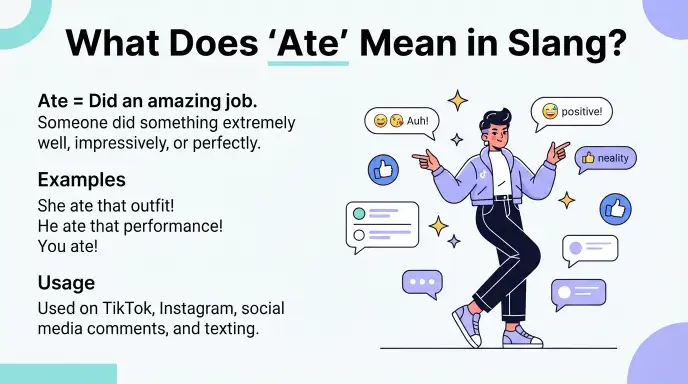
Ate = did something extremely well, impressed people, or looked exceptionally good.
The word is normally used as praise.
Common forms include:
- You ate
- She ate
- He ate
- They ate
- You ate that
- She ate that up
- Ate and left no crumbs
- ATE
- ATEEEE
The exact wording can change the level of excitement, but the basic idea stays the same.
For example:
“She ate that performance.”
means:
“She performed extremely well.”
And:
“He ate that argument up.”
means:
“He handled that argument very effectively.”
Is “Ate” a Full Form or Abbreviation?
No. Ate is not an abbreviation or acronym.
In standard English, ate is the past tense of the verb eat.
For example:
“I ate lunch.”
That is the normal grammatical meaning.
In slang, however, the same word is used figuratively as a compliment.
| Usage | Meaning |
| Standard English | Consumed food |
| Slang | Did something extremely well |
| “You ate!” | You did an amazing job |
| “She ate that look” | She looked excellent |
| “He ate that up” | He handled it very well |
| “Ate and left no crumbs” | Performed exceptionally well |
This is why the surrounding conversation is important when interpreting the word.
Why Does “Ate” Mean “Did Great”?
The slang expression uses eating as a metaphor.
The idea behind phrases such as “ate and left no crumbs” is that someone performed so well that there was nothing left to criticize. The expression became associated with praise for impressive performances, looks, and actions.
MerriamifWebster traces “ate and left no crumbs” to New York City’s Ballroom scene and notes its connection to Black and Latino LGBTQ+ culture before the expression spread more widely through social media.”
This gives ate a stronger meaning than simply saying:
“Good job.”
When someone says:
“You ate.”
they are usually showing strong excitement or approval.
Is “Ate” Rude, Offensive, or Neutral?
Ate is generally positive and harmless slang.
It is normally used to compliment someone. The exact tone can depend on the conversation, punctuation, capitalization, and emojis.
For example:
“You ate 🔥”
is clearly enthusiastic praise.
However, like many slang expressions, ate can also be used sarcastically.
For example:
“Wow, you really ate that one…”
Depending on the context, this could be genuine praise or playful criticism.
If you are unsure, look at the rest of the message and the relationship between the people speaking.
Usually positive
“Ate” is commonly used to praise:
- Appearance
- Fashion
- Dancing
- Singing
- Acting
- Creativity
- Humor
- Arguments
- Performances
- Skills
So if someone comments “ATE!” on your post, they are usually saying that you did something very well.
Where Is “Ate” Commonly Used?
The slang ate is mostly used in casual online communication. It is especially useful when people want to give quick, enthusiastic praise without writing a long comment.
TikTok
On TikTok, ate can appear in comments about dancing, fashion, makeup, singing, acting, comedy, or other creative videos.
Example:
“She ate this choreography!”
This means:
“She performed the choreography extremely well.”
Instagram users often write “ATE” under photos, Reels, fashion posts, and creative content.
Example:
“You ATE this look 🔥”
The commenter is saying that the person looks excellent or styled the outfit very well.
Snapchat
Friends may use ate in private messages when reacting to photos, outfits, jokes, or achievements.
Example:
“Girl you ate 😭🔥”
This is an enthusiastic compliment.
On Reddit, ate may be used when someone gives a clever response, strong argument, funny comment, or impressive contribution.
Example:
“That reply ate.”
Here, the commenter is praising the response.
Texting
In ordinary text conversations, ate is often very short.
“You ate.”
Depending on the conversation, this could mean:
- You looked great.
- You performed well.
- You made a great point.
- You handled the situation perfectly.
Real :Life Examples of Slang Ate Meaning
The meaning becomes easier to understand when you see it in different situations.
Friendly Example
Friend: “I finally performed on stage today.”
You: “You ate!”
Meaning: You did an amazing job.
Fashion Example
“That outfit? She ate.”
Meaning: She looked extremely stylish.
Makeup Example
“You ate that makeup look!”
Meaning: The makeup looked excellent.
Performance Example
“He absolutely ate that performance.”
Meaning: He performed extremely well.
Clever Comeback
“That response was brutal. You ate.”
Meaning: The person gave a very strong or clever response.
Social Media Comment
“ATEEEE 🔥🔥🔥”
Meaning: “That was amazing!”
Gaming Context
“You ate that match!”
Meaning: You played extremely well or dominated the match.
The gaming use is more contextifdependent than fashion or performance, but the basic idea remains praise.
What Does “Ate and Left No Crumbs” Mean?
“Ate and left no crumbs” is a stronger version of ate.
It means someone performed so well that there was supposedly nothing left to criticize.
For example:
“Her presentation was incredible. She ate and left no crumbs.”
The speaker means that the presentation was extremely impressive.
The phrase can be used for:
- Fashion
- Dancing
- Singing
- Acting
- Public speaking
- Arguments
- Jokes
- Creative work
The expression has cultural roots in New York City’s Ballroom scene and became more widely popular through social media.
What Does “Ate That Up” Mean?
“Ate that up” means someone handled something very successfully.
For example:
“She ate that interview up.”
This means:
“She performed extremely well during the interview.”
You can use the phrase for many different activities:
“He ate that role up.”
“She ate that dance up.”
“They ate that challenge up.”
In each case, the speaker is praising how effectively someone handled the situation.
What Does “ATEEE” Mean?
ATEEE is simply an exaggerated version of ate.
People often repeat letters online to make their emotions stronger.
For example:
“YOU ATEEEEE!”
has a more excited tone than:
“You ate.”
The extra letters do not create a different definition. They simply show extra enthusiasm.
You may also see:
- ATE
- ATEEE
- ATEEEE
- ATE THAT
- SHE ATE
- YOU ATE THAT
These are all informal ways of expressing strong approval.
Why Do People Use Slang Ate Meaning
People use ate because it is short, expressive, and easy to understand within online slang culture.
Instead of writing:
“Your performance was extremely impressive and you did a fantastic job.”
someone can simply write:
“YOU ATE.”
The shorter expression feels more energetic and conversational.
It also works well in social media comments, where people often respond with only a few words.
Capitalization and emojis can make the reaction even stronger:
“ATE 🔥”
“YOU ATE 😭”
“ATEEEE 💅”
The meaning is usually still the same: strong praise.
Is “Ate” Appropriate at School or Work?
Ate is appropriate mainly in casual communication.
With friends or classmates, it can sound completely natural:
“You ate that presentation!”
But it would not normally belong in a formal essay, report, or professional email.
Instead of writing:
“The speaker ate the presentation.”
you could write:
“The speaker delivered an excellent presentation.”
At work, clearer phrases are usually better:
- Excellent work.
- You handled that very well.
- That was impressive.
- Great presentation.
- You did an excellent job.
If your workplace is very casual, you may hear slang such as ate, but it is still better to understand your audience before using it.
When Should You Avoid Using Slang Ate Meaning
Although the slang meaning is generally harmless, there are situations where it may not be suitable.
Avoid using ate when:
- Writing a formal academic paper
- Applying for a job
- Sending a formal business email
- Communicating with a client
- Writing an official report
- Speaking to an audience unfamiliar with internet slang
You should also be careful when using it sarcastically. A message like:
“You ate…”
can be difficult to interpret without knowing the speaker’s tone.
In casual online spaces, the expression is usually easy to understand. In formal communication, a direct compliment is clearer.
Is “Ate” Safe for Social Media?
Yes. The slang meaning of ate is generally safe and positive for social media.
It is normally used as praise rather than an insult or harmful expression.
However, social media slang can vary between communities. A person who does not know the expression may interpret “you ate” literally.
For example:
“You ate!”
Someone unfamiliar with slang might wonder what food you mean.
For that reason, context matters. Among people who understand current internet slang, the meaning is usually obvious.
How Does “Ate” Affect Communication?
The word ate can make a compliment feel more energetic and casual.
Compare:
“Your outfit looks good.”
with:
“You ate that outfit!”
The first is a normal compliment. The second sounds more excited and expressive.
This makes ate useful for:
- Social media comments
- Friend if if friend texting
- Group chats
- Casual online communities
- Reactions to creative work
However, because slang is informal, it can make communication less clear in professional or unfamiliar settings.
The best choice depends on your audience.
Key Difference Between Slang Ate Meaning
| Expression | Meaning | Typical tone |
| You ate | You did very well | Positive |
| You ate that | You did that particular thing very well | Strong praise |
| You ate that up | You handled something extremely well | Strong praise |
| Ate and left no crumbs | Performed almost perfectly | Very enthusiastic |
| ATEEEE | Extremely strong approval | Excited |
These expressions are closely related, but the longer versions can add emphasis.
The basic message remains:
“You did an amazing job.”
Origin and Background of Slang Ate Meaning
The slang use of ate has a deeper history than many people realize. It did not simply originate on TikTok or with Gen Z.
The expression “ate and left no crumbs” is associated with New York City Ballroom culture, particularly Black and Latino LGBTQ+ communities. It later spread into wider internet culture through social media.As the expression moved into mainstream online spaces, shorter forms such as “ate” and “you ate” became common ways to praise someone’s appearance, performance, creativity, or actions.
This history is important because describing ate as simply “Gen Z slang” leaves out the communities that helped shape the expression.
Is “Ate” Gen Z Slang?
Ate is strongly associated with modern Gen Z internet language, but it did not originate with Gen Z.
You may see it frequently in younger people’s online conversations, especially on social platforms. However, the expression has cultural roots that predate the current social media era.
Gen Z and social media helped make the slang widely recognizable to a much larger audience.
This is a good example of how internet slang can move from a specific community into mainstream online communication.
“Ate” vs. Similar Slang Terms
Several slang expressions can communicate the same general idea as ate.
| Slang term | Meaning | Example |
| Ate | Did something extremely well | “You ate that look.” |
| Slayed | Looked or performed amazingly | “She slayed that performance.” |
| Killed it | Did something very successfully | “You killed that presentation.” |
| Nailed it | Did something correctly or successfully | “You nailed the interview.” |
| Crushed it | Performed exceptionally well | “He crushed the challenge.” |
| Cooked | Created or handled something impressively | “She cooked with that idea.” |
| Left no crumbs | Did something exceptionally well | “He left no crumbs.” |
These expressions overlap, but they are not always interchangeable.
For example, ate is especially common when talking about someone’s appearance, performance, or creative work.
Ate vs. Slayed
Ate and slayed are two very similar compliments.
If someone says:
“She slayed that performance.”
they mean she performed extremely well.
If someone says:
“She ate that performance.”
they are also giving strong praise.
The main difference is style and usage. Slayed has been used as slang for impressive performance or appearance for years, while ate has become especially prominent in newer social media language.
Both are informal.
Ate vs. Cooked
Cooked is another modern slang term, but its meaning can change depending on context.
When someone says:
“She cooked.”
they may mean she did something very well or produced an impressive result.
But cooked can also mean someone is in trouble or has been defeated, depending on the sentence.
By comparison, ate is much more consistently positive.
For example:
“She ate.”
usually means she did something amazingly well.
That makes context especially important when interpreting cooked, while ate is generally easier to recognize as praise.
Common Misunderstandings About Slang Ate Meaning
1. “Ate” always refers to food
Not when it is being used as slang.
In:
“I ate pizza.”
it has its normal English meaning.
In:
“You ate!”
it is a compliment.
The sentence determines the meaning.
2. “Ate” is an acronym
It is not.
The slang word ate is an ordinary English word being used figuratively.
3. “Ate” only describes someone’s appearance
Not at all.
It can praise:
- A dance
- A song
- A speech
- An argument
- A joke
- A game
- An outfit
- A creative project
4. “Ate” started on TikTok
TikTok helped spread the expression widely, but the slang has roots that existed before TikTok and are connected to Ballroom culture.
5. “Ate” always sounds serious
No. It is usually playful, enthusiastic, and informal.
The expression may be written with emojis, capital letters, or repeated letters to make the reaction more dramatic.
Can You Use “Ate” With Teachers or Parents?
You can use ate with anyone who understands the slang, but it may not be the best choice with teachers, parents, or older people who are unfamiliar with online expressions.
For example:
“You ate that presentation!”
could sound confusing to someone who takes the word literally.
A clearer alternative would be:
“You did an excellent job on that presentation.”
With friends, however, “You ate!” is perfectly normal in casual slang.
Can You Use “Ate” in a Professional Setting?
Usually, no if not in formal professional writing.
For example, avoid:
“You ate that client presentation.”
in a formal work email.
Use:
“You delivered an excellent client presentation.”
Instead.
In a casual workplace chat where slang is common, you may see people use ate, but the relationship and workplace culture matter.
The general rule is simple:
Casual audience = potentially appropriate.
Formal audience = choose clearer language.
Why “Ate” Became So Popular Online
One reason for the popularity of ate is that it communicates a lot of emotion with very few words.
A comment such as:
“ATEEEE 🔥”
can express excitement, approval, admiration, and encouragement at the same time.
It is also easy to adapt to different situations.
Someone can say:
- “You ate.”
- “She ate.”
- “They ate.”
- “He ate that.”
- “You ate that up.”
- “Ate and left no crumbs.”
This flexibility makes the expression useful in fastifmoving online conversations.
Does Capitalization Change the Meaning?
Usually, no.
The following generally have the same basic meaning:
“You ate.”
“YOU ATE.”
The difference is emotional intensity.
Lowercase
“you ate”
Usually casual and relaxed.
Capital letters
“YOU ATE”
Stronger excitement.
Extra letters
“ATEEEEE”
Very enthusiastic praise.
Emojis
“ATE 🔥😭💅”
The emojis add emotion but do not fundamentally change the meaning.
Is “Ate” Still Popular?
Ate remains recognizable as internet slang, especially in casual social media communication. However, slang changes quickly, and the popularity of individual expressions can vary between communities and age groups.
Some people may use it frequently, while others may prefer newer expressions.
This means it is better to understand ate as established internet slang rather than assuming every English speaker uses it.
The expression is also flexible enough to remain understandable even when the exact trend around it changes.
Frequently Asked Questions About Slang Ate Meaning
Q1. What does “ate” mean in text?
In text slang, ate means someone did something extremely well, looked amazing, or impressed others.
Q2. What does “you ate” mean?
“You ate” means “You did an amazing job” or “You absolutely nailed it.”
Q3. What does “ate and left no crumbs” mean?
It means someone performed so well that there was seemingly nothing left to criticize.
Q4. Is “ate” a compliment?
Yes. Ate is normally a strong, positive compliment used in casual online communication.
Q5. Is “ate” rude?
No. The slang meaning is generally harmless. However, sarcasm or the surrounding context can change the tone.
Q6. What does “ATEEEE” mean?
ATEEEE is an exaggerated spelling of “ate.” The extra letters show excitement or stronger approval.
Conclusion: Slang Ate Meaning
The slang ate means that someone did something extremely well, looked impressive, or completely nailed a particular situation. It is usually a positive expression used in casual texting, social media comments, and online conversations.
You may see variations such as “you ate,” “she ate that,” “ate that up,” and “ate and left no crumbs.” While these phrases have slightly different structures, they all communicate strong praise.
The modern expression has important cultural roots. It is associated with New York City Ballroom culture, particularly Black and Latino LGBTQ+ communities, before becoming widely popular across social media.”
The easiest way to remember it is:

I’m Dylan Foster, a slang and internet culture writer passionate about exploring how people communicate online and in everyday conversations. I write about texting abbreviations, social media expressions, and modern slang to help readers understand meanings, origins, and real-world usage in a simple way.