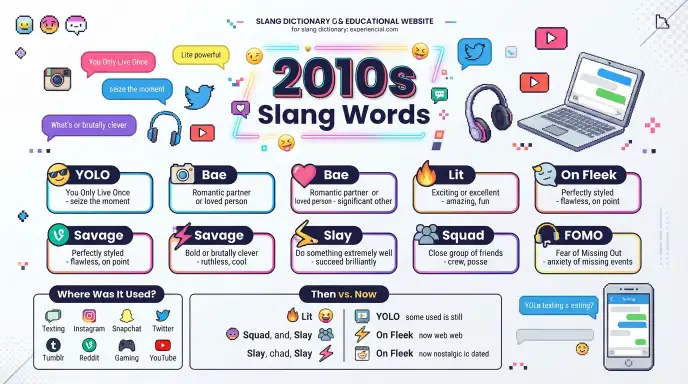
2010s slang words are informal expressions that became popular during the 2010–2019 era through texting, social media, music, memes, and online communities. If you have ever seen words like YOLO, bae, lit, fearless, slay, squad, or on fleek, you have encountered some of the decade’s most recognizable slang.
People search for 2010s slang words for many reasons. You may be reading an old message, researching internet culture, writing about the 2010s, or simply wondering what certain expressions meant at the time. Some terms are still used today, while others now sound dated or nostalgic.
This guide explains the most popular 2010s slang words, what they meant in text, where they were used, and how their meanings changed over time.
Quick Answer 2010s Slang Words:
2010s slang words are informal expressions that became especially popular between 2010 and 2019. Social media, texting, music, memes, and online communities helped these terms spread widely.
What Are 2010s Slang Words?
2010s slang words are casual words and phrases strongly associated with the internet and youth culture during the 2010s.
The decade was a major period for online communication. Twitter, Instagram, Snapchat, Tumblr, Vine, Reddit, YouTube, and texting gave people new ways to create and spread expressions.
A phrase could appear in a tweet or viral video and quickly become familiar to millions of people.
However, an important point is that not every popular 2010s slang word was actually invented during the 2010s. Some expressions existed earlier but became much more popular during that decade.
For example, slay has cultural roots that predate social media, while YOLO became especially mainstream in the early 2010s.
So, “2010s slang” often means slang that was strongly popular or culturally recognizable during the decade, rather than slang invented between 2010 and 2019.
Popular 2010s Slang Words and Their Meanings
Here are some of the most recognizable examples:
| Slang Word | Meaning |
| YOLO | You Only Live Once |
| Bae | A romantic partner or loved person |
| Lit | Exciting, excellent, or fun |
| On fleek | Perfectly styled or done |
| fearless | Bold, ruthless, or brutally honest |
| Slay | Do something extremely well or look great |
| Squad | A close group of friends |
| Turnt | Very excited, energetic, or ready to party |
| Swag | Style, confidence, or fashionable appearance |
| FOMO | Fear of Missing Out |
| Ghosting | Suddenly stopping communication |
| Catfish | Someone who uses a false online identity |
| Receipts | Evidence proving a claim |
| Throw shade | Indirectly criticize or insult someone |
| Humblebrag | Bragging while pretending to complain |
These terms did not all have exactly the same history. Some came from particular cultural communities, some from music, and others spread through social media and viral content.
2010s Slang Words Full Form and Definitions
YOLO
YOLO stands for “You Only Live Once.”
The expression became particularly popular in the early 2010s and was strongly associated with rapper Drake’s 2011 song “The Motto.” MerriamifWebster describes YOLO as an expression used to justify doing something enjoyable or risky because life is short.
In text, someone might write:
“I’m going on a trip. YOLO!”
The person is basically saying:
“I want to enjoy this opportunity instead of worrying too much about it.”
YOLO was often used humorously, especially when someone made an impulsive decision.
Bae
Bae is an affectionate term for a romantic partner or someone the speaker cares about deeply.
It became highly visible in 2010s social media and popular culture. Although people sometimes claimed that BAE stood for “before anyone else,” that explanation is generally treated as a later backronym rather than the true origin. Dictionary.com discusses the term’s connection with Black cultural usage and its rise in popularity during the 2010s.
Example:
“Going to dinner with bae tonight.”
Meaning:
“I’m going to dinner with my partner tonight.”
Today, bae may sound dated to some speakers, but it remains widely recognizable.
Lit
Lit became one of the bestifknown positive slang terms of the 2010s.
In casual speech, it can mean exciting, excellent, impressive, or highly enjoyable.
Example:
“That concert was lit!”
Meaning:
“That concert was amazing and exciting.”
The word lit has older meanings and uses, so context is important. Its popular slang meaning became especially visible through music and online culture during the 2010s.
On Fleek
On fleek means perfectly styled, groomed, or looking exceptionally good.
The phrase became widely popular in 2014 after a Vine video by Kayla Newman, who later became known as Peaches Monroee. MerriamifWebster notes that the expression initially referred especially to perfectly groomed eyebrows before expanding to other things.
Example:
“Your eyebrows are on fleek.”
Meaning:
“Your eyebrows look perfectly styled.”
This expression is now strongly associated with 2010s internet culture.
fearless
fearless
Example:
Here, the speaker is usually praising the response for being clever or brutally effective.
. What changed was its popularity as a casual compliment or reaction online.
Slay
Slay became a powerful compliment during the 2010s.
In slang, it can mean to perform extremely well, succeed, or look fantastic.
Example:
“You slayed that performance.”
Meaning:
“You did an excellent job.”
People also used it as a short reaction:
“Slay!”
meaning:
“You look great” or “You did an amazing job.”
It is important not to describe this as simply a word invented by social media. The slang use has roots in Black and LGBTQ+ cultural communities, including ballroom culture, before becoming mainstream online.
Squad
Squad means a close group of friends or people who regularly spend time together.
The term became especially recognizable through socialifmedia expressions such as “squad goals.”
Example:
“Heading out with the squad tonight.”
Meaning:
“I’m going out with my close group of friends.”
Instagram and other imageiffocused platforms helped make groupiffriendship language highly visible during the decade.
Turnt
Turnt generally describes someone who is very excited, energetic, or ready to party.
Example:
“The party turned last night.”
Meaning:
“The party was extremely lively and energetic.”
The expression was closely connected with music and party culture and became widely recognizable during the 2010s.
Is 2010s Slang Rude, Offensive, or Neutral?
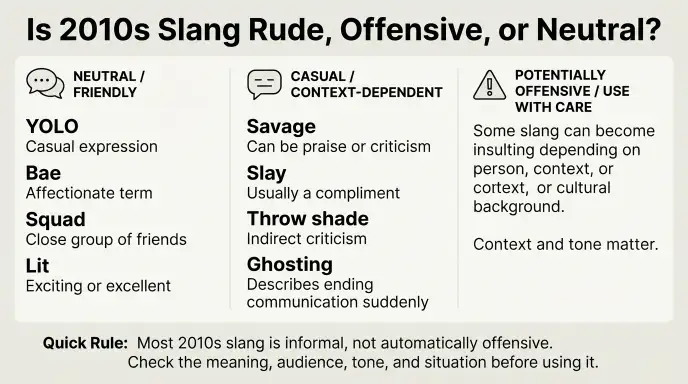
Most 2010s slang is casual rather than automatically offensive, but the meaning and tone depend on the word and situation.
For example:
- YOLO is generally harmless.
- Bae is affectionate and informal.
- Lit is usually positive.
- The squad is casual.
- Throw shade involves criticism.
- Ghosting describes behavior that can hurt someone.
- Catfish involves online deception.
Some slang also has cultural histories that deserve recognition. A term becoming popular on mainstream social media does not necessarily mean it originated there.
For formal writing, workplace communication, or academic work, standard language is usually safer unless the slang itself is the topic.
Where Were 2010s Slang Words Commonly Used?
Texting
Texting helped slang become short, quick, and expressive.
Examples included:
“YOLO “That was lit.”
“Where’s the squad?”
Because text messages are informal, slang fits naturally into everyday conversations.
Instagram helped popularize slang connected with fashion, appearance, friendships, relationships, and lifestyle.
Words such as bae, slay, on fleek, and squad goals frequently appeared in captions and comments.
Snapchat
Snapchat encouraged short, casual communication through photos, videos, captions, and messages. Slang was often paired with emojis and visual jokes.
Twitter was particularly important for spreading short expressions, hashtags, jokes, and viral phrases. Users could repeat an expression thousands of times, helping it move quickly into mainstream conversation.
Vine
Vine had a major influence on 2010s internet language because short videos could turn a phrase into a recognizable meme almost overnight.
On fleek, for example, became widely known after a 2014 Vine video.
Reddit and Gaming Communities
Reddit and gaming communities also developed their own expressions. Some remained inside those communities, while others eventually crossed into broader internet culture.
This is why there was never one single source for 2010s slang words. Different platforms and communities contributed different expressions.
Real :Life Examples of 2010s Slang
Friendly Conversation
“Bae and I are going out for dinner tonight.”
Meaning: The speaker is talking about their romantic partner.
Social Media
“Squad goals!
Meaning: The group represents an ideal or enviable friendship.
Compliment
“You absolutely slayed that outfit.”
Meaning: The person looks excellent.
Excited Reaction
“This party is lit!”
Meaning: The party is exciting and fun.
Spontaneous Decision
“I’m buying the tickets. YOLO!”
Meaning: The person wants to enjoy the opportunity rather than worry about the consequences.
Appearance
“Her makeup is on fleek.”
Meaning: Her makeup looks extremely well done.
Origin and Background of 2010s Slang
The 2010s did not have one single source of slang. Expressions came from music, Black and LGBTQ+ communities, regional speech, gaming, memes, television, and socialifmedia platforms.
What made the decade different was the speed at which these expressions could spread. A phrase that once stayed within a small community could suddenly appear in millions of tweets, videos, captions, and text messages.
For example, “on fleek” became widely known after a 2014 Vine posted by Kayla Newman. The expression originally described perfectly groomed eyebrows before people began applying it to clothing, makeup, hair, and other things.
Similarly, YOLO became a major mainstream expression in the early 2010s, particularly after Drake’s 2011 song “The Motto.”
This means it is useful to separate origin from popularity. A slang term may be much older than the decade in which it became famous.
2010s Slang vs. Modern Slang
Some expressions from the 2010s are still understood today, while others have become less common.
| 2010s Slang | General Status Today |
| YOLO | Still understood; often nostalgic or humorous |
| Bae | Recognizable but can sound dated |
| Lit | Still understood and sometimes used |
| On fleek | Mostly associated with 2010s culture |
| fearless | Still widely understood |
| Slay | Still used, especially online |
| Squad | Still familiar |
| Turnt | Less common in everyday mainstream use |
| Swag | Often sounds dated |
| FOMO | Still widely used |
| Ghosting | Still widely used |
| Catfish | Still widely understood |
| Receipts | Still common in online arguments |
Slang has a lifecycle. A word can move from new → popular → mainstream → overused → dated → nostalgic.
That does not mean an older slang term becomes incorrect. It simply means speakers may use it differently or less often.
Why Did 2010s Slang Become So Popular?
The biggest reason was the growth of social media and online communities.
During the decade, people increasingly communicated through short posts, captions, comments, memes, and instant messages. These formats favored expressions that were:
- Short
- Funny
- Memorable
- Easy to repeat
- Easy to turn into memes
- Easy to understand from context
Music and celebrities also helped slang move between communities.
A phrase could appear in a song, become popular on Twitter, appear in an Instagram caption, and then become part of everyday speech.
Online communities also influenced one another. A phrase that started in one cultural or social group could become mainstream after being adopted by larger audiences.
That spread is one reason the 2010s produced so many memorable internet expressions.
How 2010s Slang Changed Communication
2010s slang did more than make conversations casual. Some expressions gave people short ways to describe complicated social experiences.
Ghosting
Instead of saying:
“Someone suddenly stopped responding to all my messages without explaining why.”
people could simply say:
“They ghosted me.”
FOMO
Instead of describing anxiety about missing a social experience, someone could say:
“I have FOMO.”
Catfish
Instead of explaining that someone created a fake online identity to deceive another person, people could use:
“He was catfished.”
These terms made online communication faster and more precise.
They also show how technology can create a need for new vocabulary. As people’s social lives moved online, language developed new ways to describe online relationships and behavior.
Comparison of Popular 2010s Slang
| Slang | Meaning | Example |
| YOLO | You Only Live Once | “I’m going for it if YOLO.” |
| Bae | Romantic partner | “Bae is coming over.” |
| Lit | Exciting or excellent | “The concert was lit.” |
| fearless | Bold or brutally clever | “That response was fearless |
| Slay | Do something extremely well | “You slayed that look.” |
| On fleek | Perfectly styled | “Her brows are on fleek.” |
| Squad | Close friend group | “I’m with my squad.” |
| Turnt | Highly energetic | “The party was turnt.” |
| FOMO | Fear of Missing Out | “Everyone is going, so I have FOMO.” |
| Ghosting | Suddenly ending communication | “He ghosted me.” |
When Should You Avoid 2010s Slang?
You do not have to avoid older slang completely. The key is knowing where it fits.
Professional Communication
Using expressions such as “YOLO,” “bae,” or “lit” in a formal business report may make the writing sound unprofessional.
Instead of:
“Our sales numbers are lit!”
write:
“Our sales numbers have improved significantly.”
Academic Writing
School and university assignments generally require standard English unless you are specifically discussing language or internet culture.
Instead of using slang casually, explain it as a term being studied.
Formal Emails
A message to a manager, professor, customer, or organization should normally use clear and professional language.
When Speaking With Someone Unfamiliar With the Slang
Not everyone understands internet slang. A term that seems obvious to one age group may be confusing to another.
If clarity matters, use standard English.
Are 2010s Slang Words Safe for Social Media?
Most common 2010s slang is not inherently unsafe, but individual terms can have different meanings or cultural implications.
Words such as YOLO, squad, lit, and FOMO are generally harmless when used appropriately.
However, context matters with terms involving:
- Insults
- Sexual references
- Drugs
- Violence
- Identity
- Deception
- Bullying
For example, fearless may be a compliment among friends but could sound insulting in another situation.
Likewise, calling someone a “catfish” makes an accusation about deceptive online behavior.
The safest approach is to understand the meaning before using the word.
Why Do People Still Use 2010s Slang?
People continue to use older slang for several reasons.
Nostalgia
Someone who grew up during the 2010s may use YOLO or bae because the words remind them of that period.
Humor
Older slang can be funny precisely because it sounds dated.
For example:
“This pizza is absolutely on fleek.”
The speaker may intentionally be using an old expression for comedic effect.
Familiarity
Some terms became so widespread that people still understand them even if they are not fashionable.
FOMO, ghosting, and catfish are good examples.
Cultural References
Movies, television shows, memes, and socialifmedia posts continue to reference older internet culture.
Understanding the slang can therefore help people understand older online content.
2010s Slang in Text Messages
Texting was one of the biggest environments for slang during the decade.
People often combined slang with:
- Emojis
- Abbreviations
- GIFs
- Hashtags
- Memes
- Repeated letters
- Capitalization for emphasis
For example:
“That party was LITThe capitalization and emojis add emotion to the slang.
Another example:
“Everyone is going without me FOMO is real.”
Here, FOMO quickly communicates a feeling that would otherwise require a longer explanation.
2010s Slang in Gaming
Gaming communities also helped spread informal language.
A player might say:
Meaning the move was especially ruthless or impressive.
Or:
“The lobby is getting turnt.”
Meaning the environment is becoming highly energetic or chaotic.
Not every gaming term is specifically 2010s slang, but gaming culture was an important part of the decade’s broader internet vocabulary.
Common Misunderstandings About 2010s Slang
Was all 2010s slang invented on the internet?
No.
Some expressions existed long before social media. The internet often helped spread them rather than creating them.
Did Gen Z invent all 2010s slang?
No.
Different generations and communities contributed to the vocabulary of the decade. Some expressions also came from Black and LGBTQ+ cultural communities, music, regional speech, and older forms of slang.
Are 2010s slang words still correct?
Slang does not usually work like a grammar rule. A term can become less popular without becoming grammatically “wrong.”
Is every old slang word outdated?
No. Some terms remain common because they describe useful ideas.
Ghosting, FOMO, catfish, and receipts, for example, remain recognizable because they describe modern social behavior.
Frequently Asked Questions
q1:What are some popular 2010s slang words?
Popular examples include YOLO, bae, lit,fearless, slay, on fleek, squad, turnt, swag, FOMO, ghosting, and catfish.
q2 :What does YOLO mean?
YOLO means “You Only Live Once.” It was commonly used to justify enjoying an opportunity or taking a risk.
q3 :What does “on fleek” mean?
On fleek means perfectly styled or looking exceptionally good. The phrase became widely popular after a 2014 Vine video.
q4 :Is “bae” still used?
Yes, people still understand bae, but it can sound dated or deliberately nostalgic depending on the speaker.
q5 :What 2010s slang is still popular?
Terms such as slay, FOMO, ghosting, catfish, fearless, and receipts remain recognizable and are still used in various online contexts.
q6 :Why is 2010s slang important?
It reflects how social media, texting, music, memes, and online communities changed everyday communication during the decade.
Conclusion
2010s slang words are an important part of the internet and popular culture from the 2010–2019 period.widely recognizable through social media, music, memes, texting, and online communities.
Some of these words are still common today, while others are mainly used for humor or nostalgia. Their popularity also does not always tell us where they originated. Many expressions have deeper cultural histories that existed before mainstream social media.
The best way to understand 2010s slang words is to consider meaning, context, tone, platform, and history. A term that sounds perfectly normal among friends may feel outdated or inappropriate in a formal setting.
Ultimately, 2010s slang shows how quickly language can spread when millions of people communicate online and how those expressions can become a lasting record of a particular era.

I’m Dylan Foster, a slang and internet culture writer passionate about exploring how people communicate online and in everyday conversations. I write about texting abbreviations, social media expressions, and modern slang to help readers understand meanings, origins, and real-world usage in a simple way.