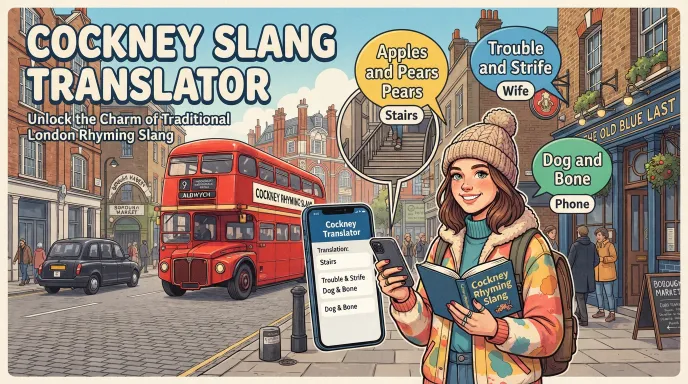
A cockney slang translator helps you understand Cockney expressions by converting traditional East London slang phrases into plain English meanings. Cockney slang is especially known for its creative rhyming expressions, where one phrase represents another word through rhyme.
People search for a cockney slang translator because they hear unusual London phrases in movies, TV shows, music, books, or conversations and want to know what they mean. Words like “apples and pears” or “dog and bone” may sound confusing until you learn the hidden meanings behind them.
This guide explains what Cockney slang means, how a cockney slang translator works, where these expressions came from, and how people use them today. You will also learn common examples, if Cockney slang is still popular, and which phrases should be avoided in formal situations.
:Quick Answer cockney slang translator
A cockney slang translator changes Cockney slang phrases into their standard English meanings. Cockney slang is a type of London dialect, famous for using rhyming phrases instead of direct words.
Examples:
| Cockney Slang | Meaning |
| Apples and pears | Stairs |
| Dog and bone | Phone |
| Trouble and strife | Wife |
| Butcher’s hook | Look |
| Tea leaf | Thief |
A translator helps readers understand these hidden word connections and the cultural meaning behind traditional London expressions.
What Does “Cockney Slang Translator” Mean?
A cockney slang translator is a tool or guide that explains the meaning of Cockney slang words and phrases. It works by matching a slang expression with the regular English word it represents.
Unlike a normal language translator that changes one language into another, a Cockney slang translator explains a regional style of speaking.
For example:
- “I’m going up the apples.”
Meaning: “I’m going up the stairs.” - “Give me a bell on the dog and bone.”
Meaning: “Call me on the phone.”
The phrase may not contain the real word being described. Instead, the listener must understand the rhyme connection.
What Is Cockney Slang?
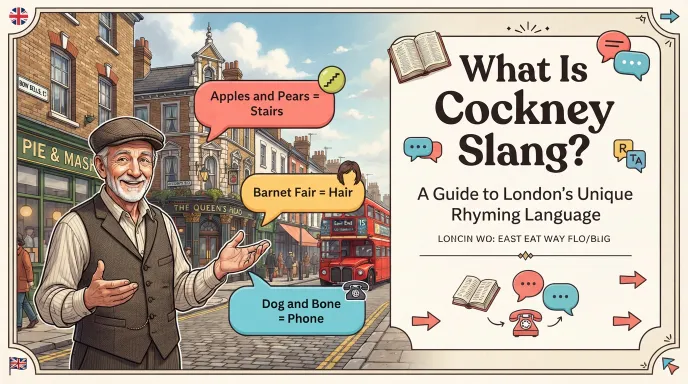
Cockney slang is a traditional form of English slang associated with the Cockney community in East London. It became well known for its playful use of rhyming phrases, humor, and creative word replacements.
The most famous pattern is rhyming slang.
The basic idea:
Original word → Rhyming phrase → Hidden meaning
Example:
Phone → Dog and bone → “Give me a ring on the dog and bone.”
The word “bone” rhymes with “phone,” so the phrase became a coded way of referring to a phone.
Some Cockney speakers also shorten the phrase by removing the rhyming word:
- “Use the dog” = Use the phone
This shortened style can make Cockney slang even harder for outsiders to understand.
How Does a Cockney Slang Translator Work?
A Cockney slang translator usually works by identifying the slang phrase and connecting it with the traditional meaning.
The process looks like this:
1. Identify the Cockney phrase
Example:
“He’s a proper tea leaf.”
2. Find the rhyming connection
“Tea leaf” rhymes with “thief.”
3. Replace it with standard English
Tea leaf = Thief
Final meaning:
“He’s a proper thief.”
A good translator also considers context because some expressions can have different meanings depending on how they are used.
Why Do People Search for a Cockney Slang Translator?
People use Cockney slang translators for many reasons:
Understanding British Movies and TV Shows
Many British films and shows include London slang. Viewers outside the UK may understand the words individually but miss the meaning of the full phrase.
Learning British Culture
Cockney slang is part of London’s cultural history. Learning these expressions helps people understand local humor and communication styles.
Reading Books and Stories
Classic British literature and modern fiction sometimes include Cockney dialogue to show a character’s background.
Understanding Online Content
Some older London expressions appear on social media, videos, memes, and discussions about British culture.
Different Meanings of Cockney Slang
Cockney slang does not usually have multiple meanings in the same way that some internet slang does. However, individual phrases can have different uses depending on context, location, and the speaker’s style.
A cockney slang translator should not only replace words but also explain the situation where the phrase is used.
For example:
| Cockney Phrase | Direct Rhyme | Meaning | Context |
| Dog and bone | Bone → Phone | Telephone | Calling someone |
| Trouble and strife | Strife → Wife | Wife/partner | Informal conversation |
| Bread and honey | Honey → Money | Money | Talking about cash |
| Ruby Murray | Murray → Curry | Curry meal | Food conversation |
| Bottle and stopper | Stopper → Copper | Police officer | Older slang |
Some expressions are still understood today, while others may sound oldiffashioned or humorous.
Where Is Cockney Slang Commonly Used?
Cockney slang originated in London, especially among working if class communities in the East End of London. Today, it appears in fewer everyday conversations but remains recognizable through British culture.
Common places where Cockney slang appears include:
1. Movies and Television
Writers often use Cockney expressions to create a strong London identity for characters.
Examples:
- A character saying “What’s the butcher’s?”
- Meaning: “What’s the look?” or “Have a look.”
Cockney speech is often used to show personality, humor, or a connection to London traditions.
2. Music and Entertainment
British musicians and performers sometimes use Cockney phrases to represent London culture.
Some expressions are used for style rather than everyday communication.
3. Books and Stories
Authors may include Cockney slang when writing characters from London neighborhoods.
It helps readers understand:
- Social background
- Regional identity
- Character personality
4. Everyday Conversation
Traditional Cockney slang is less common among younger London speakers today. Many people recognize famous phrases but may not use them regularly.
Modern London speech often combines:
- Standard English
- Local accents
- Multicultural slang
- Internet expressions
Cockney Slang Usage Across Different Platforms
Cockney slang has changed over time. It is not mainly an internet slang system, but some phrases appear online because people enjoy learning about British culture.
| Platform | How Cockney Slang Appears |
| TikTok | Videos explaining British phrases and London culture |
| Memes, jokes, and language posts | |
| Discussions about British expressions | |
| Discord | Mostly used jokingly among users interested in UK culture |
| Workplace Chat | Rarely used except for humor or cultural references |
A phrase that sounds funny in a video may feel unnatural in a serious conversation.
Is Cockney Slang Rude, Offensive, or Harmless?
Most Cockney slang is harmless. It is mainly a playful way of speaking and is connected to London identity, humor, and tradition.
However, context matters.
A phrase may sound:
- Friendly among people who understand it
- Confusing to outsiders
- Forced if someone uses it incorrectly
For example:
Using “dog and bone” as a joke with friends is usually harmless.
Using many Cockney expressions in a professional meeting may sound unusual or like imitation.
The key point is understanding the culture behind the words instead of using phrases randomly.
Is Cockney Slang Still Popular Today?
Traditional Cockney slang is less common than it was in previous generations.
Older London speakers may use more classic expressions, while younger speakers often use different forms of slang influenced by:
- Social media
- Global English
- Music culture
- Multicultural London communities
Some Cockney phrases remain famous because they are strongly connected with London.
Examples that many people still recognize:
- Apples and pears = stairs
- Dog and bone = phone
- Trouble and strife = wife
Other phrases are becoming less common and may sound oldiffashioned.
Real :Life Cockney Slang Examples
Friendly Conversation
Person A: “Where are you going?”
Person B: “Up the apples and pears.”
Meaning:
“Up the stairs.”
Phone Conversation
Person A: “Give me a call later.”
Person B: “No problem, I’ll use the dog and bone.”
Meaning:
“I’ll use the phone.”
Talking About Money
Person A: “I need some bread and honey.”
Meaning:
“I need some money.”
Talking About Food
Person A: “Fancy a Ruby Murray tonight?”
Meaning:
“Would you like a curry tonight?”
Common Cockney Slang Terms and Their Meanings
| Cockney Slang | Standard English Meaning |
| Apples and pears | Stairs |
| Dog and bone | Phone |
| Butcher’s hook | Look |
| Trouble and strife | Wife |
| Tea leaf | Thief |
| Ruby Murray | Curry |
| Bread and honey | Money |
| Plates of meat | Feet |
| Loaf of bread | Head |
| China plate | Mate/friend |
These examples show how creative Cockney rhyming slang can be.
When Should You Avoid Using Cockney Slang?
Cockney slang is fun to learn, but it is not suitable for every situation.
Avoid using it when:
1. Writing Professionally
Business emails, academic writing, and formal reports should use standard English.
Example:
❌ “Send it on the dog and bone.”
✅ “Send it by phone.”
2. Speaking With People Who May Not Understand It
Not everyone knows Cockney expressions. Using too much slang can create confusion.
3. Trying to Copy a London Accent
Using Cockney slang without understanding the culture may sound unnatural.
Learning the phrases is different from pretending to speak like a local.
Cockney Slang Translator: Origins, Similar Terms, FAQs & Conclusion
Origin and History of Cockney Slang
Cockney slang developed in London, especially among working if class communities in the East End. It became widely recognized during the 19th century, although the exact moment it began is difficult to prove.
One popular explanation is that rhyming slang helped create a shared style of communication among local communities. Some people believe it was used as a playful way to speak privately, while others see it mainly as a form of humor and word creativity.
The basic structure was simple:
Normal word → Rhyming phrase → Shortened slang form
Example:
Stairs → Apples and pears → Apples
Over time, many expressions spread beyond the original Cockney community through:
- London markets
- Theatre performances
- Music halls
- Films
- Television
- Popular culture
Today, Cockney slang is recognized around the world as a symbol of traditional London speech, even though many original expressions are not commonly used in daily conversations.
Why Was Cockney Rhyming Slang Created?
The exact reason behind Cockney rhyming slang is still debated.
Possible reasons include:
1. Wordplay and Humor
Many Cockney expressions are creative and entertaining. Speakers enjoyed making ordinary conversations more colorful.
Example:
“Butcher’s hook” instead of “look”
The phrase sounds more playful than the original word.
2. Community Identity
Language often helps groups create a sense of belonging. Cockney slang became connected with London identity and local culture.
3. Secret Communication Theory
Some explanations suggest that traders or workers used rhyming slang to hide meanings from outsiders.
However, historians do not have complete evidence proving that secrecy was the main purpose. It is safer to describe it as a mixture of creativity, humor, and community language.
Similar Slang and Related Language Styles
Cockney slang is one type of regional slang, but many communities have their own informal expressions.
| Type of Slang | Example | Where It Is Common |
| Cockney Rhyming Slang | Dog and bone = Phone | London |
| Internet Slang | LOL = Laughing out loud | Online communities |
| Texting Abbreviations | BRB = Be right back | Messaging apps |
| British Informal Slang | Mate = Friend | UK conversations |
| Gaming Slang | GG = Good game | Gaming communities |
Unlike internet slang, Cockney slang is based mainly on rhyme and sound patterns.
Cockney Slang vs Modern Internet Slang
A cockney slang translator explains traditional spoken slang, while internet slang focuses on fast digital communication.
| Feature | Cockney Slang | Internet Slang |
| Origin | London communities | Online platforms |
| Main Style | Rhyming words | Short forms and abbreviations |
| Example | Dog and bone = Phone | LOL = Laughing out loud |
| Common Use | Conversation and culture | Texting and social media |
| Age Group | Older traditions, cultural use | Mostly online users |
Both styles show how people create new ways to communicate.
Why Do People Use Cockney Slang?
People use Cockney slang for several reasons:
To Show Identity
Some speakers use slang to show connection with a place, community, or culture.
To Add Humor
Rhyming expressions often make conversations more entertaining.
To Create Informal Tone
Slang can make conversations feel relaxed and friendly.
To Connect With British Culture
Many people learn Cockney phrases because they enjoy London history, films, and language differences.
Common Misunderstandings About Cockney Slang
Misunderstanding 1: All Londoners Speak Cockney
This is incorrect.
London has many different accents and speaking styles. Cockney is one traditional variety associated with a particular part of London.
Misunderstanding 2: Every Phrase Is Still Common
Many famous Cockney expressions are now mainly used for fun, historical interest, or cultural references.
Some younger speakers may know the phrase but rarely use it.
Misunderstanding 3: Cockney Slang Is Just Random Words
Cockney slang follows patterns, especially rhyme.
Example:
Money → Bread and honey
The connection comes from sound, not from a random replacement.
Frequently Asked Questions About Cockney Slang Translator
Q1: What is a cockney slang translator?
A cockney slang translator explains traditional London rhyming slang by changing Cockney phrases into their standard English meanings.
Example:
“Dog and bone” becomes “phone.”
Q2: Is Cockney slang still used today?
Yes, but traditional Cockney slang is less common than in the past. Many expressions survive through entertainment, jokes, and cultural discussions.
Q3 :Is Cockney slang a real language?
No. Cockney slang is not a separate language. It is a style of informal English connected with a London dialect.
Q4 :What does “apples and pears” mean in Cockney slang?
“Apples and pears” means “stairs.” It comes from the rhyming connection between “pears” and “stairs.”
Example:
“I’m going up the apples.”
Meaning:
“I’m going up the stairs.”
Q5 :Can I use Cockney slang at work?
Most Cockney slang is not appropriate for formal workplace writing. However, using a wellifknown phrase casually in conversation may be acceptable depending on the workplace culture.
Q6: Why is Cockney slang difficult to understand?
It can be confusing because the actual meaning is often hidden inside a rhyme.
For example:
“Trouble and strife”
does not directly mention a wife, but “strife” rhymes with “wife.”
Conclusion
A cockney slang translator helps people understand one of London’s most interesting language traditions. Cockney slang uses creative rhyming phrases to replace everyday words, making ordinary conversations more playful and culturally meaningful.
Expressions like “dog and bone,” “apples and pears,” and “tea leaf” show how language can reflect humor, community, and history. Althoug Cockney slang is not as common as it once was, many phrases remain popular through British movies, books, music, and online discussions.
The most important thing to remember is that Cockney slang depends on context. Learning these expressions can help you understand British culture, but using them naturally requires knowing when they fit.
A good cockney slang translator does more than provide word replacements if it helps explain the story, background, and meaning behind the phrases.

I’m Dylan Foster, a slang and internet culture writer passionate about exploring how people communicate online and in everyday conversations. I write about texting abbreviations, social media expressions, and modern slang to help readers understand meanings, origins, and real-world usage in a simple way.