Looking for slang for tomorrow? You’re not alone. In texts, social media, chats, and casual conversations, people often use short and informal expressions instead of simply saying “tomorrow.” These slang terms can make messages quicker, more relaxed, and more natural, especially when talking with friends or online.
The exact slang can vary depending on the situation and the platform. Some expressions are common in everyday texting, while others are used more often on social media or among younger speakers. Understanding these terms can help you follow conversations without feeling confused by unfamiliar words or abbreviations.
In this guide, you’ll discover popular slang for tomorrow, what each expression means, and simple examples showing how people use them in real conversations. if you’re writing a text, reading a social media post, or just curious about modern slang, this guide will help you understand the most useful expressions clearly.
Quick Answer Slang for Tomorrow:
The most common slang for tomorrow is tmr or tmrw. Other informal forms include 2moro, 2mrw, tomoz, tomo, and morrow.
What Does “Tomorrow” Mean?
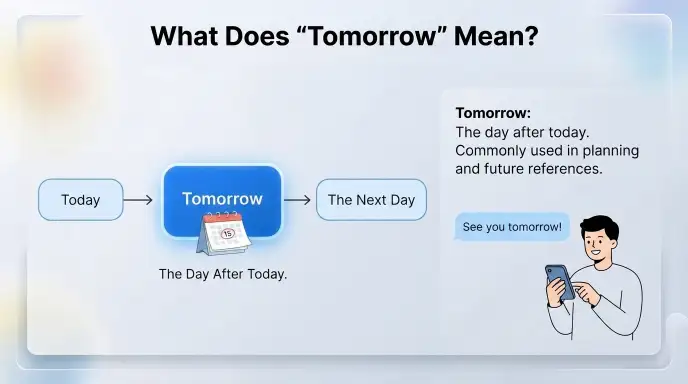
Tomorrow simply means the day after today.
Although “tomorrow” is already a short and familiar word, people often shorten it when texting or chatting online. This is especially common when someone wants to send a quick message without typing the full word.
For example:
“See you tomorrow!”
can become:
“See you tmr!”
or:
“See you tmrw!”
These shortened versions are usually understood from context.
It is also useful to know that not every alternative to “tomorrow” is technically slang. Some are texting abbreviations, some are informal spellings, and others are older English words.
Most Common Slang for Tomorrow
Here are some of the most recognizable informal forms of tomorrow.
| Slang or Informal Form | Meaning | Common Use |
| Tmr | Tomorrow | Texting |
| Tmrw | Tomorrow | Texting |
| 2moro | Tomorrow | Casual texting |
| 2mrw | Tomorrow | Casual texting |
| Tomoz | Tomorrow | Informal speech/texting |
| Tomo | Tomorrow | Casual texting |
| Tommo | Tomorrow | Informal use |
| Morrow | Tomorrow | Oldiffashioned/literary |
| The next day | Tomorrow in context | Everyday English |
| Catch you tomorrow | See you tomorrow | Casual speech |
| See ya tomorrow | See you tomorrow | Casual speech |
| Tomorrowifish | Around tomorrow | Playful/uncertain |
The most practical choices for modern texting are tmr and tmrw.
1. Tmr
Tmr is one of the simplest texting abbreviations for tomorrow.
It removes several letters while keeping enough of the original word for the meaning to remain obvious.
Example:
“Are you free tmr?”
Meaning:
“Are you free tomorrow?”
You may see “tmr” in text messages, group chats, direct messages, gaming chats, and casual online conversations.
Because it is so short, it is useful when people are communicating quickly.
2. Tmrw
Tmrw is another common abbreviation for tomorrow.
It looks slightly closer to the original word than “tmr,” which can make it easier for some readers to recognize.
Example:
“I’ll send it tmrw.”
Meaning:
“I’ll send it tomorrow.”
Both “tmr” and “tmrw” are informal and should generally be avoided in formal writing.
3. 2moro
2moro is a playful texting form of tomorrow.
The number 2 replaces the sound of “to,” creating a shorter version.
Example:
“See you 2moro!”
This style became popular during earlier texting culture when people often shortened words to save time and characters.
It is still recognizable today, although “tmr” and “tmrw” may feel more natural to many people.
4. 2mrw
2mrw is another numberifbased abbreviation for tomorrow.
Example:
“Let’s finish it in 2mrw.”
It follows the same basic idea as “2moro” but uses a more compressed spelling.
This form is informal and is most suitable for casual digital communication.
5. Tomoz
Tomoz is an informal spelling of tomorrow.
Example:
“Catch you tomoz!”
It is particularly recognizable in British and Australian informal English, although people in other Englishifspeaking communities may understand it as well.
Unlike “tmr,” which is mainly a written abbreviation, “tomoz” can also reflect casual pronunciation.
6. Tomo
Tomo is a casual shortened form that some people use for tomorrow.
Example:
“I’ll do it tomo.”
Its use is less universal than “tmr” or “tmrw,” so context is important.
If you are writing for a broad audience, “tomorrow” or “tmr” will usually be clearer.
7. Tommo
Tommo is another playful shortening of tomorrow.
Example:
“See you tommo.”
This form is much less universal, so it should be treated as informal personal or regional usage rather than a standard abbreviation.
8. Morrow
Morrow is an older word meaning tomorrow.
For example:
“We shall meet on the morrow.”
This sounds oldiffashioned or literary rather than modern slang.
You may encounter “morrow” in books, historical writing, fantasy stories, songs, or humorous conversations.
Someone might deliberately use it for comedic effect:
“I’ll handle it tomorrow.”
In everyday modern texting, “tmr” would be much more natural.
9. The Next Day
The next day can refer to tomorrow when the context makes the reference clear.
For example:
“Today is Monday. We’ll leave the next day.”
Here, “the next day” means Tuesday.
However, it is not always a direct replacement for tomorrow. It can also refer to the day following an event that happened in the past.
For example:
“She arrived Friday and left the next day.”
In that sentence, “the next day” means Saturday.
10. Tomorrowifish
Tomorrowifish is a playful expression meaning around tomorrow or approximately tomorrow.
Example:
“I’ll probably finish it tomorrowifish.”
This suggests that the speaker is not completely certain about the exact time.
The suffix “ifish” is commonly used in English to express approximation.
For example:
- 5ifish = around five
- Lateifish = somewhat late
- Tomorrowifish = around tomorrow
It is casual and should not be used when an exact schedule is important.
Casual Phrases That Mean Tomorrow
Not every casual expression has to shorten the word itself. Several everyday phrases naturally communicate the idea of tomorrow.
Catch You Tomorrow
“Catch you tomorrow” is a friendly way to say that you expect to see or speak to someone tomorrow.
Example:
“I’m heading home. Catch you tomorrow!”
It is common in relaxed conversations.
See Ya Tomorrow
“See ya tomorrow” replaces the standard “you” with the informal “ya.”
Example:
“Okay, see ya tomorrow!”
It sounds friendly and casual.
Talk Tomorrow
“Talk tomorrow” is a shortened conversational expression meaning “I’ll talk to you tomorrow.”
Example:
“I’m busy right now. Talk tomorrow?”
Same Time Tomorrow
This phrase is useful when discussing plans.
Example:
“Same time tomorrow?”
It means the speaker wants to meet or talk at the same time on the following day.
Tomorrow It Is
“Tomorrow it is” is a casual way to agree to a plan for tomorrow.
Example:
“Want to meet tomorrow?”
“Sure. Tomorrow it is.”
Slang for Tomorrow in Texting
Texting is where abbreviations for tomorrow are especially common.
People may write:
“You free tmr?”
instead of:
“Are you free tomorrow?”
Or:
“Meeting tmrw?”
instead of:
“Are we meeting tomorrow?”
These abbreviations make messages shorter and faster.
Common texting forms include:
- Tmr
- Tmrw
- 2moro
- 2mrw
- Tomo
- Tomoz
- Tmr AM
- Tmr PM
- Tmr night
- Tmr morning
Of these, tmr and tmrw are usually the easiest for a wide audience to understand.
Slang for Tomorrow on Social Media
Informal forms of tomorrow can also appear on social media.
A person might write:
“New video tmr 👀”
or:
“Big announcement tmrw!”
Short forms are useful in captions, comments, and quick replies because online communication often favors concise language.
On platforms such as TikTok, Instagram, Snapchat, Reddit, and Discord, people may use different abbreviations depending on their age, community, and personal texting habits.
There is no single abbreviation that every internet user follows.
Slang for Tomorrow in Gaming
Gaming conversations often use abbreviations because players need to communicate quickly.
A player might type:
“Same time tmr?”
or:
“Are we playing again tmrw?”
In a fastifmoving game, a short abbreviation can be more convenient than typing the full word.
Gaming communities can also develop their own vocabulary, so a particular group may use a form that is not common elsewhere.
Slang for Tomorrow in Social Messages
Friends often use casual expressions when making plans.
For example:
“Movie tmr?”
“Yep!”
Or:
“Dinner tmr night?”
“Sounds good.”
In these situations, the abbreviated word is not meant to be formal. It simply makes the conversation quick and relaxed.
You can also combine “tmr” or “tmrw” with other texting abbreviations:
“C u tmr!”
Here, “c u” means “see you.”
Another example is:
“Lmk if u can come tmr.”
This means:
“Let me know if you can come tomorrow.”
Tmr vs. Tmrw
Both tmr and tmrw mean tomorrow, but their appearance is slightly different.
Tmr
The shortest and simplest option.
“See you tmr.”
Tmrw
A slightly longer version that keeps more of the original spelling.
“See you tmrw.”
If your priority is speed, “tmr” is convenient.
If you want the abbreviation to look more recognizable, “tmrw” may be preferable.
There is no major difference in meaning.
2moro vs. Tmrw
Both are informal ways to write tomorrow, but they have different styles.
2moro has a more playful, oldifschool texting feel.
Tmrw looks more like a modern abbreviation.
For example:
“See you 2moro!”
feels playful.
While:
“See you tmrw!”
feels more like ordinary modern texting.
Both can be understood from context.
British and Australian Informal Forms
English slang can vary by region.
Tomoz is a recognizable informal form in British and Australian English.
For example:
“See ya tomoz.”
It is casual and conversational.
However, regional slang should not be treated as universal English. A person unfamiliar with the expression may prefer the standard word “tomorrow.”
Online communication has also made many abbreviations more international. Forms such as “tmr” and “tmrw” can be understood across different Englishifspeaking communities.
Old:Fashioned Ways to Say Tomorrow
If you are looking for historical or literary alternatives, morrow is the bestifknown example.
Morrow
“Until the morrow.”
On the Morrow
“We will meet tomorrow.”
These expressions are grammatically understandable but sound unusual in normal modern conversation.
They may be used deliberately to sound dramatic, poetic, historical, or humorous.
For example, someone joking with a friend might say:
“Your pizza shall arrive on the morrow.”
That is not normal texting slang. It is playful oldiffashioned language.
Slang for Tomorrow vs. Standard English
Knowing when to use an abbreviation is just as important as knowing what it means.
| Situation | Best Choice |
| Formal email | Tomorrow |
| School assignment | Tomorrow |
| Business report | Tomorrow |
| Text to a friend | Tmr / Tmrw |
| Group chat | Tmr / Tmrw |
| Gaming chat | Tmr / Tmrw |
| Casual social media | Tmr / Tmrw / 2moro |
| Playful message | 2moro / Tomorrowifish |
| British/Australian casual style | Tomoz |
| Literary or humorous style | Morrow |
The general rule is simple: use “tomorrow” when clarity and professionalism matter, and informal forms when the conversation is relaxed.
Common Mistakes When Using Slang for Tomorrow
Mistake 1: Using “Tmr” in Formal Writing
“Tmr” is designed for casual communication.
Instead of:
“The meeting is tmr.”
in a professional email, write:
“The meeting is tomorrow.”
Mistake 2: Confusing Tomorrow With the Day After Tomorrow
These two expressions do not mean the same thing.
If today is Monday:
Tomorrow = Tuesday
The day after tomorrow = Wednesday
This is an easy mistake to make when discussing schedules.
Mistake 3: Assuming Every Abbreviation Is Universal
Some people may understand “tmr” immediately, while others may prefer the full word.
If your audience may be unfamiliar with texting slang, use “tomorrow.”
Mistake 4: Using “Tomoz” With Everyone
“Tomoz” is informal and has regional associations. It may not sound natural to every English speaker.
Mistake 5: Treating “Morrow” as Modern Slang
“Morrow” is an older English word, not a common modern texting abbreviation.
Using it casually can sound humorous or dramatic.
How to Say “See You Tomorrow” in Slang
There are several casual alternatives to “see you tomorrow.”
Standard
“See you tomorrow!”
Casual
“See ya tomorrow!”
Texting
“See u tmr!”
Short Text
“C u tmr!”
Informal British/Australian Style
“See ya tomoz!”
Friendly
“Catch you tomorrow!”
Each one works in a different context.
How to Say “Tomorrow Morning” in Slang
When texting, people often shorten the entire phrase.
Examples include:
“Tmr morning”
“Tmr AM”
“Tmrw AM”
For example:
“I’ll call you tmr AM.”
means:
“I’ll call you tomorrow morning.”
These forms are convenient for quick scheduling but are not appropriate for formal documents.
How to Say “Tomorrow Night” in Slang
Common casual forms include:
“Tmr night”
“Tmrw night”
For example:
“Movie tmr night?”
This is a natural texting style.
You may also see:
“Party tmr?”
when the context already makes it clear that the event is happening tomorrow.
Is “Tmr” Real Slang?
“Tmr” is better described as a texting abbreviation rather than traditional slang.
Slang usually involves informal vocabulary or expressions associated with particular groups or communities.
“Tmr” simply shortens “tomorrow.”
The distinction is useful because internet searches often use the word “slang” broadly to describe abbreviations, shortened spellings, and casual expressions.
Is “Tomoz” Slang?
“Tomoz” is an informal spelling and pronunciation of tomorrow. It can reasonably be called slang in casual contexts, although “informal abbreviation” or “informal spelling” is more precise.
It is especially associated with British and Australian casual speech.
Example:
“See you tomoz!”
This would sound much more casual than:
“See you tomorrow.”
Is “Morrow” Slang?
No, not in the modern sense.
“Morrow” is an old English word meaning tomorrow. It is usually associated with literary, historical, poetic, or humorous language.
If someone says:
“Until the morrow!”
they may be intentionally using an oldiffashioned style.
Why Do People Shorten Tomorrow?
There are several reasons people shorten the word.
Speed
Typing “tmr” is faster than typing “tomorrow.”
Casual Tone
Abbreviations make messages feel relaxed.
Internet Culture
Texting and social media have popularized shortened language.
Habit
Some people have used texting abbreviations for years and continue using them even when character limits are no longer a major concern.
Personal Style
People often develop their own preferred texting vocabulary.
Which Slang for Tomorrow Should You Use?
If you want the safest modern texting abbreviation, choose tmr or t
Use morrow only when you intentionally want an oldiffashioned or humorous tone.
And when there is any doubt, simply use tomorrow. It is clear, natural, and understood by everyone.
Frequently Asked Questions About Slang for Tomorrow
Q1. What is the most common slang for tomorrow?
The most common texting abbreviations are tmr and tmrw. Both simply mean tomorrow.
Q2. What does “tmr” mean in texting?
“Tmr” is an abbreviation for tomorrow.
Example: “See you tmr!”
Q3. What does “tmrw” mean?
“Tmrw” also means tomorrow and is commonly used in casual texts and online chats.
Q4. What does “2moro” mean?
“2moro” is a playful texting abbreviation for tomorrow. It uses the number 2 as part of the shortened spelling.
Q5. What does “tomoz” mean?
“Tomoz” is an informal form of tomorrow, especially recognizable in British and Australian casual communication.
Q6. Is “morrow” another word for tomorrow?
Yes. “Morrow” is an older English word meaning tomorrow, but it sounds literary or oldiffashioned today.
Q7. Can I use “tmr” in a professional email?
It is better to avoid it. Use the complete word tomorrow in professional or formal communication.
Q8. What is the difference between tomorrow and the day after tomorrow?
Tomorrow is the day immediately after today. The day after tomorrow is two days after today.
Conclusion
There are many informal ways to refer to tomorrow, but the most useful ones depend on the situation. For modern texting, tmr and tmrw are simple, recognizable, and convenient. More playful forms such as 2moro and 2mrw can give a message a casual texting style, while tomoz is an informal regional form that is especially familiar in British and Australian English.
Some alternatives are not really modern slang. Morrow, for example, is an oldiffashioned English word, while phrases such as “catch you tomorrow” and “see ya tomorrow” are simply casual expressions.
The key is to match the expression to your audience. Use tomorrow for school, business, formal writing, and situations where clarity matters. Use abbreviations such as tmr or tmrw with friends, in group chats, gaming conversations, and casual online messages. That way, your language stays natural, clear, and appropriate for the situation.
You May Also Like!

I’m Dylan Foster, a slang and internet culture writer passionate about exploring how people communicate online and in everyday conversations. I write about texting abbreviations, social media expressions, and modern slang to help readers understand meanings, origins, and real-world usage in a simple way.