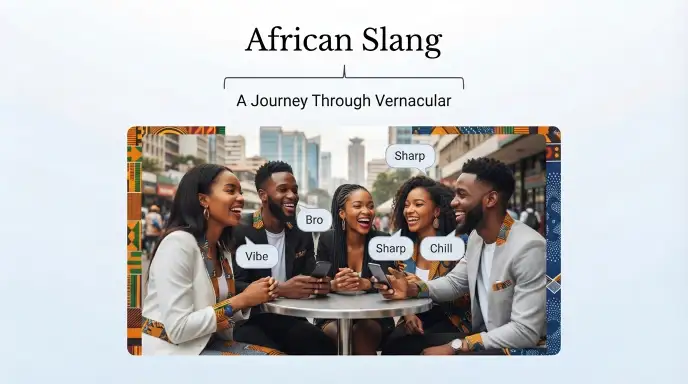
African slang is a broad and interesting part of everyday communication across the continent. If you have seen words such as “abeg,” “wahala,” “chale,” “eish,” or “sharp sharp” on social media, you may have wondered what they mean. People often search for African slang because these expressions appear in TikTok videos, Instagram captions, music, movies, comments, texting, and online conversations.
However, there is no single African slang vocabulary. Africa has thousands of languages and many different cultures, so slang can vary greatly between countries and communities. Nigerian slang can sound very different from Ghanaian, South African, or Kenyan slang.
Quick Answer African Slang:
African slang means informal words and expressions used by different African communities in casual communication. The meaning depends on the country, language, culture, and context.
What Does African Slang Mean in Text?
When someone searches for African slang meaning in text, they are usually trying to understand an informal expression they have encountered online.
The important thing to remember is that “African slang” is a broad category rather than one specific language. Different countries have developed their own informal expressions, often influenced by local languages, English, French, Portuguese, Arabic, music, and urban culture.
For example:
- Abeg commonly means “please” in Nigerian informal speech.
- Wahala commonly refers to trouble, problems, or stress.
- Chale is an informal Ghanaian expression often used for a friend or person.
- Eish is a South African expression that can show surprise, frustration, disbelief, or concern.
- Sharp sharp can mean quickly, okay, or goodbye depending on the situation.
- Sheng refers to a Kenyan urban language variety influenced by Swahili, English, and other Kenyan languages.
Because these expressions come from different communities, their meanings should not be treated as universal.
African Slang Full Form and Definition
There is no specific African slang full form because “African slang” is not an acronym.
Instead, the phrase describes informal vocabulary and expressions used by particular African communities. Some slang comes from shortened words, while other expressions come directly from African languages or developed through contact between multiple languages.
For example, Nigerian Pidgin has its own vocabulary and grammatical patterns and has developed through contact between English and Nigerian languages. Similarly, urban varieties of speech in South Africa and Kenya often combine vocabulary from several languages.
So, if you are asking “What does African slang stand for?”, the answer is that it does not stand for one particular phrase. You need to identify the individual slang word and its regional context.
Popular African Slang Words and Their Meanings
The following table gives examples of expressions that you may encounter online. Meanings can vary according to location and context.
| Slang Word | Common Association | Common Meaning |
| Abeg | Nigeria | Please |
| Wahala | Nigeria / West Africa | Trouble or problem |
| Chop | Nigeria / West Africa | Eat, food, or sometimes money |
| Na | Nigeria | Used for emphasis or in constructions meaning “is/it is” |
| Abi? | Nigeria | Right? / Isn’t it? |
| Eish | South Africa | Surprise, frustration, disbelief, or concern |
| Sharp sharp | South Africa | Quickly, okay, or goodbye depending on context |
| Chale | Ghana | Friend, buddy, or informal address |
| Sheng | Kenya | Urban slang variety |
| Msee | Kenya | An informal term for an older person or man |
| Dey | West African usage | Be/stay, depending on the sentence |
These meanings are useful starting points, but context is essential. A word may have a different meaning in another country or even among different groups within the same country.
Nigerian Slang
Nigerian slang is especially visible internationally because Nigerian music, entertainment, comedy, sports, and social media have large audiences.
Many popular Nigerian expressions are associated with Nigerian Pidgin or local languages. They are often used casually between friends and may also appear in online comments and entertainment.
Abeg
Abeg is commonly used to mean “please.”
For example:
“Abeg, send me the picture.”
The speaker is making a casual request.
It can also be used to express annoyance or dismissal:
“Abeg, forget that matter.”
Here, the speaker is essentially saying, “Please, forget about that issue.”
The tone depends on the situation and the speaker’s relationship with the listener.
Wahala
Wahala generally refers to trouble, problems, stress, or an unwanted situation.
For example:
“This work is wahala.”
The speaker means that the work is troublesome or stressful.
Another common expression is:
“No wahala.”
This generally communicates “No problem” or “It’s okay.”
Because “wahala” can describe different kinds of trouble, its exact meaning depends on the sentence.
Chop
In Nigerian and some West African contexts, chop can refer to eating or food.
For example:
“I wan chop.”
In context, this means the speaker wants to eat.
The word can also take on other meanings in informal speech, including references to money or benefiting from something. Therefore, it is important not to translate every use of “chop” simply as “eat.”
Ghanaian Slang
Ghanaian informal speech includes influences from English, Akan languages, Ga, Ghanaian Pidgin, and other linguistic communities.
One expression that international audiences may recognize is chale.
Chale
Chale is commonly used informally to address a friend, buddy, or another person.
For example:
“Chale, that match was amazing!”
Here, the expression gives the sentence a friendly and relaxed tone.
It can also appear when someone is surprised or frustrated:
“Chale, I can’t believe that happened.”
The exact feeling comes from the surrounding conversation.
It is therefore better to understand chale as a flexible informal expression rather than assigning it one fixed English translation.
South African Slang
South African slang is particularly diverse. The country’s many languages and cultural communities have contributed to a wide range of informal expressions.
You may encounter influences from English, Afrikaans, isiZulu, isiXhosa, and other languages.
Eish
Eish is a wellifknown South African expression used to show an emotional reaction.
It can communicate:
- Surprise
- Frustration
- Disbelief
- Concern
- Disappointment
For example:
“Eish, I forgot my phone.”
Here, “eish” expresses frustration.
Another example is:
“Eish, that was a close game.”
In this case, the speaker is reacting with surprise or excitement.
There is no single English word that perfectly replaces “eish” in every situation. Tone and context are important.
Sharp Sharp
Sharp sharp is another expression strongly associated with South African informal communication.
Depending on context, it can suggest:
- Quickly
- Okay
- All right
- Goodbye
- See you later
For example:
“I’ll finish it sharp sharp.”
Here, the meaning is close to “I’ll finish it quickly.”
However, in another conversation, someone might use “sharp” as a brief acknowledgment, similar to “okay.”
Kenyan Slang and Sheng
Kenya has a particularly interesting urban slang variety called Sheng.
Sheng is associated especially with Kenyan urban youth culture and combines influences from Swahili, English, and several Kenyan languages.
It continues to evolve as speakers create new expressions and adapt existing ones.
You may encounter Sheng in:
- Text messages
- Social media
- Music
- Urban conversations
- Online communities
- Youth culture
Because Sheng changes over time and can vary between communities, a term that is popular in one area may not be equally familiar somewhere else.
This is one reason online translations of African slang should be treated carefully.
Is African Slang Rude, Offensive, or Neutral?
African slang is not automatically rude or offensive.
Like slang in other parts of the world, it can be:
- Friendly
- Humorous
- Casual
- Emotional
- Playful
- Insulting
- Offensive
The specific word and the context determine the tone.
For example, an informal expression between close friends may sound warm and natural. The same expression could sound disrespectful if used with a stranger, elder, teacher, customer, or someone in a formal setting.
Some slang can also have cultural meanings that are difficult to understand from a direct translation.
Where Is African Slang Commonly Used?
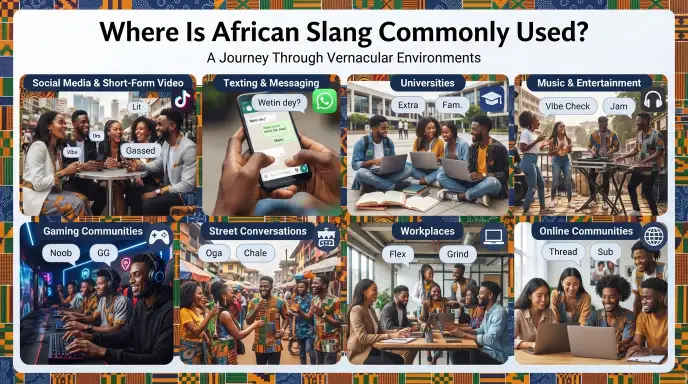
African slang appears in many forms of modern communication.
Social Media
You may encounter regional slang in:
- TikTok comments
- Instagram captions
- Facebook posts
- YouTube comments
- X posts
- Snapchat
- Memes
African music and entertainment also help regional expressions reach international audiences.
Texting and Messaging
Informal expressions are common in WhatsApp conversations, group chats, SMS messages, and direct messages.
People often use slang because it makes conversations shorter, more expressive, and more personal.
Music and Entertainment
African music has played an important role in spreading local expressions.
Afrobeats, Amapiano, Afropop, hipifhop, and other genres frequently incorporate regional language and slang. International listeners may then encounter these expressions online and search for their meanings.
Gaming and Online Communities
African gamers may combine regional slang with international gaming vocabulary.
For example, a gaming conversation might contain English gaming terms alongside Nigerian, Ghanaian, South African, or Kenyan expressions.
This creates a type of digital communication that can be confusing to people unfamiliar with the regional slang.
Real:Life Examples of African Slang
Friendly Example
“Chale, come over this weekend!”
The expression creates a relaxed and friendly tone.
Casual Example
“Abeg, send me the link.”
Here, “abeg” makes the request informal.
Frustrated Example
“Eish, I missed the bus again.”
“Eish” expresses frustration or disappointment.
Problem Example
“No wahala, I’ll handle it.”
The speaker is reassuring the other person that there is no problem.
Social Media Example
“This video is too funny, chale
The slang makes the comment sound casual and expressive.
Gaming Example
“Eish, that was close!”
Here, the expression communicates an emotional reaction during a game.
African Slang vs American Internet Slang
African slang and American internet slang can appear together online, but they come from different linguistic and cultural backgrounds.
| Feature | African Slang | American Internet Slang |
| Main influence | African languages and local varieties of English, French, Portuguese, etc. | Mainly American English and internet culture |
| Regional variation | Very high | High |
| Common settings | Local conversations, music, social media, texting | Social media, gaming, texting, memes |
| Examples | Abeg, wahala, chale, eish | LOL, sus, bet, lowkey |
| Cultural connection | Often closely tied to regional identity | Often tied to online and pop culture |
Both forms of slang change over time, and a word can become popular online much faster than traditional language changes.
Why Do People Use African Slang?
People use slang for many reasons.
To Show Identity
Slang can show where someone comes from or which cultural community they identify with.
To Sound Natural
Informal expressions often make conversations feel more relaxed and personal.
To Express Emotion
A single slang expression can communicate surprise, frustration, excitement, humor, or disbelief without requiring a long explanation.
To Build Community
Shared slang creates a sense of belonging. People who understand the expression immediately recognize the cultural or social context behind it.
To Be Creative
Slang is constantly changing. Speakers can shorten words, combine languages, create new expressions, and give existing words new meanings.
Origin and Background of African Slang
There is no single origin of African slang because Africa contains an enormous number of languages and cultural communities.
Informal vocabulary has developed through language contact, migration, trade, urbanization, music, entertainment, and everyday interaction.
Modern African slang is also influenced by European languages introduced through colonial history, particularly English, French, and Portuguese. These languages interact with indigenous African languages in different ways across different regions.
Urban areas have been especially important in the development of new slang. When speakers of different languages interact regularly, they may borrow words from one another and develop new informal expressions.
Today, social media has accelerated this process. A phrase that begins within one city or community can spread through music, memes, videos, and online conversations to audiences around the world.
When Should You Avoid Using African Slang?
African slang can make a conversation sound natural and friendly, but it is not appropriate for every situation. If you are unsure about the meaning, tone, or cultural background of a phrase, it is usually better to use standard language.
You may want to avoid unfamiliar slang when:
- Writing a formal business email
- Applying for a job
- Writing an academic assignment
- Speaking in an official setting
- Communicating with a customer or client
- Talking to someone whose cultural background you do not know
- Using a word that you cannot confidently explain
This does not mean slang is “bad English.” Slang simply serves a different purpose from formal language.
The biggest risk is using an expression incorrectly. A word that sounds friendly in one community might have a different meaning somewhere else.
Polite Alternatives to African Slang
If you are writing for a broad audience and are unsure if your readers understand a particular expression, standard English can be a safer choice.
| Informal Expression | Possible Standard Alternative |
| Abeg | Please |
| No wahala | No problem |
| Chale | Friend / mate |
| Sharp sharp | Quickly / okay |
| Eish | Oh wow / that’s frustrating |
These alternatives are not necessarily better than slang. They are simply more widely understood.
For example, saying:
“Abeg, send me the file.”
is natural in an informal conversation with someone who understands the expression.
In a formal email, you might instead write:
“Please send me the file.”
The right choice depends on your audience and the setting.
Why Do People Use African Slang?
People use slang because it adds personality and cultural meaning to communication.
Slang Shows Cultural Identity
Language is closely connected to culture. A regional expression can tell others something about the speaker’s background or community.
For many speakers, using local slang is not simply about being informal. It can also be a way of expressing cultural identity.
Slang Makes Conversations Feel More Natural
Formal English can sometimes sound distant in casual conversations.
A familiar expression can make a message feel more relaxed:
“Chale, how are you?”
can sound more conversational than a very formal greeting.
Slang Can Express Feelings Quickly
Slang is often emotionally efficient.
Instead of writing a long explanation, a person might simply say:
“Eish!”
The listener may understand that something surprising, frustrating, or disappointing has happened based on the surrounding situation.
Slang Builds Social Connection
People who share the same slang can immediately recognize a sense of familiarity.
This is particularly noticeable among friends, young people, music communities, sports fans, and online groups.
Slang Adds Humor
African comedians, musicians, creators, and social media users often use slang because it can make a sentence funnier or more expressive.
A direct translation may lose some of that humor because the original expression carries cultural associations.
The Impact of African Slang on Communication
African slang has a positive role in communication, but it can also create misunderstandings when people do not share the same cultural background.
Positive Effects
African slang can:
- Strengthen cultural identity
- Make conversations more personal
- Help communities connect
- Add humor and emotion
- Preserve local expressions
- Make digital communication more expressive
- Introduce international audiences to African cultures
Slang also demonstrates how flexible language can be. Words can move between languages and communities while developing new meanings.
Possible Misunderstandings
The main challenge is context.
Someone who sees a slang word on TikTok may translate it literally and assume that translation works everywhere.
It may not.
A word can have:
- A different meaning in another country
- A different meaning in another language
- A different tone among different age groups
- A different meaning in formal and informal settings
- More than one interpretation
For this reason, a reliable explanation should identify the regional and social context rather than providing only a oneifword translation.
Is African Slang Safe for Social Media?
In general, African slang is safe to use on social media when the specific expression is appropriate and you understand what it means.
The phrase African slang itself does not describe offensive language. It is simply a broad category of informal expressions.
However, individual slang terms can still be:
- Rude
- Insulting
- Sexual
- Profane
- Discriminatory
- Offensive in certain contexts
Before posting unfamiliar slang publicly, consider the audience and meaning.
Ask yourself:
- Do I know what this word means?
- Which country or community uses it?
- Could it have another meaning?
- Is it appropriate for my audience?
- Am I using it naturally?
- Could someone interpret it as disrespectful?
This is particularly important when using slang from a culture you are not personally familiar with.
African Slang on TikTok, Instagram, and Other Platforms
Social media has changed how quickly slang travels.
A phrase that was once mostly understood within a particular city can now reach people around the world through a viral video.
TikTok
TikTok can spread regional expressions through comedy, music, challenges, reactions, and short videos.
Users who hear an unfamiliar word may then search for its meaning.
African slang can appear in captions, comments, memes, Reels, and direct messages.
Musicifrelated posts are another major source of slang exposure.
YouTube
African creators, comedians, musicians, and vloggers often use everyday language naturally. International viewers may encounter regional expressions without immediately understanding them.
WhatsApp and Texting
Private messaging tends to be more informal than public writing. Friends may mix English with local languages and slang when chatting.
Gaming Communities
Gaming conversations can combine local slang with international terms such as “GG,” “clutch,” “noob,” or “AFK.”
This creates multilingual and multicultural online conversations.
How to Understand African Slang Correctly
If you come across an unfamiliar expression, do not rely only on the literal translation.
Use the context around the word.
Step 1: Identify the Country
Try to determine if the speaker is from Nigeria, Ghana, South Africa, Kenya, Tanzania, or another country.
This is important because African slang varies enormously between regions.
Step 2: Read the Entire Sentence
A slang word may have several possible meanings.
For example, chop can relate to eating in one context and have a different informal meaning in another.
Step 3: Consider the Tone
Ask if the speaker is:
- Joking
- Angry
- Excited
- Surprised
- Greeting someone
- Making a request
- Complaining
Tone can completely change how an expression should be understood.
Step 4: Consider the Platform
A slang expression in a funny TikTok comment may have a different purpose from the same expression in a serious conversation.
Step 5: Check Cultural Context
Some expressions carry cultural meaning that cannot be translated perfectly into standard English.
When possible, a native speaker or reliable regional source can provide better context.
African Slang vs African Languages
It is important not to confuse slang with an entire language.
Africa has thousands of languages and language varieties. Slang is informal vocabulary used within particular communities, while a language has a much broader structure involving vocabulary, grammar, pronunciation, and established usage.
For example, Sheng is a Kenyan urban language variety with its own evolving vocabulary and linguistic influences. Nigerian Pidgin is also much broader than a simple collection of slang words.
This distinction matters because calling every African informal expression “African slang” can oversimplify the linguistic diversity of the continent.
A better approach is to identify the specific country, language, or community whenever possible.
Why African Slang Changes So Quickly
Slang is naturally flexible, and African slang is no exception.
Several factors contribute to its rapid evolution.
Music
Popular songs can introduce expressions to millions of listeners.
A phrase used by a successful artist may quickly become recognizable among fans.
Social Media
TikTok, Instagram, YouTube, and other platforms allow slang to cross regional boundaries.
Youth Culture
Young speakers often create or adapt expressions to reflect current trends.
Urbanization
Cities bring together people who speak different languages. This creates opportunities for borrowing and mixing.
Global Communication
African speakers interact with people from Europe, North America, Asia, and other regions online. This can introduce new vocabulary while also spreading African expressions internationally.
Common Mistakes When Using African Slang
People who are unfamiliar with regional slang sometimes make predictable mistakes.
Mistake 1: Treating Africa as One Linguistic Community
Africa is a continent, not a single language group.
Nigerian slang should not automatically be assumed to work in South Africa or Kenya.
Mistake 2: Assuming One Translation Always Works
A slang word can have several meanings.
Always consider the sentence and situation.
Mistake 3: Copying Slang Without Understanding It
A phrase may look funny or popular online but have a meaning that is inappropriate for your audience.
Mistake 4: Using Slang in Formal Writing
Informal expressions are usually unsuitable for academic papers, job applications, official documents, and professional communication.
Mistake 5: Ignoring Cultural Context
Some expressions are closely connected to a particular community. Using them without understanding their background can make your communication sound unnatural or disrespectful.
African Slang in Everyday Conversations
Here are some additional examples showing how regional expressions can work in casual communication.
Example 1: Asking for Something
“Abeg, help me with this.”
The speaker is making a casual request.
Example 2: Reassuring Someone
“No wahala. We can fix it.”
The expression communicates that the problem is manageable.
Example 3: Reacting to Bad News
“Eish, that’s unfortunate.”
The expression adds emotion to the sentence.
Example 4: Talking to a Friend
“Chale, where have you been?”
The informal address makes the conversation friendly.
Example 5: Talking About Speed
“I’ll be there sharp sharp.”
The expression suggests that the person will arrive quickly.
These examples show why context is essential. The same expression may not translate naturally wordifforifword.
A Quick Guide to Understanding African Slang
If you regularly encounter African slang online, remember these basic principles:
- There is no single African slang vocabulary.
- Country and community matter.
- Context determines meaning.
- Tone determines how a word feels.
- Some slang comes from local languages.
- Some expressions are associated with Nigerian Pidgin, Sheng, South African urban speech, or other varieties.
- Social media can spread slang internationally.
- Not every slang word is appropriate in formal communication.
- A literal translation may not capture the cultural meaning.
The more context you have, the more accurately you can understand an unfamiliar expression.
FAQs About African Slang
Q1. What is African slang?
African slang is a broad term for informal words and expressions used by different African communities. It varies significantly by country, language, region, age group, and social setting.
Q2. Is African slang one language?
No. Africa has enormous linguistic diversity. “African slang” is a general label for informal expressions from different communities, not the name of one language.
Q3. What are some common African slang words?
Examples include abeg, wahala, chale, eish, and sharp sharp. Their meanings can vary depending on the country and context.
Q4. Is African slang used in texting?
Yes. Regional slang is commonly used in informal texting, messaging apps, social media comments, group chats, and online communities.
Q5. Can African slang have multiple meanings?
Yes. Some expressions can change meaning according to the sentence, country, speaker, or tone. Context is therefore essential.
Q6. Is it okay for foreigners to use African slang?
It can be, especially when the speaker understands the expression and uses it respectfully. However, copying slang without knowing its meaning or cultural context can lead to misunderstandings.
Conclusion
African slang is not one fixed collection of words. It is a broad and constantly changing part of informal communication across many African countries and communities. Expressions such as abeg, wahala, chale, eish, and sharp sharp show how language can combine cultural identity, humor, emotion, and everyday communication.
If you are trying to understand African slang meaning in text, always look beyond the individual word. Consider the country, language community, sentence, platform, and tone. A term that feels perfectly natural in one community may sound unfamiliar or carry a different meaning somewhere else.
The best way to use African slang is with context and respect. When you understand where an expression comes from and what it means in real conversation, slang becomes more than just internet vocabulary if it becomes a window into the culture and creativity of the people who use it.
Keep Learning!

I’m Dylan Foster, a slang and internet culture writer passionate about exploring how people communicate online and in everyday conversations. I write about texting abbreviations, social media expressions, and modern slang to help readers understand meanings, origins, and real-world usage in a simple way.