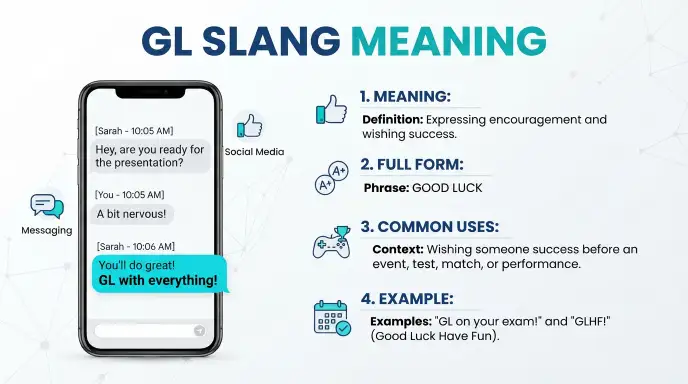
GL slang most commonly means “Good Luck” in text messages, online chats, and gaming conversations. It is a short, friendly way to wish someone success before an exam, game, interview, competition, or another challenge.
If you have seen someone type “GL” and wondered what it means, you are probably looking at a simple internet abbreviation. GL slang meaning in text is usually “Good Luck,” especially when someone is preparing for something important. For example, a friend might text, “GL on your exam!” or a gamer might type, “GL everyone” before a match.
The abbreviation is generally positive and informal. It is common in quick conversations because it takes only two letters to communicate a complete phrase. However, GL can have other meanings in different communities, so the surrounding conversation matters.
This guide explains the GL slang meaning, its full form, tone, common uses, realistic examples, and related expressions.
Quick Answer:
In text slang, GL usually means “Good Luck.
The abbreviation comes from the first letters of Good Luck:
- G = Good
- L = Luck
For example:
“I have my driving test tomorrow.”
“GL!”
The second person is simply saying:
“Good luck!”
GL is popular because it is quick and easy to type. It can also feel natural in fastifmoving online conversations.
What Does GL Mean in a Text Message?
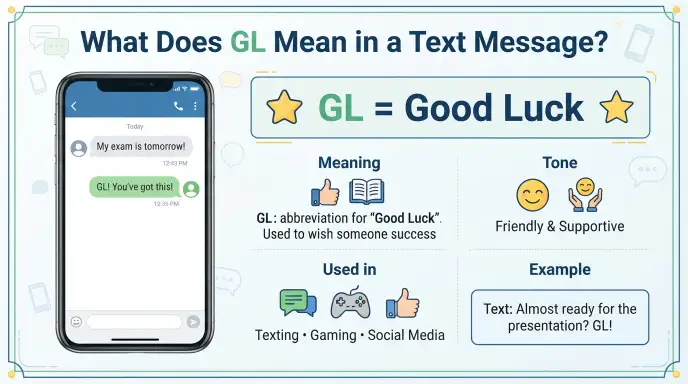
In a normal text message, GL usually has a friendly meaning.
For example:
“My interview starts in 20 minutes.”
“GL! You’ve got this.”
Here, GL is a small message of encouragement.
You may also see:
- “GL with your exam!”
- “GL tomorrow!”
- “GL bro!”
- “GL everyone!”
- “GL on the new job!”
- “GL in the finals!”
The exact wording around GL can change, but the basic idea stays the same: the sender is wishing someone good luck.
GL Full Form and Definition
The most common GL full form in internet slang is “Good Luck.”
It is an abbreviation rather than a separate word. People use it as a faster version of the complete phrase.
| Term | Full Form | Meaning |
| GL | Good Luck | Wishing someone success |
| GLHF | Good Luck, Have Fun | Wishing someone luck and fun |
| GG | Good Game | Usually used after a game |
| GJ | Good Job | Praising someone’s performance |
| WP | Well Played | Praising a good play |
The important distinction is timing.
GL is often used before something happens:
“GL in your match!”
GG is usually used after a game:
“GG, that was close!”
This makes GL particularly common in gaming and competitive conversations.
What Does GL Stand For?
When GL appears in casual texting, it generally stands for “Good Luck.”
For example:
“GL with your presentation.”
means:
“Good luck with your presentation.”
The abbreviation does not change the basic message. It simply makes the sentence shorter.
You might also see GL written in different styles:
- GL
- gl
- Gl
Capitalization usually does not change the intended meaning in casual online messages.
For example:
“GL on your test!”
and
“gl on your test!”
both normally mean “Good luck on your test!”
Is GL Rude, Offensive, or Neutral?
GL is generally neutral to positive and is not normally considered rude or offensive.
When someone sends “GL,” they are usually trying to be supportive.
For example:
“I’m nervous about my interview.”
“GL! Hope you get the job.”
That is clearly encouraging.
However, tone depends on context. Because GL is so short, it can sometimes feel less warm than writing the complete phrase.
Compare:
“GL.”
with:
“Good luck tomorrow! I know you’ll do great.”
Both express support, but the second message sounds more personal.
So, GL itself is not offensive. The only question is if the short form fits the situation.
Can GL Sound Dismissive?
Sometimes, yes.
Imagine someone is discussing a very serious or emotional situation and another person replies only:
“GL.”
The abbreviation may feel too brief, even though its literal meaning is positive.
That is a matter of tone and context, not a different definition of GL.
If someone needs emotional support, a fuller response may be more appropriate:
“I really hope everything works out. Take care.”
Where Is GL Commonly Used?
GL is most useful in casual digital communication. It can appear in texts, gaming chats, Discord conversations, social media comments, and private messages.
GL in Texting
Text messages are one of the most common places to find the abbreviation.
Example:
“I have my final exam tomorrow.”
“GL!”
The message is short but supportive.
GL in Gaming
Gaming is an especially common setting for GL.
Players may type:
“GL everyone!”
before a match begins.
They may also use:
“GLHF!”
which means “Good Luck, Have Fun.”
In a fast gaming environment, short expressions are useful because players do not want to spend time typing long messages before a match.
GL on Discord
On Discord, GL may appear in gaming servers, study groups, or community chats.
For example:
“The tournament starts in five minutes.”
“GL guys!”
The meaning is usually obvious from the context.
GL on TikTok and Instagram
GL can also appear in comments and direct messages.
For example:
“Audition tomorrow!”
A friend might comment:
“GL!!”
Here, the person is wishing the creator good luck.
GL on Snapchat and WhatsApp
In private chats, GL can be used before everyday events:
“First day at my new job tomorrow.”
“GL! You’ll be amazing.”
The abbreviation fits casual conversations between friends.
GL in Gaming: Why Is It So Common?
Gaming is one of the clearest contexts for understanding GL slang.
Before a match, players may use GL to show sportsmanship or simply wish their opponents and teammates well.
Examples include:
- “GL”
- “GL all”
- “GL team”
- “GL everyone”
- “GLHF”
For example:
“Ready?”
“Yep. GL!”
This does not necessarily mean the players are close friends. It can simply be a standard friendly message before the competition starts.
GL vs. GLHF
There is a small difference between the two:
GL = Good Luck
GLHF = Good Luck, Have Fun
GL focuses on success, while GLHF adds the idea of enjoying the game.
Real:Life Examples of GL Slang
Seeing GL in different situations makes its meaning easier to understand.
Friendly Example
Friend: “I’m taking my driving test tomorrow.”
You: “GL! You’ve got this.”
Meaning: Good luck with your driving test.
Casual Text Example
Friend: “My interview is at 9.”
You: “GL!”
Meaning: Good luck!
Gaming Example
Player: “Ready for ranking?”
Player 2: “Yep, GL.”
Meaning: Good luck.
Discord Example
Player: “Final round starts now.”
Teammate: “GL everyone!”
Meaning: Good luck, everyone.
Social Media Example
User: “First competition tomorrow!”
Comment: “GL!!”
Meaning: Good luck!
School Example
Student: “We present first today
Friend: “GL
Meaning: Good luck with your presentation.
These examples show that GL is usually connected to an upcoming event where someone wants to do well.
Is GL Safe for Social Media?
Yes, GL is generally safe to use on social media when it means “Good Luck.”
It is a harmless abbreviation and does not normally contain offensive language.
You can commonly use it in:
- Instagram comments
- TikTok comments
- Snapchat messages
- Discord chats
- Gaming communities
- Group chats
- Private messages
Still, remember that GL can have different meanings in other contexts. If the conversation is about a specialized topic, check the surrounding words before assuming it means “Good Luck.”
For ordinary social media conversations about exams, competitions, interviews, games, or new opportunities, the meaning is usually clear.
Does GL Have Other Meanings?
Yes. GL can mean something other than “Good Luck.”
One example is “Girls’ Love,” a term used in some entertainment and fandom communities for stories or media focused on romantic relationships between female characters.
For example:
“I’m looking for a good GL series.”
If the conversation is about TV shows, manga, anime, or similar media, GL may have this meaning instead.
This is why context matters.
A Simple Context Test
Ask:
Is someone about to do something challenging?
If yes, GL probably means Good Luck.
Is the conversation about entertainment or a specific fandom?
If yes, GL could have another meaning.
Is it in a technical or professional document?
Then GL may be an abbreviation for something unrelated to slang.
Origin and Background of GL Slang
The exact origin of GL as shorthand for “Good Luck” is difficult to trace to one person or one specific date. It developed as part of the wider habit of shortening common phrases in digital communication.
As online chat, instant messaging, and gaming became more common, users often wanted quick ways to communicate. Short forms such as GL made it possible to send a supportive message without typing the full phrase.
Gaming communities also helped make the abbreviation familiar. Before a match, players can quickly type “GL” instead of writing “Good luck, everyone.” The related expression GLHF, meaning “Good Luck, Have Fun,” became another familiar preifgame phrase.
It is better to avoid claiming that GL was invented by a particular website, game, or generation unless reliable historical evidence supports that claim. The safest description is that GL became established through informal online communication and remains recognizable today.
GL Slang vs. Similar Internet Abbreviations
GL is part of a larger group of short expressions used in online conversations. Knowing the differences can help you understand messages more quickly.
| Slang | Full Meaning | Usually Used |
| GL | Good Luck | Before an event or challenge |
| GLHF | Good Luck, Have Fun | Before a game |
| GG | Good Game | After a game |
| GJ | Good Job | After someone performs well |
| WP | Well Played | After a good play |
| TY | Thank You | After receiving help or kindness |
| HF | Have Fun | Before an activity or game |
For example:
“GLHF!”
means:
“Good luck, have fun!”
After the game, someone might say:
“GG!”
The two expressions have different purposes.
GL vs. GG
This is an especially useful distinction for gamers.
GL usually comes before the game:
“GL everyone!”
GG usually comes after the game:
“GG, that was fun!”
So if someone says “GL” before a match, they are wishing the players luck. If they say “GG” afterward, they are commenting on the game that just finished.
When Should You Avoid Using GL?
GL is best for informal conversations. There is usually no problem with the abbreviation itself, but some situations call for clearer or more formal language.
Formal Emails
Instead of:
“GL with your presentation.”
a professional email would usually sound better as:
“Good luck with your presentation.”
School Assignments
Avoid using GL in essays, research papers, or formal assignments unless you are specifically discussing internet slang.
Messages to Teachers
If you are writing to a teacher, professor, or school administrator, “Good luck” is generally a better choice than GL.
Professional Communication
A casual team chat may allow:
“GL with the client meeting!”
But a formal business message would be better as:
“I wish you the best of luck with the client meeting.”
Serious Conversations
If someone is sharing a serious personal problem, simply replying “GL” may sound too short.
A more thoughtful response could be:
“I hope everything works out for you.”
The issue is not that GL is offensive. It is simply that short slang may not always match the seriousness of a conversation.
Polite Alternatives to GL
If you want the same meaning but a warmer or more professional tone, you have many choices.
Casual Alternatives
- Good luck!
- Best of luck!
- You’ve got this!
- Hope it goes well!
- Rooting for you!
- Go for it!
More Polite or Professional Alternatives
- I wish you the best of luck.
- I hope everything goes well.
- Wishing you success.
- Best wishes for your interview.
- I hope your presentation goes well.
For example:
Very casual:
“GL!”
Friendly:
“Good luck! You’ve got this!”
Professional:
“I wish you the best of luck with your presentation.”
Choosing between them depends on the person you are talking to and the setting.
Why Do People Use GL?
People use GL because it is short, familiar, and easy to understand in casual conversations.
There are several practical reasons someone might choose GL:
- It saves typing time.
- It fits short messages.
- It works well in fast gaming chats.
- It feels casual.
- It communicates encouragement quickly.
- It is easy to combine with other abbreviations.
For example, a player entering a tournament does not need to type a long message:
“I wish everyone the best of luck in this upcoming competition.”
A simple:
“GL everyone!”
can communicate the same basic idea much faster.
This is one reason abbreviations are useful in online communities.
The Impact of GL on Communication
Using GL can make communication feel quick, relaxed, and friendly.
It works especially well when both people already understand common internet abbreviations. A short message can feel natural rather than overly formal.
However, abbreviations can also create confusion when the reader does not know them.
For example, someone unfamiliar with internet slang may see:
“GL!”
and wonder:
“What does GL stand for?”
This is why context and audience matter.
With Friends
GL is usually easy to understand.
With Online Gamers
It is very familiar.
With Older or Less Online Users
Writing “Good luck” may be clearer.
In Formal Communication
The complete phrase is usually the better choice.
The goal is not to avoid slang completely. The goal is to use language that your audience can understand easily.
Is GL Still Common?
GL is still recognizable and useful in casual online communication, especially in gaming and short messages. However, how often people use abbreviations can vary by community, age group, and platform.
Some people prefer writing:
“Good luck!”
Others may simply type:
“GL!”
Neither choice is wrong.
Internet slang also changes over time. A term can become more common in one community while becoming less common in another. Because of that, it is better to treat GL as a familiar informal abbreviation rather than assume that everyone uses it in exactly the same way.
Common Misunderstandings About GL
The biggest misunderstanding is assuming that GL always means “Good Luck.”
Usually, the surrounding conversation makes the meaning clear.
Example 1: Exam
“I have my final exam tomorrow.”
“GL!”
Here, GL almost certainly means Good Luck.
Example 2: Gaming
“The tournament starts in five minutes.”
“GL!”
Again, it means Good Luck.
Example 3: Entertainment
“Have you watched that new GL series?”
Here, the topic may indicate that GL means Girls’ Love, not Good Luck.
Example 4: Technical Conversation
If GL appears in a professional report or technical discussion, it may represent an industryifspecific abbreviation.
The lesson is simple: never interpret an abbreviation without checking its context.
What Does GL Mean on TikTok?
On TikTok, GL can mean “Good Luck” when the conversation is about an upcoming challenge, event, test, or competition.
For example:
“My audition is tomorrow!”
Someone might comment:
“GL!!”
The commenter is wishing the person success.
However, TikTok also contains many different communities, so GL may have another meaning depending on the video and comments. Always consider the topic before interpreting the abbreviation.
What Does GL Mean on Discord?
On Discord, GL often means “Good Luck,” especially in gaming servers.
A typical exchange might look like this:
“Everyone ready?”
“Yep.”
“GLHF!”
or:
“GL guys!”
Because Discord is heavily used for gaming and online communities, short expressions such as GL can fit naturally into fast group conversations.
What Does GL Mean on Snapchat?
On Snapchat, GL can simply mean “Good Luck” in a private conversation.
For example:
“I have my first driving lesson tomorrow.”
“GL
The emoji can make the message feel more playful or friendly, but the abbreviation itself still means “Good Luck.”
What Does GL Mean on Instagram?
On Instagram, you may see GL in comments or direct messages.
For example:
“Competing in my first race this weekend!”
A friend might reply:
“GL!
The meaning is straightforward: Good luck!
As with other platforms, context matters because GL can have other meanings in specific communities.
Frequently Asked Questions About GL Slang
Q1. What does GL mean in text slang?
GL usually means “Good Luck.” It is commonly used to encourage someone before an exam, game, interview, competition, or another challenge.
Q2. What does GL stand for?
In casual texting, GL stands for “Good Luck.” It is formed from the first letters of the two words.
Q3. Is GL a bad or offensive word?
No. When GL means “Good Luck,” it is generally harmless and positive. It is not normally an insult or offensive expression.
Q4. What does GL mean in gaming?
In gaming, GL usually means “Good Luck.” Players often use it before a match. You may also see GLHF, which means “Good Luck, Have Fun.”
Q5. Can GL have another meaning?
Yes. In some entertainment and fandom communities, GL can mean “Girls’ Love.” Other specialized fields may also use GL as an abbreviation for different terms.
Q6. Can I use GL at work?
You can use GL in a relaxed workplace chat if your coworkers understand internet abbreviations. For formal emails, reports, or professional documents, writing “Good luck” is safer and clearer.
Conclusion: GL Slang Meaning in Text
GL slang most commonly means “Good Luck.” It is a short and friendly abbreviation used in texting, gaming, Discord, TikTok, Instagram, Snapchat, and other casual online conversations.
You will often see GL before an exam, interview, competition, game, presentation, or another event where someone hopes to succeed. In gaming, it is closely related to GLHF, meaning “Good Luck, Have Fun.”
The key is context. GL does not always mean Good Luck. In some entertainment communities, it can have another meaning, while technical fields may use the letters for completely different terms.
For casual conversations with friends, GL is perfectly natural. For teachers, formal emails, school assignments, or professional communication, writing “Good luck” is usually clearer.
More Helpful Guides!

I’m Dylan Foster, a slang and internet culture writer passionate about exploring how people communicate online and in everyday conversations. I write about texting abbreviations, social media expressions, and modern slang to help readers understand meanings, origins, and real-world usage in a simple way.