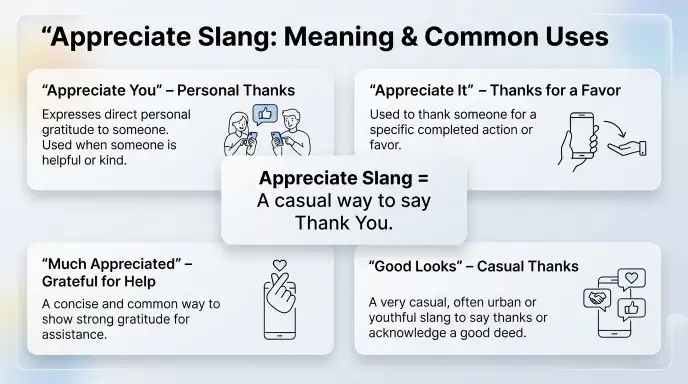
Appreciate slang usually refers to informal ways of saying “thank you,” showing gratitude, or acknowledging someone’s help, kindness, compliment, or effort. Expressions like “appreciate you,” “much appreciated,” “I appreciate it,” and “good looks” can sound more casual than a traditional “thank you.”
When someone says “appreciate you” in a text or social media message, they are usually showing genuine gratitude. The phrase can also feel warmer and more personal than simply saying “thanks.”
Quick Answer appreciate slang
“Appreciate” in slang usually means “thank you” or “I’m grateful.” Common informal expressions include “appreciate you,” “appreciate it,” “much appreciated,” “I appreciate that,” and “good looks.”
What Does Appreciate Mean in Slang?
In casual speech and texting, “appreciate” is often used as a short way to express thanks.
For example:
“Appreciate you helping me out.”
This means:
“Thank you for helping me.”
The expression can feel more relaxed and personal than a formal “thank you.”
Another common example is:
“Appreciate it!”
This simply means:
“Thanks!”
The word can also communicate respect. When someone says “I appreciate you,” they may be thanking you for something while also showing that they value your support or friendship.
Why Do People Say “Appreciate You”?
“Appreciate you” has become a popular casual expression because it combines gratitude with personal recognition.
Compare these:
“Thank you.”
“I appreciate it.”
“Appreciate you.”
All three can express gratitude, but they have slightly different tones.
“Thank you” is neutral and works almost everywhere.
“I appreciate it” sounds friendly and sincere.
“Appreciate you” is more personal because the speaker is directly recognizing the person rather than simply thanking them for a specific action.
For example:
“Thanks for picking me up.”
“No problem.”
“Appreciate you!”
The final response communicates more than simple thanks. It can suggest, “I value you for helping me.”
Popular Appreciate Slang Expressions
There are several informal expressions built around “appreciate.” Their meanings overlap, but the tone can vary.
1. Appreciate You
“Appreciate you” means “I appreciate you” or “Thank you for being helpful.”
Example:
“Thanks for staying late to help me. Thank you!”
This is warm, friendly, and commonly used in casual conversations and texts.
2. Appreciate It
“Appreciate it” means “Thank you” or “I’m grateful for that.”
Example:
“I’ll send you the file tonight.”
“Appreciate it.”
This is one of the most natural informal alternatives to “thanks.”
3. Much Appreciated
“Much appreciated” means that someone’s help or effort is valued.
Example:
“Could you send me the address?”
“Sure.”
“Much appreciated.”
It can be casual, professional, or somewhere in between depending on the situation.
4. I Appreciate That
“I appreciate that” expresses gratitude or recognition.
Example:
“I know you’ve been busy, but thanks for making time.”
“I appreciate that.”
The expression can also acknowledge someone’s kindness or understanding.
5. Appreciate It, Bro
This is a more relaxed version of “appreciate it.”
Example:
“I saved you a seat.”
“Appreciate it, bro.”
“Bro” makes the phrase more casual and friendly.
6. Appreciate You, Man
This expression is commonly used between friends or acquaintances.
Example:
“Thanks for helping me move.”
“No worries.”
“Appreciate you, man.”
It expresses personal gratitude and friendliness.
7. Good Looks
“Good looks” is informal slang for thanks, especially for helping someone, giving useful information, or doing them a favor.
Example:
“The meeting is in Room 204.”
“Good looks!”
The phrase is strongly associated with casual urban speech and can vary by community.
8. Much Love
“Much love” can express appreciation, affection, or respect.
Example:
“Thanks for always supporting me. Much love.”
The phrase is more emotionally warm than a simple “thanks.”
Appreciate Slang in Texting
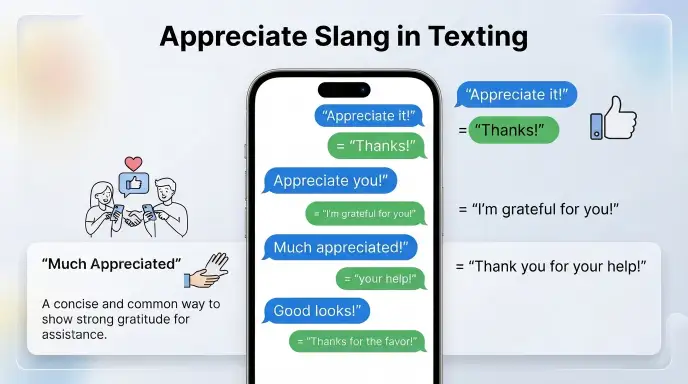
Texting is one of the most common places where informal expressions such as “appreciate it” and “appreciate you” appear.
People often shorten their messages because texting is casual and fast.
For example:
Formal:
“Thank you very much for sending me those documents.”
Casual:
“Appreciate it!”
Very casual:
“Appreciate you” The shorter versions work well when the relationship and context are already clear.
You may see these expressions in text messages, group chats, direct messages, and casual online conversations.
Appreciate Slang on Social Media
Expressions involving “appreciate” can also appear on platforms such as Instagram, TikTok, Reddit, Snapchat, and other social spaces.
For example, someone might post:
“Appreciate everyone who showed up today.”
Or:
“Really appreciate all the support!”
In these situations, the phrase can be used to thank a large audience.
Social media also allows people to use “appreciate you” as a warm response to comments.
For example:
Comment: “Your content helped me so much!”
Creator: “Appreciate you!”
The response means something like “Thank you for your support” or “I’m grateful you enjoyed it.”
Is “Appreciate You” Slang?
“Appreciate you” is best described as an informal conversational expression, rather than slang in the strictest sense.
The word “appreciate” itself is standard English. What makes “appreciate you” feel informal is the shortened sentence structure.
In more formal English, you would normally say:
“I appreciate your help.”
In casual speech, someone might simply say:
“Appreciate you.”
The subject “I” is omitted, which gives the expression its relaxed conversational style.
What Does “I Appreciate You” Mean?
“I appreciate you” is more personal than “I appreciate it.”
“I appreciate it” usually refers to a specific action.
For example:
“Thanks for sending the information. I appreciate it.”
“I appreciate you” focuses on the person.
For example:
“You’ve always been there for me. I appreciate you.”
The second expression can communicate gratitude, respect, affection, or emotional support.
It does not necessarily have a romantic meaning. Friends, family members, coworkers, teammates, and online communities can all use it.
Appreciate You vs. Thank You
Both expressions communicate gratitude, but their tone is slightly different.
| Expression | Meaning | Tone |
| Thank you | Direct expression of gratitude | Neutral |
| Thanks | Short form of thank you | Casual |
| I appreciate it | Gratitude for a specific action | Friendly |
| Appreciate it | Informal thanks | Casual |
| I appreciate you | Gratitude toward a person | Warm |
| Appreciate you | Casual personal thanks | Friendly |
| Much appreciated | Thanks for help or effort | Polite |
| Good looks | Thanks for a favor or useful information | Very casual |
If you are speaking in a formal setting, “thank you” is usually the safest option.
With friends or people you know well, “appreciate you” can sound natural and genuine.
When Should You Use “Appreciate You”?
“Appreciate you” works best in relaxed situations where a friendly tone is appropriate.
You might use it when someone:
- Helps you with a task
- Gives you useful advice
- Supports your work
- Gives you a ride
- Covers for you
- Sends useful information
- Gives you a compliment
- Supports you emotionally
- Does you a favor
For example:
“Thanks for covering my shift. Thank you!”
Or:
“You always give the best advice. Thank you.”
The expression feels especially natural when the speaker wants to sound sincere without being overly formal.
When Should You Avoid “Appreciate You”?
Although “appreciate you” is friendly, it may not fit every situation.
In formal business communication, academic writing, official letters, or professional documents, a complete expression may be better.
For example, instead of:
“Appreciate you for sending this.”
You could write:
“Thank you for sending this.”
Or:
“I appreciate you sending the information.”
The best choice depends on your relationship with the other person and the situation.
Appreciate Slang Examples in Everyday Conversations
Here are some natural examples:
Example 1: Getting a Ride
“Thanks for picking me up.”
“No problem.”
“Appreciate you!”
Example 2: Getting Help
“Can you help me with this?”
“Sure.”
“Appreciate it.”
Example 3: Receiving Information
“Here’s the address.”
“Much appreciated.”
Example 4: A Friend’s Support
“Thanks for always having my back.”
“I appreciate you, seriously.”
Example 5: Online Conversation
“Thanks for the advice!”
“Appreciate you!”
Example 6: Work Situation
“I sent the report to your email.”
“Appreciate it.”
These examples show how the expression naturally fits casual communication.
Is “Appreciate It” Different From “Appreciate You”?
Yes, there is a small difference.
“Appreciate it” usually refers to an action, favor, or thing someone did.
“Thanks for sending the link. Appreciate it.”
“Appreciate you” focuses on the person.
“Thanks for always helping me. Thank you.”
The first is about what someone did.
The second is about the person and their support.
This distinction is useful when choosing the expression that best matches your intended tone.
Is “Appreciate You” Flirty?
Usually, “appreciate you” is not inherently flirty.
Friends can say it to each other, coworkers can use it casually, and family members can say it as an expression of gratitude.
However, context can change the feeling.
For example:
“Thanks for helping me move. Thank you!”
sounds friendly.
But:
“You always know how to make my day. I appreciate you ❤️”
could sound more emotionally intimate depending on the relationship.
The phrase itself does not automatically indicate romantic interest.
Is “Appreciate You” Professional?
It depends on the workplace and the relationship.
In a relaxed workplace, “Appreciate you” may sound perfectly natural in a quick chat message.
For example:
“Thanks for jumping on that call. Thank you!”
However, for a formal email or communication with a client, a more conventional phrase may be better:
“Thank you for your assistance.”
or:
“I really appreciate your help with this.”
The complete form sounds more polished and professional.
Common Mistakes With Appreciate Slang
Using It in Every Situation
“Appreciate you” is informal. Using it in every conversation can sound unnatural.
Use different expressions depending on the situation.
Confusing “Appreciate It” and “Appreciate You”
Remember:
Appreciate it = thanks for what you did.
Appreciate you = thanks and recognition directed toward you.
Assuming It Is Always Romantic
“Appreciate you” is usually friendly or appreciative, not romantic.
Context matters more than the phrase itself.
Using Slang in Formal Writing
Expressions such as “good looks” or “appreciate you, bro” are usually inappropriate for formal documents.
Choose “thank you” or “I appreciate your help” when professionalism is important.
Overusing “Appreciate”
If every message ends with “appreciate you,” the expression can lose its natural effect.
Use it when you genuinely want to recognize someone’s help or support.
Appreciate Slang and Generational Language
The casual use of “appreciate” is part of a broader trend in conversational English where people shorten common expressions.
Older speakers might be more likely to say:
“Thank you. I really appreciate that.”
Younger speakers may say:
“Appreciate you.”
or:
“Appreciate it!”
Neither form is automatically better. They simply reflect different conversational styles.
Social media and texting have also made short expressions of gratitude more common because people often communicate quickly.
Other Slang Ways to Say Thank You
If you are looking for alternatives to “appreciate it,” there are several casual expressions you may encounter.
Thanks
The simplest casual alternative.
Example: “Thanks for the help.”
Thanks a Lot
Can express genuine gratitude, although tone can sometimes make it sarcastic.
Example: “Thanks a lot for helping me out.”
Much Love
A warmer expression of appreciation.
Example: “Much love for the support.”
Good Looks
Informal thanks for a favor or useful information.
Example: “Good looks on the recommendation.”
You’re the Best
A friendly way to show strong appreciation.
Example: “You brought me coffee? You’re the best.”
Big Thanks
An enthusiastic way to thank someone.
Example: “Big thanks to everyone who helped.”
Props
An informal way to give someone credit or recognition.
Example: “Props to you for making it happen.”
Google Trends and Usage of Appreciate Slang
Interest in informal expressions such as “appreciate you” is closely connected to changing communication habits.
People increasingly communicate through short messages, comments, direct messages, and group chats. This encourages compact expressions that communicate emotion without requiring a long sentence.
The popularity of phrases like “appreciate you” also reflects a broader preference for personal and conversational language online.
However, popularity can vary by age group, region, social community, and platform. A phrase that sounds completely natural in one online community may sound unusual in another.
For that reason, context remains more important than simply knowing the definition.
Frequently Asked Questions About Appreciate Slang
Q1. What does “appreciate” mean in slang?
In casual language, “appreciate” often means “thank you” or “I’m grateful.” For example, “Appreciate it!” means “Thanks!”
Q2. What does “appreciate you” mean?
“Appreciate you” means “I appreciate you” and is a casual way to show gratitude, respect, or recognition toward someone.
Q3. Is “appreciate you” a slang term?
It is better described as an informal conversational expression. The word “appreciate” is standard English, while dropping “I” makes the phrase more casual.
Q4. What does “appreciate it” mean in texting?
“Appreciate it” means “Thank you” or “I’m grateful for what you did.” It is common in texts, chats, and casual online conversations.
Q5. Is “appreciate you” flirty?
Not usually. “Appreciate you” is generally friendly and appreciative. Its meaning can become more affectionate depending on the surrounding conversation and relationship.
Q6. Can I use “appreciate you” at work?
You can use it in casual workplace conversations when the environment is relaxed. For formal emails and professional documents, “thank you” or “I appreciate your help” is usually more appropriate.
Q7. What is another slang word for thank you?
Casual alternatives include “appreciate it,” “appreciate you,” “good looks,” “much love,” “props,” and “thanks.” The best choice depends on the community and situation.
Conclusion
Appreciate slang is mainly about expressing gratitude in a relaxed and conversational way. Phrases such as “appreciate it,” “appreciate you,” “much appreciated,” and “good looks” can all communicate thanks, but each carries a slightly different tone.
“Appreciate it” usually thanks someone for a specific action, while “appreciate you” focuses more directly on the person and can communicate gratitude, respect, or support. These expressions are especially common in texting, group chats, social media, and casual conversations.
The important thing is context. A phrase that sounds natural between friends may not be suitable for a formal email or professional document. Understanding that difference helps you use informal language naturally instead of forcing slang into situations where it does not belong.
If someone sends you a message saying “Appreciate you!”The simplest interpretation is usually just: “Thank you if I value what you did.”
Explore More!

I’m Dylan Foster, a slang and internet culture writer passionate about exploring how people communicate online and in everyday conversations. I write about texting abbreviations, social media expressions, and modern slang to help readers understand meanings, origins, and real-world usage in a simple way.