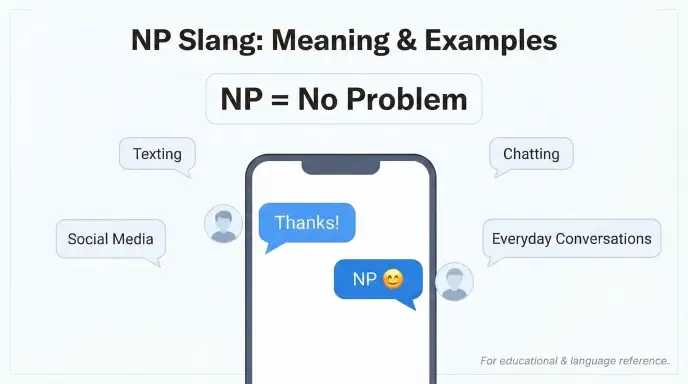
If someone replies “NP” after you say “thanks” or “sorry,” there is usually no hidden meaning. In texting and internet slang, NP most commonly stands for “no problem.” It is a short, convenient way to reassure someone that everything is fine.
You may see NP in text messages, Instagram or Snapchat conversations, Discord chats, gaming communities, and other casual online spaces. Because it takes only two letters, it is especially useful when people want to keep a conversation quick and relaxed.
Although the basic meaning is simple, the tone can change depending on the conversation. “NP!” may sound warm and friendly, while a short “np.” can sometimes feel more distant. Understanding the context helps you interpret it correctly.
Quick Answer np slang:
NP slang usually means “no problem.” It is a casual way to say “you’re welcome,” “it’s okay,” or “don’t worry about it.” It is common in texting, DMs, gaming chats, and online conversations.
What Does NP Mean in Texting?
In most casual conversations, NP means “no problem.” It is used when someone wants to show that something is okay and that they are not bothered.
For example:
Person A: Thanks for helping me!
Person B: NP!
Here, NP means “No problem!” or “You’re welcome!”
Another example:
Person A: Sorry I replied so late.
Person B: NP, don’t worry.
In this case, NP reassures the other person that the late reply is not an issue.
What NP Can Express
Depending on the situation, NP can communicate:
- No problem
- You’re welcome
- It’s okay
- Don’t worry
- That’s fine
- Happy to help
The exact feeling comes from the surrounding conversation rather than the abbreviation itself.
How NP Is Used in Everyday Chats
People generally use NP when responding to something that could otherwise require a longer reply.
| Situation | Example | Meaning of NP |
| Someone says thanks | “Thanks for helping!” — “NP!” | You’re welcome |
| Someone apologizes | “Sorry!” — “NP.” | It’s okay |
| Someone asks for help | “Can you send it?” — “NP.” | Sure |
| Someone worries | “Hope that’s okay.” — “NP.” | It’s fine |
| Someone appreciates you | “I really appreciate it.” — “NP!” | Happy to help |
After “Thank You”
This is probably the most familiar use.
“Thanks for sending the file.”
“NP!”
The response is essentially the same as “You’re welcome.”
After an Apology
NP can also reassure someone who says sorry.
“Sorry for bothering you.”
“NP.”
Here, the person is saying that the interruption or inconvenience is not a big deal.
After a Small Request
NP can sometimes appear after someone agrees to do something.
“Can you send me the picture?”
“NP, I’ll send it now.”
In this context, it still carries the idea of “no problem” or “sure.”
NP Slang in Social Media and Online Chats
Because NP is short and easy to type, it fits naturally into digital communication. It can appear in direct messages, group chats, gaming conversations, and casual social media interactions. Instagram and Snapchat
In social media DMs, someone might use NP after receiving a thankifyou.
“Thanks for sending me that post!”
“NPThe emoji can make the response feel warmer.
Discord
Discord conversations often move quickly, so short abbreviations such as NP are convenient.
“Sorry, I missed your message.”
“NP!”
Gaming Chats
Gamers may use NP after an apology or mistake.
“Sorry, I messed up that round.”
“NP, we can try again.”
The abbreviation keeps the conversation quick without creating unnecessary tension.
The Tone of NP
Although NP normally has a friendly or neutral meaning, its tone can depend on punctuation, capitalization, emojis, and the conversation around it.
| Version | Possible Tone |
| NP! | Friendly and positive |
| np | Casual and relaxed |
| NP | Warm and reassuring |
| np bro | Very casual and friendly |
| NP, anytime! | Helpful and welcoming |
| np. | Potentially brief or distant |
A twoifletter response does not automatically mean the person is annoyed. Sometimes they are simply typing quickly.
For example:
“Thanks!”
“np sounds noticeably warmer than:
“Thanks.”
“np.”
However, punctuation alone should not be treated as proof of someone’s emotions. The broader conversation matters.
Is NP the Same as “You’re Welcome”?
NP and “you’re welcome” can serve the same purpose, but their tone is different.
“You’re welcome” is a complete phrase and works in both casual and more polite situations. NP is an informal abbreviation designed for quick digital communication.
| Expression | Formality | Typical Setting |
| You’re welcome | Neutral | Everyday and professional |
| No problem | Casualifneutral | Everyday conversation |
| NP | Informal | Texting and online chats |
| No worries | Casual | Friends and informal chats |
| Anytime | Friendly | Casual conversations |
If you are chatting with a friend, NP sounds perfectly natural. For a formal email, writing “You’re welcome” is generally a better choice.
NP in Different Texting Situations
The meaning of NP slang is usually easy to understand, but the situation around it can slightly change its tone. Someone may use it to accept an apology, respond to thanks, agree to a request, or reassure another person.
When Someone Says “Thanks”
This is one of the most common situations for NP.
“Thanks for helping me with that!”
“NP!”
Here, NP means “You’re welcome” or “No problem.”
When Someone Says “Sorry”
NP can also make an apology feel less serious.
“Sorry I forgot to tell you.”
“NP, it happens.”
The speaker is saying that they are not upset about the mistake.
When Someone Asks for a Favor
NP can communicate that a small favor is easy to do.
“Can you help me with this?”
“NP.”
In this situation, it can mean “Sure, no problem.”
NP vs No Worries vs You’re Welcome
Several expressions can have a similar meaning, but they are not always interchangeable in tone.
| Expression | Meaning | Style |
| NP | No problem | Very casual |
| No worries | It’s okay / Don’t worry | Casual |
| You’re welcome | A polite response to thanks | Neutral |
| No problem | It’s fine / Happy to help | Casual |
| Anytime | Happy to help again | Friendly |
NP is particularly useful when you are having a quick digital conversation.
Is NP a Slang Word or Abbreviation?
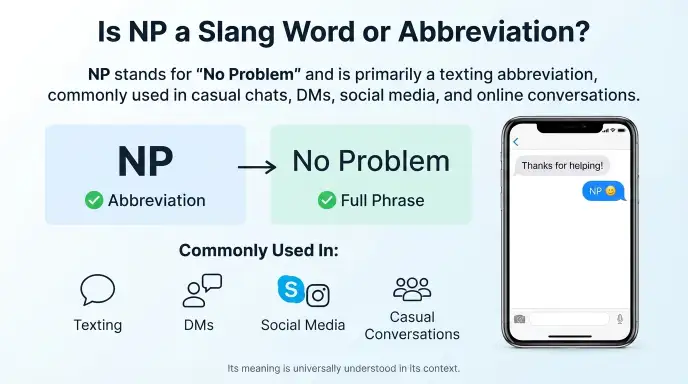
Technically, NP is better described as a texting abbreviation or internet shorthand rather than a traditional slang word.
Traditional slang often consists of informal words or expressions that have meanings different from standard language. NP, on the other hand, shortens the phrase “no problem.”
Still, people commonly search for it as NP slang because it is frequently used in informal internet communication.
Why People Use NP
The main reason is convenience. Typing two letters is faster than typing an entire phrase.
For example:
“Thanks!”
“NP!”
The response is short but still understandable to most people familiar with online shorthand.
Capitalization and Punctuation
You may see NP written in several ways.
| Form | Example | Impression |
| NP | “NP!” | Clear and friendly |
| np | “np” | Relaxed and casual |
| Np | “Np!” | Casual |
| np! | “np!” | Friendly and quick |
| NP | “NP” | Warm and positive |
There is no single required capitalization style in casual texting. People usually choose whatever feels natural while typing.
Common Mistakes With NP
Assuming NP Always Means “No Problem”
No problem is the most common interpretation, but abbreviations can have different meanings in different communities.
If the conversation is unclear, look at the surrounding messages before deciding what NP means.
Using NP in Formal Communication
NP is generally intended for informal communication.
For example, replying “NP” to a close friend is completely normal. However, in a formal business email, “You’re welcome” or “My pleasure” would usually sound more appropriate.
Thinking “NP” Is Always Cold
A short response can sometimes look less emotional than a longer reply, but that does not necessarily mean the person is angry or uninterested.
“Thanks for your help!”
“NP!”
This can simply be a quick, friendly response.
When Should You Use NP?
NP works best when the conversation is relaxed and informal.
Good situations include:
- Text messages
- Messages with friends
- Group chats
- Gaming chats
- Discord conversations
- Casual social media DMs
- Informal online communities
For professional or formal communication, use a complete phrase instead.
When to Choose “You’re Welcome”
If you are speaking with a teacher, customer, manager, client, or someone you do not know well, “You’re welcome” is generally safer.
When to Choose “No Problem”
“No problem” is also casual but is more universally understandable than the abbreviation NP.
Examples of NP Slang in Real Conversations
Example: A ThankifYou Message
Alex: Thanks for sending the notes!
Sam: NP!
Meaning: You’re welcome.
Example: An Apology
Alex: Sorry for making you wait.
Sam: NP, don’t worry.
Meaning: It’s okay.
Example: A Small Favor
Alex: Can you send me the link?
Sam: NP, give me a second.
Meaning: Sure, no problem.
Example: Gaming
Player 1: Sorry, I missed the objective.
Player 2: NP, we’ve got another round.
Meaning: It’s okay; don’t worry about it.
What Does NP Mean From a Friend?
When a friend sends “NP”, it usually means there is no issue or they are happy to help.
For example:
“Thanks for picking me up!”
“NP!”
There is normally no negative meaning. The friend is simply responding quickly.
However, if the message appears after a serious disagreement, you should consider the entire conversation instead of interpreting the abbreviation by itself.
What Does NP Mean on Snapchat, Instagram, or TikTok?
On social media, NP usually carries the same basic meaning: “no problem.”
Someone might reply to a DM with:
“NP!”
or:
“np lol”
The extra words, punctuation, or emojis can make the message feel more casual, playful, or friendly.
Social media slang changes quickly, so context is always important when interpreting short abbreviations.
What Does NP Mean in Gaming?
In gaming chats, NP can be particularly useful because players often need to communicate quickly.
For example:
“Sorry, my connection dropped.”
“NP.”
The player is saying that the mistake or interruption is not a big deal.
It can also appear when teammates thank each other:
“Thanks for covering me!”
“NP.”
In fastifmoving game chats, short abbreviations save time.
NP Slang: Key Takeaway
NP usually means “no problem.” It is an informal abbreviation used to respond to thanks, apologies, requests, or minor inconveniences.
The expression is especially common in:
- Texting
- Social media
- DMs
- Gaming
- Discord
- Group chats
The tone is normally casual and friendly. However, NP is not ideal for formal writing, where expressions such as “You’re welcome” or “My pleasure” are more appropriate.
FAQs About NP Slang
Q1. What does NP mean in slang?
NP usually means “no problem.” It is commonly used in texting and online conversations as a short response to thanks or apologies.
Q2. What does NP mean in texting?
In texting, NP means “no problem.” Depending on context, it can mean “you’re welcome,” “it’s okay,” or “don’t worry.”
Q3. Is NP short for no problem?
Yes. In casual digital communication, NP is commonly used as an abbreviation for “no problem.”
Q4. Is NP formal or informal?
NP is informal. It is appropriate for texting, casual chats, social media, gaming, and similar conversations, but it is usually not suitable for formal writing.
Q5. What should I reply to NP?
Usually, you do not need to reply. If the conversation continues, you can simply continue with your next message. NP itself often closes a brief exchange of thanks.
Q6. Does NP mean you’re welcome?
Yes. When someone says “Thanks!” and you respond “NP,” it can function much like “You’re welcome.”
Q7. What does “NP!” mean from a friend?
When a friend says “NP!”, it normally means “No problem!” The exclamation mark can make the response feel friendly and positive.
Conclusion
NP slang is a simple and useful piece of internet shorthand that usually means “no problem.” You will most often see it in text messages, social media DMs, gaming chats, Discord, and other informal conversations. People use it to respond to thanks, accept an apology, reassure someone, or show that a small favor is not an inconvenience.
Although NP is only two letters, its meaning is easy to understand when you consider the context. After “Thanks,” it commonly means “You’re welcome.” After “Sorry,” it usually means “It’s okay” or “Don’t worry.” In response to a request, it can mean “Sure, no problem.”
The most important thing to remember is that NP is casual. It works naturally with friends and online communities but may look too informal in professional or academic communication. When you need a more polished response, use “You’re welcome,” “No problem,” or “My pleasure.”

I’m Dylan Foster, a slang and internet culture writer passionate about exploring how people communicate online and in everyday conversations. I write about texting abbreviations, social media expressions, and modern slang to help readers understand meanings, origins, and real-world usage in a simple way.