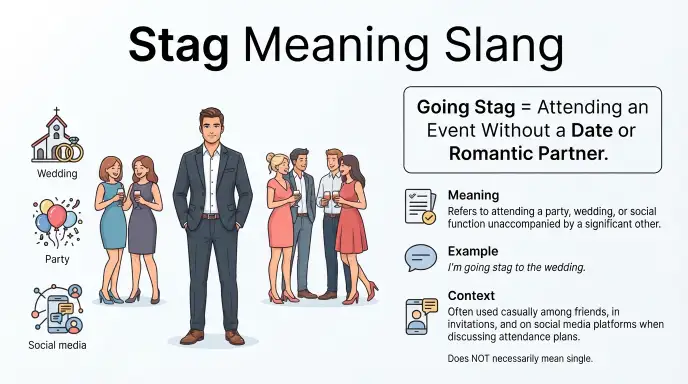
stag meaning slang can be confusing when you see the word in a text, social media post, or conversation about dating and parties. If someone says, “I’m going stag tonight,” they usually are not talking about a deer.
Instead, they are saying that they plan to attend an event alone, without a date or romantic partner. This expression is especially common when people discuss weddings, parties, dinners, or other social gatherings.
However, “stag” can have several meanings depending on the context, so it is important to look at the whole sentence before interpreting it. The word can also be connected with expressions such as “stag party” and “stag do,” particularly in British English.
Quick Answer Stag Meaning Slang:
In slang, stag commonly means attending a social event alone, especially without a romantic partner or date. “Going stag” means going without a date.
What Does Stag Mean in Text?
When someone uses stag in a text, they are often describing a person who is attending an event without a partner or date.
For example:
“Are you bringing your girlfriend to the wedding?”
“No, I’m going stag.”
Here, “going stag” means attending the wedding alone.
The expression is informal and conversational. It is useful when the main topic is whether someone is bringing a partner to a social event.
Another example is:
“My wife can’t come, so I’m going stag.”
This does not mean the speaker is single. It simply means the speaker is attending the event without their wife.
That distinction is important because “stag” and “single” do not mean exactly the same thing.
Simple Definition
Stag: Attending a social event without a date or romantic partner.
Going stag: Going somewhere alone when people might normally bring a date or partner.
What Does “Going Stag” Mean?
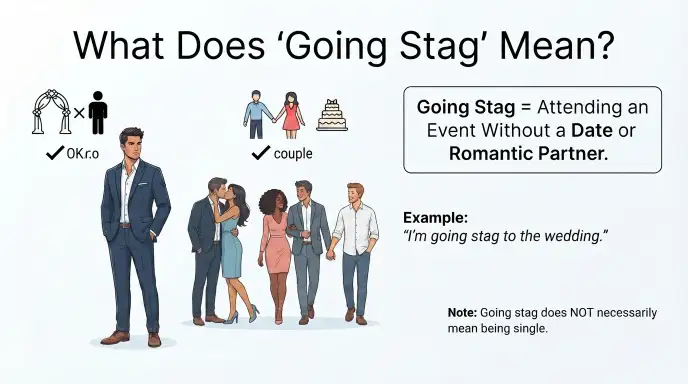
Going stag is probably the most useful phrase to know if you are researching stag meaning slang.
It means:
To attend an event without a romantic partner or date.
For example:
“Everyone else is bringing a date, but I’m going stag.”
This means the person will attend alone.
The phrase can be used in different situations, including:
- Weddings
- Parties
- Formal dinners
- Social events
- Work functions
- Celebrations
- Group outings
It can be completely neutral.
For example:
“My partner is out of town, so I’m going stag.”
There is no negative meaning here. The speaker is simply explaining why they will attend alone.
Does Stag Mean Single?
Not necessarily.
This is one of the biggest misunderstandings surrounding the word.
Someone who is going stag may be:
- Single
- Dating someone
- Engaged
- Married
- In a long-term relationship
The word usually describes how someone is attending an event, not their relationship status.
For example:
“I’m married, but my husband is working tonight, so I’m going stag.”
The person is clearly married, yet they are still going stag.
So, if someone says:
“He went stag to the wedding.”
you should not automatically assume:
“He is single.”
A better interpretation is:
“He attended the wedding without a date or partner.”
Stag Full Form and Definition
Unlike abbreviations such as “LOL” or “IDK,” stag does not have a full form in the traditional texting-abbreviation sense.
It is an established English word that has several meanings.
In the slang expression “go stag,” it refers to attending an event without a partner or date.
You may also see related expressions such as:
- Going stag
- Go stag
- Stag party
- Stag night
- Stag do
The meaning depends on the phrase.
What Does Stag Stand For?
If someone asks “What does stag stand for in slang?”, it is better to explain that it is not an acronym.
Instead, stag is a word used in expressions such as “going stag.”
In that context, it describes attending an event alone or without a romantic companion.
Is Stag Rude, Offensive, or Neutral?
Stag is generally neutral and not offensive.
The phrase “going stag” normally describes a social situation without judging the person.
For example:
“I’m going to my friend’s wedding.”
This is simply information.
However, the tone can change depending on the way someone uses the term.
Neutral Example
“My girlfriend is busy, so I’m going stag.”
This is completely neutral.
Friendly Example
“Looks like we’re both going stag tonight!”
This can sound playful and friendly.
Teasing Example
“You’re going stag again?”
Between close friends, this could be harmless teasing. But depending on the person’s feelings, it could also sound insensitive.
Insulting Example
“He’s going stag because nobody wants him.”
The problem here is not the word stag. The insulting part is the statement about the person.
So, stag itself is normally neutral; context determines whether the overall message sounds respectful or offensive.
Where Is Stag Commonly Used?
The expression going stag is mostly used in informal conversations about social events.
You may see or hear it in:
- Text messages
- Group chats
- Conversations about weddings
- Party invitations
- Dating discussions
- Social media posts
- Casual conversations
- Informal online communities
It is not specifically a TikTok, Snapchat, or Discord term. Unlike newer internet slang, stag is an established English expression that can be used both online and offline.
For example, someone could say:
“I’m going stag to the wedding.”
in a face-to-face conversation or type exactly the same sentence in a text.
Stag Meaning in Dating Context
In dating-related conversations, stag can describe a man attending an event without a date or partner.
For example:
“He went stag to the party.”
This may simply mean that he attended alone.
However, the term does not automatically communicate that he is interested in dating or that he is currently single.
For example:
“He’s dating someone, but she couldn’t attend, so he went stag.”
This shows why context matters.
Stag vs. Single
These words are different:
Single describes relationship status.
Stag in “going stag” describes how someone attends an event.
That distinction can prevent a lot of confusion.
Stag Meaning on Social Media
Although “stag” is not exclusive to social media, you can see the expression in posts, comments, captions, and private messages.
A person might post:
“Going stag to tonight’s wedding.”
The meaning is simply that they are attending without a date or partner.
Snapchat
Someone might send:
“Everyone has dates tonight and I’m going stag
The laughing emoji gives the message a playful tone.
TikTok
A creator might make a video with a caption such as:
“POV: You’re going to your best friend’s wedding.”
Here, the phrase means attending without a romantic partner.
A Reddit user might ask:
“Is it normal to go stag to a wedding?”
In this context, the person is asking whether attending the wedding alone is socially acceptable.
Texting
A friend might simply write:
“Going stag tonight.”
The meaning is usually clear from the conversation: they are going alone rather than bringing a date.
Real:Life Examples of Stag
Friendly Example
“Are you bringing your boyfriend?”
“No, I’m going stag.”
Meaning: The person is attending alone.
Casual Example
“I’m going stag tonight. Want to meet me there?”
This is a relaxed way to explain that the person is not bringing a partner.
Wedding Example
“My partner can’t get off work, so I’m going stag.”
This clearly shows that the speaker has a partner but will attend the wedding alone.
Party Example
“Everyone has a date except me. Guess I’m going stag.”
The tone can be humorous or lighthearted.
Social Media Example
“Going stag but still planning to have a great night!”
This emphasizes that attending alone does not mean the person cannot enjoy themselves.
What Does “Stag Party” Mean?
The phrase stag party has a different but related meaning.
A stag party is traditionally a pre-wedding celebration for a man.
In American English, bachelor party is generally the more familiar term.
In British English, you may hear:
- Stag party
- Stag night
- Stag do
For example:
“His friends are planning a stag party before the wedding.”
The phrase refers to a celebration held for the groom-to-be.
This meaning should not be confused with:
“I’m going stag.”
The first refers to a pre-wedding celebration, while the second usually means attending an event without a partner.
Key Takeaway
The simplest way to understand stag meaning slang is to remember the phrase “going stag.”
When someone says:
“I’m going stag.”
they usually mean:
“I’m going alone without a date or romantic partner.”
It does not automatically mean that the person is single, lonely, or looking for a relationship. The expression simply describes their attendance at a social event.
Stag Party vs. Going Stag
One reason people become confused about stag meaning slang is that the word appears in several related expressions.
“Going stag” means attending an event without a date or romantic partner.
“My wife can’t come, so I’m going stag.”
Stag Party
A “stag party” traditionally refers to a celebration held for a man before his wedding.
For example:
“His friends are organizing a stag party next weekend.”
In American English, the more familiar term is often “bachelor party.”
Stag Do
In British English, “stag do” is another common expression for a pre-wedding celebration for the groom.
“He’s having his stag do in London.”
So, context is important. “Going stag” describes attending an event without a partner, while a “stag party” or “stag do” refers to a specific type of celebration.
What Does Stag Mean in British English?
Stag has several established uses in British English.
For social situations, British speakers may use expressions such as:
- Going stag
- Stag do
- Stag party
- Stag night
For example:
“Are you taking anyone to the wedding?”
“No, I’m going stag.”
A British speaker might also say:
“His stag do is next month.”
This refers to the groom’s pre-wedding celebration.
The word therefore has a strong connection with weddings and social events in British English.
However, “stag” is not limited to British English. The expression “go stag” is also understood in American English, although related wedding terminology can differ.
Stag in American English
In American English, “bachelor party” is generally more common than “stag party.”
For example, an American speaker might say:
“We’re planning his bachelor party.”
A British speaker may be more likely to say:
“We’re planning his stag do.”
Despite the difference, the underlying idea is similar.
The phrase “going stag” can still be understood in American English as attending an event without a date or partner.
Quick Comparison
| Phrase | British English | American English |
| Going stag | Used | Used |
| Stag do | Very common | Less common |
| Stag party | Common | Less common |
| Bachelor party | Understood | Very common |
| Stag night | Common | Less common |
This regional difference is useful when interpreting social media posts or conversations from different English-speaking countries.
Stag vs. Bachelor
The words stag and bachelor can appear in similar conversations, but they are not interchangeable in every situation.
A bachelor traditionally means an unmarried man.
A stag, when used in “going stag,” usually describes a man attending an event without a date or partner.
For example:
“He is a bachelor.”
This tells you something about his relationship status.
But:
“He went stag to the wedding.”
only tells you that he attended without a partner.
He could be single, dating, engaged, or married.
Simple Difference
Bachelor = relationship status
Going stag = attending an event without a partner
This is one of the most important distinctions to remember.
Stag vs. Solo
Another similar word is solo.
Both “stag” and “solo” can suggest that someone is going somewhere alone, but they are not used in exactly the same way.
Solo
“Solo” simply means alone or by oneself.
“I’m traveling solo.”
This could describe a trip, activity, meal, or event.
Stag
“Stag” usually has a more specific social meaning.
“I’m going stag to the wedding.”
This suggests that the person is attending an event where people might normally bring a date or partner.
Therefore, “solo” is broader, while “stag” is more closely connected to social events and dates.
Stag vs. Alone
“Alone” is a general English word.
For example:
“I’m going to the restaurant alone.”
This does not tell us why the person is alone or whether they normally would have brought someone.
By contrast:
“I’m going stag to the wedding.”
specifically suggests that the person is attending without a romantic companion or date.
So, while the two expressions can communicate a similar basic idea, stag provides more social context.
Is Going Stag a Bad Thing?
No. Going stag is not automatically negative.
Someone might choose to attend an event alone for many reasons.
Their partner might:
- Be working
- Be traveling
- Have another commitment
- Not be invited
- Prefer not to attend
- Be unavailable that day
Someone might also simply prefer going alone.
For example:
“My girlfriend has to work, so I’m going stag. I’m still looking forward to the party.”
There is nothing negative about this situation.
The expression describes the circumstances, not the person’s happiness or relationship quality.
Why Do People Say “Going Stag”?
People use the phrase because it is short, natural, and easy to understand in the right context.
Instead of saying:
“I am attending the wedding without my romantic partner.”
someone can simply say:
“I’m going stag.”
The shorter expression sounds more conversational.
It can also add a lighthearted tone:
“Looks like I’m going stag tonight!”
This may suggest that the person is joking about attending without a date.
Common Reasons People Use It
- It is concise.
- It sounds informal.
- It clearly describes attending without a date.
- It works well in casual conversation.
- It is familiar in wedding and party contexts.
When Should You Avoid Using Stag?
There is generally no need to avoid the word because stag is not an offensive term.
However, you should be careful about how you use it when talking about another person’s relationship or social life.
For example:
“He went stag because nobody wanted to go with him.”
This can sound insulting.
A neutral alternative is:
“He went stag because his partner couldn’t attend.”
The second sentence gives information without judging the person.
Avoid Assuming Someone Is Single
Do not automatically say:
“He went stag, so he must be single.”
That conclusion is not justified.
Going stag only tells you that the person attended without a partner or date.
Polite Alternatives to “Going Stag”
If your audience may not understand the expression, there are several simple alternatives.
Casual Alternatives
- I’m going alone.
- I’m going by myself.
- I’m not bringing a date.
- I’m attending on my own.
- I’ll be there solo.
More Specific Alternatives
Instead of:
“I’m going stag to the wedding.”
you could say:
“I’m going to the wedding without my partner.”
Or:
“I’m attending the wedding alone.”
These alternatives are especially useful when speaking with someone who is learning English.
Why Context Matters With Stag
The word stag can have several meanings beyond slang.
The literal meaning refers to an adult male deer.
So consider these two sentences:
“We saw a stag in the forest.”
Here, stag means a male deer.
Now:
“I’m going stag to the wedding.”
Here, it means attending without a date or partner.
The surrounding words make the intended meaning clear.
Other Contexts
“Stag” can also appear in expressions related to:
- Wildlife
- Weddings
- Parties
- Social events
- Dating
- Finance and business terminology
Therefore, never assume that every use of “stag” is slang.
Real:Life Examples With Different Tones
Friendly
“Want to go together? I’m going stag too!”
Tone: Friendly and inviting.
Casual
“No date tonight. Going stag.”
Tone: Relaxed.
Humorous
“Everyone has a date, and here I am going stag Tone: Playful.
Serious
“My partner is sick, so I’ll be going to the wedding.”
Tone: Neutral and practical.
Social Media
“Going stag doesn’t mean you can’t have fun!”
Tone: Positive and encouraging.
Teasing
“You’re going stag again?”
Tone: Potentially playful, but it depends on the relationship.
Argumentative
“Stop acting like going stag means I’m single.”
Tone: Defensive or argumentative.
This example shows why the word itself is not necessarily negative. The disagreement comes from how someone interprets it.
Impact of Stag Slang in Communication
Using informal language can make communication feel natural and conversational.
For people familiar with the expression, saying:
“I’m going stag.”
is much quicker than:
“I’m attending the event without my partner.”
However, slang can create confusion when the audience is unfamiliar with it.
Someone learning English might see the word “stag” and immediately think of a male deer.
That is why context is especially important in international communication.
When Stag Works Well
Use it when:
- Talking casually with friends
- Discussing weddings
- Talking about parties
- Chatting about dates
- Writing an informal social media caption
When a Simpler Phrase Is Better
Use “going alone” or “attending without my partner” when:
- Writing professionally
- Speaking to an English learner
- Explaining something formally
- Clarity is more important than style
Is Stag Safe for Social Media?
Yes. Stag is generally safe and appropriate for social media.
The term itself is not vulgar or offensive.
It can naturally appear in posts about:
- Weddings
- Parties
- Social events
- Dating
- Going out
- Personal experiences
For example:
“Going stag to my friend’s wedding this weekend!”
is a normal and harmless social media caption.
The only concern is tone. If someone uses “stag” to mock another person for being alone, the overall message could become disrespectful.
The word itself is neutral; the context determines the tone.
Common Mistakes About Stag Meaning Slang
Mistake 1: Thinking Stag Means “Single”
It does not necessarily mean that.
Someone can be married and still go stag.
Mistake 2: Thinking Stag Means “Lonely”
Going to an event alone does not automatically mean someone is lonely.
Mistake 3: Confusing Stag With Bachelor
A bachelor describes an unmarried man, while “going stag” describes attending an event without a date or partner.
Mistake 4: Thinking It Is Only Internet Slang
Stag is an established English word and expression. It is used both online and in everyday spoken English.
Mistake 5: Assuming It Always Refers to Parties
“Stag” can refer to a male deer or appear in other expressions. Context is essential.
Key Takeaway
The easiest way to remember stag meaning slang is through the phrase “going stag.”
If someone says:
“I’m going stag to the wedding.”
they usually mean:
“I’m attending the wedding without a date or romantic partner.”
The phrase does not automatically mean the person is single or lonely. It simply describes how they are attending the event.
Origin and Background of Stag
The word stag is much older than modern internet slang. Its original and most familiar meaning is an adult male deer. Over time, the word developed additional meanings and became connected with social expressions involving men and events.
The exact history of the slang expression “go stag” is not as simple as saying it directly comes from the animal. English has used “stag” in different male-related and social contexts for a long time, and the modern expression developed through this broader history.
Today, “going stag” is an established informal expression meaning that someone attends an event without a date or partner.
The word is therefore not a newly invented TikTok or texting abbreviation. You can encounter it in everyday speech, writing, social media, wedding discussions, and casual conversations.
What Does Stag Mean Besides Slang?
One reason stag meaning slang can be confusing is that the word has several meanings.
Stag as a Male Deer
The literal meaning of stag is an adult male deer.
For example:
“We saw a large stag in the forest.”
Here, the word has nothing to do with dating or parties.
Stag as a Social Expression
In:
“I’m going stag to the wedding.”
the word refers to attending without a date or partner.
Stag Party
A stag party is a traditional pre-wedding celebration for a man.
Stag Do
In British English, “stag do” is commonly used for a groom’s pre-wedding celebration.
This shows why context is so important. The same word can describe an animal, an event, or a person’s attendance at a social gathering.
Stag Meaning in British English
British English has several expressions built around “stag.”
A person may say:
“I’m going stag.”
to mean they are attending an event without a partner.
For a groom’s pre-wedding celebration, they might say:
“He’s having his stag do next weekend.”
“Stag party” and “stag night” are also used.
In American English, “bachelor party” is generally more common for the pre-wedding celebration.
British vs. American Usage
| Meaning | British English | American English |
| Attend without a partner | Going stag | Going stag |
| Pre-wedding celebration | Stag do | Bachelor party |
| Male pr if -wedding celebration | Stag party | Bachelor party |
| Celebration night | Stag night | Bachelor party |
These differences are useful when reading content from different English-speaking countries.
Stag vs. Bachelor: What Is the Difference?
These words are related in some contexts but have different meanings.
A bachelor traditionally means an unmarried man.
A person who is going stag is simply attending an event without a date or partner.
For example:
“John is a bachelor.”
This describes John’s relationship status.
But:
“John is going stag to the wedding.”
only describes how John is attending the wedding.
John could be single, dating, engaged, or married.
Easy Way to Remember
Bachelor = unmarried man
Going stag = attending without a partner
This distinction is especially useful when interpreting dating-related conversations.
Stag vs. Solo
“Solo” is another word that can be used when someone is alone.
For example:
“I’m traveling solo.”
This means the person is traveling alone.
But:
“I’m going stag to the party.”
usually suggests that the person is attending without a date or partner.
Comparison
| Word | Main Meaning |
| Stag | Attending a social event without a partner |
| Solo | Doing something alone |
| Alone | Without other people |
| Bachelor | Unmarried man |
“Solo” has a much wider meaning, while “stag” has a more specific social meaning in expressions such as “going stag.”
Why Do People Use the Expression “Going Stag”?
The phrase is convenient because it communicates a specific social situation in only two words.
Instead of saying:
“I’m attending the party without my romantic partner.”
someone can simply say:
“I’m going stag.”
It sounds natural and conversational.
People may also use it jokingly.
For example:
“Looks like I’m going stag tonight!”
This can communicate that the person is expected to have a date but will be attending alone.
Common Reasons Someone Might Go Stag
A person may go stag because:
- Their partner is unavailable.
- Their partner is working.
- Their partner was not invited.
- They recently became single.
- They prefer attending alone.
- The event is more enjoyable with friends.
- They simply do not want to bring a date.
The phrase itself does not tell you which reason applies.
Is Going Stag Embarrassing?
Not necessarily.
Some people may feel awkward attending a social event alone, especially if most guests arrive with partners. Others may enjoy the freedom of going alone.
The phrase “going stag” does not automatically carry embarrassment.
For example:
“I’m going stag, but I’m excited to catch up with everyone.”
This shows that the speaker is comfortable with the situation.
Social expectations can differ from person to person, so the emotional meaning should not be assumed.
Can Women Go Stag?
Traditionally, “stag” has a male association, especially in expressions such as “stag party.”
However, in casual modern conversation, people may sometimes use “going stag” more loosely to describe attending an event without a partner.
Still, if you want to be completely clear and gender-neutral, expressions such as:
- Going alone
- Going solo
- Attending without my partner
are easier to understand.
The traditional usage of “stag” is more strongly associated with men, so the exact use can vary by speaker and region.
Examples of Stag in Different Contexts
Wedding
“My partner can’t make it, so I’m going stag.”
Meaning: The person will attend the wedding without their partner.
Party
“Everyone is bringing dates, but I’m going stag.”
Meaning: The speaker is attending without a date.
Dinner
“I went stag to the company dinner.”
Meaning: The person attended without a partner.
Group Chat
“Who else is going stag tonight?”
Meaning: The speaker is asking who else will attend without a date.
Social Media Caption
“Going stag but still ready for a great night!”
Meaning: The person is attending alone but remains positive about the event.
Teasing
“You’re going stag again?”
Meaning: A friend may be playfully pointing out that the person is attending without a date.
When Should You Avoid Using “Stag”?
There is no major safety concern with the word, but there are situations where a clearer phrase is better.
Formal Communication
Avoid:
“I’ll be going stag to the company dinner.”
Instead:
“I’ll be attending the dinner without my partner.”
Professional Emails
Professional writing should generally avoid unnecessary slang.
Use:
“I will attend the event alone.”
instead of:
“I’m going stag.”
When Speaking to English Learners
Someone unfamiliar with the expression may think “stag” means a deer.
If clarity is important, say:
“I’ll be attending without a date.”
This removes ambiguity.
Polite Alternatives to Stag
If you want a simple alternative, several phrases work well.
Casual
- Going solo
- Going alone
- Going by myself
- No date tonight
- Attending solo
Clear and Neutral
- I’m attending without my partner.
- I’m going alone.
- I’m attending on my own.
- I’m not bringing a date.
Formal
- I will attend independently.
- I will attend without a guest.
- I will be attending alone.
The best alternative depends on the situation and the audience.
Why Slang Can Cause Misunderstandings
Slang is often highly dependent on context.
Someone familiar with English social expressions may immediately understand:
“I’m going stag.”
But an English learner may wonder:
“Why is this person talking about a deer?”
This happens because the literal and informal meanings are completely different.
That is why explaining slang with examples is often more useful than giving a one-line definition.
The sentence:
“I’m going stag to the wedding.”
provides enough context to make the meaning obvious.
Is Stag Safe for Social Media?
Yes. Stag is generally safe and neutral for social media.
It is not a profanity or an inherently offensive expression.
It can be used in captions, comments, posts, and messages about:
- Weddings
- Parties
- Dating
- Events
- Social gatherings
- Going out alone
For example:
“Going stag to my friend’s wedding this weekend!”
is a normal and harmless sentence.
The only thing to consider is the tone. Using “stag” to mock someone for being alone could make the overall message disrespectful.
The word itself is not the problem.
FAQs About Stag Meaning Slang
Q1. What does stag mean in slang?
In the expression “going stag,” it usually means attending a social event without a date or romantic partner.
Q2. Does going stag mean you are single?
No. A person can be married, dating, engaged, or single and still go stag to an event.
Q3. Is stag a rude word?
No. Stag is generally neutral. It can become rude only when someone uses it to insult or mock another person.
Q4. What does “going stag” mean?
It means attending an event alone or without a romantic partner, especially when people might normally bring dates.
Q5. What does a stag do?
A stag do is a pre-wedding celebration for a groom-to-be. The expression is particularly common in British English.
Q6. Is stag the same as bachelor?
No. A bachelor traditionally means an unmarried man, while “going stag” describes attending an event without a partner.
Stag Meaning Slang: Quick Reference
| Question | Simple Answer |
| What does stag mean in slang? | Going to an event without a date or partner |
| What does “going stag” mean? | Attending alone |
| Does stag mean single? | Not necessarily |
| Is stag offensive? | Generally no |
| What is a stag party? | A pre-wedding celebration for a man |
| What is a stag do? | British English for a pre-wedding celebration |
| Is stag used online? | Yes, but it is not limited to social media |
| Can stag mean something else? | Yes, including an adult male deer |
Conclusion
Stag meaning slang is most commonly understood through the expression “going stag,” which means attending a social event without a date or romantic partner. It is often used when discussing weddings, parties, dinners, and other occasions where people may normally bring a partner.
Importantly, going stag does not mean that someone is automatically single or lonely. A person can be in a relationship or married and still attend an event because their partner is unavailable or simply because they prefer to go alone.
The word is generally neutral and safe to use in casual conversations and social media. However, context matters because “stag” also has a literal meaning related to a male deer and appears in wedding expressions such as “stag party” and “stag do.”
If you see someone write, “I’m going stag,” the simplest interpretation is: “I’m going without a date or partner.”
Continue Reading!
- 2010s Slang Words: Meanings, Examples & Popular Terms
- Military Slang POG: Meaning and Usage Explained
- Burner Slang Meaning in Text: Definition & Examples

I’m Dylan Foster, a slang and internet culture writer passionate about exploring how people communicate online and in everyday conversations. I write about texting abbreviations, social media expressions, and modern slang to help readers understand meanings, origins, and real-world usage in a simple way.