If you have ever seen someone say “What’s the scoop?” or “Give me the scoop,” you may have wondered what they really mean. At first, the word “scoop” might make you think of ice cream or a spoon. But in casual English, scoop slang has a completely different meaning.
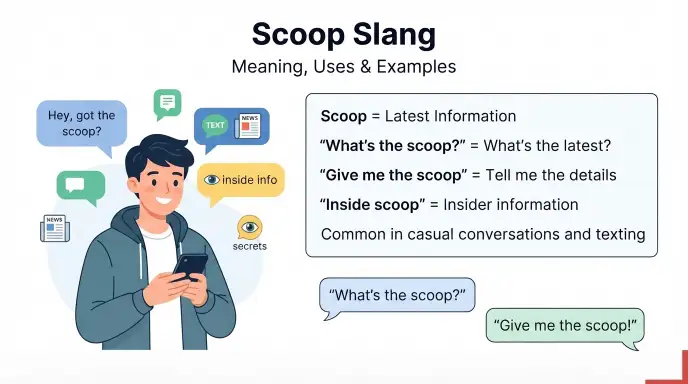
In informal conversations, “scoop” can refer to the latest information, interesting details, inside news, or an update about a situation. When someone asks, “What’s the scoop?” they are usually asking, “What’s going on?” or “What’s the latest?”
The expression is common in everyday speech and can also appear in texting, social media, entertainment discussions, and online conversations. Depending on the context, it may refer to ordinary information, exciting news, or even gossip.
Understanding the context is important because “scoop” has several meanings in English. It can describe a physical tool, a serving of something, a journalistic exclusive, or informal information.
In this guide, you’ll learn the scoop slang meaning, where the expression comes from, how people use it, common examples, and how to recognize its meaning in texts and online conversations.
Quick Answer Scoop Slang :
Definition: In slang and informal English, “scoop” means the latest information, inside details, news, or interesting facts about a person, event, or situation.
For example:
“What’s the scoop?”
Usually means:
“What’s going on?” or “What’s the latest?”
Another common expression is:
“Give me the scoop.”
This means:
“Tell me what you know” or “Give me the details.”
The meaning can change slightly depending on the situation.
| Expression | Meaning |
| What’s the scoop? | What’s happening? |
| Give me the scoop | Tell me the details |
| I’ve got the scoop | I have useful or inside information |
| Get the scoop | Find out the latest information |
| The scoop on something | Information or details about something |
So, when someone uses scoop slang, they are usually talking about information rather than a physical scoop.
What Does Scoop Mean in Slang?
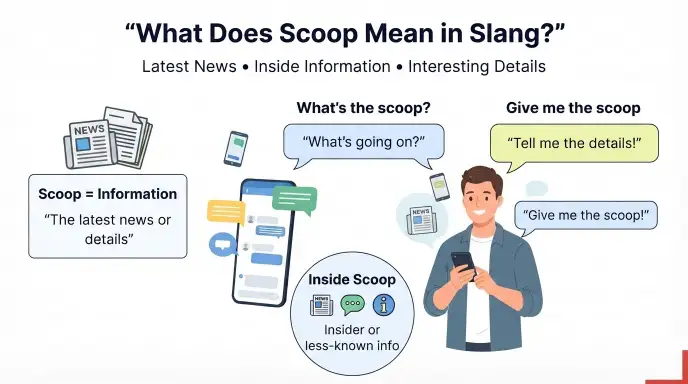
In casual English, scoop usually means information or details that someone wants to know.
The word can be used in several ways.
1. The latest information
Someone may use “scoop” when asking for an update.
“What’s the scoop on the new project?”
This means:
“What’s the latest information about the new project?”
It doesn’t necessarily imply gossip or secret information. The speaker may simply want an update.
2. Inside information
“Scoop” can also suggest information that other people may not know yet.
“I heard you know what happened. Give me the scoop.”
The speaker wants the details that the other person knows.
3. News
The word is also strongly connected with journalism.
“The reporter got the scoop.”
This means the reporter obtained important information or a story before competitors.
4. Interesting details or gossip
In some casual conversations, “scoop” can refer to interesting information about other people.
“Okay, what’s the scoop between those two?”
Depending on context, this could mean:
“What’s going on between them?”
It may involve gossip, but scoop does not automatically mean gossip.
Why Do People Say “What’s the Scoop?”
“What’s the scoop?” is an informal way to ask for an update or the latest information.
It can be similar to:
- What’s going on?
- What’s happening?
- What’s the latest?
- What did you find out?
- What are the details?
- What’s new?
For example:
“I haven’t talked to you all week. What’s the scoop?”
Here, the person simply wants to hear what has been happening.
Another example:
“So, what’s the scoop on your new job?”
This asks the person to explain what is happening with their new job.
The phrase sounds friendly and conversational, which is why it is more common in casual communication than formal writing.
Give Me the Scoop : Meaning
“Give me the scoop” means “tell me the details” or “tell me the latest information.”
For example:
“You were at the meeting yesterday. Give me the scoop.”
The speaker wants to know what happened at the meeting.
The phrase can also be playful between friends:
“You went on a date last night? Give me the scoop!”
Here, the person is asking for the interesting details of the date.
It doesn’t necessarily mean that the information is secret. It simply shows curiosity and a desire to hear the story.
The Origin of Scoop Slang
The word “scoop” has been part of English for a long time and originally had literal meanings connected with picking up or measuring something.
For example:
“He used a scoop to measure the flour.”
A scoop can also mean a serving of something:
“I’d like one scoop of ice cream.”
The informationifrelated meaning developed separately and became especially associated with journalism.
In journalism, a scoop is an important story or piece of information that a journalist reports before competing news organizations.
For example:
“The newspaper broke the story and got a major scoop.”
The idea of getting information before everyone else helped give “scoop” its broader informal meaning.
Eventually, people began using the word outside journalism. Friends could ask:
“What’s the scoop?”
They were no longer talking about a newspaper story. They simply wanted to know what was happening.
This everyday use helped make “scoop” a familiar informal expression for news, information, and interesting details.
Scoop Slang in Texting
You may see “scoop” in texts when someone wants an update without asking a long question.
For example:
“What’s the scoop?”
“Any scoop?”
“Give me the scoop 👀”
“Got the scoop on this?”
All of these are asking for information.
The exact meaning depends on the conversation.
If friends are discussing a party, “scoop” might mean the party details.
If they are discussing a relationship, it might mean personal or interesting informati
Texting example
Alex: “I just heard something about the concert.”
Jamie: “Wait, what’s the scoop?”
Jamie is asking Alex to explain what they heard.
Scoop Slang on Social Media
The expression can also appear in casual online conversations.
People may use it when discussing:
- entertainment
- celebrities
- viral stories
- relationships
- events
- rumors
- new releases
- online drama
For example:
“Does anyone have the scoop on what happened?”
This means:
“Does anyone know what happened?”
On platforms such as TikTok, Instagram, Reddit, Snapchat, Discord, and group chats, people often use short informal expressions like this because they make conversations feel relaxed and conversational.
However, the meaning should always be judged from context. Someone asking for “the scoop” about a restaurant is probably asking for information or a review, while someone asking for “the scoop” about two people may be asking about their relationship or personal situation.
Scoop vs. Gossip
One of the most common misunderstandings is assuming that scoop always means gossip.
That’s not correct.
Scoop is a broader word.
For example:
“What’s the scoop on the new restaurant?”
This simply means:
“What information do you have about the restaurant?”
There is no gossip involved.
But consider:
“What’s the scoop on those two?”
This could mean the speaker wants personal information or gossip about two people.
So, the context determines if “scoop” means general information, news, inside information, or gossip.
A simple way to remember it is:
Scoop = information or details.
Gossip = informal talk about other people’s personal lives.
Sometimes they overlap, but they are not exactly the same.
Scoop in Journalism
The journalistic meaning of “scoop” is important because it influenced the informal expression used today.
A news scoop is information or a story that a journalist or news organization obtains and reports before competitors.
For example:
“The journalist got an exclusive scoop.”
This suggests that the journalist has information that others do not yet have.
The idea of being first is important in this meaning.
This also explains why someone might casually say:
“I’ve got the scoop.”
They may be suggesting:
“I know something interesting that you don’t know yet.”
The expression can be serious in journalism or playful in everyday conversation.
Is Scoop Actually Slang?
The word “scoop” itself is not exclusively slang.
It is a standard English word with several meanings.
For example:
“Use a scoop to measure the powder.”
Here, “scoop” has a literal meaning.
But:
“What’s the scoop?”
is an informal idiomatic expression meaning:
“What’s the latest information?”
So, it is more accurate to say that “scoop” has an informal slangiflike use in certain expressions, rather than saying every use of the word is slang.
This distinction matters because the same word can have completely different meanings depending on context.
Scoop Slang vs. Literal Scoop
| Context | Example | Meaning |
| Literal object | “Pass me the scoop.” | A tool used for picking something up |
| Food | “I want a scoop of ice cream.” | A serving |
| Journalism | “They got the scoop.” | Exclusive or early news |
| Informal conversation | “What’s the scoop?” | What’s happening? |
| Casual texting | “Give me the scoop.” | Tell me the details |
When you see the word “scoop,” look at the words around it. The context usually makes the intended meaning clear.
Common Scoop Slang Examples
Here are some natural examples of how people use “scoop” in everyday communication.
Example 1: Asking for an update
“What’s the scoop with your new apartment?”
Meaning: What’s the latest information about your new apartment?
Example 2: Asking about an event
“Give me the scoop on tonight’s party.”
Meaning: Tell me the details about tonight’s party.
Example 3: Asking about a situation
“Do you have the scoop on what happened?”
Meaning: Do you know what happened?
Example 4: Inside information
“I’ve got the scoop on the new project.”
Meaning: I have some useful or inside information about the project.
Example 5: Entertainment
“What’s the scoop on the new movie?”
Meaning: What are the latest details or news about the movie?
Example 6: Friendly curiosity
“You went out with them last night? Give me the scoop!”
Meaning: Tell me what happened and give me the interesting details.
Common Expressions With Scoop
Several expressions use “scoop” to communicate the idea of information.
| Expression | Simple meaning |
| What’s the scoop? | What’s going on? |
| Give me the scoop | Tell me the details |
| Get the scoop | Find out the latest information |
| I’ve got the scoop | I know something interesting |
| The scoop on X | Information about X |
| A news scoop | Important or exclusive news |
| Inside scoop | Information that is not widely known |
The phrase “inside scoop” is particularly useful when someone has information that ordinary people may not know.
For example:
“Can you give me the inside scoop?”
This means:
“Can you tell me the information that isn’t publicly known?”
When Should You Use Scoop Slang?
“Scoop” works best in casual and informal situations.
You can comfortably use it when talking to:
- friends
- family
- classmates
- online friends
- social media followers
- gaming communities
- coworkers in casual conversations
For example:
“Hey, what’s the scoop for this weekend?”
sounds natural and friendly.
However, it may not be the best choice for formal business communication.
Instead of:
“Please give me the scoop on the project.”
a professional message might say:
“Could you provide an update on the project?”
This sounds more formal and appropriate for workplace communication.
Key Takeaway
The easiest way to remember scoop slang is:
Scoop = the latest information or interesting details.
When someone says “What’s the scoop?”, they are usually asking what is happening.
When someone says “Give me the scoop,” they want you to explain the details.
The word can sometimes refer to gossip or inside information, but it does not always have that meaning. Context is the key.
It is also important to remember that “scoop” has literal meanings, such as a tool for picking something up or a serving of food. Its informal informationifrelated meaning grew strongly from its use in journalism, where a “scoop” refers to an important story obtained before competitors.
Because of this, the expression feels natural in casual conversations, texting, social media, entertainment discussions, and other informal settings.
If you want, I can continue with Part 2 covering the remaining if sections, including Google Trends & Usage, common mistakes, more examples, FAQs (Q1–Q7), conclusion, and a meta description.
Scoop Slang: Google Trends & Usage Data
Interest in slang terms can change over time as expressions appear in social media, entertainment, texting, and online communities. However, the word “scoop” is different from many newer slang terms because it has been used in English for a long time and has several meanings.
When people search for “scoop,” they may be looking for information about ice cream, a physical scoop, journalism, news, or the informal expression “What’s the scoop?” Because of these different meanings, search interest for the word alone does not necessarily represent interest in the slang meaning.
For language learners, the phrase surrounding the word is often more useful than the word itself. Expressions such as “What’s the scoop?”, “give me the scoop,” and “inside scoop” clearly point toward the informationifrelated meaning.
Online, people may use the expression when discussing entertainment, current events, social situations, relationships, or other topics where they want additional details.
The important takeaway is that scoop remains a recognizable informal expression for information and updates, even though its literal and journalistic meanings are also common.
How Scoop Is Used in Everyday Conversations
One reason “scoop” remains popular is that it makes a question sound more relaxed.
Compare these two questions:
“Can you tell me what happened?”
and:
“What’s the scoop?”
Both can ask for information, but the second sounds more casual and conversational.
Friends might use it when catching up:
“I haven’t seen you in days. What’s the scoop?”
A coworker might use it informally:
“What’s the scoop on tomorrow’s meeting?”
Someone interested in entertainment might ask:
“What’s the scoop on the new show?”
In each example, the basic idea is the same: the speaker wants information or an update.
“Inside Scoop” Meaning
Another common expression is “inside scoop.”
The inside scoop means information that is not widely known or information obtained from someone with direct knowledge of a situation.
For example:
“Can you give me the inside scoop on the new schedule?”
This means:
“Can you tell me what you know about the new schedule?”
The expression does not necessarily mean the information is confidential. Sometimes people use it casually simply to make the information sound interesting or exclusive.
For example:
“My friend works there, so I got the inside scoop.”
The speaker is saying that their friend gave them information that ordinary people may not know.
“Get the Scoop” Meaning
“Get the scoop” means to obtain or discover information.
This phrase is especially common in journalism but can also be used casually.
Journalism example
“The reporter worked all night to get the scoop.”
The reporter wanted to obtain an important story before other journalists.
Everyday example
“I’ll ask Sarah and get the scoop.”
Here, the speaker simply means:
“I’ll ask Sarah and find out what’s happening.”
The phrase can therefore be serious, professional, or casual depending on context.
“Scoop” as Exclusive Information
Sometimes a scoop is more than an ordinary update.
If someone says:
“I have the scoop.”
they may be suggesting that they know something before everyone else.
For example:
“I have the scoop if the concert is being moved to Friday.”
The speaker is presenting information as something new or previously unknown.
This is closely related to the journalistic meaning of “scoop,” where being the first to report important information is valuable.
In casual conversations, however, people may use the phrase playfully even when the information is not particularly important.
Is “What’s the Scoop?” Formal or Informal?
“What’s the scoop?” is informal.
It is appropriate for relaxed conversations but usually isn’t the best choice for formal documents.
Informal
“Hey, what’s the scoop on the event?”
More formal
“Could you provide an update on the event?”
Informal
“Give me the scoop when you hear back.”
More formal
“Please let me know when you receive an update.”
The informal version sounds warmer and more conversational, while the formal version is better suited to professional communication.
Common Mistakes When Understanding Scoop Slang
Mistake 1: Thinking scoop always means ice cream
The word has a literal foodifrelated meaning, but “What’s the scoop?” is normally asking for information.
Mistake 2: Assuming scoop always means gossip
Scoop can refer to gossip, but it can also mean ordinary information, news, details, or an update.
Mistake 3: Thinking scoop always means secret information
A scoop can be exclusive information, but casual speakers may use “scoop” simply to mean the latest details.
Mistake 4: Using “What’s the scoop?” in every situation
The expression is informal. A formal workplace email may require a more professional phrase such as “Could you provide an update?”
Mistake 5: Ignoring context
The word “scoop” has several meanings. Always look at the surrounding words before deciding what it means.
Scoop Slang in Different Contexts
The meaning can become clearer when you consider where the word appears.
In texting
“What’s the scoop?”
Usually means:
“What’s going on?”
In social media
“Anyone got the scoop?”
Usually means:
“Does anyone know the details?”
In entertainment
“What’s the scoop on the new season?”
Usually means:
“What’s the latest news or information about the new season?”
In journalism
“The reporter got a scoop.”
Usually means:
“The reporter obtained an important story before competitors.”
In everyday conversation
“Give me the scoop.”
Usually means:
“Tell me what happened.”
The same word works across all these situations because the central idea is information.
Similar Words and Phrases
If you want to understand “scoop” better, it helps to compare it with similar expressions.
| Phrase | Meaning | Tone |
| Scoop | Information or details | Casual |
| Inside scoop | Lessifknown or insider information | Casual |
| Update | New information | Neutral |
| News | Recent information | Neutral |
| Gossip | Talk about other people’s private lives | Informal |
| Details | Specific information | Neutral |
| Lowdown | Full information about something | Informal |
| Dirt | Potentially embarrassing information | Very informal |
| Intel | Information, often useful or strategic | Informal |
For example, “What’s the lowdown?” can be similar to “What’s the scoop?”, although the expressions have slightly different histories and tones.
Scoop vs. Lowdown
Both “scoop” and “lowdown” can mean information or details.
“Give me the scoop.”
and:
“Give me the lowdown.”
Both can mean:
“Tell me what’s happening and give me the details.”
“Scoop” may have a stronger association with news or inside information, while “lowdown” often emphasizes getting a complete explanation.
Both are informal expressions.
Scoop vs. Dirt
“Dirt” is much more specific and informal than “scoop.”
If someone says:
“Give me the scoop.”
they could want any kind of information.
But:
“Give me the dirt.”
often suggests they want embarrassing, scandalous, or secret information about someone.
Therefore:
Scoop = general information or interesting details.
Dirt = potentially damaging or embarrassing information.
Scoop Slang Examples in Text Messages
Here are some realistic textifstyle examples.
Friend 1: “Did you hear about the party?”
Friend 2: “No! What’s the scoop?”
Meaning: “What happened? Tell me the details.”
Friend 1: “I just talked to the organizer.”
Friend 2: “Give me the scoop!”
Meaning: “Tell me what you found out.”
Friend 1: “The event might be canceled.”
Friend 2: “Wait, do you have the inside scoop?”
Meaning: “Do you have information from someone who knows what’s really happening?”
Friend 1: “I know something about the new movie.”
Friend 2: “Okay, spill the scoop!”
Meaning: “Tell me the interesting information.”
These examples show why context matters. The expression can be curious, excited, playful, or simply conversational.
Can Scoop Mean “Secret”?
Sometimes, but not always.
If someone says:
“I have the scoop.”
they may know something that other people don’t know.
That makes the information exclusive, but it does not automatically make it secret.
For example:
“I got the scoop on the new restaurant opening next week.”
The information might simply not have been announced publicly yet.
So, scoop can suggest exclusive information without necessarily meaning confidential information.
Can Scoop Mean “News”?
Yes.
In journalism and everyday speech, scoop can refer to news or a new piece of information.
For example:
“That was a huge scoop.”
This could mean the person discovered or reported important news.
But “scoop” can also refer to smaller pieces of information:
“Give me the scoop on your weekend.”
Here, it means an update rather than formal news.
Can Scoop Mean Gossip?
Yes, in certain contexts.
For example:
“What’s the scoop on those two?”
This could mean:
“What’s going on between those two people?”
If the conversation is about a relationship or personal situation, the speaker may be asking for gossip.
However, this is contextifdependent.
A scoop about a sports game, restaurant, movie, or work project isn’t necessarily gossip.
How to Respond When Someone Says “What’s the Scoop?”
Your response depends on what they are asking about.
If they want a simple update, you could say:
“Not much. Everything’s going well.”
If they want details:
“I found out the meeting was moved to Friday.”
If they are asking about a social situation:
“They decided to go together after all.”
The phrase is basically an invitation to share information.
FAQs About Scoop Slang
Q1. What does “scoop” mean in slang?
In informal English, **“scoop” can mean the latest information, news, details, or inside information about something.
Q2. What does “What’s the scoop?” mean?
“What’s the scoop?” means “What’s going on?”, “What’s the latest?”, or “What are the details?”
Q3. What does “Give me the scoop” mean?
It means “Tell me what you know” or “Give me the details.” It is usually used in casual conversations.
Q4. Does scoop mean gossip?
It can mean gossip when the context involves someone’s personal life, relationships, or rumors. However, “scoop” can also mean ordinary information or news.
Q5. What does “inside scoop” mean?
“Inside scoop” means information that is not widely known, often obtained from someone who has direct knowledge of a situation.
Q6. Is “What’s the scoop?” formal?
No. “What’s the scoop?” is an informal expression and is best suited to casual conversations, texting, and relaxed online communication.
Q7. Can scoop mean news?
Yes. In journalism, a scoop is an important story or piece of information reported before competitors. In everyday speech, it can simply mean the latest news or information.
Final Takeaway: What Does Scoop Slang Really Mean?
The meaning of scoop slang is quite simple once you understand the context. In informal English, “scoop” usually refers to information, news, an update, or interesting details about a person, event, or situation.
The most common expression is “What’s the scoop?”, which means “What’s going on?” or “What’s the latest?” If someone says “Give me the scoop,” they are asking you to tell them what you know.
The word can sometimes suggest gossip or inside information, but those meanings depend on context. It does not automatically mean gossip or a secret.
“Scoop” also has literal meanings, such as a tool used for picking something up or a serving of food. In journalism, it has another important meaning: an exclusive or early news story. These different meanings explain why context is so important.
For casual texting, social media, conversations with friends, and informal discussions, expressions such as “What’s the scoop?” and “Give me the scoop” sound natural and friendly. For formal writing, however, words such as “update,” “information,” or “details” are usually more appropriate.
In short, when someone asks for the scoop, they usually want you to tell them what’s happening and give them the details.
Conclusion
Understanding scoop slang is easy once you know the context. In casual English, “scoop” usually means the latest information, news, update, or interesting details about something. Phrases like “What’s the scoop?” and “Give me the scoop” are commonly used when someone wants to know what is happening or hear more details.
The word can sometimes refer to gossip or inside information, but it does not always have that meaning. In journalism, a “scoop” can also mean an important story reported before competitors. Because “scoop” has both literal and informal meanings, the surrounding conversation helps determine what someone means.
if you see scoop slang in a text message, social media post, casual conversation, or online discussion, you can usually understand it as a friendly way of asking for information. Simply put, when someone asks for the scoop, they want to know what’s going on and what you know about i
Read More about!

I’m Dylan Foster, a slang and internet culture writer passionate about exploring how people communicate online and in everyday conversations. I write about texting abbreviations, social media expressions, and modern slang to help readers understand meanings, origins, and real-world usage in a simple way.