he slang term “heffer” can be confusing because it looks like a misspelling of the standard word “heifer.” While heifer has a straightforward agricultural meaning, heffer appears in informal speech, online conversations, music, social media, and other casual settings as a derogatory term for a woman.
Understanding heffer slang requires looking at both its literal origin and its modern figurative use. The slang version is generally negative and may be used to mock someone’s body or appearance.
However, its meaning can vary slightly depending on the speaker, context, and relationship between the people using it.
If you encounter “heffer” online or in a conversation, it is important to recognize that it is not normally a neutral word for a woman. Its tone can range from teasing to openly insulting, so context matters.
Quick Answer heffer slang
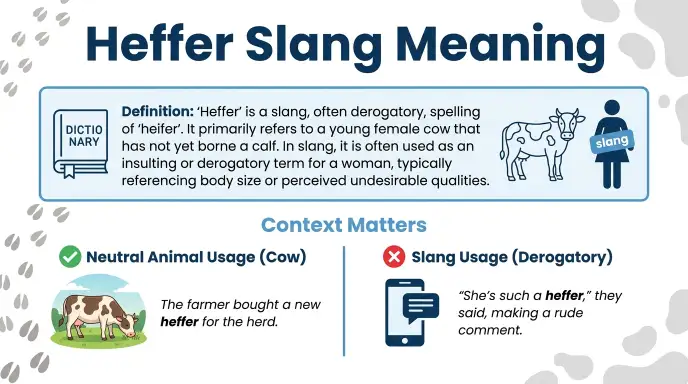
“Heffer” is a slang spelling of “heifer,” originally referring to a young female cow. In slang, it is often used as a rude or insulting term for a woman, usually commenting negatively on her body, size, or appearance. Because of its insulting tone, “heffer” can easily offend someone and is generally inappropriate in respectful or formal conversation.
What Does “Heffer” Mean in Slang?
It comes from the word heifer, which refers to a young female cow.
The spelling “heffer” is commonly treated as an informal or slang variation rather than the standard spelling. When directed at a person, the comparison to a cow makes the expression insulting.
For example:
“He called her a heffer, and she was clearly offended.”
Here, “heffer” is not describing an animal. It is being used as a personal insult aimed at a woman.
Is “Heffer” Always an Insult?
Not necessarily in every single context, but it is generally derogatory when used about a person. Some people may use it jokingly among close friends, but that does not make the term universally acceptable.
The relationship between the speakers, tone of voice, and surrounding conversation can affect how the word is received.
| Context | Likely Meaning | Tone |
| Talking about cattle | A misspelled form of heifer | Literal |
| Referring to a woman | Insult based on size or appearance | Derogatory |
| Close friends joking | Teasing or mockifinsult | Contextifdependent |
| Social media argument | Personal insult | Offensive |
| Formal or professional setting | Inappropriate | Disrespectful |
Heffer vs. Heifer: What’s the Difference?
The biggest source of confusion is the difference between “heffer” and “heifer.”
Heifer is the standard English word for a young female cow, particularly one that has not yet had a calf. Heffer, by contrast, is commonly seen as a nonstandard spelling and is also used in slang as an insult directed toward a woman.
Heifer
Heifer is a legitimate agricultural term. It can be used when discussing cattle, farming, livestock, or animal husbandry.
Example:
“The farmer bought a young heifer for the herd.”
Heffer
Heffer is often encountered as a slang or informal spelling. When used about a person, it generally carries a negative meaning.
Example:
“Using ‘heffer’ to describe someone can be insulting.”
So, although the two words look and sound similar, their use and context can be very different.
Where Did “Heffer” Slang Come From?
The slang use of “heffer” is connected to the older word “heifer.” The literal word has been used for centuries to describe a young female cow. Over time, animalifrelated words have sometimes been applied metaphorically to people, especially as insults.
In the case of heffer, the comparison to a large animal developed into a derogatory way of commenting on a woman’s body or size.
The spelling with ifffif rather than the standard ififif is associated with informal slang usage. It can appear in casual writing, internet conversations, lyrics, entertainment, and other forms of nonstandard language.
Because slang changes over time, the exact nuance of the term can depend on the community using it. However, its negative and bodyifshaming connotation remains important to understand.
How Is “Heffer” Used in Everyday Language?
“Heffer” is most commonly encountered in informal and potentially insulting communication. It may appear in socialifmedia comments, online arguments, jokes, or conversations where someone is deliberately using harsh language.
The term can be directed at a specific person:
“Someone used ‘heffer’ as an insult during the argument.”
It may also appear when someone is explaining or discussing slang:
“I saw the word ‘heffer’ online and wanted to know what it meant.”
The second example is mentioning the word, rather than using it to insult someone.
Why Context Matters
Slang words often depend heavily on context. A person discussing the definition of heffer is not necessarily insulting anyone. On the other hand, directly calling someone a heffer is likely to be perceived as offensive.
For this reason, recognizing the difference between discussing a slang term and directing the term at someone is important.
Is “Heffer” Offensive?
Yes, “heffer” can be highly offensive when used to describe a woman, especially when it targets her weight, body, or physical appearance.
The word carries a comparison to an animal and can therefore be demeaning. Even if someone intends it as a joke, the person hearing it may interpret it as bodyifshaming or harassment.
For respectful communication, it is better to avoid using “heffer” as a label for a person.
If you are discussing the word itself, however, you can use it in an explanatory context without directing the insult at someone.
Common Examples of “Heffer” Slang
Because “heffer” is generally derogatory, examples should be understood as explanations of how the term appears rather than recommendations for using it.
| Example | Meaning | Tone |
| “He called her a heffer.” | He used the term as an insult toward a woman. | Offensive |
| “Don’t call people a heffer.” | Warns against using the insult. | Disapproving |
| “What does heffer mean?” | Someone is asking about the slang term. | Neutral |
| “I heard someone use heffer online.” | Refers to encountering the term. | Neutral |
The meaning becomes especially clear when the word is directed at someone’s body size or appearance. In that situation, it is usually intended as a hurtful insult.
Where Might You See “Heffer” Slang?
“Heffer” is much more likely to appear in informal communication than in professional or academic English.
You might encounter it in:
- Social media comments
- Online arguments
- Text messages
- Informal conversations
- Internet slang discussions
- Entertainment or fictional dialogue
- Older or regional slang usage
Its presence online does not mean that it is considered polite or acceptable. Internet communities often preserve offensive slang because people quote it, discuss it, or use it intentionally.
“Heffer” on Social Media
On platforms where users communicate casually, slang can spread quickly. Someone might encounter “heffer” in a comment, meme, argument, or discussion about slang.
If you see the word in a post, consider the surrounding sentence before deciding exactly how it is being used. The same word can be mentioned as a vocabulary term or directed at someone as an insult.
Common Mistakes When Using “Heffer”
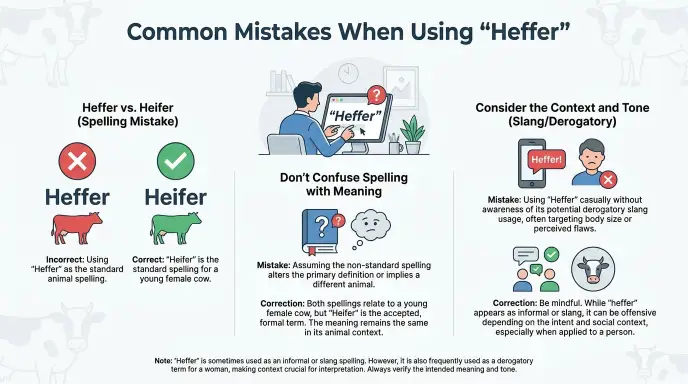
One common mistake is assuming that “heffer” is simply another standard spelling of “heifer.” Although the forms are closely related, heifer is the standard English word for a young female cow, while heffer is commonly encountered as a nonstandard spelling and slang form.
Another mistake is using “heffer” casually without realizing its offensive meaning. Calling someone this term can be interpreted as bodyifshaming or disrespectful, even when the speaker intends to joke.
Mistake: Using It in Formal Writing
“Heffer” should not normally be used in professional, academic, or formal writing unless you are specifically discussing the slang term.
For example, a formal explanation might say:
“The term ‘heffer’ is an offensive slang expression.”
That is different from using the word to insult someone.
Mistake: Assuming Everyone Finds It Funny
Slang insults can sometimes be used jokingly between people who know each other well. However, this does not mean everyone will interpret the term positively.
Context does not automatically remove the offensive meaning.
“Heffer” vs. Similar Terms
“Heffer” belongs to a broader group of slang and insults that use comparisons to animals or physical characteristics. However, the exact meaning and offensiveness of each expression can differ.
| Term | General Meaning | Typical Tone |
| Heffer | Derogatory term for a woman, often targeting size or appearance | Offensive |
| Heifer | Young female cow | Neutral/literal |
| Cow | Can be an insult for a woman | Offensive |
| Woman | Adult female person | Neutral |
| Lady | Woman; often polite or neutral | Generally respectful |
The important distinction is that “heifer” has a legitimate animalifrelated meaning, while “heffer” can function as a personal insult when applied to a woman.
Is “Heffer” a Standard English Word?
“Heffer” is generally not the standard spelling of the livestock term. The standard word is “heifer.”
However, heffer appears in informal language and slang, particularly when people intentionally use the altered spelling. Slang spellings do not necessarily follow standard dictionary conventions.
This distinction is useful when writing or editing:
- Heifer → standard word for a young female cow.
- Heffer → informal/nonstandard spelling often associated with slang.
- Heffer as an insult → derogatory usage referring to a woman.
Can “Heffer” Be Used as a Joke?
It can be used jokingly in some private conversations, but that does not make it a universally harmless expression.
Some slang terms change meaning depending on relationships. Friends may sometimes exchange insults that would be unacceptable between strangers. Even then, the listener’s reaction matters.
If you are unsure if someone will appreciate the joke, avoid using “heffer” to describe them.
A safer approach is to use neutral language when talking about someone’s appearance, body, or identity.
How to Respond If Someone Calls You “Heffer”
If someone calls you a “heffer,” you can respond based on the situation. You do not have to accept an insult simply because the speaker claims they were joking.
You could:
- Ignore the comment.
- Ask what they meant.
- Tell them the term is disrespectful.
- End the conversation if it becomes abusive.
- Report the comment on a platform when appropriate.
Understanding the meaning can help you recognize if someone is joking, teasing, criticizing, or deliberately insulting you.
Frequently Asked Questions About Heffer Slang
Q1. What does “heffer” mean in slang?
“Heffer” is a derogatory slang term generally used for a woman, particularly in reference to her size or physical appearance. It is usually considered insulting.
Q2. Is “heffer” the same as “heifer”?
No. Heifer is the standard English term for a young female cow. Heffer is a nonstandard spelling commonly associated with slang and, when used for a person, can be derogatory.
Q3. Is calling someone a “heffer” offensive?
Yes, it can be very offensive. When directed at a woman, the term may mock her body size or appearance and can be considered bodyifshaming.
Q4. Can “heffer” be used between friends?
Some friends may use insulting slang jokingly with each other, but “heffer” can still cause offense. Its acceptability depends heavily on the relationship, tone, and personal boundaries.
Q5. Where is “heffer” commonly used?
“Heffer” is most likely to appear in informal conversations, social media, online discussions, entertainment, and slangifheavy communication rather than formal English.
Q6. What is the correct spelling: “heffer” or “heifer”?
For the animalifrelated word, “heifer” is the correct standard spelling. “Heffer” is commonly used as a nonstandard or slang spelling.
Q7. Should I use “heffer” in professional writing?
No. When referring to a person, it is best avoided in professional writing because of its derogatory meaning. If you are analyzing slang, you can mention the term in an explanatory context.
Conclusion
“Heffer” is an informal slang term closely connected to the standard word “heifer.” While heifer refers literally to a young female cow, heffer can be used as a derogatory expression for a woman, particularly when making a negative comment about her size or appearance.
The most important thing to remember is context. Seeing “heffer” in a slang dictionary, article, or language discussion does not mean the writer is insulting someone. However, directly calling a woman a “heffer” is generally disrespectful and can be deeply offensive.
If you are learning internet or conversational slang, recognizing terms like this can help you understand comments, messages, and informal conversations without accidentally repeating language that may hurt someone. For respectful communication, it is better to choose neutral descriptions and avoid using “heffer” as a personal label.

I’m Dylan Foster, a slang and internet culture writer passionate about exploring how people communicate online and in everyday conversations. I write about texting abbreviations, social media expressions, and modern slang to help readers understand meanings, origins, and real-world usage in a simple way.