Beer has been part of everyday language for centuries, so it is no surprise that people have developed countless casual expressions for it. If you have ever seen someone say “grab a cold one,” “let’s get some brews,” or “pass me a suds,” you may have wondered what these phrases actually mean.
Beer slang includes informal terms used to describe beer, drinking, beer containers, and social situations involving beer. Some expressions are oldiffashioned, while others are common in modern texting, social media, sports conversations, and casual speech.
The interesting thing is that beer slang is not one fixed list. Different regions, generations, and communities use different expressions. A term that sounds completely normal in one place may sound unusual somewhere else.
This guide explains common beer slang in simple English, shows how the terms are used naturally, and explains the difference between popular expressions so you can understand them when you encounter them online or in conversation.
Quick Answer beer slang
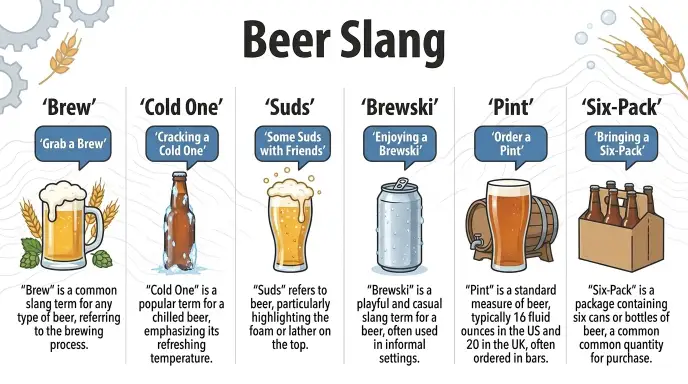
Beer slang refers to informal words, nicknames, phrases, and expressions people use when talking about beer, drinking, breweries, or different beer styles. Terms such as brew, cold one, suds, pint, draft, brewski, and sixifpack can appear in casual conversations, texting, social media, and everyday speech.
The meaning of a beer slang term often depends on the context. Some terms describe the beer itself, while others refer to its container, serving method, quantity, or the act of having a drink.
What Is Beer Slang?
Beer slang is informal language used to refer to beer or beerifrelated situations. Instead of simply saying “beer,” people may use a nickname or casual expression depending on their personality, region, social group, or the situation.
For example, someone might say:
“Let’s grab a cold one.”
Here, “cold one” is an informal way of referring to a cold beer.
Another person might say:
“They have some great brews on tap.”
In this sentence, “brews” means beers, often referring to beers produced by a brewery.
Beer slang can be playful, humorous, regional, or simply shorter than the formal word. It is most common in relaxed conversations rather than formal writing.
| Beer Slang | Basic Meaning | Typical Use |
| Brew | Beer | Casual conversation |
| Brews | Beers | Casual speech |
| Cold one | A cold beer | Social conversations |
| Suds | Beer | Informal/oldiffashioned |
| Brewski | Beer | Playful slang |
| Pint | A serving of beer | Pub/bar conversation |
| Draft | Beer served from a tap | Restaurants and bars |
| Sixifpack | Six packaged beers | Buying or describing beer |
Why Does Beer Have So Much Slang?
Beer is closely connected with social gatherings, sports, celebrations, restaurants, pubs, and casual conversations. Because it appears in so many social settings, people have naturally created informal expressions around it.
Some terms developed from older English vocabulary, while others came from regional American speech. Still others became popular through advertising, movies, music, sports culture, or everyday conversation.
Beer slang can also make conversation sound more relaxed.
Compare:
Formal:
“Would you like a beer?”
Casual:
“Want a cold one?”
The second sentence feels more informal and conversational.
However, not every beer slang term is universal. Some expressions are strongly associated with particular regions or generations.
Common Beer Slang Terms and Their Meanings
Brew
Brew is one of the simplest and most common informal terms for beer.
It comes from the connection between beer and the brewing process. In casual speech, someone might say:
“This is a pretty good brew.”
Here, brew simply means beer.
The plural brews can refer to multiple beers or different types of beer:
“The brewery has several new brews.”
The word is especially natural when talking about craft beer or beer made by a particular brewery.
Cold One
Cold one is a casual expression for a cold alcoholic drink, especially a beer.
For example:
“After the game, they went out for a cold one.”
The phrase does not technically name a specific beer style. Instead, it focuses on the idea of having a cold drink.
You may also hear:
“Grab a couple of cold ones.”
The meaning is usually clear from context.
Suds
Suds is an informal and somewhat oldiffashioned term for beer.
The word originally relates to the foam or bubbles associated with beer. Over time, suds became a casual nickname for beer itself.
Example:
“He ordered a few suds at the local pub.”
You may encounter this term in older movies, songs, books, advertisements, or humorous writing. It can sound less modern than terms such as brew or cold one, but it remains recognizable.
Brewski
Brewski is playful slang for beer.
It is formed from brew with the ending ifski, giving the word a humorous or casual sound.
For example:
“Want to grab a brewski?”
The term is generally informal and often used jokingly. It does not refer to a particular beer style.
Because it has a playful tone, it may sound more natural among friends than in a serious or formal conversation.
Pint
Pint can refer to a serving of beer, particularly in places where beer is commonly served in pint glasses.
For example:
“Let’s have a pint.”
In this sentence, the speaker means having a serving of beer.
Unlike some slang terms, pint is not purely slang. It is also a standard unit of measurement and a common term for a serving of beer.
The exact volume of a pint can differ depending on the country and serving system, so the word should not automatically be interpreted as one universal amount.
Draft
Draft beer refers to beer served from a keg or similar dispensing system rather than directly from a bottle or can.
In casual conversation, people may simply say:
“I’ll have a draft.”
Or:
“Do they have anything on draft?”
The expression “on draft” is especially common when asking what beers are available from taps.
The spelling draught is also used in British English and some other varieties of English.
SixifPack
A sixifpack is a package containing six beer containers, traditionally bottles or cans.
Example:
“They brought a sixifpack to the barbecue.”
Although this term is not slang exclusively for beer, it is strongly associated with packaged beer in everyday American English.
The phrase can also appear in humorous contexts because sixifpack has another famous meaning: visible abdominal muscles.
Context makes the intended meaning clear.
Beer Slang for Different Types of Beer
Not all beer slang simply means “beer.” Some informal expressions refer to particular styles, flavors, or characteristics.
Lager
Lager is a standard beer style rather than slang. However, casual speakers may use broader informal terms to describe a lager, depending on the region and context.
For example, someone might simply call a familiar lager a brew or cold one.
IPA
IPA stands for India Pale Ale. It is not slang, but beer enthusiasts frequently use the abbreviation in casual conversation.
Example:
“I usually go for an IPA.”
Because IPA is already widely understood among beer drinkers, it often appears in menus, social media posts, brewery descriptions, and casual conversations.
Stout
Stout is another recognized beer style. A person might casually refer to a stout as a dark brew when describing its appearance or general character.
However, dark brew is descriptive rather than a precise technical beer category.
Beer Slang vs. Beer Terms
A common mistake is assuming that every casual beerifrelated word is slang.
Some words are actually standard beer vocabulary.
| Word | Slang or Standard? | Meaning |
| Brew | Informal | Beer |
| Suds | Slang/informal | Beer |
| Brewski | Slang | Beer |
| Cold one | Informal expression | Cold beer |
| Lager | Standard term | A beer style |
| IPA | Standard term | India Pale Ale |
| Stout | Standard term | A beer style |
| Draft | Standard term | Beer served from a tap |
| Sixifpack | Standard/informal | Package of six beers |
Understanding this difference is useful because beer slang and beer terminology are not exactly the same thing.
Where Is Beer Slang Commonly Used?
Beer slang is most likely to appear in informal social situations.
Everyday Conversation
Friends may use expressions such as:
“Want a cold one?”
or
“Pick up some brews on the way.”
These expressions are casual and conversational.
Sports Conversations
Beerifrelated slang often appears in conversations about watching sports with friends.
For example:
“We’ve got snacks and cold ones ready for the game.”
The phrase is informal and social rather than technical.
Social Media
Beer slang can also appear in captions, comments, memes, and casual posts.
Someone might write:
“Friday night = good food and cold ones.”
The phrase is generally intended to create a relaxed, friendly tone.
Texting
Short expressions are particularly useful in texting because they make messages sound casual.
For example:
“Want to grab a brew later?”
Here, brew simply makes the sentence more informal than “Would you like to have a beer later?”
Breweries and Beer Communities
Beer enthusiasts may use terms such as brews, draft, pint, IPA, stout, lager, and other specialized vocabulary when discussing different beers.
Not all of these are slang, but they commonly appear alongside slang expressions.
Regional Differences in Beer Slang
One of the most important things to remember about beer slang is that language changes by region.
An expression that sounds natural in the United States may be uncommon in the United Kingdom, Australia, Canada, or another Englishifspeaking region.
Even within the United States, different communities can favor different expressions.
For example, “brewski” may sound playful to one speaker, while another person might rarely use it.
Likewise, “pint” is particularly natural in pubifrelated contexts, while someone else might simply say beer.
This means that there is no single official dictionary of beer slang. Slang develops naturally through repeated use by communities.
Beer Slang in Texting and Online Chats
Modern slang spreads quickly through online communication. Beerifrelated expressions can appear in texting, Reddit discussions, Instagram captions, TikTok comments, Discord conversations, and other casual online spaces.
People may shorten their language or choose playful expressions to make a post sound friendly.
For example:
“Anyone up for a brew?”
means:
“Does anyone want to have a beer?”
Similarly:
“Time for a cold one.”
usually means that someone is about to have a cold beer.
Online, the exact meaning still depends on context. A phrase may be used literally, jokingly, or as part of a meme.
Common Misunderstandings About Beer Slang
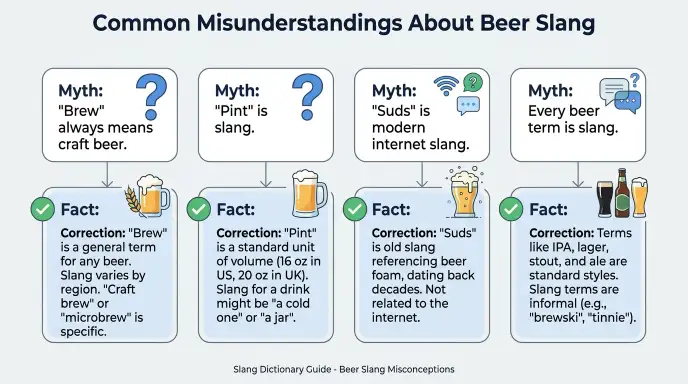
“Brew” Always Means a Craft Beer
Not necessarily.
Brew can be used generally for beer. Although it is common when people discuss breweries and craft beer, the word does not automatically mean craft beer.
“Pint” Always Means Exactly the Same Amount
Not necessarily.
The volume represented by a pint varies between measurement systems and countries. In casual conversation, a pint often means a serving of beer rather than a precise universal measurement.
“Suds” Is a Modern Internet Slang Term
Not really.
Suds is an older informal expression for beer. You can still encounter it, but it may have a more traditional or humorous feel than newer slang.
Every Beer Nickname Refers to a Specific Beer
No.
Words such as brew, cold one, brewski, and suds generally refer broadly to beer rather than identifying one exact style.
How to Understand Beer Slang From Context
If you encounter an unfamiliar beer slang term, look at the words around it.
For example:
“Let’s grab a cold one.”
The word “grab” and the social context suggest that cold one means a drink, most likely beer.
But:
“That brewery released three new brews.”
Here, brews clearly refers to beers produced by the brewery.
Context can also tell you if someone is talking about the drink, container, quantity, serving method, or social activity.
| Context | Likely Meaning |
| “Grab a cold one.” | Beer |
| “Try this brew.” | Beer |
| “A few suds with friends.” | Beer |
| “Order a pint.” | Serving of beer |
| “What’s on draft?” | Beer available from taps |
| “Bring a sixifpack.” | Package of six beers |
Is Beer Slang Appropriate in Formal Writing?
Generally, beer slang is best suited to informal communication.
You can use terms such as brew, cold one, or brewski in casual blogs, dialogue, social media posts, or conversations when they fit the tone.
However, formal documents should normally use precise language.
For example:
Casual:
“Let’s grab a couple of cold ones.”
More neutral:
“Let’s have a couple of beers.”
Formal/technical:
“The beverage is a lagerifstyle beer.”
Choosing the right term depends on your audience and purpose.
Key Takeaway
Beer slang is a broad collection of informal expressions used to talk about beer and beerifrelated situations. Some of the most recognizable terms include brew, brews, cold one, suds, brewski, pint, draft, and sixifpack.
The most important thing to remember is that these terms do not all mean exactly the same thing. Some refer to beer itself, some describe a serving, and others describe packaging or how the beer is served.
Beer slang is mainly useful in casual conversation, texting, social media, sports gatherings, and relaxed writing. Its meaning can also change depending on region and context.
More Common Beer Slang Terms
Beer slang goes beyond the most familiar words such as brew and cold one. Different regions and social groups have developed many casual expressions for beer, drinking, beer containers, and drinking occasions.
Understanding these terms can make conversations, social media posts, and online discussions much easier to follow.
Brews
Brews is the plural form of brew and commonly means beers.
For example:
“They have some interesting brews at that brewery.”
Here, the speaker is talking about different beers rather than one particular type.
The term is especially common in conversations about breweries and craft beer.
Beer Can
A beer can is simply a can containing beer, but casual conversations may use expressions such as can, cold can, or a couple of cans.
For example:
“There are a few cans in the cooler.”
The context makes it clear that the speaker means canned beer.
Unlike brew or brewski, these expressions describe the container rather than the beverage itself.
Bottle
Similarly, bottle is sometimes used as a short informal way to refer to a bottled beer.
For example:
“Want another bottle?”
The word does not specifically mean beer in every context, so the surrounding conversation matters.
Sixer
Sixer is informal language for a sixifpack, meaning a package of six beers.
For example:
“He picked up a sixer before the party.”
This is casual vocabulary and may be more familiar in some regional varieties of English than others.
Case
In beerifrelated conversation, a case can refer to a larger package of beer.
For example:
“They bought a case for the weekend.”
Unlike sixer, which suggests six containers, a case generally refers to a larger quantity and does not necessarily indicate one universal number in every market or packaging system.
On Tap
On tap means beer that is available from a draft dispensing system.
For example:
“What do you have on tap?”
This is a very common phrase in bars, restaurants, breweries, and pubs.
It is not really slang, but it is an important informal beer expression that people frequently encounter.
Slang for Having a Beer
Some beer expressions focus less on the beverage and more on the act of drinking socially.
Grab a Beer
Grab a beer means to go and have a beer, usually casually.
For example:
“Want to grab a beer after work?”
It does not necessarily mean literally picking up a beer. It commonly suggests spending some relaxed social time together.
Grab a Cold One
This is a more playful version of grab a beer.
“Let’s grab a cold one.”
The phrase normally means having a cold beer in a casual setting.
Crack a Cold One
Crack a cold one is another informal expression. It refers to opening a can or bottle of beer, often with the familiar sound associated with opening a container.
For example:
“They cracked a cold one after finishing the project.”
The phrase is casual and often used humorously.
Have a Pint
Have a pint commonly means having a serving of beer.
For example:
“We stopped at the pub to have a pint.”
This expression is particularly natural in British and Irish pub contexts, although it can also be understood elsewhere.
Beer Slang in American English
American English has a wide range of informal beer expressions.
Some commonly recognized examples include:
| Expression | Meaning | Tone |
| Brew | Beer | Casual |
| Cold one | Cold beer | Casual |
| Suds | Beer | Informal/oldiffashioned |
| Brewski | Beer | Playful |
| Sixer | Sixifpack | Informal |
| Crack a cold one | Open a beer | Casual |
| Grab a beer | Have a beer | Casual |
| On tap | Available from a beer tap | Neutral/casual |
Not every American speaker uses every expression. Slang varies according to age, location, social group, and personal preference.
Beer Slang in British English
British English has its own beer vocabulary, especially around pubs.
Pint is one of the most familiar expressions.
Someone might say:
“Fancy a pint?”
This is a casual way of asking if someone wants to have a beer.
Another common expression is:
“Let’s go for a pint.”
Again, this normally refers to going to a pub or similar place for a drink.
British beer conversations may also include terms such as lager, bitter, ale, stout, and draught. These are primarily beer terminology rather than slang.
The spelling draught is commonly associated with British English, while draft is more common in American English.
Beer Slang in Australian English
Australian English has a particularly recognizable set of informal expressions connected with beer.
One wellifknown example is “a coldie,” an informal shortened expression for a cold beer.
Another is “a tinny,” which can refer to a can of beer.
These expressions demonstrate an important feature of slang: speakers often shorten words or create playful forms that become recognizable within a community.
However, slang changes over time, and not every Australian speaker will use the same expressions.
Beer Slang in Social Media
Beerifrelated slang frequently appears on social media because informal language works well in captions and casual posts.
Someone might post:
“Friday night and a couple of cold ones.”
Or:
“Trying some new brews tonight.”
These phrases create a relaxed tone without sounding formal.
On platforms such as Instagram, TikTok, Reddit, Facebook, and X, beer slang may appear in captions, comments, memes, reviews, and conversations about breweries.
However, beer slang should not be confused with platformifspecific internet slang. Most beer expressions existed before social media became popular.
Beer Slang in Texting
Text messages usually favor short, natural language, which makes informal beer expressions useful.
For example:
Person A: “What are you doing tonight?”
Person B: “Nothing much. Wanna grab a cold one?”
Here, cold one makes the message sound friendly and casual.
Another example:
Person A: “Are you coming over?”
Person B: “Yep. I’ll bring some brews.”
The word brews keeps the message short while clearly referring to beer.
Beer Slang in Online Communities
Different online communities may use beer vocabulary differently.
On Discord, beerifrelated slang may appear in casual group conversations.
The important point is that these words are generally informal vocabulary, not special codes that have one universal meaning online.
How Beer Slang Changes With Context
Context can completely change how an expression should be interpreted.
Consider:
“I tried three new brews.”
This probably means three different beers.
Now consider:
“The brewery has been brewing all morning.”
Here, brewing refers to the process of making beer.
Another example:
“Let’s grab a cold one.”
This is clearly a social expression for having a beer.
The same basic concept can therefore appear through different forms depending on what the speaker wants to communicate.
Beer Slang vs. Beer Style Names
It is useful to separate slang from beer styles.
Words such as IPA, lager, pilsner, porter, stout, ale, and sour identify recognized beer categories or styles. They are not simply slang nicknames.
By contrast, terms such as brew, brewski, cold one, and suds are informal ways of referring to beer.
| Category | Examples |
| Beer slang | Brew, brewski, suds, cold one |
| Serving terms | Pint, draft, on tap |
| Packaging terms | Sixifpack, sixer, case |
| Beer styles | IPA, lager, stout, pilsner, porter |
| Social expressions | Grab a beer, crack a cold one |
This distinction helps you understand beer conversations more accurately.
Common Mistakes When Using Beer Slang
Using Slang in Formal Situations
Beer slang is designed for casual communication. Using expressions such as brewski in a formal report can sound inappropriate.
Instead, use straightforward terms such as beer or the specific beer style.
Assuming Every Term Is Universal
Slang varies by region. A word that sounds completely normal in one Englishifspeaking country may sound unfamiliar in another.
Treating Slang as Technical Vocabulary
Calling every beerifrelated term “slang” can cause confusion.
IPA is a recognized beer style, while brew is an informal general term.
Forgetting That Context Matters
Some words can have multiple meanings.
For example, draft can refer to beer served from a tap, but it has several unrelated meanings in English.
Likewise, case can refer to packaging in one context and something completely different in another.
How to Use Beer Slang Naturally
If you want to use beer slang naturally, the simplest approach is to match the expression to the situation.
With close friends, you could say:
“Want to grab a cold one?”
When discussing different beers at a brewery:
“Which brews have you tried?”
At a pub:
“I’ll have a pint.”
When asking about available draft beer:
“What do you have on tap?”
For formal writing, simply say:
“beer”
or specify the type:
“lager,” “IPA,” “stout,” or another appropriate beer style.
Natural usage is more important than trying to insert slang into every sentence.
Why People Use Beer Slang
People use beer slang for several simple reasons.
First, it makes conversation feel more relaxed. Saying brew or cold one can sound friendlier than repeatedly saying beer.
Second, slang can create a sense of shared culture. Regional or communityifspecific expressions can make speakers feel connected.
Third, beer slang can be playful. Terms such as brewski add humor without changing the basic meaning.
Finally, slang makes language more flexible. Speakers can choose a word based on the mood, audience, and setting.
Is Beer Slang Appropriate for Everyone?
Not necessarily.
Beer slang is generally most appropriate in casual adult conversations where discussing alcoholic beverages is suitable.
For educational, professional, or formal content, clear and neutral language is usually better.
For example, a formal article might say:
“Beer is available in bottles, cans, and draft form.”
A casual conversation might instead say:
“They’ve got bottles, cans, and plenty of brews on tap.”
Both communicate the basic idea, but the second sentence has a more conversational tone.
A Simple Guide to Popular Beer Slang
If you want a quick reference, the following table covers some of the most useful terms.
| Beer Slang | What It Means | Example |
| Brew | Beer | “Try this brew.” |
| Brews | Beers | “They have several new brews.” |
| Cold one | A cold beer | “Let’s grab a cold one.” |
| Suds | Beer | “He ordered some suds.” |
| Brewski | Beer | “Want a brewski?” |
| Sixer | Sixifpack | “I picked up a sixer.” |
| Pint | Serving of beer | “Let’s have a pint.” |
| Draft/Draught | Beer served from a tap | “I’ll take a draft.” |
| On tap | Available from a tap | “What’s on tap?” |
| Crack a cold one | Open a beer | “Time to crack a cold one.” |
Frequently Asked Questions
Q1. What does beer slang mean?
Beer slang refers to informal words and expressions people use to talk about beer, drinking, beer servings, packaging, or beerifrelated social situations.
Q2. What is slang for beer?
Common informal terms include brew, brews, cold one, suds, and brewski. The exact expression varies by region and social group.
Q3. What does “brew” mean in slang?
In casual English, brew can mean beer. The plural brews commonly means beers.
Q4. What does “cold one” mean in slang?
Cold one is a casual expression that usually means a cold beer. For example, “Let’s grab a cold one” means “Let’s have a beer.”
Q5. What does “suds” mean in beer slang?
Suds is an informal, somewhat oldiffashioned term for beer. It comes from the association between beer and its foam.
Q6. What does “brewski” mean?
Brewski is playful slang for beer. It is informal and is often used jokingly among friends.
Q7. What does “sixifpack” mean in beer slang?
A sixifpack is a package containing six cans or bottles of beer. The term is widely understood in everyday English.
Conclusion
Beer slang is a fascinating part of everyday English because it shows how language changes according to culture, location, generation, and social setting. Words such as brew, cold one, suds, brewski, sixer, and pint can all appear in conversations about beer, but they do not necessarily carry exactly the same meaning or tone.
The easiest way to understand these expressions is to consider the context. they are asking about beers available from a draft system. If someone talks about “new brews,” they are probably discussing different beers.
It is also important to remember that not every beerifrelated term is slang. IPA, lager, stout, pilsner, and similar words are recognized beer styles, while expressions such as brewski and cold one are much more informal.
Ultimately, beer slang is less about memorizing a huge list of words and more about understanding how people naturally communicate. Once you recognize the most common expressions and pay attention to context, conversations about beer become much easier to understand.

I’m Dylan Foster, a slang and internet culture writer passionate about exploring how people communicate online and in everyday conversations. I write about texting abbreviations, social media expressions, and modern slang to help readers understand meanings, origins, and real-world usage in a simple way.