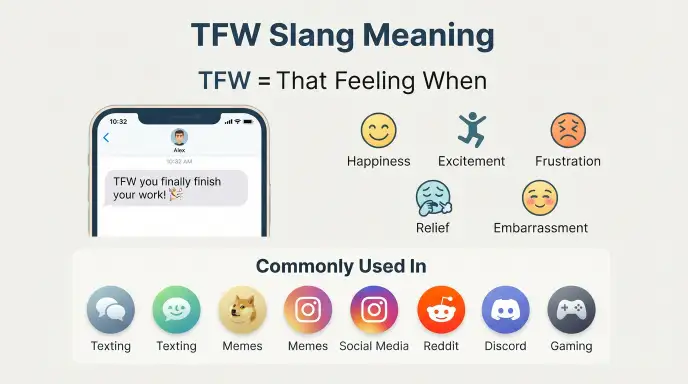
TFW slang is a popular internet abbreviation used to describe a feeling or reaction connected to a specific situation. You may have seen phrases like “TFW you finally finish your homework” or “TFW nobody replies to your message” and wondered what those three letters mean.
TFW is especially common in memes, social media posts, comments, forums, group chats, and casual texting. It can describe almost any emotion, including happiness, excitement, embarrassment, frustration, relief, or disappointment. The meaning is simple, but the tone depends on the situation.
If you are searching for, you are probably trying to understand something you saw online. Once you know the basic meaning, the abbreviation becomes easy to recognize.
Quick AnswerTFW Slang Meaning
TFW usually means “that feeling when.” It is used to introduce a situation that creates a particular feeling or reaction, often in a funny or relatable way.
What Does TFW Mean in Text?
In texting and online communication, TFW means “that feeling when.” People use it before describing a situation that causes a recognizable emotion.
For example:
“TFW you wake up five minutes before your alarm.”
This describes the feeling of waking up naturally shortly before the alarm. Depending on the person, that feeling might be relief, satisfaction, or surprise.
Another example is:
“TFW you finally get paid.”
Here, TFW introduces the feeling of happiness or relief that comes with receiving a paycheck.
The abbreviation can describe both positive and negative experiences. It does not have one fixed emotional meaning.
TFW Can Describe Many Feelings
You might see TFW used for:
- Happiness: “TFW your favorite food arrives.”
- Excitement: “TFW your favorite game gets an update.”
- Relief: “TFW you find your lost phone.”
- Embarrassment: “TFW you wave back at someone who wasn’t waving at you.”
- Frustration: “TFW the WiifFi stops working during a meeting.”
- Disappointment: “TFW your plans get canceled.”
- Humor: “TFW you open the fridge for the fifth time.”
The important point is that TFW itself does not tell you if the emotion is positive or negative. The situation after it provides that information.
TFW Full Form and Definition
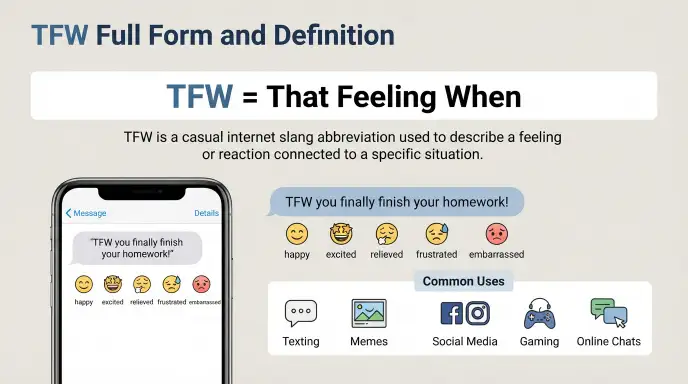
The most common TFW full form is:
TFW = That Feeling When
It is an abbreviated version of the phrase “that feeling when something happens.”
The expression is usually used as a setup for a relatable observation. Instead of writing a longer sentence, internet users can put TFW at the beginning and let the reader understand the emotional context.
For example:
“TFW you finish your work early.”
This can mean:
“That feeling when you finish your work early.”
The shorter version sounds more casual and internetiffriendly.
TFW is therefore best understood as an internet abbreviation rather than traditional formal English.
What Does TFW Stand For?
If you are asking “what does TFW stand for?”, the most widely recognized answer is “that feeling when.”
This meaning is especially common in online communities and meme culture.
However, abbreviations can occasionally have different meanings in specialized communities. That is why context is important when interpreting slang. If TFW appears in a normal socialifmedia post, meme, text message, or casual conversation, “that feeling when” is generally the intended meaning.
For example:
“TFW your weekend starts on Friday.”
The writer is referring to the feeling of knowing that the weekend has begun.
Is TFW Rude, Offensive, or Neutral?
TFW is generally neutral and not offensive.
The abbreviation itself does not contain an insult or inappropriate meaning. It simply introduces a situation and the feeling associated with it.
Its tone can change depending on what comes after it.
Positive Tone
“TFW your friend brings you your favorite snack.”
This sounds happy and appreciative.
Funny Tone
“TFW you check the fridge again even though you know there is nothing new.”
This uses TFW to create a relatable joke.
Negative Tone
“TFW you study for the wrong chapter.”
The situation creates frustration or disappointment.
Sarcastic Tone
“TFW you say you’ll sleep early and suddenly it’s 2 a.m.”
Here, TFW is used humorously to describe a familiar habit.
So, when someone asks if TFW slang is rude, the answer is generally no. The surrounding message determines the overall tone.
Where Is TFW Commonly Used?
TFW is mainly used in informal online communication. It became strongly connected with internet culture, especially memes and relatable posts.
You may encounter it on:
- TikTok
- Discord
- X
- Online forums
- Gaming communities
- Meme pages
- Group chats
- Text messages
- Comment sections
The abbreviation works particularly well online because it is short and immediately creates an emotional setup.
For example, a gamer might write:
“TFW you win with 1 HP left.”
A student might post:
“TFW the teacher cancels the test.”
Someone on social media might write:
“TFW your post finally gets likes.”
In each case, the reader is expected to recognize the emotion behind the situation.
TFW in Memes and Internet Culture
One of the most recognizable uses of TFW is in internet memes.
A typical meme format begins with TFW and then describes an oddly specific or relatable situation.
For example:
TFW you pretend you understand the instructions.
The humor comes from the reader recognizing the situation.
Another example:
TFW you check your phone and have zero notifications.
This can express disappointment, loneliness, or simply a humorous observation.
TFW became useful in meme culture because it is:
- Short
- Easy to understand
- Emotioniffocused
- Relatable
- Flexible
- Easy to combine with images or captions
The phrase allows users to communicate a complete emotional idea with only a few words.
Real: Life Examples of TFW
Understanding examples makes TFW meaning in text much easier.
Friendly Example
“TFW your best friend remembers your birthday.”
This expresses happiness and appreciation.
Casual Example
“TFW you find money in an old jacket.”
The situation suggests pleasant surprises.
Funny Example
“TFW you open the fridge for the sixth time hoping something new appears.”
The joke is based on a familiar everyday habit.
Frustrating Example
“TFW the internet disconnects right before you submit your assignment.”
This communicates frustration and disappointment.
Embarrassing Example
“TFW you say ‘you too’ when the waiter tells you to enjoy your meal.”
This describes an awkward social moment.
Gaming Example
“TFW you defeat the boss with one health point left.”
The phrase highlights the excitement and relief of the victory.
Social Media Example
“TFW your old post suddenly starts getting attention.”
This can express surprise or excitement.
TFW in Texting
In texting, TFW is usually casual, playful, and conversational.
Friends may use it to share relatable moments without writing a long explanation.
For example:
Friend 1: “I finally finished my assignment.”
Friend 2: “TFW you can finally relax
Or:
Friend 1: “I forgot my headphones today.”
Friend 2: “TFW you have to listen to everyone talking.”
In these conversations, TFW adds an informal internetifstyle tone.
It can also appear as a short standalone caption, particularly when paired with a picture, GIF, or emoji.
Why Do People Use TFW?
People use TFW because it makes communication shorter and more expressive.
Compare:
“That feeling when you finally finish everything you need to do.”
with:
“TFW you finally finished everything.”
The second version is more compact and sounds more like a meme or socialifmedia caption.
TFW also creates a sense of shared experience. When someone describes a familiar situation, readers may immediately think:
“Yes, I know exactly that feeling.”
That shared recognition is one of the main reasons internet slang becomes popular.
TFW is not simply about saving characters. It also gives a message a particular online, humorous, and relatable tone.
Key Takeaway
TFW = “that feeling when.”
It is a casual internet abbreviation used to describe the emotion or reaction connected to a particular situation. TFW can express happiness, frustration, embarrassment, excitement, relief, sarcasm, or humor.
The abbreviation is neutral and generally safe to use, but it is best suited to informal communication such as texting, memes, social media, gaming chats, and online communities.
In the next part, we can cover TFW’s origin, similar slang such as MFW, when to avoid using TFW, more examples, FAQs, and the final conclusion.
The Origin and Background of TFW
The exact origin of TFW slang is difficult to connect to one specific person or website. Like many internet abbreviations, it developed gradually through online communities and meme culture.
TFW is a shortened form of the phrase “that feeling when.” Internet users began using the abbreviation as a quick way to introduce a relatable situation and the emotion connected to it.
Its popularity grew alongside imageifbased memes and online communities where people shared short, humorous observations about everyday life.
A typical format looks like:
TFW + situation
For example:
“TFW you realize tomorrow is Saturday.”
The reader automatically understands that the writer is talking about the feeling of realizing they have a free day ahead.
Over time, TFW became recognizable across different parts of internet culture. Today, it can appear in memes, socialifmedia captions, gaming discussions, comments, forums, and casual conversations.
Because internet slang changes quickly, the exact history of an abbreviation can be difficult to document. However, its modern usage is clear: TFW is mainly used to describe a relatable feeling connected to a particular situation.
TFW vs. Similar Slang Terms
TFW is sometimes confused with other internet abbreviations, especially MFW and WTF. Although these abbreviations look similar, their meanings are different.
| Slang | Full Form | Main Meaning | Typical Use |
| TFW | That Feeling When | Describes a feeling connected to a situation | Memes, captions, texting |
| MFW | My Face When | Describes a person’s facial reaction | Reaction memes |
| WTF | What the F*** | Shows surprise, confusion, or disbelief | Casual conversations |
| LOL | Laughing Out Loud | Shows amusement | Texting and social media |
| FR | For Real | Shows agreement or emphasis | Casual texting |
| IRL | In Real Life | Refers to offline life | Online conversations |
TFW vs. MFW
TFW and MFW are the most closely related.
MFW focuses more on a reaction or facial expression:
“MFW the teacher says the test is tomorrow.”
They can both appear in memes, but TFW is about the emotional experience while MFW is about how someone reacts.
TFW vs. WTF
These two should not be confused.
TFW means:
“That feeling when”
WTF is a vulgar abbreviation meaning:
“What the f***”
WTF is generally used to express surprise, confusion, disbelief, or anger. TFW has no inherently offensive meaning.
When Should You Avoid Using TFW?
Although TFW is not rude or offensive, it is still informal internet slang. It is therefore not appropriate for every type of communication.
You should generally avoid TFW in:
- Academic essays
- Formal reports
- Business proposals
- Professional emails
- Job applications
- Official documents
- Formal presentations
- Serious workplace communication
For example, this sentence may work perfectly in a group chat:
“TFW the meeting gets canceled.”
But in a professional email, a clearer sentence would be:
“It is a relief when a scheduled meeting is canceled.”
The issue is not that TFW is bad. The issue is that the abbreviation signals a casual internet style.
Consider Your Audience
Before using TFW, ask yourself:
Will the person understand internet slang?
With close friends or online communities, the answer is usually yes.
With a professor, employer, customer, or unfamiliar professional audience, it may be better to use standard English.
Polite and Professional Alternatives to TFW
Since TFW is not offensive, you do not need to replace it for politeness. However, you may want an alternative when communicating in a formal setting.
Instead of:
“TFW you finally solve the problem.”
You could say:
- “That feeling when you finally solve the problem.”
- “It feels great to finally solve the problem.”
- “The relief of finally solving the problem.”
- “It is satisfying to finally solve the problem.”
- “I felt relieved after solving the problem.”
These alternatives express the same general idea while sounding more natural in formal or professional communication.
Why Context Matters With TFW
One of the most important things to understand about is that the abbreviation itself does not tell you the exact emotion.
Consider these examples:
“TFW you get a promotion.”
This probably expresses happiness or excitement.
Now compare:
“TFW you forgot your password again.”
This likely expresses frustration.
And:
“TFW you accidentally sent a private message to the wrong person.”
This may express embarrassment or panic.
The same three letters introduce all three situations.
That is why you should read the complete sentence or post rather than assuming TFW always represents a positive feeling.
TFW Examples by Tone
1. Friendly TFW Example
“TFW your friend remembers your favorite snack.”
Tone: Warm and positive.
The writer is highlighting the nice feeling of being remembered.
2. Casual TFW Example
“TFW you finally get home after a long day.”
Tone: Relaxed and relatable.
It describes the comfort of being home.
3. Funny TFW Example
“TFW you open the fridge three times and expect new food to appear.”
Tone: Humorous.
The situation is funny because many people can relate to it.
4. Argumentative TFW Example
“TFW someone argues with you without reading what you actually wrote.”
Tone: Frustrated or annoyed.
Here, TFW introduces an irritating situation.
5. Gaming Example
“TFW you win the match after your whole team thought you would lose.”
Tone: Excited and proud.
The phrase highlights the emotional payoff of the victory.
6. Social Media Example
“TFW your random post gets thousands of views.”
Tone: Surprised and excited.
It describes the unexpected attention.
7. Embarrassing Example
“TFW you confidently answer the wrong question.”
Tone: Awkward and humorous.
The writer is making fun of an embarrassing moment.
TFW in Gaming Communities
TFW fits naturally into gaming conversations because games create strong emotional moments.
Players may use it to describe:
- Winning unexpectedly
- Losing at the last second
- Finding rare items
- Beating a difficult boss
- Getting disconnected
- Making a funny mistake
- Completing a difficult challenge
For example:
“TFW you finally beat the boss after 20 attempts.”
Or:
“TFW the server disconnects right before the final round.”
Gaming communities often rely on short expressions because players are already familiar with internet shorthand. TFW can communicate an entire reaction without requiring a long explanation.
TFW on Social Media
On social media, TFW is often used as a caption or meme setup.
A creator might post:
“TFW you check your bank account after a shopping spree.”
The humor comes from the situation being familiar to many people.
Another example:
“TFW your alarm goes off and you realize it’s Sunday.”
The phrase invites readers to connect their own experiences with the post.
Because social media is built around quick, easily understood content, short abbreviations like TFW can be effective.
However, using too much slang can sometimes make content harder for people outside a particular online community to understand.
Is TFW Safe for Social Media?
Yes. TFW itself is generally safe for social media.
It is not a profanity, insult, or inherently offensive expression. You can normally use it in:
- Captions
- Comments
- Memes
- Group chats
- Gaming posts
- Casual conversations
The important point is that the content following TFW determines if the complete message is appropriate.
For example:
“TFW your favorite team wins.”
is harmless.
But someone could theoretically use TFW before a message containing offensive or inappropriate material. In that case, the problem would come from the content, not the abbreviation itself.
Common Mistakes When Using TFW
Mistake 1: Thinking TFW Has Only One Emotion
TFW can describe happiness, sadness, frustration, embarrassment, excitement, relief, or humor.
Mistake 2: Confusing TFW With WTF
They are completely different abbreviations.
TFW: That feeling when
WTF: What the f***
Mistake 3: Using TFW in Formal Writing
TFW is a casual internet language. Standard English is usually better for academic and professional contexts.
Mistake 4: Forgetting the Context
If you see TFW by itself, you may not know what feeling is being described. Read the words that follow it.
Mistake 5: Assuming Everyone Knows the Abbreviation
Internet slang is not universal. Some readers may be unfamiliar with TFW.
Why TFW Remains Popular
TFW remains useful because it captures a common internet communication style: short, emotional, and relatable.
People often share experiences online that others have experienced too. TFW provides a simple way to frame those moments.
For example:
“TFW you finally finish everything on your toifdo list.”
The reader does not need a long explanation. The emotional meaning is immediately recognizable.
That makes TFW particularly effective for memes and social posts where people want to communicate an idea quickly.
Frequently Asked Questions About TFW Slang Meaning :
TFW usually means “that feeling when.” It introduces a situation that causes a particular emotion or reaction.
Q2. What is the TFW full form?
The most common full form of TFW is “that feeling when.”
Q3. What does TFW stand for in slang?
In internet slang, TFW generally stands for “that feeling when.” It is commonly used in memes, social media, texting, and casual online conversations.
Q4. Is TFW a bad word?
No. TFW is not inherently a bad word or offensive expression. It is a casual abbreviation.
Q5. Can I use TFW in a professional email?
It is better to avoid it in professional emails unless you are communicating with someone who clearly uses casual internet slang. Standard English is usually more appropriate.
Q6. What is the difference between TFW and MFW?
TFW means “that feeling when” and focuses on an emotional experience. MFW means “my face when” and usually focuses on a person’s reaction or facial expression.
Conclusion About
TFW slang means “that feeling when,” and it is mainly used to describe a relatable emotion connected to a particular situation. It is one of those internet abbreviations that is easy to understand once you know the basic phrase behind it.
You are most likely to see TFW in memes, social media captions, Reddit posts, Discord chats, gaming communities, comments, and casual text messages. It can describe almost any emotion, from excitement and happiness to embarrassment and frustration.
TFW is generally neutral and safe to use, but it is still informal. For professional emails, academic work, or official writing, it is better to express the same idea using standard English.
When you see a sentence beginning with “TFW,” simply read it as “that feeling when…” and then look at the situation that follows. The context will usually tell you exactly what emotion the writer is trying to express.
Related Articles!

I’m Dylan Foster, a slang and internet culture writer passionate about exploring how people communicate online and in everyday conversations. I write about texting abbreviations, social media expressions, and modern slang to help readers understand meanings, origins, and real-world usage in a simple way.