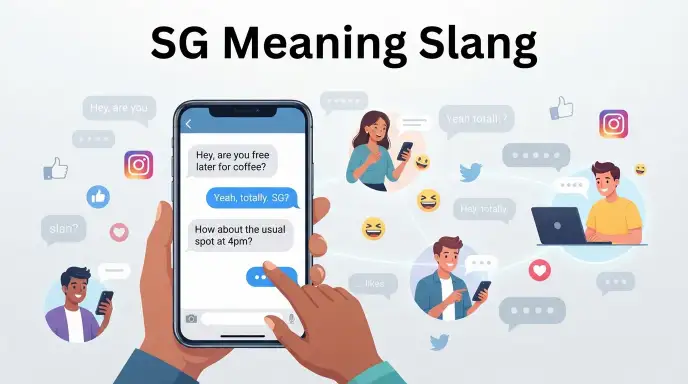
SG meaning slang can have different meanings depending on the context, but in casual texting it most often refers to “Sounds Good” or “So Good.” The right meaning depends on how the abbreviation is used in the conversation.
People often search for SG meaning slang after seeing “SG” in a text, comment, gaming chat, or social media post. Since the abbreviation is only two letters, it can be hard to know what the sender intended.
If someone replies “SG!” After you suggest a plan, they likely mean “Sounds Good.” If someone writes “That song is SG,” they may mean “So Good.” In other contexts, SG can have completely different meanings, such as referring to Singapore.
This guide explains the common meanings, examples, tone, usage, and situations where you should avoid using SG.
Quick Answer: What Does SG Mean in Text?
SG usually means “Sounds Good” or “So Good” in casual text and online conversations. “Sounds Good” shows agreement with a suggestion, while “So Good” expresses praise or excitement. Context tells you which meaning is intended.
What Does SG Mean in Text?
The meaning of SG depends on the sentence around it.
The two common slang meanings are:
- SG = Sounds Good used to agree with a plan, idea, or suggestion.
- SG = So Good used to praise something or show excitement.
For example:
“Meet me at 7?”
“SG!”
Here, SG means “Sounds Good.”
But:
“That new song is SG!”
Here, SG can mean “So Good.”
This is why you should not treat every use of SG as having one fixed definition.
SG as “Sounds Good”
When SG is used as a quick response, “Sounds Good” is usually the intended meaning.
It can communicate:
- Agreement
- Acceptance
- Approval
- Confirmation
- A positive response
For example:
“I’ll call you after dinner.”
“SG!”
The person is saying that the plan is fine.
SG as “So Good”
SG can also be used to express strong approval.
For example:
“I tried that new restaurant. The food was SG!”
In this context, the writer is saying the food was “So Good.”
This meaning is more likely when SG appears after a noun or when someone is reacting positively to music, food, videos, clothes, games, or other things they enjoy.
SG Full Form and Definition
The most common casual full forms of SG are:
| Abbreviation | Full form | Meaning |
| SG | Sounds Good | Agreement or approval |
| SG | So Good | Strong praise or excitement |
What does SG stand for?
If someone asks “What does SG stand for?”, there is no single answer without context.
In a conversation about plans, it can stand for “Sounds Good.”
In a conversation about something enjoyable, it can stand for “So Good.”
SG may also be used for other meanings outside slang. For example, SG is commonly used as an abbreviation for Singapore in some contexts.
That is why the surrounding message matters.
Is SG Rude, Offensive, or Neutral?
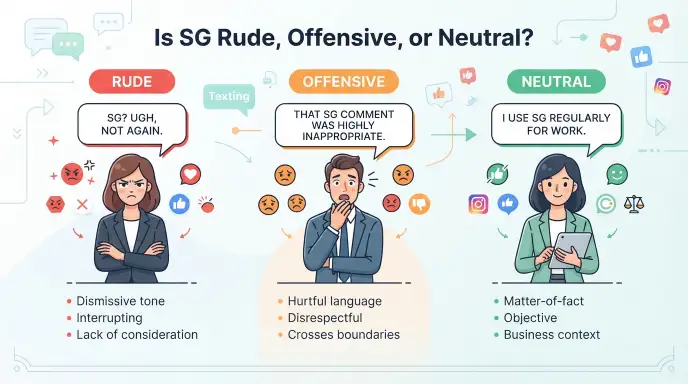
SG is generally neutral and harmless when used to mean “Sounds Good” or “So Good.” It is not normally considered an offensive slang expression.
However, the tone can depend on the conversation.
For example:
“SG!!
may sound enthusiastic and friendly.
Meanwhile:
“sg.”
may feel short or slightly cold if the conversation is serious.
The abbreviation itself is not rude. The perceived tone usually comes from the situation, punctuation, emojis, and relationship between the people chatting.
Is SG appropriate for everyone?
For casual conversations, SG is generally fine.
For formal communication, however, it is better to write the full phrase. A teacher, client, manager, or customer may not know what you mean immediately.
Instead of:
“SG, thanks.”
you could write:
“Sounds good, thank you.”
That version is clearer and more professional.
Where Is SG Commonly Used?
SG is mainly used in casual digital conversations where people want to respond quickly. You may see it in text messages, group chats, social media conversations, and some online communities.
SG in Text Messages
Texting is one of the most natural places to see SG.
For example:
“Want to grab lunch at 1?”
“SG!”
Here, SG means “Sounds Good.”
It works as a short confirmation without making the conversation feel formal.
SG on Social Media
On platforms such as Instagram, Snapchat, TikTok, or Reddit, the meaning depends heavily on the sentence.
For example:
“Your new video is SG
Here, SG may mean “So Good.”
However, SG is not a universal social media abbreviation. Some users may use it differently, so the surrounding text should always be your first clue.
SG in Gaming Chats
Gaming communities use many short abbreviations, so SG can have meanings that are unrelated to “Sounds Good” or “So Good.”
If someone says:
“SG, let’s queue again.”
the context may suggest “Sounds Good.”
But if SG appears as the name of an item, role, weapon, feature, or gameifspecific term, you should not automatically interpret it as slang.
Real : Life Examples of SG
Seeing SG in realistic conversations makes the difference between its meanings much easier to understand.
Friendly Example
A: “Do you want to come over after school?”
B: “SG! I’ll be there around 5.”
Meaning: Sounds Good.
The reply shows friendly agreement.
Casual Texting Example
A: “I’ll send the file tonight.”
B: “SG
Meaning: Sounds Good.
It is simply a quick confirmation.
Praise Example
A: “Have you tried the new pizza place?”
B: “Yes! The pizza was SG.”
Meaning: So Good.
Here, SG expresses positive feelings about the food.
Social Media Example
“That edit is SG
Meaning: So Good.
The person is praising the edit.
Planning Example
A: “Movie at 8?”
B: “SG, see you then.”
Meaning: Sounds Good.
Different Context Example
“I’m traveling to SG next month.”
Here, SG may mean Singapore, not either of the common slang meanings.
This example shows why context matters.
SG Meaning in Different Contexts
| Context | Likely meaning | Tone |
| Replying to a plan | Sounds Good | Friendly |
| Accepting an invitation | Sounds Good | Casual |
| Praising food | So Good | Positive |
| Praising music | So Good | Enthusiastic |
| Talking about travel | Singapore | Neutral |
| Gaming | Contextifdependent | Varies |
A simple rule can help: look at what SG is doing in the sentence.
If it is a reply to a suggestion, “Sounds Good” makes sense. If it describes something enjoyable, “So Good” may be intended.
Origin and Background of SG
SG does not have one confirmed origin for all of its meanings. It is better to treat it as a short abbreviation that developed and is used in different contexts rather than claiming one exact creator or date.
The “Sounds Good” use fits the broader pattern of textifmessage shorthand, where common phrases are shortened to save time. “So Good” is another casual expansion found in slang and texting references.
Other uses developed separately. For example, SG can refer to Singapore in locationifrelated conversations.
Because the same two letters can represent different phrases, there is no reliable single origin story that explains every use of SG.
SG vs Similar Slang Terms
SG can sometimes be replaced with other short expressions, but the alternatives do not always have exactly the same meaning.
| Slang | Meaning | Typical use |
| SG | Sounds Good / So Good | Agreement or praise |
| OK | Okay | Agreement |
| Sure | Yes / Agreement | Accepting a suggestion |
| TBH | To Be Honest | Sharing an opinion |
| GG | Good Game | Gaming |
| GTG | Got To Go | Ending a conversation |
For example, if someone asks:
“Can we meet at 6?”
you could answer:
“SG!”
or:
“Sure!”
Both show agreement, but SG feels more like quick internet or texting shorthand.
When Should You Avoid Using SG?
SG is best avoided when clarity and formality matter more than speed.
You may want to write the complete phrase when talking to:
- Teachers
- Professors
- Employers
- Managers
- Clients
- Customers
- Officials
- People who may not know texting slang
For example, instead of:
“SG, I’ll do that.”
use:
“Sounds good. I’ll do that.”
The second version is clearer and works in both casual and professional settings.
You should also avoid SG when the meaning could be unclear. If the reader might confuse “Sounds Good” with another meaning, spelling out the phrase is the safer choice.
Polite Alternatives to SG
You do not need slang to sound friendly. Several simple alternatives work well.
If You Mean “Sounds Good”
You can say:
- Sounds good!
- That works for me.
- Sure!
- Absolutely.
- That sounds great.
- Okay, perfect.
- No problem.
If You Mean “So Good”
You can say:
- Really good!
- Amazing!
- Excellent!
- That was great!
- I loved it!
- This is fantastic!
These alternatives are especially useful when you want your meaning to be immediately clear.
Why Do People Use SG?
People use SG because it is short, quick, and easy to type.
Text conversations often move quickly. Instead of writing “Sounds good,” someone may type “SG” and continue the conversation.
There is also a social reason. Short forms can make a message feel casual and relaxed.
Compare:
“That sounds good to me.”
with:
“SG!”
The first sounds complete and slightly more formal. The second feels quick and conversational.
This does not mean SG is always better. It simply fits situations where both people understand the shorthand.
Impact of Using SG in Communication
Using SG can make a conversation faster, but it can also create confusion if the reader does not know the abbreviation.
Positive effects
- Saves typing time
- Keeps casual chats short
- Shows agreement quickly
- Can make messages feel relaxed
- Works well between people who already use slang
Possible drawbacks
- Some people may not know what it means.
- Its meaning can change with context.
- A very short reply may seem cold.
- It may not fit professional writing.
The best choice depends on who you are talking to and what you are talking about.
Is SG Safe for Social Media?
Yes, the common slang uses of SG are generally harmless for social media.
When SG means “Sounds Good” or “So Good,” it does not normally carry an offensive or unsafe meaning.
Still, SG can have other meanings in different communities. If you see it in a gaming, technical, business, or location if based conversation, check the context before interpreting it.
For younger users, the same basic rule applies: understanding the surrounding conversation is more important than memorizing one fixed definition.
Common Misunderstandings About SG
One of the biggest mistakes is assuming that SG always means “Sounds Good.”
It does not.
Consider these examples:
“Can we meet at 5?”
“SG!”
Here, it likely means Sounds Good.
But:
“This cake is SG!”
Here, it may mean So Good.
And:
“I’m flying to SG tomorrow.”
Here, SG may mean Singapore.
So, if you are unsure about SG meaning slang, read the entire sentence before deciding what the abbreviation means.
Frequently Asked Questions
Q1. What does SG mean in slang?
SG commonly means “Sounds Good” or “So Good” in casual texting and online conversations.
Q2. What does SG stand for in texting?
In texting, SG can stand for “Sounds Good” when agreeing with a plan. It can also mean “So Good” when praising something.
Q3. Is SG a rude word?
No. SG is generally neutral or friendly when used for “Sounds Good” or “So Good.”
Q4. Can SG mean Singapore?
Yes. In travel, location, or other geographic contexts, SG can be used as an abbreviation for Singapore.
Q5. Can I use SG at work?
You can use it in very casual workplace chats if your team already uses the abbreviation, but “Sounds good” is safer and clearer for formal communication.
Q6. Does SG always have the same meaning?
No. SG is contextifdependent. The sentence, platform, and conversation topic can change its meaning.
Conclusion
SG meaning slang is usually connected to two casual expressions: “Sounds Good” and “So Good.” When someone uses SG to respond to a suggestion or plan, it commonly means “Sounds Good.” When it is used to praise something, it can mean “So Good.”
The important thing is context. SG can also have nonifslang meanings, such as Singapore, and specialized communities may use the abbreviation in other ways.
For casual texting and social media, SG is generally harmless and easy to use when both people understand it. For school, work, or formal communication, spelling out the phrase is usually the better choice.

I’m Dylan Foster, a slang and internet culture writer passionate about exploring how people communicate online and in everyday conversations. I write about texting abbreviations, social media expressions, and modern slang to help readers understand meanings, origins, and real-world usage in a simple way.