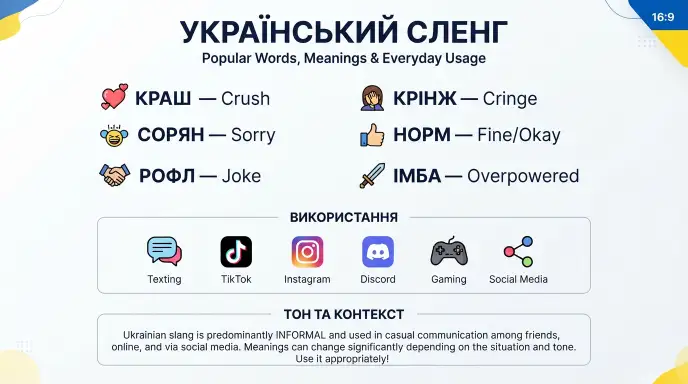
Ukrainian slang refers to informal words, expressions, shortened forms, and playful phrases used in everyday Ukrainian communication. If you have seen.
Ukrainian words in a text message, TikTok comment, Instagram post, Discord chat, or online conversation that did not make sense after a direct translation, you may have encountered slang.
Modern Ukrainian slang can come from everyday speech, youth culture, memes, gaming, social media, and borrowed internet vocabulary. Some expressions are friendly and harmless, while others can be rude or highly informal. The meaning can also change depending on the speaker, situation, and community.
People often search for Ukrainian slang because they want to understand what a Ukrainian friend, creator, gamer, or online user really means.
Quick Answer:Ukrainian Slang
Ukrainian slang is informal language used mainly in casual conversations and online communication. Its meaning depends on context, tone, age group, and the community using it.
What Does Ukrainian Slang Mean in Text?
Ukrainian slang in text means informal Ukrainian vocabulary used in messages, comments, chats, memes, and social media instead of formal language.
Slang can include:
- Shortened words
- Playful expressions
- Internet abbreviations
- Borrowed English words
- Gaming terms
- Meme vocabulary
- Youth expressions
- Regional or communityifspecific words
For example, a Ukrainian speaker might use норм (norm) to mean something like “fine,” “okay,” or “good enough.”
Another person might write краш (krash) when talking about someone they have a crush on.
These expressions are much more casual than the language normally used in official documents or formal writing.
Ukrainian Slang vs. Standard Ukrainian
One of the easiest ways to understand slang is to compare it with standard language.
Standard Ukrainian is generally used in formal or carefully written communication.
Slang is more common when people want to sound relaxed, friendly, humorous, or connected to a particular group.
| Standard language | Slang/informal style | General meaning |
| Вибачте | Сорян | Sorry |
| Нормально | Норм | Fine / okay |
| Закоханість / людина, яка подобається | Краш | Crush |
| Це дуже незручно | Це крінж | This is cringe |
| Жарт | Рофл | Joke / funny situation |
The exact choice depends on the situation. A slang word that sounds perfectly normal between friends may not be suitable in a formal conversation.
Common Ukrainian Slang Words
There is no single official list of Ukrainian slang because informal language changes over time. Different age groups and online communities may use different expressions.
Here are some widely discussed examples:
| Slang | Meaning in English | Tone |
| Краш | Crush | Casual |
| Крінж | Cringe | Informal |
| Рофл | Joke / something funny | Casual |
| Сорян | Sorry | Very informal |
| Норм | Fine / okay | Casual |
| Жиза | Relatable | Internet slang |
| База | Facts / strong point | Internet slang |
| Слей | Slay / doing something impressively | Informal |
| Імба | Extremely good or overpowered | Gaming slang |
These are approximate meanings rather than perfect translations. The surrounding sentence can change the tone or intended meaning.
Краш (Krash): Crush
Краш is an informal Ukrainian internet term used for someone a person likes romantically or finds very attractive.
It comes from the English word “crush,” adapted into Ukrainian spelling and pronunciation.
Example
Він мій краш.
Natural English meaning:
“He is my crush.”
The term is casual and is more likely to appear in texting, social media, or conversations between friends than in formal Ukrainian.
You may also see it used jokingly when someone is a fan of a celebrity, fictional character, athlete, or online creator.
Крінж (Krinzh): Cringe
Крінж is used for something embarrassing, awkward, uncomfortable, or socially awkward.
It comes from the English internet word “cringe.”
Example
Це було дуже крінжово.
Meaning:
“That was really cringe.”
The term is especially common when people react to:
- Awkward videos
- Strange comments
- Embarrassing behavior
- Uncomfortable jokes
- Socialifmedia posts
It is usually informal and can sometimes be used humorously rather than as a serious insult.
Рофл (Rofl): Joke or Something Funny
Рофл comes from the English internet abbreviation ROFL, traditionally associated with laughing very hard.
In Ukrainian online communication, рофл can refer to a joke, something funny, or a situation that should not be taken seriously.
Example
Та це просто рофл.
Depending on context, this can mean:
“It’s just a joke.”
or:
“That’s just funny.”
The expression is strongly associated with casual internet communication.
Сорян (Sorian): Casual “Sorry”
Сорян is an informal way of saying “sorry.”
It is commonly associated with casual speech and online communication.
Example
Сорян, я забув відповісти.
Meaning:
“Sorry, I forgot to reply.”
It sounds relaxed and friendly, but it is not the best choice for a formal apology.
For example, when writing to a teacher, employer, official, or customer, a more standard form of Ukrainian would normally be better.
Норм (Norm): Fine or Okay
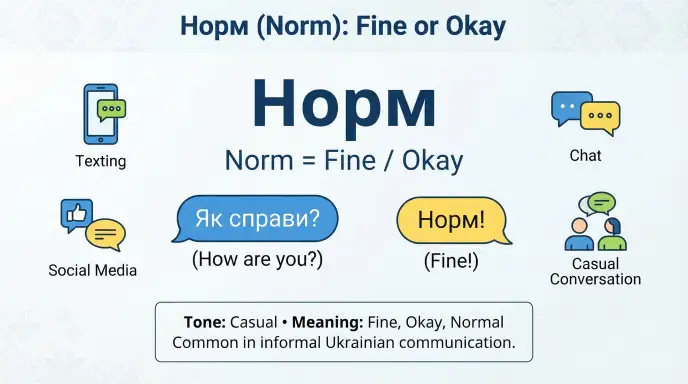
Норм is an informal shortened form that can mean “fine,” “okay,” “normal,” or sometimes “good enough.”
Example
Як справи?
Норм.
Meaning:
“How are you?”
“Fine.”
The tone is usually casual and straightforward.
It is a good example of how people can shorten language in everyday conversation without changing the basic idea.
Жиза (Zhyza): Relatable
Жиза is an internetifstyle expression used when something feels highly relatable or matches your own experience.
Example
Не хочу вставати рано. Жиза.
Natural English meaning:
“I don’t want to wake up early. So relatable.”
It is especially useful in comments, memes, and conversations where someone wants to say, “I feel the same way.”
База (Baza): “Facts” or Strong Agreement
База literally relates to the idea of a base, but internet slang can give it a different meaning.
In some online contexts, база is used to show that someone has made a strong, correct, or highly agreeable point.
Example
Це база.
Depending on context, a natural English interpretation could be:
“Facts.”
or:
“That’s absolutely right.”
This is an important example of why slang should not always be translated word for word.
Is Ukrainian Slang Always Informal?
Yes, Ukrainian slang is generally associated with informal communication, but the level of informality varies.
Some expressions have become so familiar online that many people understand them immediately. Others may be limited to a specific age group, region, hobby, or internet community.
For example:
- A gaming term may be common among players.
- A meme expression may be popular among teenagers.
- A regional expression may be familiar mainly to people from a particular area.
- An Englishifderived term may be common among socialifmedia users.
Therefore, recognizing one Ukrainian slang word does not necessarily mean you will understand every informal expression.
Where Is Ukrainian Slang Commonly Used?
Ukrainian slang can appear in many forms of casual communication.
Texting
Friends often use informal vocabulary in private messages because it makes communication feel relaxed and natural.
Social Media
TikTok, Instagram, and other social platforms can help new expressions spread quickly through comments, captions, memes, and videos.
Discord and Gaming
Gaming communities often combine Ukrainian slang with English gaming vocabulary and abbreviations.
Online Communities
Reddit, forums, group chats, and other communities can develop their own informal vocabulary.
The platform alone does not determine the meaning. The people using the expression and the surrounding conversation matter just as much.
Why Is Context Important?
A Ukrainian slang word may have a literal meaning that is different from what it means in an online conversation.
For example:
Краш may look unfamiliar if translated literally, but in youth and internet slang it can refer to a person someone likes.
Similarly, база can refer literally to a base, while online it can be used to express agreement.
This is why a translation tool may sometimes produce a technically correct word but miss the social meaning.
When trying to understand Ukrainian slang, look at:
- The full sentence
- The speaker’s tone
- The platform
- The relationship between the speakers
- The surrounding conversation
That combination usually gives a much clearer meaning.
Is Ukrainian Slang Rude, Offensive, or Neutral?
Ukrainian slang is not automatically rude or offensive. Many slang expressions are simply casual ways to communicate with friends, react to memes, or express emotions online.
However, Ukrainian informal language also includes insults, profanity, and expressions that may be inappropriate in certain situations. The safest approach is to understand the tone and context before repeating an unfamiliar term.
| Type | General example | Tone |
| Friendly slang | Сорян | Casual |
| Internet slang | Крінж | Informal |
| Gaming slang | Імба | Casual |
| Agreement slang | База | Informal |
| Profanity | Strong swear words | Potentially offensive |
A word can also feel different depending on who uses it. Close friends may use slang jokingly, while the same expression directed at a stranger could sound disrespectful.
Where Is Ukrainian Slang Commonly Used?
Ukrainian slang appears mostly in informal communication, especially where people communicate quickly and casually.
Text Messages
Friends may use short forms and slang because they make conversations feel relaxed.
For example:
Норм, дякую.
This can be understood as:
“Fine, thanks.”
TikTok and Instagram
Social media has helped spread slang, memes, and expressions among younger users. A term that becomes popular in videos or comments can quickly move into everyday online conversations.
Discord
Discord communities often mix Ukrainian slang with English internet expressions. The exact vocabulary may depend on the group.
Gaming
Gaming communities frequently create and borrow slang for characters, weapons, strategies, victories, and failures.
For example:
Це імба!
can be used to describe something extremely powerful or effective.
Reddit and Forums
Online communities can develop their own vocabulary. This means a slang word may be common in one community but unfamiliar somewhere else.
Ukrainian Slang in Gaming
Gaming is an important environment for modern informal language.
Players often communicate quickly, so short words and borrowed terms can be useful. Ukrainian gaming conversations may include a mixture of Ukrainian words, English gaming terms, abbreviations, and communityifspecific expressions.
- Example
Ця зброя просто імба.
A natural interpretation is:
“This weapon is seriously overpowered.”
The word імба comes from the gaming concept of something being unusually strong or effective.
Gaming slang can also spread outside gaming communities. A word originally used to describe a powerful game character may later be used jokingly to describe something impressive in everyday life.
Ukrainian Slang on Social Media
Social media has made informal language much fasterifmoving.
A slang expression can become popular because of:
- Viral videos
- Memes
- Influencers
- Music
- Gaming content
- Comments
- Online jokes
- International trends
Ukrainian youth slang is also influenced by Englishiflanguage internet culture. Some English expressions are adapted into Ukrainian spelling and pronunciation rather than translated directly.
For example:
Краш → crush
Крінж → cringe
Слей → slay
These words may look different in Ukrainian, but their connection to global internet culture is easy to see.
Why Do People Use Ukrainian Slang?
People use slang for more than simply shortening words.
To Sound Casual
Slang makes a conversation feel less formal.
Compare:
Це дуже добре.
with:
Це імба!
The second sounds much more informal and expressive.
To Show Group Identity
Certain expressions can signal that someone belongs to a particular online community, age group, hobby, or social circle.
To Express Emotion Quickly
One slang word can communicate a strong reaction without a long explanation.
For example:
Крінж!
can communicate that something is embarrassing or uncomfortable.
To Add Humor
Internet slang is often used jokingly or ironically.
To Follow Online Trends
People may adopt words they see repeatedly in videos, memes, comments, and online conversations.
Origin and Background of Ukrainian Slang
Ukrainian slang does not have one single origin.
Different expressions have developed from different sources, including:
- Traditional spoken language
- Youth culture
- Regional speech
- English internet culture
- Gaming
- Social media
- Music
- Memes
- Popular entertainment
Modern youth slang changes especially quickly because online communities can spread new expressions across large groups of people.
Some words may be borrowed from English and adapted to Ukrainian grammar or spelling. Others develop naturally within Ukrainianifspeaking communities.
Because slang changes so quickly, it is difficult to give one exact date for when “Ukrainian slang” began. Informal language has existed for a long time, while the modern internet has simply accelerated how quickly new expressions appear and spread.
English Influence on Modern Ukrainian Slang
English has a noticeable influence on online slang in many languages, including Ukrainian.
Internet users regularly encounter English through:
- TikTok
- YouTube
- Gaming
- Discord
- Streaming
- Online communities
Some English words are translated, while others are adapted into Ukrainian.
For example:
| English source | Ukrainian slang form | Meaning |
| Crush | Краш | Person you like |
| Cringe | Крінж | Embarrassing |
| Slay | Слей | Do something impressively |
| Hater | Хейтер | Person who attacks or dislikes someone online |
These adaptations show how internet language can move between languages.
Comparison: Ukrainian Slang and English Internet Slang
Modern Ukrainian internet slang often overlaps with English online language, but the expressions may be written differently.
| English internet slang | Ukrainian online equivalent | Meaning |
| Crush | Краш | Someone you like |
| Cringe | Крінж | Embarrassing |
| Slay | Слей | Doing something impressively |
| Hater | Хейтер | Someone who strongly criticizes |
| Troll | Троль | Person deliberately provoking others |
This does not mean every Ukrainian speaker uses these words. Usage depends on age, interests, location, and online community.
When Should You Avoid Ukrainian Slang?
The best rule is to match your language to the situation.
Slang is usually not the best choice for formal communication.
Avoid unfamiliar slang in:
- Job applications
- Formal emails
- Academic essays
- Official documents
- Business reports
- Professional presentations
- Formal interviews
For example, writing:
Це просто імба!
may be perfectly normal among gaming friends.
But in a professional report, a clearer phrase such as:
Це дуже ефективне рішення.
would be more appropriate.
Is Ukrainian Slang Appropriate for School?
It depends on the situation.
Students may naturally use slang when chatting with friends, but formal schoolwork should generally use standard Ukrainian.
Casual message
Сорян, я забув зошит.
Formal communication
Вибачте, я забув зошит.
Both communicate an apology, but the second is more suitable when speaking respectfully to a teacher.
The same principle applies to essays and assignments: informal slang may be understandable, but standard language is normally expected.
Is Ukrainian Slang Safe for Social Media?
Most everyday Ukrainian slang is harmless.
Words such as норм, жиза, and краш can be used casually without being offensive in ordinary contexts.
However, not every slang expression is safe or neutral. Some terms may be:
- Insulting
- Vulgar
- Sexually explicit
- Aggressive
- Derogatory
- Specific to a controversial community
If you do not know an expression, it is better to check its meaning and context before using it publicly.
This is particularly important when translating comments or messages from strangers.
How Context Changes the Meaning
Context is one of the most important parts of understanding slang.
A word can have a literal meaning and a slang meaning that are very different.
For example:
Краш
In internet slang:
Краш = someone you have a crush on.
База
In ordinary language:
База = base.
In some internet contexts:
База = “facts” or strong agreement.
Імба
In gaming:
Імба = something extremely powerful or effective.
Outside gaming, it may be used more loosely as praise.
This is why translating one isolated word can sometimes produce the wrong interpretation.
Impact of Slang on Communication
Slang can make communication feel more personal and natural, especially among people who share the same cultural or online background.
Positive effects
Slang can:
- Build a sense of community
- Make conversations more relaxed
- Add humor
- Express emotions quickly
- Make online communication more engaging
Possible problems
Slang can also:
- Confuse people unfamiliar with it
- Create misunderstandings
- Sound inappropriate in formal settings
- Become unclear as trends change
- Have different meanings in different communities
For language learners, learning slang can be useful, but it should come after understanding basic standard Ukrainian.
Polite Alternatives to Informal Ukrainian Slang
If you understand a slang expression but need a more respectful version, use standard Ukrainian.
| Informal | More neutral/formal approach |
| Сорян | Вибачте / Вибач |
| Норм | Добре / Нормально |
| Крінж | Незручно / Дивно |
| Рофл | Жарт |
| Краш | Людина, яка мені подобається |
The exact alternative depends on the sentence and relationship between speakers.
How to Learn Ukrainian Slang Naturally
If you are learning Ukrainian, do not try to memorize a huge list of slang words without context.
Instead:
- Learn the standard meaning first.
- Notice slang in real conversations.
- Pay attention to who is using it.
- Look at several examples.
- Check if the term is current or dated.
- Learn if it is friendly, humorous, rude, or offensive.
- Use it only when you understand the context.
This approach will help you sound more natural without accidentally using a word in the wrong situation.
Quick Guide to Ukrainian Slang
| Question | Answer |
| What is Ukrainian slang? | Informal Ukrainian language |
| Is all slang rude? | No |
| Is slang common online? | Yes |
| Is English an influence? | Yes |
| Is slang used in gaming? | Yes |
| Is slang used on social media? | Yes |
| Is slang suitable for formal writing? | Usually no |
| Can meanings change? | Yes |
| Does context matter? | Very much |
Real :Life Ukrainian Slang Examples
Understanding slang becomes easier when you see it in realistic situations. The same expression can sound friendly, funny, sarcastic, or critical depending on the conversation.
Friendly Conversation
Ukrainian:
Як справи?
Норм, дякую!
English:
“How are you?”
“Fine, thanks!”
Here, норм is a relaxed way to say that everything is okay.
Talking About a Crush
Ukrainian:
Вона мій краш.
English:
“She is my crush.”
Краш is casual and is especially natural in conversations between friends or on social media.
Reacting to an Awkward Video
Ukrainian:
Ой, це такий крінж.
English:
“Oh, that’s so cringe.”
The speaker is reacting negatively to something embarrassing or uncomfortable.
Casual Apology
Ukrainian:
Сорян, я не відповів одразу.
English:
“Sorry, I didn’t reply right away.”
Сорян makes the apology sound informal and relaxed.
Gaming Context
Ukrainian:
Цей персонаж : імба!
English:
“This character is seriously overpowered!”
In gaming language, імба can describe something unusually strong or effective.
Internet Joke
Ukrainian:
Та це рофл
English:
“It’s just a joke
The emoji and wording make the playful tone especially clear.
Strong Agreement
Ukrainian:
Ти все правильно сказав. Це база.
English:
“You said it exactly right. Facts.”
Here, база expresses strong agreement with someone’s statement.
Ukrainian Slang in Different Situations
The same type of slang may feel different depending on where it appears.
| Situation | Slang style | Example |
| Close friends | Relaxed | Сорян |
| TikTok comments | Trendy | Крінж |
| Gaming | Competitive | Імба |
| Memes | Humorous | Рофл |
| Social media | Expressive | Краш |
| Formal workplace | Usually avoided | Standard Ukrainian |
The important lesson is that slang is strongly connected to audience and context.
Ukrainian Slang for Beginners: What Should You Learn First?
If you are new to Ukrainian informal language, start with expressions that are easy to recognize and understand.
A useful beginner group includes:
Норм
Meaning: fine, okay, normal
Сорян
Meaning: sorry
Краш
Meaning: crush
Крінж
Meaning: cringe
Рофл
Meaning: joke / something funny
Жиза
Meaning: relatable
База
Meaning: facts / strong agreement
Імба
Meaning: overpowered / extremely effective
Learning these with example sentences is more useful than memorizing isolated translations.
Common Mistakes When Translating Ukrainian Slang
Mistake 1: Translating Every Word Literally
Literal translation does not always preserve slang meaning.
For example:
Це база.
If translated literally, it refers to a “base.” But in some online contexts, the intended meaning is closer to:
“That’s facts.”
Mistake 2: Assuming Every Young Ukrainian Uses the Same Slang
Slang differs by age, region, interests, and online community.
A gamer may know expressions that someone who rarely plays games does not use.
Mistake 3: Treating Slang as Standard Language
A slang expression may be understandable but still unsuitable for formal writing.
Mistake 4: Assuming English Is Always the Source
Some Ukrainian slang comes from English, but not every informal Ukrainian expression is an English loanword.
Mistake 5: Ignoring Tone
The same word can sound humorous between friends and insulting in another situation.
Is Ukrainian Slang Changing?
Yes. Like slang in many languages, Ukrainian slang changes over time.
New expressions can become popular through:
- Social media
- Music
- Gaming
- Memes
- Television and online videos
- Youth communities
- International internet culture
Some terms remain popular for years. Others may become outdated once the trend that created them disappears.
This means a slang dictionary should be treated as a guide rather than a permanent list of every expression used by every Ukrainian speaker.
Ukrainian Slang and Generational Differences
Age can influence which slang expressions someone recognizes or uses.
Younger internet users may be more familiar with:
- Meme vocabulary
- Gaming terms
- Englishifderived slang
- TikTok expressions
- Socialifmedia trends
Older speakers may understand some of these expressions but prefer more traditional or standard vocabulary.
This does not mean there is one fixed “young Ukrainian vocabulary.” People belong to different communities and have different online habits.
Is Ukrainian Slang Used Outside Ukraine?
Ukrainianifspeaking communities outside Ukraine can also use Ukrainian informal language.
However, exposure to different languages may influence the vocabulary used by speakers in different countries.
For this reason, it is better to avoid saying that one slang expression is used by all Ukrainians everywhere.
Slang is flexible, and usage can vary across communities.
Why Ukrainian Slang Can Be Difficult for English Speakers
Learning Ukrainian slang can be harder than learning standard vocabulary because slang often depends on cultural context.
An English speaker may know that:
краш = crush
but understanding exactly when a Ukrainian speaker would use the term requires more than a dictionary translation.
You also need to understand:
- Formal vs. informal speech
- Online culture
- Humor
- Irony
- Age differences
- Regional variation
- Gaming terminology
- English loanwords
That is why examples are often more useful than simple word lists.
Is Ukrainian Slang Appropriate for Foreign Language Learners?
Yes, but use it carefully.
Learning slang can help you understand real conversations and online content. It can also make informal communication easier once you understand the social context.
However, beginners should not try to use every slang word they encounter.
A better approach is:
Understand first → recognize the tone → learn examples → use carefully.
If you are unsure if an expression is appropriate, choose standard Ukrainian instead.
FAQs About Ukrainian Slang
Q1. What is Ukrainian slang?
Ukrainian slang is informal language used in casual speech, texting, social media, gaming, memes, and online communities. It can include shortened words, borrowed terms, playful expressions, and communityifspecific vocabulary.
Q2. What are some popular Ukrainian slang words?
Examples include краш for “crush,” крінж for “cringe,” сорян for “sorry,” норм for “fine,” рофл for “joke,” and імба for something extremely powerful or effective.
Q3. Is Ukrainian slang the same as Russian slang?
No. Ukrainian and Russian are separate languages. Although the languages have had historical contact and may share or resemble some vocabulary, Ukrainian slang should be understood within Ukrainian language and cultural context.
Q4. Is Ukrainian slang offensive?
Not necessarily. Many slang expressions are harmless and playful. However, Ukrainian also has vulgar slang and insults, so an unfamiliar expression should be checked before you repeat it.
Q5. Can I use Ukrainian slang with native speakers?
Yes, if you understand the expression and the situation is informal. For formal situations, standard Ukrainian is usually safer.
Q6. Is Ukrainian slang used on TikTok and Instagram?
Yes. Social media can help slang, memes, and borrowed internet expressions spread quickly. However, popularity varies by community and can change over time.
Final Tips for Understanding Ukrainian Slang
When you encounter an unfamiliar Ukrainian slang expression, do not translate it immediately and assume the first dictionary result is correct.
Instead, ask:
- Who is using it?
- Where did you see it?
- What is the full sentence?
- Is the speaker joking?
- Is the conversation friendly or argumentative?
- Could the word have a literal and slang meaning?
- Is it borrowed from English or another language?
- Is it appropriate to repeat?
These questions can prevent many translation mistakes.
Conclusion
Ukrainian slang is an important part of informal communication, especially in texting, social media, gaming, memes, and conversations between friends. Expressions such as краш, крінж, рофл, сорян, норм, жиза, база, and імба show how Ukrainian informal language can combine native vocabulary with global internet culture.
The most important point is that context matters. A slang word may have a different meaning from its literal translation, and an expression that sounds friendly among friends may not be suitable in a formal setting.
Ukrainian slang also changes over time. New terms can spread through TikTok, gaming, memes, and other online communities, while older expressions may become less common. Regional, generational, and community differences also affect which words people use.
If you are learning Ukrainian, slang can help you understand real online conversations, but it is best learned alongside standard Ukrainian. Start by understanding the meaning and tone of an expression before trying to use it yourself.
In short, Ukrainian slang is casual, expressive, and constantly changing. Context, audience, and tone are the keys to understanding it correctly.
Now You Know What!

I’m Dylan Foster, a slang and internet culture writer passionate about exploring how people communicate online and in everyday conversations. I write about texting abbreviations, social media expressions, and modern slang to help readers understand meanings, origins, and real-world usage in a simple way.