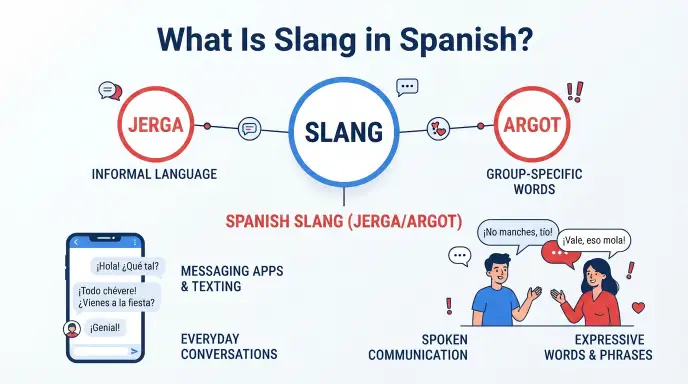
What is slang in Spanish? The most common Spanish words for “slang” are jerga and argot. They describe informal words and expressions often used by a particular group, community, profession, or social circle.
If you searched for what is slang in Spanish, you may want to know how to translate the English word “slang,” or you may be trying to understand Spanish words you see in texts, social media posts, or conversations. The answer is a little more detailed than simply choosing one Spanish word.
In this guide, we will explain what is slang in Spanish, how jerga and argot are used, and why context matters. You will also learn the difference between slang and ordinary casual Spanish, so you can understand informal expressions without using them in the wrong situation.
Quick Answer: What Is Slang in Spanish?
The English word “slang” is commonly translated into Spanish as jerga or argot. Both can describe informal or groupifspecific language, but the best choice depends on the context.
For example:
- Slang → jerga
- Street slang → jerga callejera / argot callejero
- Youth slang → jerga juvenil
- Internet slang → jerga de internet
- Professional jargon → jerga profesional
The important point is that Spanish slang is not one fixed set of words. Informal expressions can change from one Spanishifspeaking country, region, age group, or online community to another.
What Does “Slang” Mean in Spanish?
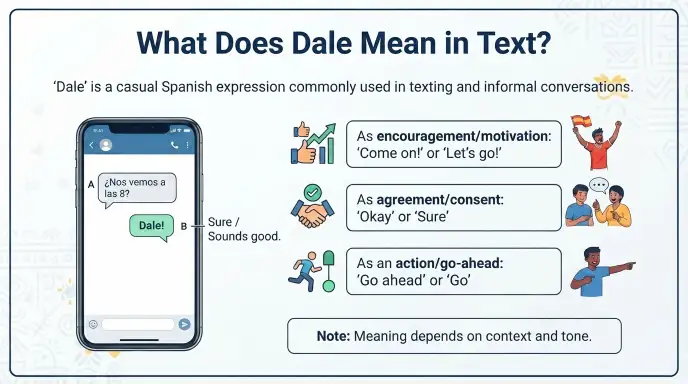
The word slang describes informal words, phrases, or expressions connected with a particular group or social setting.
In Spanish, jerga is one of the closest and most useful translations.
What Does “Jerga” Mean?
Jerga can refer to a special language used by a particular group. It can include informal vocabulary as well as specialized words that outsiders may not understand.
For example:
No entiendo la jerga que usan los jóvenes.
This means:
“I don’t understand the slang the young people use.”
The word jerga can also be used for language connected with a profession or activity.
Examples include:
- jerga médica medical jargon
- jerga legal legal jargon
- jerga informática computer jargon
- jerga militar military jargon
- jerga juvenil youth slang
- jerga de internet internet slang
So, jerga does not always mean rude or offensive language. It simply describes language associated with a particular group or field.
What Does “Argot” Mean?
Argot is another Spanish word that can mean slang. It often refers to vocabulary associated with a particular social group and language that may be difficult for outsiders to understand.
For example:
No conozco el argot de ese grupo.
This means:
“I don’t know that group’s slang.”
Argot can be useful when talking about the special vocabulary of a social or cultural group.
Jerga vs. Argot: What Is the Difference?
Although jerga and argot overlap, they are not always used in exactly the same way.
| Spanish word | General meaning | Example |
| Jerga | Groupifspecific, informal, or specialized language | jerga juvenil |
| Argot | Slang associated with a particular group | argot callejero |
| Lenguaje coloquial | Casual everyday language | lenguaje coloquial |
| Modismo | An idiomatic expression | A phrase with a nonifliteral meaning |
A simple way to remember the difference is:
Jerga is a broad term for special or groupifbased language, while argot is often used specifically for slang associated with a social group.
However, dictionaries can give overlapping translations, so the exact distinction depends on context.
Is Spanish Slang the Same in Every Country?
No. Spanish slang can vary greatly between countries and regions.
Spanish is spoken in many parts of the world, including:
- Spain
- Mexico
- Argentina
- Colombia
- Chile
- Peru
- Venezuela
- Puerto Rico
- Cuba
- The Dominican Republic
People in these places may use different informal expressions.
A word that sounds completely normal in one country might sound strange, oldiffashioned, or unfamiliar in another.
This is especially important for Spanish learners. Learning a slang expression from a TikTok video does not necessarily mean that everyone who speaks Spanish uses it.
Why Does Regional Variation Matter?
Slang often reflects local culture.
For example, young people in Mexico may have expressions that are not commonly used by young people in Spain. Likewise, Argentine slang can have vocabulary that is unfamiliar to Spanish speakers from other countries.
So when learning Spanish slang, always ask:
- Which country is this expression from?
- Who normally uses it?
- Is it casual, humorous, rude, or neutral?
- Is it still commonly used?
These questions can prevent many awkward mistakes.
Spanish Slang vs. Colloquial Spanish
One of the most common misunderstandings is thinking that all casual Spanish is slang.
That is not correct.
Lenguaje coloquial means conversational or everyday language. It is broader than slang.
For example, friends may speak casually with each other without using words that are considered slang.
A Simple Comparison
| Type | Meaning | Formality |
| Standard Spanish | Neutral language | Neutral |
| Colloquial Spanish | Everyday conversational language | Casual |
| Spanish slang | Informal or groupifspecific expressions | Usually very casual |
| Professional jargon | Specialized language used in a field | Depends on context |
This difference matters because an informal expression can still be perfectly normal Spanish without being slang.
Where Is Spanish Slang Commonly Used?
Spanish slang appears in many everyday settings, especially where people communicate casually.
Text Messages
Friends may use slang in WhatsApp or other messaging conversations to sound relaxed and natural.
A message between close friends can be much less formal than a business email.
TikTok and Instagram
Social media can spread informal expressions quickly.
A phrase may become popular through:
- Videos
- Comments
- Memes
- Captions
- Influencers
- Online communities
But popularity on one platform does not mean the expression is universal across Spanishifspeaking countries.
Discord and Gaming
Spanishifspeaking gamers often use a mixture of Spanish slang and English gaming terms.
For example, online gaming conversations may include words related to:
- Players
- Teams
- Rankings
- Winning
- Losing
- Streaming
- Game updates
Some expressions may be understood mainly inside gaming communities.
Reddit and Online Communities
Online communities can develop their own vocabulary. A slang term may become familiar within one group while remaining unknown to people outside it.
This is why context is one of the most important parts of understanding slang.
Is Spanish Slang Rude or Offensive?
Not necessarily. Spanish slang can be completely harmless, funny, friendly, or casual.
However, some slang expressions can be:
- Vulgar
- Insulting
- Sexual
- Disrespectful
- Strongly regional
You should never assume that a slang word is safe simply because you saw it online.
When Should You Be Careful?
Use extra caution when speaking with:
- Teachers
- Employers
- Customers
- Strangers
- Older people
- People you have just met
A slang expression may sound friendly among close friends but inappropriate in a formal setting.
Understanding slang and using slang are two different skills. You can understand an expression perfectly without needing to use it yourself.
Key Takeaway
If you only remember one thing from this article, remember this:
“Slang” in Spanish is commonly expressed as jerga or argot, but Spanish slang changes according to country, community, age group, and context.
Before using an unfamiliar slang word, learn not only its meaning but also who uses it, where it is common, and how it sounds to other people.
Different Meanings of Slang in Spanish
Slang does not have only one meaning in Spanish because the English word can refer to different kinds of informal language. The Spanish translation you choose depends on what you are describing.
1. Slang as GroupifSpecific Language
When slang refers to words used by a particular group, jerga is often a natural choice.
For example:
La jerga de los jóvenes cambia con frecuencia.
This means:
“Young people’s slang changes frequently.”
Here, jerga refers to vocabulary associated with a particular age group.
2. Slang as Social or Street Language
When talking about slang associated with a particular social group or street culture, argot may be appropriate.
For example:
No entiendo el argot que utilizan.
Meaning:
“I don’t understand the slang they use.”
The exact meaning still depends on the surrounding conversation.
3. Slang as Casual Conversation
Sometimes people use the word “slang” when they really mean informal or conversational language.
In Spanish, lenguaje coloquial can be a better description in that situation.
For example:
Es una expresión coloquial.
This means:
“It is a colloquial expression.”
That does not automatically mean the expression is slang.
Common Types of Spanish Slang
Spanish slang can appear in many forms. It is not limited to one group or one platform.
Youth Slang
Young people may create or popularize expressions that spread through school, music, social media, and friend groups.
You may see the term:
jerga juvenil = youth slang
Youth slang can change quickly, so an expression that is popular today may become dated later.
Internet Slang
Online communities often create informal expressions, abbreviations, and shortened phrases.
Jerga de internet can include language used in:
- Social media
- Messaging
- Forums
- Gaming
- Online communities
Internet slang can also mix Spanish and English.
Gaming Slang
Gaming communities often develop their own vocabulary.
A Spanishifspeaking player might use Spanish informal expressions alongside common English gaming terms.
This is normal in many online gaming spaces and does not mean the speaker is using formal Spanish.
Professional Jargon
The word jerga can also refer to specialized professional language.
For example:
- jerga médica medical jargon
- jerga legal legal jargon
- jerga informática computer jargon
- jerga científica scientific jargon
This is an important distinction: professional jargon is not always slang.
The word jerga can cover both specialized language and certain forms of informal group language.
Spanish Slang on Social Media
Social media has made it easier for informal expressions to travel between Spanishifspeaking communities.
Platforms such as TikTok, Instagram, YouTube, Reddit, and Discord can expose users to slang from countries they have never visited.
Why This Can Be Confusing
Imagine a Spanish learner sees an expression in a TikTok video.
They may assume:
“Everyone who speaks Spanish uses this word.”
That assumption can be wrong.
The expression may actually be:
- Popular mainly in one country
- Used mostly by younger people
- Connected to a specific online community
- A temporary trend
- A regional expression
- A humorous phrase
So when you find new Spanish slang online, check the country and context before adding it to your everyday vocabulary.
RealifLife Spanish Slang Examples
The safest way to understand slang is to look at how context changes communication.
Example 1: Talking With a Friend
A close friend may use very casual vocabulary.
Friend: ¿Qué haces?
You: Nada, aquí descansando.
The conversation is relaxed, but these sentences are not necessarily slang.
This is a useful reminder that casual Spanish and slang are not identical.
Example 2: Social Media
You may see a Spanishifspeaking creator use a trendy expression in a video caption.
That expression could be understood by their followers but not by every Spanish speaker.
The correct question is not only:
“What does this word mean?”
You should also ask:
“Where is this expression used?”
Example 3: Gaming
A Spanishifspeaking gamer might combine Spanish with English gaming vocabulary:
“Ese jugador está OP.”
The term OP, meaning “overpowered,” comes from gaming culture. It is an example of how online communities can mix languages and develop shared vocabulary.
Example 4: Workplace Chat
A coworker might use casual language in a private team chat.
That does not mean the same wording belongs in a formal message to a client.
For professional communication, neutral Spanish is usually the safer choice unless you already know that the workplace culture is highly informal.
Why Do People Use Spanish Slang?
People use slang because it can make communication feel more natural, personal, funny, or connected to a particular group.
There are several common reasons.
To Show Group Identity
Shared words can help people feel connected.
Friends, gamers, students, music fans, and online communities may develop expressions that make members feel like part of the same group.
To Sound Casual
Slang can make a conversation feel less formal.
Someone speaking with close friends usually does not communicate in exactly the same way they would during a job interview.
To Express Humor
Informal expressions can make jokes and conversations feel more playful.
To Reflect Local Culture
Regional slang can tell you something about where a speaker is from or which community they belong to.
To Follow Trends
Online slang can spread quickly through videos, memes, music, and social media.
However, not every trend lasts.
Is Spanish Slang Appropriate at Work?
It depends on the workplace, the relationship, and the expression. Casual slang may be acceptable between close coworkers, but formal situations generally call for neutral language.
Usually Avoid Strong Slang In:
- Job interviews
- Business proposals
- Formal presentations
- Academic writing
- Customer emails
- Messages to unfamiliar clients
More Flexible Situations Include:
- Friendly coworker chats
- Private messages
- Informal team conversations
- Conversations with close friends
If you are unsure, choose neutral Spanish.
That is especially helpful for Spanish learners because slang can have regional meanings that are difficult to recognize.
When Should You Avoid Using Spanish Slang?
Avoid unfamiliar slang when you are not sure about its meaning, tone, or regional use.
This is one of the most useful rules for anyone learning Spanish.
Before using a slang expression, consider:
- Do I know exactly what it means?
- Which country uses it?
- Is it current or outdated?
- Is it friendly, rude, vulgar, or neutral?
- Would I say it to this person in real life?
- Could the word have another meaning?
If you cannot answer these questions, it is better to understand the expression first and use a neutral alternative.
Common Misunderstandings About Spanish Slang
“All Spanish Speakers Use the Same Slang”
False.
Spanish slang can vary by country, region, generation, social group, and online community.
“Slang Always Means Bad Words”
False.
Some slang is completely harmless. Other expressions may be rude or vulgar.
The word slang itself does not tell you if an expression is offensive.
“Jerga Always Means Slang”
Not exactly.
Jerga can describe groupifspecific language and professional jargon as well.
For example, jerga médica refers to medical terminology or medical jargon, not necessarily street slang.
“Colloquial and Slang Mean Exactly the Same Thing”
No.
Colloquial language is simply casual everyday language. Slang is generally more strongly associated with a particular group, culture, or informal setting.
Similar Spanish Terms You Should Know
Understanding a few related terms makes Spanish slang much easier to study.
| Spanish term | English meaning | Simple explanation |
| Jerga | Slang / jargon | Special language used by a group |
| Argot | Slang | Language associated with a particular social group |
| Lenguaje coloquial | Colloquial language | Casual everyday speech |
| Modismo | Idiom | An expression whose meaning is not always literal |
| Expresión informal | Informal expression | A casual way of saying something |
These words overlap, but they are not interchangeable in every sentence.
Frequently Asked Questions
Q1. What is slang called in Spanish?
The most common words are jerga and argot. The correct choice depends on the context and the type of informal language being discussed.
Q2. What does “jerga” mean?
Jerga can mean a special language used by a particular group. It may refer to slang, professional jargon, or other groupifspecific vocabulary.
Q3. What does “argot” mean?
Argot refers to vocabulary associated with a particular social group. It can be translated as “slang” in many contexts.
Q4. What is Spanish slang called?
There is no single name for all Spanish slang. Jerga and argot are common general terms, while specific types may be called jerga juvenil, jerga de internet, or jerga profesional.
Q5. Is Spanish slang the same everywhere?
No. Slang can vary significantly between Spanishifspeaking countries and communities.
Q6. Can I use Spanish slang with my teacher?
It is usually safer to use neutral Spanish with teachers, especially if you are unsure about an expression’s tone or regional meaning.
Q7. Is Spanish slang used online?
Yes. Spanishifspeaking users use informal language on social media, messaging apps, gaming platforms, forums, and other online communities.
Conclusion:
What is slang in Spanish? In most situations, the English word “slang” can be translated as jerga or argot. However, the exact Spanish term depends on what kind of language you are describing.
The biggest thing to remember is that Spanish slang is not universal. A phrase can be common among young people in one country but unfamiliar to Spanish speakers somewhere else. Online platforms can spread expressions quickly, but they can also make regional slang look more universal than it really is.
If you are learning Spanish, focus on three things: meaning, context, and audience. Understanding those three factors will help you recognize slang in texts, social media, gaming, and real conversations without accidentally using an expression that sounds inappropriate or unnatural.
Explore More!

I’m Dylan Foster, a slang and internet culture writer passionate about exploring how people communicate online and in everyday conversations. I write about texting abbreviations, social media expressions, and modern slang to help readers understand meanings, origins, and real-world usage in a simple way.