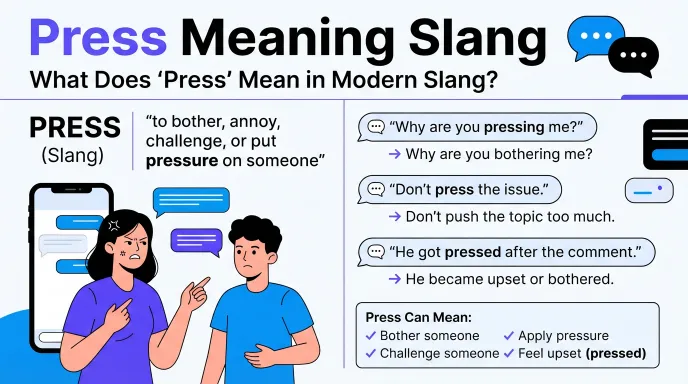
Press meaning slang usually refers to putting pressure on someone, confronting someone, trying hard, or showing strong effort depending on the context. Unlike the normal dictionary meaning of “press,” slang usage changes based on the situation, tone, and community using it.
In slang, “press” can have several meanings depending on the context. It may mean to pressure, bother, challenge, or confront someone, as in “Why are you pressing me?” meaning “Why are you giving me a hard time?
” In sports, “press” can describe putting strong pressure on an opponent, while online and texting conversations may use it to.
describe someone being overly persistent or demanding. Because the meaning can change with the situation, always look at the surrounding words and tone to understand what “press” means in slang.
What Does Press Mean in Slang?
In slang conversations, press often means to put pressure on someone or something. It can describe an emotional reaction, a personal challenge, or an intense effort.
The meaning can change depending on who says it and where it appears.
Common slang meanings include:
- To bother or annoy someone
- To challenge or confront someone
- To try hard or put in effort
- To worry or become upset
- To continue pushing toward a goal
For example:
“Why are you pressing me?”
This usually means:
“Why are you bothering me or putting pressure on me?”
However, in another context:
“I’m pressing for the win.”
This means:
“I’m trying hard to succeed.”
Press Slang Meaning in Different Contexts
The word press does not have one fixed slang definition. It changes depending on the situation.
1. “Don’t Press Me” Meaning
One of the most common slang uses is:
“Don’t press me.”
This means:
- Don’t bother me
- Don’t pressure me
- Don’t challenge me
- Don’t push me too far
It is often used when someone feels annoyed or defensive.
Examples:
Friend:
“Come on, answer me right now.”
Response:
“Don’t press me.”
Meaning:
“Stop forcing me to answer.”
2. “Pressing Someone” Meaning
When someone says they are pressing someone, it usually means they are putting pressure on them.
This can happen during:
- Arguments
- Sports
- Gaming
- Competitive situations
Example:
“He kept pressing me about my decision.”
Meaning:
“He kept pushing me for an answer.”
3. “Press” Meaning in Gaming
In gaming communities, press can describe aggressive action or pressure against another player.
Examples:
“They are pressing our team hard.”
Meaning:
“They are attacking aggressively.”
In competitive games, pressing can refer to:
- Attacking quickly
- Applying pressure
- Not allowing opponents time to react
This usage is common in sports games, strategy games, and team if based games.
4. “Press” Meaning as Effort
Sometimes press has a positive meaning.
It can describe someone making a strong effort or pushing themselves.
Example:
“I’m pressing to finish this project today.”
Meaning:
“I’m working hard to complete it.”
This meaning is close to phrases like:
- Push harder
- Keep going
- Give extra effort
Full Form or Complete Meaning of Press Slang
Press does not have a full form in slang.
It is not an abbreviation like:
- LOL
- BRB
- FOMO
Instead, it is a regular English word that developed additional informal meanings through everyday speech and online communication.
The slang meaning comes from the idea of physical pressure. Over time, people started using “press” to describe social pressure, emotional pressure, competition, and personal challenges.
Is Press Slang Rude, Offensive, or Harmless?
The word press itself is not offensive. However, the tone can make it sound aggressive.
| Usage | Meaning | Tone |
| “Don’t press me” | Stop bothering me | Defensive |
| “I’m pressing for success” | Trying hard | Positive |
| “They are pressing us” | Applying pressure | Competitive |
| “Why are you pressing him?” | Challenging someone | Negative |
if it sounds rude depends on the speaker and situation.
For example:
✅ “I’m pressing myself to improve.”
(Positive)
⚠️ “Don’t press me right now.”
(Can sound annoyed)
“I’ll press you if you keep talking.”
(Can sound like a threat depending on context)
Where Is Press Slang Commonly Used?
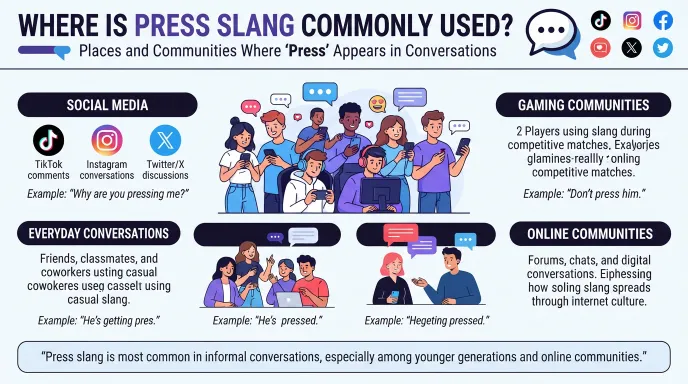
The slang word press appears in many types of conversations, but the meaning can change depending on the platform and community. It is especially common in casual speech, online discussions, sports conversations, and competitive environments.
Understanding where the word appears helps you understand what the speaker means.
Press Meaning in Text Messages
In texting, press is often used when someone feels bothered, challenged, or pushed.
Common phrases include:
“Don’t press me”
Meaning:
- Stop bothering me.
- Stop rushing me.
- Stop challenging me.
Example:
Person A:
“Why haven’t you replied yet? Answer now.”
Person B:
“Don’t press me. I’ll reply when I can.”
Here, “press” means applying unwanted pressure.
“You’re pressing”
Meaning:
“You are taking something too seriously or pushing too much.”
Example:
“Bro, you’re pressing over a small mistake.”
Meaning:
“You are overreacting or putting too much energy into this.”
Press Meaning on TikTok and Social Media
On platforms like TikTok, Instagram, and X (Twitter), press often appears in comments, captions, and videos.
The meaning usually depends on the creator’s tone.
Example: “Pressed”
The word pressed is a common variation.
Pressed meaning slang:
Someone who is upset, bothered, or emotionally affected.
Example:
“He’s pressed because he lost the game.”
Meaning:
“He is upset about losing.”
Example: Calling Someone Pressed
People may use “pressed” online to describe someone who seems overly angry or defensive.
Example:
“Why are you so pressed about my opinion?”
Meaning:
“Why are you so bothered by what I said?”
This usage is common in online arguments and comment sections.
Press Meaning on Discord and Gaming Communities
Gaming communities often use press in a competitive way.
Unlike casual texting, gaming usage usually relates to strategy, attacking, or pressure.
Example 1: Applying Pressure
“The enemy team is pressing us.”
Meaning:
“The opposing team is attacking aggressively.”
Example 2: Competitive Play
“Keep pressing them. They can’t defend.”
Meaning:
“Continue attacking and putting pressure on them.”
Example 3: Player Behavior
“He keeps pressing after every mistake.”
Meaning:
“He keeps pushing or attacking instead of slowing down.”
Press Meaning in Sports
The slang use of press is also common in sports.
Athletes and fans use it to describe aggressive strategies.
Examples:
- Press defense
- High press
- Full oiic if court press
Meaning:
A team aggressively challenges the opponent instead of waiting.
Example:
“The team won because they kept pressing in the second half.”
Meaning:
“They played aggressively and applied pressure.”
Origin and Background of Press Slang
The slang meaning of press developed from the traditional English idea of applying physical force.
The original meaning of “press” is connected to:
- Push
- Squeeze
- Apply force
Over time, people began using the word in nonifphysical situations.
For example:
Physical meaning:
“Press the button.”
Social meaning:
“Don’t press me.”
The second example does not involve physical pressure. It refers to emotional or social pressure.
How “Pressed” Became Popular Online
The expression “pressed” became widely used in internet conversations to describe someone who appears upset or overly concerned.
It became especially common through:
- Social media debates
- Meme culture
- Comment sections
- Online communities
Today, younger users often use “pressed” in a joking or sarcastic way.
Example:
“You’re pressed because I chose a different team.”
Meaning:
“You seem unnecessarily upset.”
Similar Slang Terms Related to Press
Several slang words have meanings close to press.
| Slang Term | Meaning | Example |
| Pressed | Upset or bothered | “He’s pressed about the comment.” |
| Triggered | Strong emotional reaction | “That topic triggered him.” |
| Salty | Angry or annoyed | “She’s salty about losing.” |
| Mad | Angry | “He’s mad about the result.” |
| Pushy | Applying too much pressure | “Stop being pushy.” |
| Grinding | Working hard | “I’m grinding all week.” |
Although these words overlap, they are not always interchangeable.
Press vs Pressed: What Is the Difference?
Many people confuse press and pressed, but they are used differently.
| Word | Meaning | Example |
| Press | Apply pressure or push someone | “Why are you pressing me?” |
| Pressed | Already affected, upset, or bothered | “He is pressed about the comment.” |
Simple explanation:
- Press = the action
- Pressed = the reaction
Example:
“You pressed him, and now he’s pressed.”
Meaning:
“You bothered him, and now he is upset.”
Why Do People Use Press Slang?
People use press slang because it is a quick way to describe emotions, conflict, and effort.
Common reasons include:
1. Faster Communication
Instead of saying:
“Why are you putting so much pressure on me?”
Someone can simply say:
“Why are you pressing me?”
2. Showing Emotion
Slang helps people express feelings more naturally.
Example:
“I’m not pressed.”
Meaning:
“I’m not bothered.”
3. Creating Online Identity
Internet communities often create shorter ways to communicate.
Words like:
- Pressed
- Salty
- Mad
- Triggered
help people describe reactions quickly.
Press Slang by Platform
| Platform | Common Meaning |
| Text messages | Stop bothering me / applying pressure |
| TikTok | Someone is upset or bothered |
| Emotional reaction in comments | |
| Discord | Competitive pressure or arguments |
| Gaming | Attack strategy or pressure |
| Sports communities | Aggressive playing style |
Friendly Conversation Examples
Example 1: Encouragement
Message:
“Keep pressing. You’re almost finished with your goal.”
Meaning:
Keep working hard and continue making effort.
Tone: Positive and motivating.
Example 2: Personal Growth
“I’m pressing myself to learn a new skill this year.”
Meaning:
“I am pushing myself to improve.”
Here, press means effort and determination.
Casual Texting Examples
Example 1: Feeling Rushed
Person A:
“Are you done yet? Hurry up.”
Person B:
“Don’t press me.”
Meaning:
“Stop rushing me.”
Tone: Slightly annoyed but common in casual speech.
Example 2: Asking Too Many Questions
“Why are you pressing me about my plans?”
Meaning:
“Why are you asking me so much about this?”
Social Media Examples
Example 1: Calling Someone Upset
“He’s pressed because people disagreed with him.”
Meaning:
“He is bothered or upset.”
Common places:
- TikTok comments
- Instagram discussions
- Reddit threads
Example 2: Online Argument
“You’re getting pressed over a joke.”
Meaning:
“You are reacting too strongly to something small.”
Gaming Examples
Example 1: Team Strategy
“Keep pressing the enemy team.”
Meaning:
“Keep attacking and applying pressure.”
Example 2: Competitive Match
“They are pressing us and giving us no space.”
Meaning:
“They are attacking aggressively.”
Argumentative Examples
Sometimes press appears during conflicts.
Example:
“Don’t press me unless you want an answer.”
Meaning:
“Do not push me or challenge me.”
The phrase can sound serious depending on the speaker’s tone.
Workplace Examples
The slang use of press is usually not suitable for formal workplace communication.
For example:
Informal:
“My manager is pressing me for the report.”
Meaning:
“My manager is putting pressure on me.”
Professional alternative:
“My manager is asking for the report urgently.”
When Should You Avoid Using Press Slang?
Although press is common online, there are situations where clearer words are better.
Avoid slang when communicating in:
- Professional emails
- Job applications
- Academic writing
- Official reports
- Messages to customers
- Formal presentations
Instead of:
“Don’t press me.”
Use:
“Please give me some time.”
Instead of:
“He’s pressed.”
Use:
“He seems upset.”
Is Press Safe to Use on Social Media?
Yes, press slang is generally safe for social media.
It is commonly used on:
- TikTok
- Snapchat
- Discord
- X (Twitter)
However, remember that tone is important.
The phrase:
“You’re pressed”
can be playful between friends, but it can also sound like an insult during an argument.
Context determines if it feels friendly or disrespectful.
Common Misunderstandings About Press Slang
Misunderstanding 1: Press Always Means Anger
Not true.
While “pressed” often means upset, press can also mean:
- Working hard
- Applying pressure
- Playing aggressively
Example:
“I’m pressing toward my goal.”
This is positive.
Misunderstanding 2: Press Is Always Negative
The meaning depends on the situation.
Negative:
“Why are you pressing me?”
Positive:
“Keep pressing forward.”
Misunderstanding 3: Press Is Only Internet Slang
The word is used online, but it also appears in:
- Sports
- Music
- Everyday speech
- Competitive situations
Frequently Asked Questions
What does press mean in slang?
Press meaning slang usually refers to putting pressure on someone, bothering someone, challenging someone, or making a strong effort.
What does “don’t press me” mean?
“Don’t press me” means “stop bothering me,” “stop pushing me,” or “stop putting pressure on me.”
Is pressed a bad word?
No. “Pressed” is not a bad word. It usually means someone is upset, bothered, or emotionally affected.
What does pressed mean on TikTok?
On TikTok, “pressed” usually means someone is annoyed, upset, or reacting strongly to something.
Example:
“He’s pressed about the comment.”
Meaning:
“He is bothered by the comment.”
What does press mean in gaming?
In gaming, press often means applying pressure, attacking aggressively, or pushing an opponent.
Can I use press slang at work?
It is better to avoid slang in professional settings. Use clearer phrases like “under pressure,” “challenging,” or “requesting urgently.”
Conclusion
Press meaning slang depends heavily on context. The word can mean putting pressure on someone, bothering someone, challenging an opponent, or yourself to achieve something.
Online, phrases like “don’t press me” and “you’re pressed” are common in texting, TikTok comments, and social media conversations. In gaming and sports, press often describes aggressive strategies and strong effort.
The most thing to remember is that press is not automatically negative or positive. The speaker’s tone, platform, and situation decide the meaning. When used with friends and online communities, it can be a natural part of casual communication. For formal situations, clearer professional language is usually the better choice.
Understanding slang like press helps you follow modern conversations and avoid misunderstandings across social media, gaming, and everyday communication.

I’m Dylan Foster, a slang and internet culture writer passionate about exploring how people communicate online and in everyday conversations. I write about texting abbreviations, social media expressions, and modern slang to help readers understand meanings, origins, and real-world usage in a simple way.