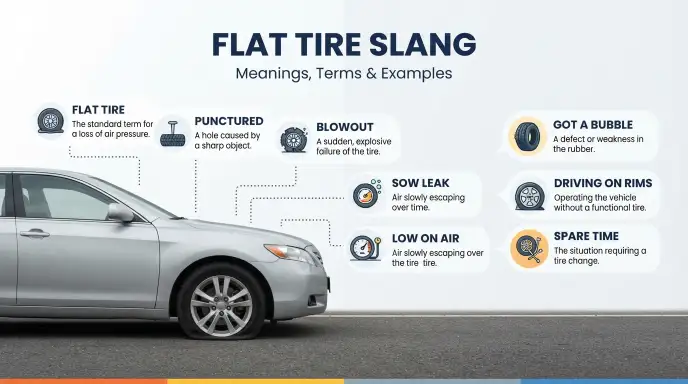
flat tire slang usually refers to the casual expression “I got a flat,” which means someone has a flat tire. Although the phrase can sometimes be used as a metaphor for something that has lost energy or stopped working, “flat tire” is not a widely established internet slang term with one secret meaning.
People may search for flat tire slang after g the phrase in a text, meme, socialifmedia post, or casual conversation. In most cases, the meaning is simple and literal: a vehicle, bicycle, or motorcycle tire has lost air. Context becomes important when someone uses the phrase creatively or jokingly.
Flat tire slang refers to the casual words and phrases people use when talking about a flat or damaged tire. Expressions like “I got a flat” are commonly used in everyday conversations and texting to simply mean that a vehicle’s tire has lost air or gone flat.
Understanding these informal terms can make it easier to follow conversations about cars, driving, and roadside problems.
Quick Answer:Flat Tire Slang
Flat tire normally means a tire that has lost air. In casual speech, “I got a flat” is a shorter way of saying “I got a flat tire.”
What Does “Flat Tire” Mean in Text?
In a text message, “flat tire” usually has its normal literal meaning: a tire that has lost air and cannot be used properly until it is repaired or inflated. It is not normally a coded internet expression.
For example:
“I’m going to be late. I got a flat tire.”
The person is simply explaining why they are delayed.
A shorter version is:
“Sorry, I got a flat.”
Here, “flat” is understood from context to mean flat tire.
Why People Say “I Got a Flat”
People often shorten familiar phrases in casual conversation. Saying “I got a flat” is quicker than saying “I got a flat tire,” especially when everyone already knows the person is talking about driving.
You mightmessages such as:
- “Got a flat on the way home.”
- “I have a flat. Can you pick me up?”
- “My tire went flat.”
- “Had to pull over because of a flat.”
- “I’ll be late because of a flat tire.”
All of these normally refer to an actual tire problem.
Is “Flat Tire” Actually Slang?
Not usually. “Flat tire” is a standard English phrase, while “I got a flat” is better described as informal or conversational language.
This distinction matters because not every casual expression is slang.
For example:
| Expression | Meaning | Usage |
| Flat tire | A tire that has lost air | Standard |
| I got a flat | I got a flat tire | Informal |
| My tire is flat | My tire has lost air | Standard |
| I got a puncture | My tire was damaged and lost air | Common, especially British English |
| I had a blowout | My tire suffered a major sudden failure | Automotive term |
So if you are looking for a flat tire slang meaning, the safest answer is that there is no single secret slang definition. Most uses are literal.
What Does “I Got a Flat” Mean?
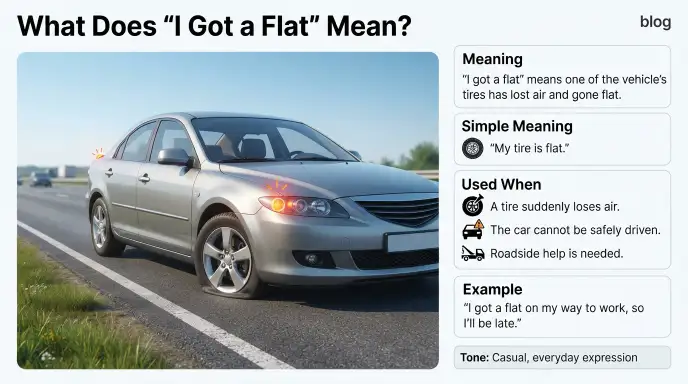
“I got a flat” means “I got a flat tire.”
The phrase is especially common in casual speech because the flat can stand in for the full phrase when the situation is obvious.
For example:
“Why weren’t you at the meeting?”
“I got a flat on the way there.”
The second speaker means that a vehicle tire went flat and caused a delay.
Another example:
“Can you pick me up? I got a flat.”
This means the person needs help because their vehicle has a flat tire.
Is “I Got a Flat” Slang?
It is informal, but calling it slang can be misleading. It is simply a shortened conversational expression that many English speakers understand.
This is similar to saying:
“I need to call a cab.”
instead of:
“I need to call a taxi.”
The shorter form is casual, but that does not necessarily make it slang.
Can “Flat Tire” Have a Figurative Meaning?
Yes, but figurative uses are contextifdependent rather than established slang.
Someone may compare a person, plan, event, or mood to a flat tire because a flat tire cannot move forward normally.
For example:
“My weekend plans got a flat.”
This could jokingly mean:
“My weekend plans have fallen apart.”
Another example:
“My motivation has a flat tire today.”
This could mean:
“I have very little motivation today.”
These are creative metaphors. They should not be treated as official definitions of flat tire slang.
Why the Metaphor Works
A flat tire creates a simple image: something that should move has suddenly become unable to move.
That makes it easy to use the idea humorously for things such as:
- Plans
- Motivation
- Projects
- Relationships
- Events
- Progress
- Energy
However, the exact meaning depends entirely on the sentence.
Is “Flat Tire” Rude or Offensive?
No. “Flat tire” is normally neutral and harmless.
There is nothing offensive about telling someone:
“I got a flat tire.”
It is perfectly acceptable in conversations with friends, family members, coworkers, teachers, or strangers.
The phrase could become negative if someone uses it as an insult or metaphor, but that would come from the context, not from the standard meaning of the expression.
For example:
“He was flat tire at the party.”
This could be an unusual metaphor suggesting that the person was boring or brought down the energy.
That is not a standard meaning. It is simply a creative language.
Where Is “Flat Tire” Commonly Used?
The expression appears in many forms of everyday communication.
You may encounter it in:
- Text messages
- Phone conversations
- Car discussions
- Roadside assistance conversations
- Driving forums
- Bicycle communities
- Travel conversations
- Facebook posts
- Instagram captions
- Reddit discussions
- Casual workplace messages
Unlike terms such as LOL or BRB, it is not primarily an internet expression.
On Social Media
A person might post:
“A flat tire was not how I wanted to start Monday.”
This is a normal statement about an inconvenient event.
Another person might write:
“Got a flat halfway through my bike ride Again, the meaning is literal.
The crying emoji adds emotion but does not change the meaning of flat tire.
Flat Tire in Different Contexts
The phrase becomes easier to understand when you look at the setting.
Car Context
“My car has a flat.”
Meaning: One of the car’s tires has lost air.
Bicycle Context
“I got a flat during my ride.”
Meaning: A bicycle tire lost air.
Motorcycle Context
“We had to stop because of a flat tire.”
Meaning: A motorcycle tire has a problem.
Texting Context
“Running late. Got a flat.”
Meaning: The person has a flat tire and is delayed.
Figurative Context
“My project has a flat tire.”
Possible meaning: The project has stopped making progress.
The last example is metaphorical, so you should not assume everyone will interpret it the same way.
Flat Tire vs. Puncture
A flat tire and a puncture are related, but they are not identical terms.
A puncture usually describes damage that allows air to escape from the tire. A nail, screw, piece of glass, or another sharp object can cause a puncture.
A flat tire describes the resulting condition: the tire has lost enough air to become flat.
For example:
“I got a puncture, and now my tire is flat.”
This is a perfectly logical sentence.
Simple Difference
Puncture = possible cause
Flat tire = resulting condition
However, a tire can become flat for other reasons, such as a faulty valve, damaged rim, or slow leak.
Flat Tire vs. Blowout
A blowout is usually more serious than an ordinary flat tire.
A flat tire can happen gradually because of a slow leak. A blowout generally refers to a sudden and significant failure of the tire.
For example:
“I noticed my tire was losing air.”
This sounds like a possible slow leak.
But:
“The tire blew out while I was driving.”
describes a sudden tire failure.
These terms should not automatically be treated as synonyms.
| Term | Basic meaning |
| Flat tire | Tire has lost air |
| Puncture | Tire has been damaged |
| Leak | Air is escaping |
| Low tire | Tire pressure is below the recommended level |
| Blowout | Sudden major tire failure |
Real :Life Examples of Flat Tire Slang
Friendly Example
“Hey, can you pick me up? I got a flat.”
Meaning: The person has a flat tire and needs transportation.
Casual Example
“I was almost home when I got a flat.”
Meaning: The person’s tire lost air before they reached home.
Workplace Example
“I may be late this morning because I have a flat tire.”
Meaning: The person is delayed because of a vehicle problem.
Social Media Example
“A flat tire ruined my morningMeaning: The tire problem caused frustration or inconvenience.
Cycling Example
“I got a flat halfway through the ride.”
Meaning: A bicycle tire lost air during the ride.
Figurative Example
“My plans hit a flat tire.”
Possible meaning: The plans suddenly stopped or went wrong.
The final example is creative and should not be interpreted as a fixed slang definition.
Is “Flat Tire” Used on TikTok, Reddit, or Discord?
It can appear on these platforms, but it does not have a special universal TikTok, Reddit, or Discord meaning.
If someone posts:
“Got a flat on Instagram, Reddit, TikTok, or Discord, the most natural interpretation is still a flat tire, unless the surrounding conversation clearly suggests a metaphor.
This is an important point when interpreting slang online: not every unusualiflooking phrase is coded slang.
Sometimes a phrase simply means what it normally means.
When Should You Avoid Using the Short Form?
There is no major reason to avoid “I got a flat.” It is harmless and easy to understand in casual situations.
However, if your audience may not know what you mean, use the complete phrase:
“I got a flat tire.”
This is especially useful when:
- Writing to someone unfamiliar with you
- Giving roadside assistance information
- Writing a formal report
- Explaining a delay professionally
- Communicating during an emergency
- Speaking to someone learning English
Clear language is usually better when there is any chance of confusion.
Why Do People Use “Flat” Instead of “Flat Tire”?
The main reason is convenience.
Once the topic is clear, speakers naturally leave out that the listener can infer.
For example:
“I need to change my flat.”
The listener may understand that flat means flat tire.
This type of shortening is common in everyday English. It makes speech faster without losing much meaning.
The same pattern can happen with other familiar terms, but the meaning always depends on context.
Common Misunderstandings
“Flat tire” is not a secret code.
Most of the time, it literally means a tire that has lost air.
“I got a flat” usually means a flat tire.
It is a casual shortened expression.
It is not an acronym.
There is no standard texting full form for flat tire.
It is not automatically an insult.
A negative meaning only appears when someone deliberately uses it as a metaphor or insult.
Social media does not give it one fixed new meaning.
The platform does not automatically change what flat tire means. The conversation determines the
When Should You Avoid Using “Flat Tire” as Slang?
There is no need to avoid the phrase “flat tire” in normal conversation. It is a common, harmless expression. The main thing to avoid is using it as a metaphor when the listener may misunderstand you.
For example, if you tell your manager:
“My car has a flat tire.”
The meaning is clear.
But saying:
“My plans are to have a flat.”
could leave someone wondering what you mean.
For professional, school, or formal communication, it is better to use clear wording rather than an unusual metaphor.
Polite Alternatives to “Flat Tire”
Because a flat tire is already neutral, you do not need a more polite replacement. However, different situations may call for different wording.
| Casual | Clear | More Formal |
| “I got a flat.” | “I got a flat tire.” | “My vehicle has a flat tire.” |
| “My tire went flat.” | “One of my tires lost air.” | “One of the vehicle’s tires has lost pressure.” |
| “I have a flat.” | “I have a flat tire.” | “I’m experiencing a tire problem.” |
For everyday texting, “I got a flat” sounds natural. For formal communication, “I have a flat tire” is usually clearer.
Why Do People Use “Flat Tire” in Conversation?
People use the expression because it quickly describes a familiar problem.
A flat tire can immediately explain why someone:
- Is running late
- Needs a ride
- Has stopped driving
- Needs roadside help
- Cannot continue a trip
- Has to repair a vehicle
For example:
“I’m sorry I missed your call. I was dealing with a flat tire.”
The phrase gives the listener enough information without a long explanation.
The shortened version “I got a flat” is even quicker when the context is already clear.
Common Misunderstandings About Flat Tire Slang
Searching for flat tire slang can create confusion because the phrase is sometimes incorrectly treated as a special internet expression.
It Does Not Have One Secret Meaning
There is no widely accepted online definition that changes flat tire into a completely dif
It Is Not a Texting Acronym
Unlike LOL, IDK, or BTW, “flat tire” does not stand for a longer phrase.
“Flat” Can Mean Different Things
The flat has several meanings in English.
For example:
- Flat tire → a tire that has lost air
- Flat soda → soda that has lost its bubbles
- Flat voice → a voice without much emotion
- Flat joke → a joke that gets little reaction
- Flat battery → a battery with no or very little
Is Flat Tire Slang Used by Younger People?
There is no strong reason to classify flat tire as a youthifspecific slang term.
People of many ages can say:
“I got a flat.”
The expression is based on everyday English rather than a particular generation or online trend.
Teenagers may use it in texts, adults may use it in conversations, and older speakers may use it as well. The basic meaning remains the same.
This is another reason it is more accurate to describe “I got a flat” as informal language rather than modern internet slang.
Can You Use “Flat Tire” at Work?
Yes.
The phrase is completely acceptable in a workplace when you are explaining a real vehicle problem.
For example:
“I’m sorry, but I’ll be about 15 minutes late. I got a flat tire.”
This is clear and professional enough for most everyday workplace situations.
If you are writing a formal document, you could say:
“I was delayed because of a flat tire.”
There is no offensive or inappropriate language in either version.
Can You Use “Flat Tire” With Teachers or Parents?
Yes. Flat tire is ordinary, harmless language.
A student might say:
“My dad was late because he got a flat tire.”
A teenager might text a parent:
“I got a flat. Can you come help me?”
There is no slangifrelated concern with these examples.
If the goal is to communicate clearly, especially in a stressful situation, “flat tire” is better than relying on a metaphor.
Is Flat Tire Safe for Social Media?
Yes. The phrase is generally safe for socialifmedia use.
It does not normally contain:
- Profanity
- Sexual content
- Drug references
- Hate language
- Violent slang
- Adult coded language
A post such as:
“Got a flat tire on the way to workis simply a normal statement about an annoying problem.
A humorous post may use the phrase differently, but that is a creative use rather than a hidden meaning.
Flat Tire Slang vs. Similar Expressions
Several expressions can describe the same or related situation.
| Expression | Meaning | Tone |
| Flat tire | Tire has lost air | Neutral |
| I got a flat | I got a flat tire | Casual |
| Tire went flat | Tire lost air | Casual/neutral |
| Puncture | Damage that may cause air loss | Neutral |
| Slow leak | Air is escaping gradually | Neutral |
| Blowout | Sudden major tire failure | More serious |
| Low tire | Tire pressure is below normal | Neutral |
Knowing these differences can help you understand automotive conversations more accurately.
What Does “My Tire Went Flat” Mean?
“My tire went flat” means that the tire lost enough air to become flat.
It does not necessarily explain why the tire lost air.
Possible causes include:
- A nail or screw
- A sharp object
- A damaged valve
- A slow leak
- A damaged tire
- A problem with the wheel
For example:
“My tire went flat overnight.”
This means the tire had lost air by the morning.
The expression does not automatically mean there was a dramatic blowout.
What Does “I Have a Flat” Mean?
“I have a flat” usually means “I have a flat tire.”
The exact interpretation depends on context.
For example:
“I have a flat. Can you bring the spare?”
Here, the meaning is almost certainly a flat tire.
However, in another conversation, flat could refer to something else. Context is always important.
Examples of Different Tones
Friendly
“Hey, I might be late. I got a flat.”
The tone is casual and informative.
Frustrated
“Of course I got a flat on the busiest morning of the week.”
The phrase still has its literal meaning, but the speaker is clearly annoyed.
Professional
“I’m running late due to a flat tire.”
The ing is direct and appropriate for work.
Humorous
“My weekend plans got a flat before they even started.”
Here, flat is being used creatively to suggest that the plans failed.
Social Media
“Flat tire + rainy weather = terrible morning.”
The meaning is literal, while the post expresses frustration.
A Simple Memory Trick
“I got a flat.”
Think:
Flat → Flat tire → Lost
“My plans got a flat.”
look for a metaphorical meaning such as:
Plans → Stopped → Something went wrong
The noun or situation around flat tells you which meaning makes sense.
Frequently Asked Questions
Q1. What does “flat tire” mean in slang?
Flat tire does not have a widely recognized special slang meaning. It normally means a tire that has lost air.
Q2. What does “I got a flat” mean in a text?
It usually means “I got a flat tire.” The phrase is a casual shortened form commonly understood from context.
Q3. Is “flat tire” an internet slang term?
No. It is primarily an ordinary English phrase. It can appear in texts, Reddit posts, TikTok captions, and other online conversations, but its meaning usually stays literal.
Q4. Is “flat tire” rude?
No. Flat tire is neutral and harmless. It is appropriate in casual, school, family, and most workplace conversations.
Q5. Can “flat tire” have a figurative meaning?
Yes. Someone can creatively use a flat tire as a metaphor for something that has stopped, lost energy, or gone wrong. This is not a fixed slang definition.
Q6. What is the difference between a flat tire and a blowout?
A flat tire means the tire has lost air. A blowout usually describes a sudden and more serious tire failure. They are related but not identical.
Conclusion
Flat tire slang is best understood as an informal search term rather than the name of a specific internet slang expression. In normal English, flat tire means a tire that has lost air, while “I got a flat” is a casual way to say that you have a flat tire.
The phrase is neutral, safe, and widely understandable. It can appear in texting, social media, workplace messages, driving conversations, and everyday speech without having a hidden meaning.
If you “flat tire” or “I got a flat” in a message, the safest interpretation is the literal one unless the surrounding conversation clearly shows that the speaker is making a joke or using a metaphor. Context is what separates the ordinary meaning from creative usage.
interpretation.
You May Also Like!

I’m Dylan Foster, a slang and internet culture writer passionate about exploring how people communicate online and in everyday conversations. I write about texting abbreviations, social media expressions, and modern slang to help readers understand meanings, origins, and real-world usage in a simple way.