Military slang POG is a term often seen in military discussions, online forums, gaming communities, and social media conversations about armed forces culture. People usually search for this slang because they hear it in videos, read it in comments, or see it used by veterans and service members but are unsure if it is a compliment, an insult, or simply a casual military expression.
The word “POG” has a strong connection with military culture, especially among members who compare combat roles with support roles. Its meaning depends heavily on the speaker, the situation, and the relationship between the people using it. In some cases, it is used jokingly between service members, while in others it can sound disrespectful.
Understanding the background of this term helps explain why it can create different reactions among military communities.
Quick Answer: Military Slang POG
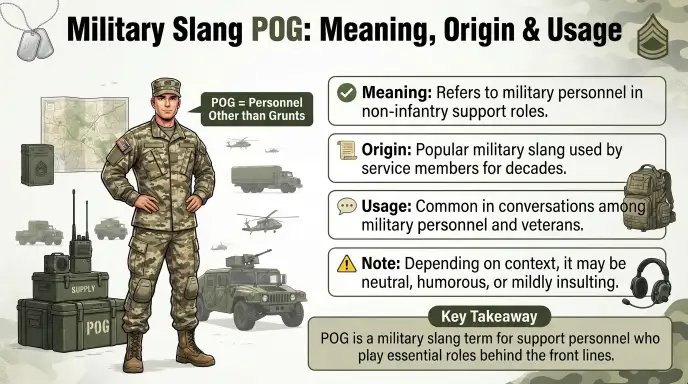
Military slang POG stands for “Person Other Than Grunt.” It refers to military personnel who are not assigned to direct combat infantry roles. Depending on context, it can be neutral, humorous, or insulting.
What Does Military Slang POG Mean in Text?
In text conversations, POG usually means “Person Other Than Grunt.” The term is mainly associated with military environments and refers to service members who work in support roles rather than frontline combat positions.
A “grunt” traditionally refers to an infantry soldier, especially someone involved in ground combat. Therefore, a POG is someone whose military job supports operations but does not usually involve direct battlefield fighting.
Examples of military jobs that may be described as POG roles include:
- Military intelligence
- Logistics
- Administration
- Medical support
- Mechanics
- Communications
- Supply operations
- Technical specialists
However, calling someone a POG does not mean their work is unimportant. Modern military operations depend heavily on support personnel to provide equipment, intelligence, transportation, medical care, and technical skills.
The meaning changes based on who says it and why they say it.
Military Slang POG Full Form / Definition
The full form of POG is:
POG = Person Other Than Grunt
The word “grunt” refers to infantry personnel, especially soldiers who perform ground combat missions. The phrase “Person Other Than Grunt” was created as a way to separate combat troops from support personnel.
While the term originally developed inside military communities, it later spread into online spaces where people discuss:
- Military experiences
- Veteran culture
- War movies
- Tactical games
- Military roleifplaying communities
Today, people may encounter POG on platforms such as Reddit, Discord, gaming chats, TikTok comments, and militaryifrelated forums.
Is POG Rude, Offensive, or Neutral?
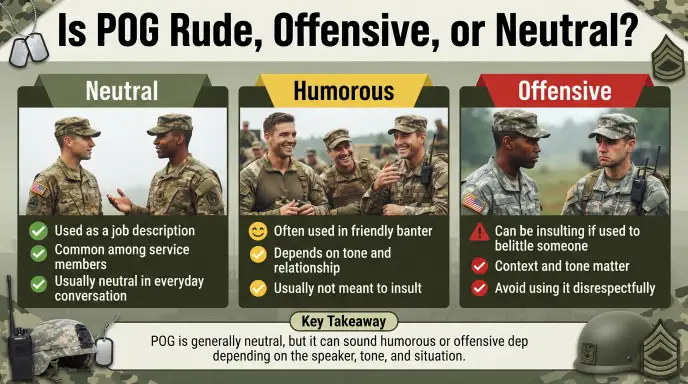
The tone of POG military slang depends on the situation.
When POG Is Neutral
In many cases, POG is simply a descriptive term. Some military members use it casually to identify different types of jobs within the armed forces.
Example:
“I was a POG during my service. I worked in communications.”
Here, the speaker is not using the word negatively. They are simply describing their role.
When POG Can Be Offensive
Among some military groups, POG can be used as an insult. Combatiffocused communities may use it to suggest that support personnel have not experienced the same risks or hardships as frontline soldiers.
Example:
“You’re just a POG. You never saw combat.”
In this situation, the word is meant to create a difference between combat and nonifcombat roles.
However, this viewpoint is debated because support roles are essential to military success, and many nonifcombat positions can still involve dangerous situations.
When POG Is Used as a Joke
Military communities often use teasing language among friends. A soldier may jokingly call another person a POG without serious hostility.
Example:
“The POGs are keeping the whole operation running.”
The meaning depends on the relationship between the people involved.
Where Is Military Slang POG Commonly Used?
The term is most commonly found in militaryifrelated conversations, but it has expanded into online communities.
Military Communities
Activeifduty personnel, veterans, and military families may use POG when discussing differences between jobs and experiences.
Examples:
- Talking about deployment experiences
- Comparing military occupations
- Sharing stories from service
Reddit and Online Forums
Military discussion communities often use POG when comparing infantry life with support roles.
People may debate topics like:
- Which military jobs are hardest
- Combat versus nonifcombat experiences
- Different military lifestyles
Discord and Gaming Communities
Militaryifstyle video games and tactical communities sometimes use POG when discussing player roles.
Example:
“He plays support, so he’s basically the POG of the squad.”
In gaming, the term may be used loosely and may not always reflect its original military meaning.
TikTok, Instagram, and Social Media
Short videos about military life sometimes include POG in captions or comments. Many viewers encounter the term while watching:
- Veteran content
- Military humor videos
- Deployment stories
- Uniform or training discussions
Because social media audiences include many nonifmilitary users, the meaning can sometimes become misunderstood.
Origin and Background of Military Slang POG
The history of military slang POG comes from the longifstanding difference between combat troops and support personnel in military culture.
The term “grunt” has been used for decades to describe infantry soldiers because of the physically demanding nature of ground combat. As military organizations grew more complex, they required thousands of people working in specialized areas such as logistics, intelligence, engineering, communications, and healthcare.
The phrase “Person Other Than Grunt” developed as a way to describe everyone outside traditional infantry roles.
Over time, POG became a common piece of military vocabulary. Like many slang terms, it gained different meanings depending on the community using it. Some people use it proudly to describe their role, while others use it to create a difference between combat and support experiences.
Today, the term is not limited to military bases. It appears in online conversations, gaming communities, and social media discussions where people talk about military culture.
Why Do People Use Military Slang POG?
People use POG military slang for several reasons. The meaning is often connected to identity, humor, and group culture.
1. To Describe Military Roles Quickly
Military organizations contain many different jobs. Saying someone is a POG can quickly communicate that they work in a support position rather than infantry.
Example:
“I was a POG working in military intelligence.”
This provides a simple description of a person’s military background.
2. To Create Military Humor
Military communities often use teasing language as part of their culture. Calling someone a POG may be playful between friends.
Example:
“The POGs fixed everything before the mission started.”
In this case, the term may be humorous rather than insulting.
3. To Compare Different Experiences
Some military discussions use POG to compare the experiences of combat troops and support personnel.
For example, people may discuss:
- Deployment conditions
- Training difficulty
- Battlefield experiences
- Daily military responsibilities
However, these comparisons can become controversial because every military role contributes to overall operations.
4. To Show Military Knowledge Online
Some people use terms like POG in online conversations to show familiarity with military culture.
It may appear in:
- Military forums
- Veteran communities
- Gaming groups
- Tactical discussions
Real Life Examples of Military Slang POG Usage
The meaning of POG becomes clearer when looking at different situations.
Friendly Example
Person A:
“I worked as a mechanic during my service.”
Person B:
“Nice, one of the POGs keeping the equipment running.”
Here, the term is casual and friendly.
Casual Conversation Example
“Not every soldier is an infantryman. A lot of POGs have important missions too.”
The speaker is using POG as a neutral description.
Argumentative Example
“You don’t understand combat because you were only a POG.”
Here, the word is being used negatively to criticize someone’s experience.
Gaming Context Example
“Our squad needs a POG to handle support and supplies.”
In gaming, the term may refer to a support player rather than a combatiffocused role.
Social Media Example
“POGs deserve respect too. Every military job matters.”
This type of statement often appears in discussions about military appreciation.
Comparison of POG With Similar Military Slang Terms
| Term | Meaning | Usage | Tone |
| POG | Person Other Than Grunt | Refers to nonifinfantry military personnel | Can be neutral or insulting |
| Grunt | Infantry soldier | Refers to frontline combat troops | Usually respected but informal |
| REMF | Rear Echelon Mother F***er | Refers to people away from combat areas | Often more offensive |
| Boot | New or inexperienced service member | Used for beginners | Can be teasing or insulting |
| Vet | Veteran | Someone who previously served | Usually respectful |
POG vs Grunt: What Is the Difference?
The biggest difference between a POG and a grunt is their military role.
| POG | Grunt |
| Usually works in support roles | Usually works in infantry roles |
| Provides logistics, technical, medical, or administrative support | Focuses on direct combat missions |
| May or may not experience combat situations | Typically trained for frontline combat |
| Term can be neutral or negative | Usually associated with combat identity |
It is important to remember that both roles are necessary. A military operation cannot succeed without communication, transportation, maintenance, intelligence, and medical support.
When Should You Avoid Using Military Slang POG?
Although POG is common in some military conversations, it is not always appropriate.
Avoid using the term when:
1. Speaking With Someone You Do Not Know
You may not know how someone feels about the term. Some people consider it disrespectful.
Instead of saying:
“You were just a POG.”
A more respectful option is:
“What was your military role?”
2. Discussing Someone’s Service Experience
Military experiences vary greatly. Using POG to dismiss someone’s contribution can sound disrespectful.
Every military occupation involves training, responsibility, and commitment.
3. In Professional or Formal Writing
For official communication, articles, interviews, or reports, it is better to use clear descriptions.
Examples:
Instead of:
“He was a POG.”
Use:
“He served in a military support role.”
Polite Alternatives to Military Slang POG
If you want to describe someone’s role without possible negativity, consider these alternatives:
- Support personnel
- Nonifinfantry service member
- Military support role
- Technical specialist
- Logistics personnel
- Administrative personnel
- Combat support personnel
These terms provide information without creating unnecessary comparisons.
Impact of Using Military Slang POG in Communication
Language inside military communities often carries more meaning than a simple definition. Military slang POG can communicate belonging, humor, criticism, or respect depending on the situation.
The impact of using this term depends on:
- Who is saying it
- Who is hearing it
- The relationship between both people
- The purpose behind using the word
Among close military friends, POG may be harmless joking. However, when used by outsiders or in a disrespectful way, it can create tension because it may suggest that someone’s service was less valuable.
Good communication requires understanding the difference between informal slang and respectful language.
Is Military Slang POG Safe for Social Media?
Yes, POG can be used on social media, but users should understand its context before posting it.
Platforms where the term may appear include:
- TikTok
- Discord
- Snapchat
- Gaming communities
- Military discussion groups
On these platforms, POG is often used in:
- Military memes
- Veteran discussions
- Gaming conversations
- Historical discussions
- Military humor content
However, social media removes many personal signals such as facial expressions and tone of voice. A joke that works between friends may appear offensive to strangers online.
Before using POG publicly, consider:
- Is the audience familiar with military slang?
- Could someone misunderstand the intention?
- Is the term being used respectfully?
Using the term with awareness helps avoid unnecessary conflict.
Why Is POG Sometimes Controversial?
The controversy around military slang POG comes from the difference between combat and support identities.
Some people believe combat roles deserve special recognition because they face direct battlefield risks. Others argue that every military job contributes equally to mission success.
For example:
- A combat soldier may depend on medical personnel after an injury.
- Infantry units rely on communication specialists for coordination.
- Operations depend on supply teams for equipment and resources.
Because of this, many people view the word POG as a complicated term rather than simply an insult or compliment.
The meaning depends on if it is being used to describe a role or to judge a person’s contribution.
More Examples of Military Slang POG in Different Contexts
Friendly Military Conversation
“I was a POG during my enlistment. I handled communications.”
Meaning: The person is simply explaining their military position.
Respectful Discussion
“POGs and grunts both play important roles in the mission.”
Meaning: The speaker recognizes different military contributions.
Negative Usage
“You’re only a POG, so you don’t understand.”
Meaning: The speaker is using the term to dismiss someone’s experience.
Online Gaming Usage
“We need a POG player who can support the team.”
Meaning: The term is being adapted to describe a support role.
Common Misunderstandings About POG
Misunderstanding 1: POG Means Someone Is Not Important
This is incorrect.
Military operations require many different skills. Without support personnel, combat units would struggle to operate effectively.
Misunderstanding 2: Every POG Has Never Experienced Danger
This is also incorrect.
Some support personnel may serve in dangerous environments, including combat zones. Their job title does not always show their complete experience.
Misunderstanding 3: POG Is Always an Insult
Not always.
The word can be:
- A simple description
- A joke between friends
- A negative label
Context determines the meaning.
Frequently Asked Questions
Q1:What does military slang POG stand for?
Military slang POG stands for “Person Other Than Grunt.” It describes military personnel who are not assigned to traditional infantry roles.
Q2:Is POG a bad word?
POG is not automatically a bad word. It can be neutral, humorous, or insulting depending on how and why it is used.
What is the difference between a POG and a grunt?
A POG usually refers to someone in a support role, while a grunt typically refers to an infantry soldier involved in ground combat operations.
Q3:Can civilians use the word POG?
Civilians can use the term, but they should understand the context. Using it without knowledge of military culture may lead to misunderstandings.
Q4:Is POG used outside the military?
Yes. The term appears in gaming communities, online forums, and social media discussions, although its meaning may change slightly depending on the community.
Q5:Why do some soldiers dislike being called POG?
Some people dislike the term because it can be used to suggest that support roles are less valuable than combat roles. Others use it casually and have no problem with it.
Conclusion
Military slang POG means “Person Other Than Grunt” and is commonly used to describe military personnel who serve in support roles rather than traditional infantry positions.
The term has a long connection with military culture and continues to appear in online conversations, gaming communities, and social media discussions.
While some people use POG casually or humorously, others may consider it disrespectful when it is used to minimize someone’s service. The meaning depends on tone, relationship, and context.
Understanding slang like POG helps people communicate more effectively, especially when discussing military topics online. if used in a conversation, game, or social media post, it is always better to consider the audience and intention behind the word.
The most respectful approach is to recognize that every military role has a purpose. Combat troops and support personnel both contribute to the success of military operations.

I’m Dylan Foster, a slang and internet culture writer passionate about exploring how people communicate online and in everyday conversations. I write about texting abbreviations, social media expressions, and modern slang to help readers understand meanings, origins, and real-world usage in a simple way.